Rick’s Rules: Top ten tips for effective interviewing
Posted: September 15, 2013 Filed under: Journalism Training, Rick's Rules, Top Ten | Tags: George Clooney, Interviewing skills, Interviewing techniques, Interviews, Journalism Training, National Press Club, Rick's Rules, Top Ten 2 Comments
If you’re lucky enough to get an interview with George Clooney, don’t waste half of the time telling him about all of his movies that you’ve enjoyed.
I continue today with another edition of Rick’s Rules, my lists of professional development suggestions for journalism students and veteran journalists alike.
Feel free to email me with suggestions for future Rick’s Rules posts.
TOP TEN TIPS FOR EFFECTIVE INTERVIEWING
1. Prepare, prepare, prepare.
There is no substitute for adequate preparation — and no excuse for “winging it” in an interview. You should become an expert on the interview subject and the subject matter. If you show that you know your stuff, you are more likely to gain the respect and confidence of the interviewee.
2. Choreograph the interview in advance.
Plan out what you hope to accomplish and the series of questions that will get you from Point A to Point Z. Also plan out what you will do if the interviewee tries to hijack the interview. (See below.)
3. Listen.
A major mistake made by reporters is that they don’t pay attention to what the interviewee is saying; they just wait to ask the next question on their list. It’s very, very important to listen attentively. Your interview subject may tell you something that leads to a valuable new avenue of questioning.
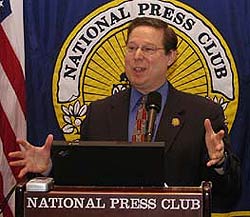
Lesson #9: Don’t talk too much.
4. Follow up.
Persistence usually pays off. If somebody tries to evade your question, try again. Depending on the situation, you can decide whether to rephrase the question or simply tell them that they haven’t answered the question. If your interview subject is evading the question, you want to let them know that you know that they aren’t answering.
5. Word your questions carefully.
You don’t want a “yes” or “no” answer, especially for audio or video. Ask a question in a manner designed to elicit a descriptive answer. It is embarrassing when you look at your notebook after an interview and you see that the answer you wrote down was “no” rather than “I didn’t do anything wrong.”
6. Know when to be the tiger and when to be the fox.
It’s important to gauge the personality of your interview subject and know when to be aggressive, when to be empathetic and when to admit your ignorance. Doing the right thing at the right time can pay off — big time. Doing the wrong thing can ruin an interview.
6. Don’t assume anything.
Ask Ms. Smith how to spell her name. It might be “Smythe.” Ask for job titles and spellings of home towns, spouses and employers’ names (if you are not certain). When possible, it’s good to double-check via a Google search to confirm on their personal or business web sites.
7. Know your subject material and don’t fake it.
You are supposed to be prepared. Remember that. But if you don’t know something, admit it. Don’t say that you’ve read a book — or a report, or an article — if you haven’t. If the interview subject believes you are fudging, it harms your credibility.
8. Don’t let the interview get hijacked.
When your interviewee says “that’s a good question, but the important point is….,” he or she is trying to change the subject and deliver a pre-packaged spin. Make sure to return as soon as possible to the questions you want to ask.
9. Don’t talk too much.
If you have a 15-minute interview, you want almost all of it to come from the mouth of your interview subject. Don’t go off on tangents or monologues. Don’t engage in too much chit chat before you get to your questions, unless you have plenty of time for the interview.
10. Appearances matter.
Look and sound professional. Don’t dress inappropriately or chew gum. Don’t smell of smoke or alcohol. It may sound obvious, but you’d be surprised how many reporters mess up their interview before uttering their first word.
Top Ten: The ten most influential U.S. senators
Posted: September 1, 2013 Filed under: Journalism Training, Top Ten, U.S. politics | Tags: Bloomberg News, Bob Corker, Chuck Schumer, Congress, Dick Durbin, Harry Reid, Hillary Clinton, John Cornyn, John McCain, Lindsey Graham, Mitch McConnell, Phil Gramm, Rand Paul, Senate, Ted Cruz, The Bloomberg Way Leave a comment
Good advice from “The Bloomberg Way”
I’ve been reading the invaluable journalism handbook “The Bloomberg Way” as I prepare to start my new life as a professor at Tsinghua University in Beijing. One of the many must-remember pieces of advice for journalists (whether seasoned or student) is author Matt Winkler’s suggestion to draw up a “top ten” list of influential people on your beat.
In his chapter on preparation, Winkler instructs the reader to get to know those influential figures on her or his beat.
Since I have covered the U.S. Congress for the past 29 years, I have put together my own list of ten most influential members of the U.S. Senate — as an example for my students and as a discussion topic for my friends in Washington:
1. Minority Leader Mitch McConnell
The Kentucky senator has proven time after time that a minority senator able to command 41 votes can have more influence over the Senate’s agenda than the leader of its majority.
2. Arizona Sen. John McCain
President Obama’s favorite frenemy in the Senate is a key player in almost all legislation to emerge from the Senate — even if his maverick ways rankle colleagues.
3. Senate Majority Leader Harry Reid
The feisty Nevada senator controls the Senate’s calendar but not necessarily the outcome.
4. New York Sen. Chuck Schumer
He’s a liberal Democrat able to build partnerships with conservative Republicans. Effective and relentless.
5. Texas Sen. John Cornyn
The second-ranking Senate Republican, an articulate and telegenic lawmaker, is more likely than McConnell to be the public face of the not-so-loyal opposition.
6. Kentucky Sen. Rand Paul
it’s rare for a freshman senator to be one of the chamber’s most influential, but the first-term firebrand (and potential 2016 presidential candidate) is a key figure in both the Tea Party and Libertarian wings of the Republican Party.
7. Illinois Sen. Dick Durbin
Like Cornyn, the number two Senate Democrat is a smoother spokesman for his party than the top guy. He’s also a key player on immigration issues.
8. Tennessee Sen. Bob Corker
The former Chattanooga mayor has emerged as a pragmatic conservative and a get-it-done legislator in the mold of legendary Tennessee Sen. Howard Baker.
9. South Carolina Sen. Lindsey Graham
He might denounce Barack Obama and meet with the president on different issues on the same day. John McCain’s sidekick is a power in his own right.
10. Texas Sen. Ted Cruz
It is exceptionally rare that a first-year senator ranks in the upper echelon in the upper chamber (Hillary Clinton and Phil Gramm are the exceptions that prove the rule). The hard-line Houston conservative has made his mark with an unceasing assault on the Obama administration and a skillful alliance with conservative opinion leaders.

 Rick Dunham Blog
Recent Comments