Analysis: How Big Will the Blue Wave Be in the Upcoming Midterms?
Posted: November 2, 2026 Filed under: U.S. politics | Tags: 2026 Election, American history, American politics, Blue Wave, Congress, Democrats, Donald Trump, history, news, politics, Republicans, trump, U.S. Congress Leave a comment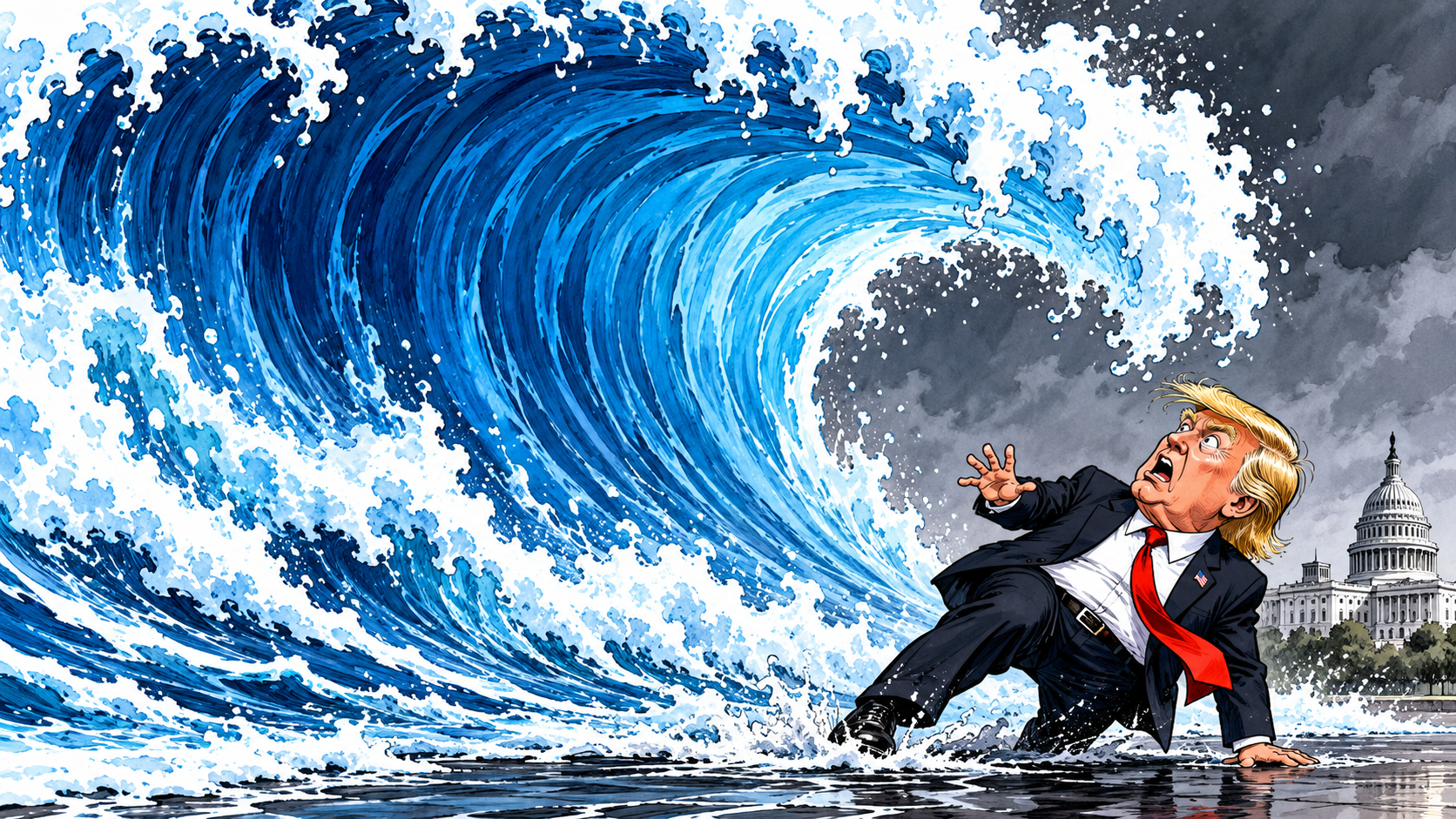
By RICK DUNHAM
The Democrats appear poised for a midterm victory. But the size of that victory — and whether it extends to the Senate —will depend on a surprisingly small number of highly competitive races.

The question is not whether the political environment favors Democrats in Tuesday’s midterm elections. By almost every analytical model and historical measure, it does. The question is how much of that advantage translates into seats in the House and particularly the Senate — and how many Republicans who have been considered safe discover, too late, that they were standing in the path of a big blue wave.
I covered the Republican revolutions of 1994 and 2010 and the Democratic takeover of Congress in 2006. One lesson from those elections is that waves often grow larger than the experts expect. A district that looks safely Republican in October can become competitive in November. That does not mean a Democratic landslide is inevitable in 2026. It means we should be careful about treating our final lists of toss-up races as the outer boundary on Election Day.
A referendum on Donald Trump
President Donald Trump has gotten his opt-repeated wish: This election a referendum on him. While Trump would defiantly disagree, that is a serious problem for Republican candidates. A late October Reuters/Ipsos poll placed his approval rating at 32%, near a record low. In the same survey, registered voters preferred Democratic control of Congress by 47% to 36%; among likely voters, the margin was 53% to 44%. One note of caution: While those are substantial leads, national preferences do not necessarily distribute themselves evenly across congressional districts.
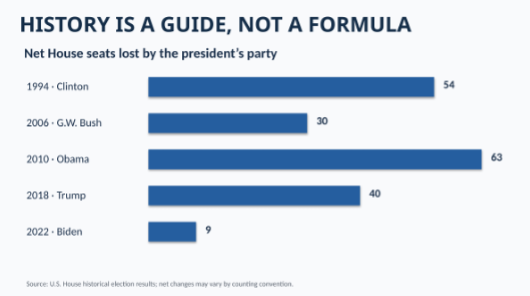
I can say from nearly five decades of covering American politics that history is not kind to the party occupying the White House in a midterm. The president’s party lost 54 House seats in 1994, 30 in 2006, 63 in 2010 and 40 in 2018. But huge setbacks are not guaranteed, even with an unpopular president. Republicans gained just nine in 2022 amid widespread unhappiness with President Joe Biden and rising prices — an important reminder that a predicted wave can become a ripple. Political conditions matter. But so does candidate quality, turnout, gerrymandering and events peculiar to individual races.
The pocketbook problem
Americans do not vote on gross domestic product. They vote on their own economic circumstances and their expectations for their families. In the polling cited in my presentation, 73% said the cost of living was moving in the wrong direction. Trump received just 26% approval for his handling of the economy and 17% for the cost of living. An AP-NORC finding cited in the deck indicated that 65% blamed his policies for driving up prices.
Democrats learned this lesson painfully in 2024. Inflation had multiple causes, including pandemic-era supply disruptions and the energy and grain shocks following Russia’s invasion of Ukraine. Many of those forces were beyond President Joe Biden’s control, but voters held his administration responsible. Trump promised to lower prices, some by 200%. (That’s definitely New Math.)
Instead, his tariffs and trade conflicts have made affordability a central political vulnerability. The precise contribution of any one policy to inflation is debatable.The electoral importance of voters’ perceptions is not. A key number: A majority of American voters now say they are dissatisfied with their own personal financial situation — for the first time since NBC News began asking this question in 1994. Eight years ago, when Republicans lost 40 House seats, more than 70% of Americans reported being satisfied with their own financial outlook midway through Donald Trump’s first term.
Health care, immigration, abortion, government competence and questions about corruption also matter. But the most useful early exit-poll numbers may not be which issue voters rank first. They may be which party voters trust to handle that issue — particularly the economy — and whether voters believe their own circumstances are stable or improving.
The popular vote is not the seat count
Democrats’ biggest challenge may be to translate a popular vote landslide nationally into victories in heavily gerrymandered House districts. This is the paradox at the heart of this election: Democrats could win a decisive nationwide House vote and still emerge with only a modest majority. Or they could win roughly the same vote share and capture dozens more seats. What matters most is whether Democrats win slim victories in Republican districts or mostly win landslides on heavily Democratic turf.
Imagine ten equally populated districts. In one model, Democrats win four districts overwhelmingly but lose the other six by relatively narrow margins. In another, they win seven districts by more modest margins. The national Democratic vote share can be identical in both examples, yet the seat totals are dramatically different. Votes piled up in a landslide district count in the national total, but they cannot elect additional representatives.
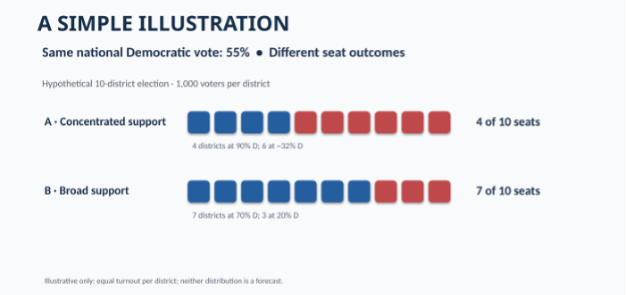
Three forces explain the disconnect: gerrymandering, the geographic concentration of like-minded voters and the decline of split-ticket voting. Mid-decade redistricting has added another complication. The Cook Political Report suggested a net Republican benefit of roughly three seats from the latest map changes, down from GOP’s best case scenario of 10 pickups. The lesson to greedy Republicans is that a favorable map is not a seawall. In a strong enough wave, seats drawn to be safe can suddenly become vulnerable.
Where the wave could reach
Start with the suburbs. Watch Northern Virginia, the Philadelphia suburbs, northern New Jersey, the areas around Detroit and Grand Rapids, and the growing metropolitan regions around Charlotte, Raleigh, Atlanta, Tampa, Orlando, Dallas and Houston. Are Democrats merely holding their previous margins, or are they expanding them? That distinction could determine control of the House and shape several Senate contests.
Then move outward. The signature of a truly broad wave would be smaller Republican margins in exurbs, working-class communities and rural counties — not just bigger Democratic majorities in already-blue cities. Watch places around Columbus, Cincinnati and Cleveland, Pennsylvania’s Lehigh Valley, the industrial Midwest and South Texas. Compare similar counties and districts with 2024, when Donald Trump made major inroads among Latino voters, young men and Black men. A caution: remember that partisan gerrymandering makes some congressional district comparisons to 2024 imperfect.
Population movement adds uncertainty. New arrivals from California, the Northeast and the Midwest have changed parts of Texas, the Carolinas, Florida, Arizona and Nevada. But migration alone does not tell us how people vote. New residents can be more conservative or more liberal than their neighbors, and they can be more shocked by corruption at the state level than longtime residents. Their states of origin are less important than their response to political shenanigans in their adopted state.

The Senate is a different battlefield
The House reflects a national political swing across hundreds of districts. The Senate reflects a much smaller collection of statewide contests, often in territory that voted for Trump in 2024. Democrats need a net gain of four seats from the 53–47 Republican starting point, because the vice president breaks ties for Republicans. Winning the House, even comfortably, would not guarantee control of the Senate.
Maine, Ohio, Iowa, Kansas, South Carolina and Texas deserve close attention, along with Republican-held seats in other states where high quality Democratic candidates have made races unexpectedly competitive. Example: Mississippi.
Democrats must also defend Michigan, where a Sunday morning endorsement of Republican nominee Mike Rogers by the Democratic primary loser, Haley Stevens, scrambled things. An unexpectedly close result in a state considered safely Republican such as Louisiana or Florida would be meaningful even if the Democrat loses: it could suggest that the wave is spreading beyond the expected battlegrounds.
Candidate quality can amplify or blunt the national tide. A strong local incumbent such as Maine Republican Susan Collins may survive a difficult year (although there is little protection against a tidal wave). A weak candidate such as Mississippi’s Cindy Hyde-Smith may lose a seat that should have been secure. Campaign money, advertising and turnout operations matter, too. That’s why we’re all looking at Texas, where sometimes-trillionaire Elon Musk has pumped in tens of millions of dollars in a rescue mission to save Republican Ken Paxton by sliming Democrat James Talarico on the issue of trans rights.
Information, enthusiasm and the unknown
Voters increasingly inhabit different information worlds. Cable television, partisan websites, podcasts, social video and political influencers can present sharply different versions of the same presidency. Republicans benefited from an influential podcast and online ecosystem in 2024. The balance may be changing, especially when podcast superstar Joe Rogan has become a sometimes-critic of Donald Trump and has welcomed Democrats including Texas’ Talarico to share his platform. Still, individual appearances or criticisms by disgruntled former MAGA acolytes are not, by themselves, proof of a nationwide shift.
Enthusiasm is another potential advantage for Democrats. Reuters/Ipsos figures showed 46% of Democrats, compared with 30% of Republicans, describing themselves as very enthusiastic wabout the midterms. While enthusiasm and early-voting statistics heavily favoring Democrats are not final turnout counts, they are important warning signs to Republican operatives. Without an extra-strong Election Day turnout, Republicans are facing major electoral challenges.
How big is the wave?
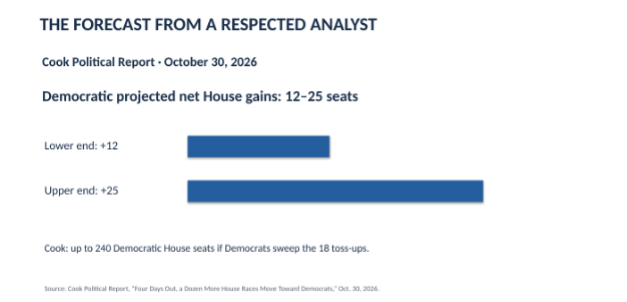
The authoritative, independent Cook Political Report’s October 30 forecast projected Democratic House gains of 12 to 25 seats, with a scenario reaching 240 Democratic seats if the party swept the toss-ups. A true blue tidal wave like the 1994 Newt Gingrich revolution could increase that total. The Cook estimate of 12 to 25 seats is a useful benchmark, not a ceiling or a guarantee. Polls have errors. Turnout models rely on assumptions. But as I always say, it’s better to be ahead in polls than behind. And it’s important to note that no respected independent polling analysts are predicting that Republicans maintain control of the House. So it’s only the size of the coming Democratic majority that’s uncertain.
There are several plausible endings. Democrats could win a narrow House majority while Republicans retain the Senate. They could sweep most competitive seats and win both chambers. A much larger wave could topple Republican incumbents in places nobody expected to be competitive. Or a pro-Republican riptide in most close districts could leave the GOP clinging to a tiny House majority despite a Democratic advantage in the national vote.
I will be watching one question above all others Tuesday night: Are Democrats winning only the races they were expected to win, or are supposedly safe Republican seats suddenly becoming toss-ups? The answer will tell us whether the blue wave is a torrent or a trickle.
>>> Read Rick Dunham’s 2026 Election Night cheat sheet
Rick Dunham’s 2026 Election Night cheat sheet
Posted: November 2, 2026 Filed under: U.S. politics | Tags: 2026 Election, American politics, cheat sheet, Congress, Democrats, Donald Trump, Republicans, U.S. Congress 1 CommentI have been crafting Election Night cheat sheets since 2000, when the presidential election between Al Gore and George W. Bush began unfolding at 6 p.m. and wasn’t finally decided until mid-December. Here is my latest installment in the series, analyzing the key bellwether contests that could decide which party controls Congress for the final two years of Donald Trump’s second term. Enjoy!
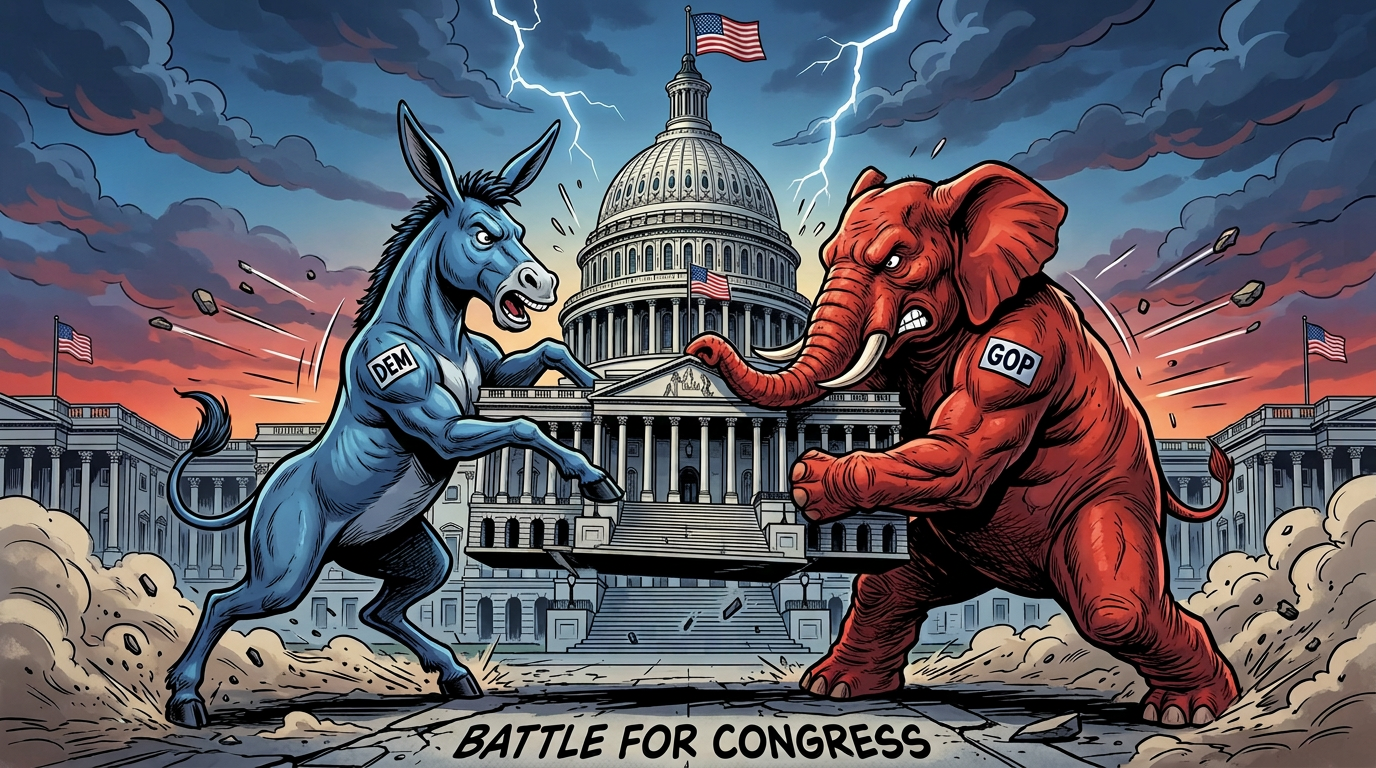
OVERVIEW
Election Day: Tuesday, November 3 • All times Eastern Standard Time (EST)
House: 435 seats; 218 normally needed for a majority if all seats are filled. Senate: Republicans entered the cycle with 53 seats to Democrats’ 47 (including independents caucusing with Democrats); Democrats need a net gain of four for control.
THE BIG QUESTION: How many districts outside the conventional battleground list become competitive? A nationwide House vote margin is not the same as a seat margin. Geographic concentration, redistricting, candidate quality and close-race outcomes matter.
LIKELIEST OUTCOMES — FILL IN AFTER FINAL FORECAST REVIEW
| Contained Democratic gain | The parties divide the competitive seats; House control remains close, with Democrats most likely to win a narrow majority. Republicans hold the Senate. |
| Expanding Democratic wave | Democrats win most toss-ups and reach Republican-leaning districts; Democratic Senate control is plausible. |
| Exceptional Democratic wave | Unexpected Republican seats fall in multiple regions; Democrats easily win Senate control |
| Republican riptide | Republicans outperform expectations in close districts, potentially retaining the House and Senate. |
ELECTION KEYS: WHAT TO WATCH
Demographics: college-educated suburban voters; non-college voters; young men and women; young Black and Hispanic men; Latino working-class communities; Mexican-Americans along the southern border; Black turnout in the South, Ohio and Michigan; independents; older voters; union households.
Geography: Virginia exurbs; Atlanta and Charlotte suburbs; Pennsylvania’s Lehigh Valley and northeastern counties; Pennsylvania’s Pennsylvania Dutch area in the southeast; Michigan industrial areas; Michigan’s suburbs of Detroit and Grand Rapids; New York and New Jersey suburbs; Texas border communities; Texas’ suburbs of Fort Worth (Tarrant County), Dallas, and Houston; Texas’ exurbs of Austin and San Antonio; California competitive districts.
Issues: prices and purchasing power; presidential approval; corruption and democracy; corporate wealth and income inequality; immigration; war and Trump foreign policy; abortion; healthcare; government competence; trade and tariffs. Measure issue importance separately from which party voters trust.
Early exit poll question results (potentially available from 6 p.m.): issue priorities, direction of country, presidential approval, personal economic circumstances, corruption. Initial figures may change and are not vote projections.
INDICATIONS OF AN EXPANDING DEMOCRATIC WAVE
Democrats win Republican-held seats beyond the toss-up column; Republican margins narrow in traditionally safe territory; Democratic gains appear in several regions rather than only affluent suburbs; Republican Senate incumbents struggle in multiple states.
INDICATIONS OF A REPUBLICAN RIPTIDE
Republicans hold suburban toss-ups, retain expected Republican Senate seats, and overperform in working-class or rural counties; Democratic gains remain concentrated in districts they already dominate.
POLL CLOSING TIMES — EST
Some states have staggered closings. A closing time does not mean a race can immediately be projected. New Hampshire local closings vary. Check state election offices for last-minute orders.
| 6:00 p.m. | Indiana and Kentucky (Eastern portions) |
| 7:00 p.m. | Georgia, South Carolina, Vermont, Virginia; most Florida; remaining Indiana/Kentucky; some New Hampshire |
| 7:30 p.m. | North Carolina, Ohio, West Virginia |
| 8:00 p.m. | Alabama, Connecticut, Delaware, D.C., Illinois, Maine, Maryland, Massachusetts, Mississippi, Missouri, New Jersey, Oklahoma, Pennsylvania, Rhode Island, Tennessee; portions of Florida, Kansas, Michigan, North Dakota, South Dakota, Texas; remaining New Hampshire |
| 8:30 p.m. | Arkansas |
| 9:00 p.m. | Arizona, Colorado, Iowa, Louisiana, Minnesota, Nebraska, New Mexico, New York, Wisconsin, Wyoming; portions of Kansas, Michigan, North Dakota, South Dakota, Texas |
| 10:00 p.m. | Montana, Nevada, Utah; portions of Idaho and Oregon |
| 11:00 p.m. | California, Washington; remaining Idaho and Oregon |
| Midnight | Hawaii; most of Alaska |
| 1:00 a.m. Wednesday | Western Aleutian Islands, Alaska |
KEY EARLY RACES TO WATCH — SENATE
SENATE MATH: Democrats need a net gain of four seats. Every Republican pickup in a Democratic-held seat increases the number of Republican-held seats Democrats must flip.
| 7:00 — Georgia | Ossoff (D): gauge whether Republican challenge breaks through; victory by more than 5 percentage points is good news for Democrats. Cook: Likely D. |
| 7:00 — South Carolina | Graham (R): Appointed senator Darline Graham is at risk of losing the seat long held by her late brother Lindsey after running a terrible campaign. A narrow win means Republicans have a shot at holding the Senate. A Democratic victory is an early indicator of a GOP meltdown. Cook: Lean R. |
| 7:30 — North Carolina | Open Republican seat: key Democratic pickup opportunity; Roy Cooper victory by more than 8 points is an early sign of strong Democratic tide. Cook: Likely D. |
| 7:30 — Ohio | Husted (R): important Republican-held toss-up. Warning: Early Ohio vote counts often favor Democrats, so examine which counties and ballot types have reported before drawing conclusions. A Sherrod Brown victory is essential to Democratic Senate control. Cook: Toss-up. |
| 8:00 — New Hampshire | Open Democratic seat; rare Republican pickup opportunity. An upset victory by Republican Sununu would be a sign of a contained Democratic wave. Cook: Lean D. |
| 8:00 — Maine | Collins (R): Republican-held toss-up. Collins is trailing in most polls but has defied predictions of defeat in the past. A clear Jackson victory would be a strong sign of a Democratic wave. Cook: Toss-up. |
| 8:00 — Mississippi | Hyde-Smith (R): Weak GOP incumbent has seen her lead slipping in polls. A close election means a Democratic trend nationally; a Democratic victory in a solidly Republican state is a harbinger of massive gains. Cook: Likely R. |
| 9:00 — Michigan | Open Democratic seat: critical Democratic defense; Republican Mike Rogers is the only candidate in position to win a Democratic seat. Warning: Early counts can be misleading in Michigan; examine reporting jurisdictions and ballot types. Cook: Toss-up. |
| 9:00 — Texas | Open Republican seat: test of the wave’s geographic reach; Democrats haven’t won a U.S. Senate seat in Texas since 1988. A James Talarico victory would be a sign of a Democratic wave. Cook: Toss-up. |
| 9:00 — Iowa | Open Republican seat: Democrat Josh Turek versus Republican Ashley Hinson. Cook: Toss-up. |
| 9:00 — Kansas | Marshall (R) versus Adam Hamilton (D): Momentum has been with the Democrats in a state that last elected a Democratic U.S. senator in 1932 (George McGill). Another test of a national wave. Cook: Toss-up. |
| 9:00 — Nebraska | Ricketts (R): Independent Dan Osborn has remained remarkably competitive against a strong Republican incumbent. Pete Ricketts’ defeat would confirm the trend of massive Republican losses. Cook: Lean R. |
| 1:00 a.m. Wed. — Alaska | Sullivan (R) versus Mary Peltola (D): A Republican-held toss-up whose late returns could help determine Senate control if the national Democratic wave is modest. Most Alaska polls close at midnight EST, with the western Aleutians at 1 a.m. This is the opposite of an early indicator. Final results may take days. Cook: Toss-up. |
Explaining the Trump TACO phenomenon (video)
Posted: October 19, 2026 Filed under: Dunham's Discourses, U.S. politics | Tags: American politics, Donald Trump, economics, international trade, tariffs, trade, trade war Leave a commentEver since Donald Trump launched his global trade war in January 2025, there has been a cycle of threats, tariffs and retreats. Critics have dubbed this the “TACO” effect: Trump Always Chickens Out.
What is the logic behind the American president’s actions? And why do his detractors believe his trade policy resembles the widely popular Mexican fast food staple?
In this YouTube video explainer, I tackled this politically tricky and economically confusing question.
A short history of tariffs — and why Trump’s actions mark a radical break from global trade history
Posted: September 27, 2026 Filed under: Dunham's Discourses, Journalism Training, U.S. politics | Tags: Adam Smith, Alexander Hamilton, China, Donald Trump, economy, international economics, international relations, Milton Friedman, politics, Smoot-Hawley, tariffs, trade, trade war, trump, Tsinghua University, United States, William McKinley Leave a comment
By RICK DUNHAM
For most of human history, governments have taxed goods crossing their borders. Tariffs — taxes levied on imports or exports — have financed empires, protected domestic industries, and punished foreign rivals. They’ve sparked wars, crashed economies, and redefined alliances.
Yet the ongoing tariff war between the United States and the world doesn’t fit neatly into any of the old molds. Rather than being a tool to nurture domestic industry or fill government coffers, tariffs are now being wielded as weapons in a sprawling contest over global power and economic dominance.
“We are seeing an upending of the whole economic order,” said Robert Blecker, an American University economist, “and the rules-based trading system that has been in effect since 1945.”
In its place, he told Global Business Journalism students at Tsinghua University, is “a Hobbesian war of all against all,” referring to the 17th century English social and political philosopher who wrote that people are inherently selfish.
With American President Donald Trump aiming at China as the top target in his massive global tariff offensive, the stakes have grown even higher — signaling a deepening rift that could reshape the global economy for decades.
“China must fail — Trump knows this,” pro-Trump influencer Benny Johnson tweeted to his 3.7 million followers on April 10. “This is more than just a trade war.”
Trump began his sprawling trade wars as soon as he took office on January 20, 2025, by targeting hemispheric allies Mexico and Canada. He took his tariff wars global on April 2 — a date he dubbed “Liberation Day” — with massive levies on dozens of jurisdictions, including some uninhabited islands. After backing down temporarily following a sharp dive in American and global stock markets, Trump restarted his tariff push in early July with daily social media missives targeting trading partners that had incurred his wrath, from Brazil to the European Union, Mexico to Myanmar.
The mercurial president’s reasons ranged far beyond traditional economic excuses for tariffs. For example, he threatened Brazil for prosecuting his close friend, former president Jair Bolsonaro, for staging a failed coup in an attempt to maintain power after losing a reelection race.
Trump believed that his threats would convince nations around the world to line up to follow Great Britain and Vietnam to negotiate trade pacts on terms favorable to the American administration. But most economists, historians and foreign policy experts instead predict more economic chaos and reality show psycho-drama.
“Under Trump’s stewardship, American trade diplomacy has ceased to be a tool of engagement and become a weapon of spectacle,” international affairs analyst Imran Khalid wrote recently in The Hill.
As much as Trump’s actions pleased his strongest supporters at home, many nonpartisan analysts say the passions unleashed by the American president’s on-again, off-again tariffs — which have increased global trade levies to their highest levels in a century — jeopardize the stability of the world’s economy.
“The [Trump] administration is playing with fire,” said Joe Brusuelas, chief economist at RSM.
Already, consumers and businesses have been burned. Around the world, companies are blaming tariffs for depressed consumer demand and lower-than-expected profits. Trump’s unilateral tariffs were struck down by the U.S. Supreme Court as unconstitutional, but the president responded by imposing another round of tariffs, daring the high court to swat him down again. The impact, for business, is unsettling.
“I don’t know what to put for this next headline, so I just kept it simple: tariffs, tariffs and the possibility of more tariffs,” the CEO of luxury furniture retailer RH, Gary Friedman, said on an earnings call while explaining forecasts of declining sales.
From Mesopotamia to McKinley: A brief history of tariffs
To understand why Trump’s tariff obsession is historically unusual, we first have to understand how tariffs evolved.
Start with this historical anomaly: Trump is the first leader of a state to use tariffs to destabilize the global economy or create economic chaos as a political strategy. Let’s go to the history books…
Tariffs — taxes on imported goods — have been around as long as nations have traded. The earliest tariffs were essentially tolls. In ancient Mesopotamia, merchants moving goods through city-states paid taxes at gates and ports. Ancient Athens imposed customs duties on goods entering its harbors; medieval European towns taxed merchants entering city gates. Small kingdoms collected duties at rivers and bridges, not out of economic strategy but because those rulers needed revenue.
Mercantilism, the dominant economic philosophy from the 16th to 18th centuries, gave tariffs a political purpose. Under mercantilist thinking, national wealth was measured by the accumulation of gold and silver. Exporting goods brought money in; importing drained it. Thus, heavy tariffs on imports became common.
One example is Britain’s Navigation Acts of the 17th century. To enrich itself and weaken rivals, Britain required that goods imported to its colonies come via British ships — often with tariffs that discouraged buying from foreign competitors.
Tariffs: American policy tool
However, tariffs were also key to early American economic development. After independence, the United States — lacking an income tax — used tariffs as its primary revenue source. As Alexander Hamilton, the United States’ first Treasury Secretary, argued in his 1791 “Report on Manufactures,” tariffs could protect the fledgling American industry from dominant British manufacturers.
“In countries where there is great private wealth, the public revenue may be derived, in a considerable degree, from it,” Hamilton wrote. “But in a country where there is little capital, taxes on consumption… are more convenient.”
Tariffs are often embraced by politicians, but they are widely despised by free-market capitalists. Adam Smith, in his 1776 classic “The Wealth of Nations,” wrote that tariffs foster economic inefficiency and complacency among protected industries. Two centuries later, Nobel Prize-winning economist Milton Friedman complained that “tariffs protect a few producers at the expense of a much larger number of consumers.”
In the decades leading up to the American Civil War, tariffs became a political flashpoint. The so-called “Tariff of Abominations” of 1828, which sharply raised duties on raw materials and manufactured goods, enraged Southern politicians and business elites, who saw themselves as victims of Northern industrial power. It triggered the Nullification Crisis, a constitutional confrontation over states’ rights between South Carolina and the federal government.
Abraham Lincoln’s Republican Party platform in 1860 was explicitly protectionist, arguing that tariffs “secure to the American laborer the full rewards of his industry.” Lincoln reflected the world mindset. Globally, tariff walls defined commerce until well into the 20th century. Many nations used tariffs to promote “infant industries,” a concept formalized by German economist Friedrich List in the 1840s. Protection, he argued, was necessary to allow industries in developing nations to catch up with more advanced economies.
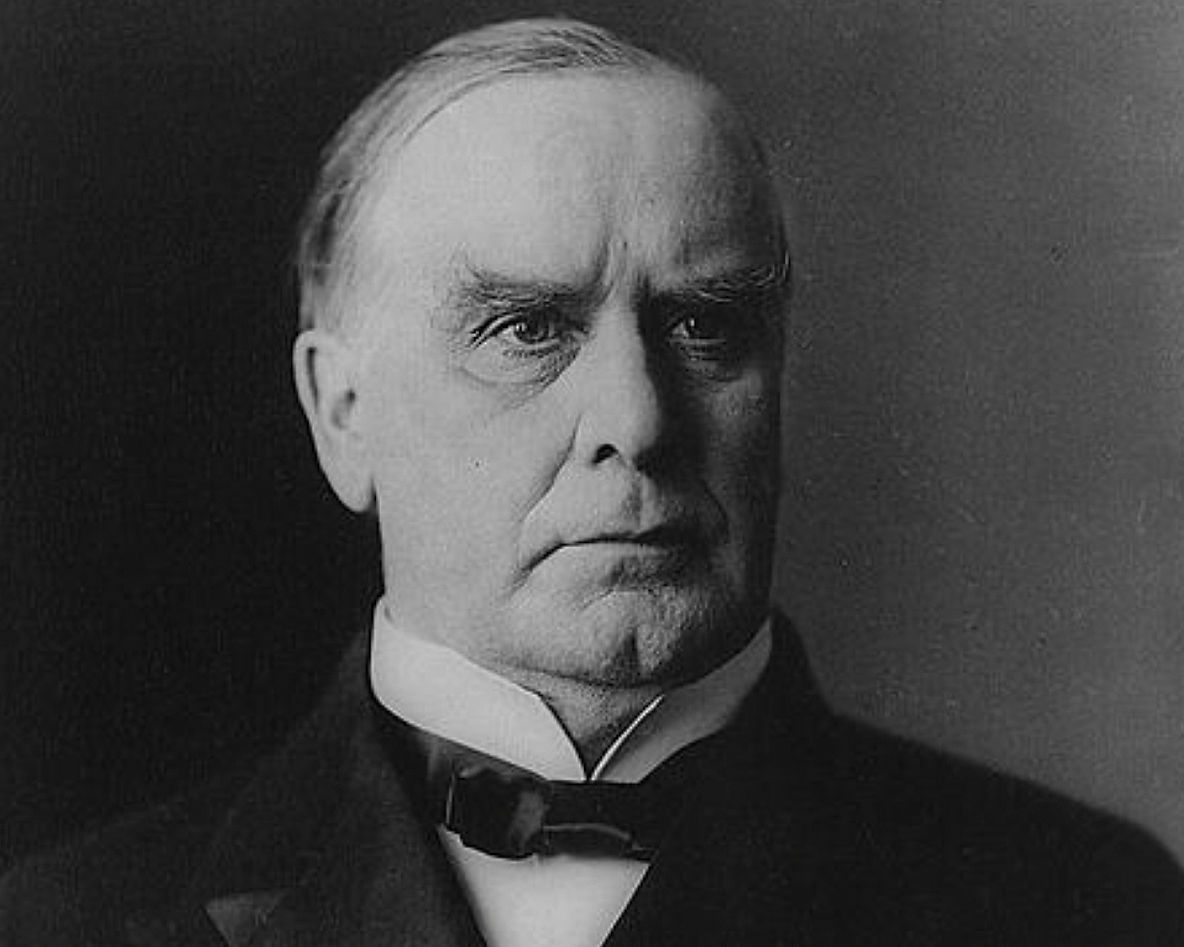
Donald Trump’s historical hero, William McKinley, created a tariff war in 1890 with neighbor Canada and Europe by writing a law as an Ohio congressman raising tariffs to 50% at the behest of American “robber baron” industrialists. The ensuing economic depression and political backlash cost Republicans 93 House seats and the White House in the 1892 mid-term elections. As president four years later, McKinley found a new use for tariff revenue: to fund a war with Spain that created a nascent American Empire from Puerto Rico to the Philippines.
Toward freer trade
In the United States, the creation of the income tax in 1913 ended the need for tariff revenue to fund federal government spending. But as the world spiraled into the Great Depression in 1930, President Herbert Hoover signed into law the infamous Smoot-Hawley Tariff Act, which raised U.S. tariffs on more than 20,000 goods, prompting retaliatory tariffs from other countries and a global collapse in trade. Tariffs were blamed for deepening the worldwide depression and abetting the rise of fascism. After the devastation of World War II, the world shifted toward lower trade barriers and fewer tariffs.
In the post-war world, nations established a new trade order. The General Agreement on Tariffs and Trade (often shortened to GATT), signed in 1947, sought to gradually reduce tariffs and other barriers. Over the next decades, through successive “rounds” of GATT negotiations, tariffs fell dramatically among developed nations.
This period of liberalization culminated in the creation of the World Trade Organization in 1995, giving the world its first comprehensive, enforceable set of trade rules. Tariffs trended downward, global trade trended upward, and extreme poverty dropped significantly around the world. Benefits to the new world order were widespread, but there were many losers, particularly in wealthier countries like the United States and stagnant nations like Russia, where manufacturing facilities shuttered or shifted to other places.
Through successive “rounds” of negotiations, countries agreed to reduce tariffs drastically. In the United States, average tariffs fell from about 20% in the 1930s to less than 5% by the 1990s. Globally, the pattern was similar. Trade exploded, and prosperity (though unevenly) followed.
China’s story fit neatly into this narrative — for a while. After decades of isolation, Beijing joined the WTO in 2001, promising reforms in exchange for access to global markets. U.S. leaders at the time believed that integrating China into the world trading system would encourage political liberalization and bind it to international norms. China’s economic system liberalized, to some degree, but its political system did not.
U.S. consumers benefited from the influx of inexpensive Chinese-produced goods, from toys to toasters, sneakers to solar panels. At the same time, American political leaders in both parties accused China of ignoring international trade rules, breaking bilateral agreements to open markets to American products and services, violating human rights, and stealing intellectual property. China accused the U.S. of bullying and interference in its domestic affairs.

The tariff wars, 2018 to 2025
Tensions between Washington and Beijing simmered for years, but they boiled over during the first Trump administration. In 2018, President Donald Trump imposed $350 billion of tariffs on Chinese goods, citing unfair trade practices, intellectual property theft, and massive trade imbalances.
China retaliated with tariffs of its own, matching U.S. tariffs almost dollar-for-dollar. Suddenly, two of the world’s largest economies were locked in a tit-for-tat spiral that affected industries from agriculture to technology.
The stakes weren’t just economic. Rather than fighting over sales of soybeans or jets, the tariffs were part of a struggle over controlling the rules of trade for the 21st century. Trump administration officials argued that tariffs were a necessary weapon against Chinese-style mercantilism, a system where state-owned enterprises received massive subsidies, foreign companies were forced into technology transfers, and markets were systematically distorted.
While there was a brief thaw — notably the 2020 “Phase One” trade deal, in which China agreed to buy more American products — underlying tensions never truly eased. American officials accused China of failing to comply with its promises to purchase those U.S. products.
When Joe Biden defeated Trump in 2020, many expected a tariff rollback. Instead, Biden kept most levies in place, while introducing new targeted measures on Chinese technology and semiconductors, emphasizing national security concerns.
But domestic political pressure ahead of the 2024 presidential election created a news flashpoint. In May Biden announced a 100% tariff on all Chinese electric vehicles and a 50% levy on solar cells. The move came after U.S. automakers warned that a flood of inexpensive Chinese EVs was threatening their survival, and unions, environmentalists and human rights organizations pressed Biden to punish China.
“We cannot trade a dependency on foreign oil for a clean energy future reliant upon China,” Ben Jealous, then the executive director of the environmentalist Sierra Club said at a 2024 White House event.
China responded swiftly. Within days, Beijing imposed tariffs of up to 50% on U.S. agricultural exports, including soybeans, corn, beef, and dairy products. The Chinese Ministry of Commerce accused the U.S. of “naked economic bullying” and filed a formal complaint with the World Trade Organization.
Why this war is different — and more dangerous
Trump returned to office in 2025, declaring that “tariffs” was his favorite word. He wasn’t joking. He began implementing tariffs in his first day in office and took only two months to target China.
Compared to past tariff disputes, like the Smoot-Hawley Tariff Act of 1930 or the U.S.-Japan trade tensions of the 1980s, the current situation is more expansive, more ideological, and more deeply entwined with national security.
- In the 1930s, tariffs were mainly about protectionism amid a global depression.
- In the 1980s, disputes with Japan focused on market access, with eventual negotiated settlements.
- Today, tariffs are instruments in a struggle over who controls the technologies and supply chains of the 21st century.
Historically, the American Congress maintains power to levy tariffs. But Congress in the 1970s delegated that power to the president in specific emergency situations. Presidents Trump and Biden have used the power in unprecedented ways over the past decade to impose new tariffs without the approval of Congress.
There are four other major reasons why the Trump tariff wars are more dangerous than the escalations of the past 150 years:
- They are no longer confined to particular industries like steel or solar panels. Entire sectors — especially in green technology, digital goods, and agriculture — are now battlegrounds.
- Tariffs are being paired with non-tariff weapons: export controls on critical technology, bans on Chinese apps, investment restrictions, and visa limits on scientists and engineers.
- In one of the starkest breaks from historical norms, tariffs are now intertwined with national security concerns. The Trump and Biden administrations alike have cited China’s control over critical supply chain, from rare earth minerals to semiconductors, as reasons for tariffs and investment restrictions. Biden’s national security adviser, Jake Sullivan, said in 2023 that American trade policy was about “safeguarding national security” and protecting “the very foundations of our economic future.”
- The trade wars are being framed explicitly as a clash of economic systems, not only about unfair trade practices.
“I’m really excited that we are rallying Americans to be anti-China,” self-proclaimed America First journalist Laura Loomer, an informal Trump adviser, posted on the social media platform X. “We need more anti-CCP energy in our country,” she added, referring to the Chinese Communist Party. “It’s about time that we wake people up to the fact that the CCP is our enemy.”
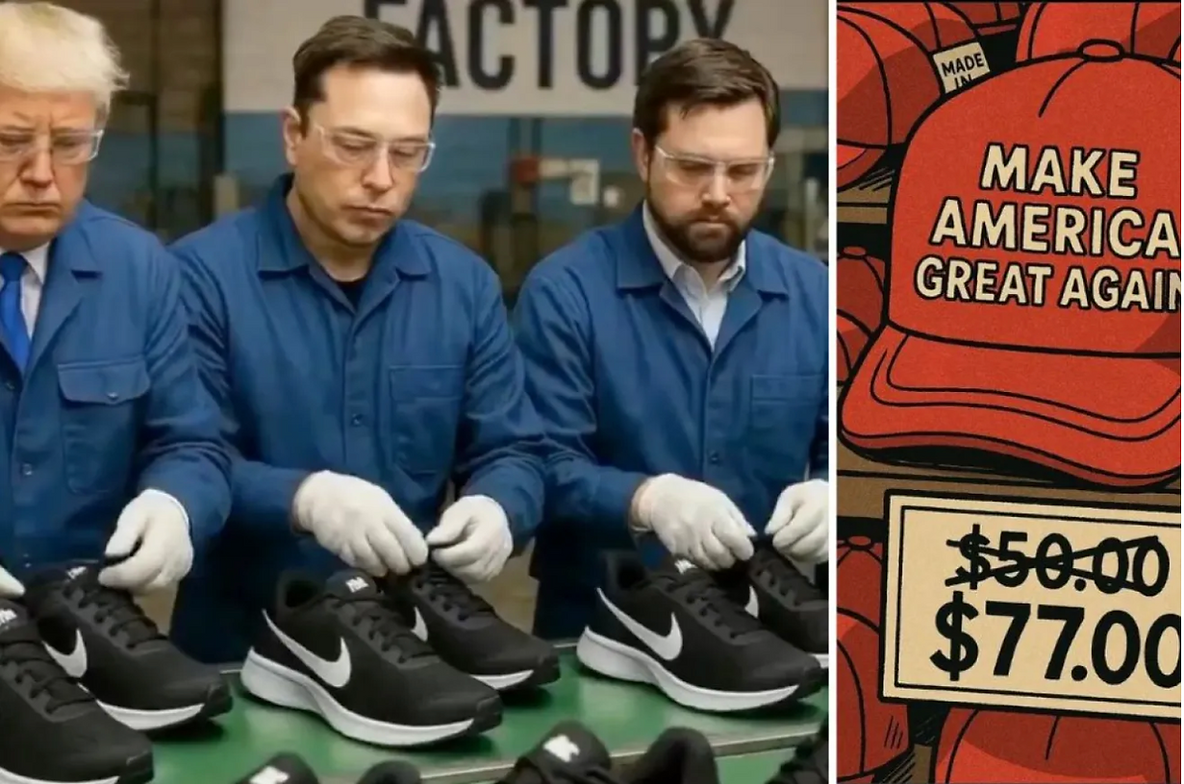
American politicians are heating up the rhetoric in a bipartisan frenzy. Congress in March passed the American Supply Chains Protection Act, mandating that critical goods (like semiconductors, pharmaceuticals, and rare earth elements) must be manufactured either domestically or in “trusted partner nations.” Chinese firms were explicitly excluded.
“To achieve a strong, resilient, supply chain, we must have a coordinated, national strategy that decreases dependence on our adversaries, like Communist China, and leverages American ingenuity,” said Senator Marsha Blackburn, a Tennessee Republican.
China’s state media responded by ratcheting up its rhetoric to levels reminiscent of the Cold War.
“The U.S. should stop whining about itself being a victim in global trade and put an end to its capricious and destructive behavior,” the Communist Party’s China Daily wrote in an editorial. “It has outsourced its manufacturing and borrowed money in order to have a higher standard of living than it’s entitled to based on its productivity. Rather than being ‘cheated,’ the U.S. has been taking a free ride on the globalization train.”
Trump compounded the economic damage by picking trade wars with his country’s two other largest trading partners, Canada and Mexico. He repeatedly declared his interest in making Canada America’s 51st state and unilaterally imposed 50% tariffs on a wide range of Canadian imports without provocation. Canada’s government responded with measured retaliation, but Canadian citizens retaliated with a wide-ranging boycott of the U.S. tourism market in 2026.
Amid this political psychodrama, and the economic uncertainty it creates, there has been real economic damage:
- U.S. inflation spiked in early 2025, as higher tariffs on EVs and electronics drove up consumer prices. As tariffs came and went, the affects on inflation varied, but economists estimated that they were responsible for continuing higher levels of consumer costs into late 2026. The U.S.-Israeli war on Iran created an energy price spike and a further inflationary spiral around the world.
- U.S. farmers face a second major hit, eerily reminiscent of the 2018–2019 pain, as Chinese buyers pivoted to Brazil, Argentina, and Russia for agricultural imports. Even after the China-U.S. truce went into effect and Chinese began small purchases of U.S. soybeans, Trump’s trade wars with Canada, Mexico and Europe had caused even more damage to American agricultural exports.
- Global supply chains are scrambling again. Companies that once thought they had weathered the U.S.-China trade storms are now exploring further diversification to India, Vietnam, Mexico, and Eastern Europe.
China, meanwhile, accelerated its “dual circulation” strategy — focusing on domestic production and internal consumption to lessen reliance on U.S. technology and markets. Chinese manufacturers have shut down production, at least temporarily, in factories in Guangdong and other provinces. Some companies are exploring outsourcing to lower-cost labor markets.
The Chinese government has reached out to nations around the world, from ASEAN countries in Southeast Asia to the European Union, to renew its commitment to the pre-Trump global trading order. But most countries are responding warily, as Trump seeks to negotiate bilateral deals.
“Nothing is certain but uncertainty when it comes to Trump tariffs!” Tengku Zafrul Aziz, Malaysia’s Minister of Investment, Trade and Industry, posted on LinkedIn.
The WTO estimated in April that reciprocal tariffs would slash the 2025 global GDP by 0.6%. The World Bank warned in an April 2025 report that a fully decoupled global economy could shave 2% off world GDP by 2030 — trillions of dollars in lost wealth. The current situation has been described as a “slow-motion fracture of the world trading system.” With Trump insistent on a permanent tariff regime, it is difficult to tell if his administration, which ends in January 2029, is an aberration or a herald of a permanently fractured system.
Global consequences
Tariffs have always been about more than just economics. They are tools of power and leverage, expressions of national priorities and fears.
But the 2025 U.S.-China tariff war marked a profound shift. It is not just a fight over trade imbalances, but a battle over the very future of global order and the hegemonic ambitions of the world’s two largest economies.
Each twist and turn in the war — each up and down in stock markets — is the subject of social media trolling and government spin. Chinese nationalists were particularly gleeful when Trump retreated from 145% to 30% tariffs on May 12. Beijing dropped its levies on U.S. goods to 10%. There have been a series of truces agreed to by both sides, the latest lasting until after the 2026 midterm elections in the United States.
“This is called, ‘victory,’” Hu Xijin, the retired editor of the state-controlled Global Times, reveled on the Weibo social media platform. “Today we have definitely driven the Americans back to the 38th parallel! [a reference to the pre-war Korean border].”
Hu’s allusion resonates deeply among Chinese superpatriots. More than 1 million Chinese troops famously drove American and other United Nations troops to retreat to near the 38th parallel after the UN forces had conquered nearly all of North Korea in the fall of 1950 in a counteroffensive following the North’s summertime invasion of the South. The war ended in 1953 after more than two additional years of bloody stalemate.
Today’s war is not being fought by soldiers but by lawyers and customs agents. Whether the world moves toward deeper fragmentation or finds a new equilibrium will depend on political will, economic realities, and, perhaps, a willingness to learn from the lessons of history.
“It is an enduring lesson of history: protectionism may feel good in the short term, but it inevitably isolates and impoverishes in the long run,” says Imran Khalid.
If the United States and China do not reach a permanent cease fire in their trade war — and Trump does not back down on universal tariffs — the entire global economy will suffer, says Callum Glennen of the World Finance website.
“No one wins,” Glennen wrote. “It will be challenging to identify a winner from the fallout of the rounds of sanctions that China and the U.S. are throwing at one another, since there is not a clearly defined goal for either side. Both economies will suffer from the tariffs, and neither is likely to see a significant redevelopment of their local industries.
“The concerns of the U.S. regarding alleged intellectual property theft by Chinese firms may be addressed, but whether that will result in a reduction of the trade deficit is unknown. Based on the U.S.’ history, the damage from a fully fledged trade war could be significant.”
This story was originally written for the Global Business Journalism program website. It was part of a series of articles created by the Global Business Journalism program to help reporters worldwide cover trade and other economic policy issues. Access the business journalism toolkit here.
Note: Economist Robert Blecker, quoted above, died after his guest lecture at Tsinghua University.
Analysis: Mueller speaks. What does it mean?
Posted: May 30, 2019 Filed under: Breaking news, Rick in the news, U.S. politics | Tags: Bill Clinton, China Radio International, Congress, CRI, Democratic Party, Donald Trump, impeachment, Justice Department, Republican Party, Robert Mueller, Russia, special counsel, United States, William Barr Leave a comment
Robert Mueller reads a statement to reporters at the U.S. Justice Department building on May 30, 2019
After two years of carefully scripted public silence, Robert Mueller spoke on May 30. In eight minutes of words, as carefully scripted as his previous silence, Mueller delivered a message radically different in tone and substance than the Trumpian tweets about a “Russia hoax” and the president’s insistence that there was “no collusion.” Two months after Mueller delivered a 448-page report to Attorney General William Barr, he closed up shop and left his job as Special Counsel. Here is a Q&A based on my interview on China Radio International.
Q: What’s your takeaway from Robert Mueller’s eight-minute statement?
A: Robert Mueller made clear that he believed Trump’s attorney general, William Barr, misstated the findings of the report when Barr claimed that Trump had been cleared of wrongdoing. Mueller was precise and diplomatic in his wording. But the words were very damaging to Barr’s credibility among open-minded Americans, although in a deeply divided country, I’m not sure how many people are open to changing their minds about anything relating to Trump. The two points Mueller made abundantly clear: There was, and is, ongoing Russian interference in the U.S. electoral process, and he cannot and will not clear Donald Trump of attempting to obstruct justice.
Q: In Mueller’s speech, he detailed 10 instances where Trump had possibly attempted to impede the investigation, but said the Constitution requires a process other than the criminal justice system to formally accuse a sitting president of wrongdoing.” Is he indicating an impeachment process?
A: Not exactly. He said the Justice Department policy is clear and that he abided by that policy. The question of whether a sitting president may be charged criminally during his or her presidency may be decided by a court at some point. Mueller did strongly suggest that it is up to Congress at this present time to formally accuse a sitting president, because the Trump Justice Department will not.
Q: Three more democrats are calling for impeachment, and one Republican has been calling for Trump’s impeachment, do you think the momentum will grow after Mueller’s speech?
A: The momentum is building slowly. The reason is that Republicans remain scared to death of Trump and his supporters. Some are afraid of being defeated in primaries. Some want to use their power in Washington to pursue their policy goals. And other simply agree with Trump’s ends and his tactics. Democratic congressional leaders want to focus the party’s efforts on defeating Trump at the ballot box in 2020 rather than impeaching him, which they could do, but there is no chance of convicting him in a Republican Senate. The same thing happened with Bill Clinton in 1999.
Q: What do you make of the division within the Democratic Party on this issue?
A: The party is divided between pragmatists, who want the House of Representatives to focus on policy issues and want Democrats to focus on electoral success, and idealists and ideologues who believe that Trump is a liar, a crook, a scoundrel, a mad king, a Russian dupe, an unfit charlatan, or some combination of those things.
Q: Mueller said he did “not believe it is appropriate” for him to testify before Congress, as House Democrats have asked. How do you look at this, and how is the Congress going to react to this that he doesn’t want to testify?
A: Mueller is a rare public figure in America who wants his words to speak for him. He wants to investigation and the report to be his legacy. He does not want to get into a personal political war with Donald Trump. Those battles have ended with damaged reputations for anyone who has gotten into a personal conflict with Trump for the past 35 years. Mueller, at his press availability, made it very, very clear that we should focus on the carefully crafted, very strong language in the report. Trump said the report cleared him. It obviously does not. Mueller wants every American to read every word of the report. He doesn’t want them to be forced to choose between political “sound bites.”
Q: Mueller has announced the formal closure of the special counsel office and his resignation from the justice department. If we look back at this investigation that went on for more than two years and costed over 25 million US dollars of tax payer’s money. Do you think it was worth it?
A: Absolutely. It was a fact-finding mission and a criminal investigation. It succeeded on both levels. The people of the world know much more about the Russian government’s aggressive and persistent efforts to elect Donald Trump and sow chaos in the American political system. Dozens of people have been convicted of criminal charges, including some of Donald Trump’s closest advisers. The Mueller investigation has spawned several ongoing criminal probes. But most of all, Mueller wrote a dispassionate, detailed report of the facts as he knew them, despite, as he strongly suggested, an aggressive attempt to obstruct his investigation.
The role of social media in the spread of hate speech
Posted: March 22, 2019 Filed under: Breaking news, Rick in the news, U.S. politics | Tags: Alexandria Ocasio-Cortez, AOC, Australia, Bernie Sanders, Beto O'Rourke, China, China Radio International, Christchurch, CRI, Devin Nunes, Donald Trump, Elizabeth Warren, extremism, Facebook, Fox News, Franklin D. Roosevelt, free speech, Gaza, hate speech, Internet, Islam, New Zealand, Pakistan, Peggy Noonan, Russia, Saudi Arabia, social media, Somalia, telecommunications, terrorism, Twitter, United States, Wall Street Journal, WeChat, Weibo, YouTube Leave a comment
Remembering the victims in New Zealand. (Wikipedia photo by “Natecull”)
Following the murder of 50 people in Christchurch, New Zealand, by a white supremacist from Australis, China Radio International devoted its weekly news round-up on March 22 to issues raised by the massacre of Muslims during services at two mosques. The discussion focused on the role of social media in the spread of hate speech and the power of the internet to radicalize the disaffected around the world.
Here are my answers to a series of questions posed by the hosts:
Q: Lots of tough questions are being asked about the role of social media in the wake of the horrific shooting at two New Zealand mosques. First of all, do you think this is an attack made by and for the internet?
A: Yes, this is a modern terrorist attack using the true definition of terror. It is designed to create fear and anxiety in the global public by making people think such mass murder and mayhem can happen anywhere. If it happened in New Zealand, is my own city safe?
The gunman was introduced to white supremacy hate material on the internet and was radicalized via the internet and social media. He chose New Zealand because it was a soft target and because he thought an attack there would have maximum impact.
Q: As the gunman decided he was going to use his camera as he began this terrible massacre, was there anything in social media to stop him?
A: Facebook live and other live-streaming sites cannot be blocked in advance. The only way it could have been stopped in advance is if his account had been suspended. After the attack was underway, police called Facebook and the live-streaming was stopped. But millions of video clips of the massacre had been shared. Such reactive measures don’t solve the problem.
Q: We know that underneath it all is white nationalism or white supremacy, a kind of racism that has always existed. What’s so special about the social media’s role in this?
A: Social media makes it easy for haters or all political ideologies to meet like-minded people and to reinforce their worst tendencies. Radicalization, whether it is Islamic extremism, Hindu extremism or white Christian supremacists, is easier on the internet. While government around the world, from the U.S. to Russia to China, have focused on potential Islamic terrorist threats, there has been little attention from governments on white supremacists in the U.S., Europe and the European colonial diaspora.
Q: What role is social media playing in the spread of extremism in today’s world?
A: Social media makes it easier to target fellow haters and share material with them. The problem is exacerbated by the algorithms of such platforms as Facebook and YouTube that suggest posts similar to the ones you are reading. Facebook and YouTube make money from the advertising, so they have little incentive to act as responsible corporate citizens. As a result, white supremacists can view one hate-inspiring video on YouTube, and YouTube abets their radicalization by suggesting other videos. I did research on anti-Jewish videos on YouTube and discovered how the YouTube algorithm opens door after door with Russian anti-Semitic videos and Middle Eastern and North African anti-Jewish diatribes.
Q: Association of New Zealand Advertisers and Commercial Communications Council said in a statement, quote “The event in Christchurch raise the question, if the site owners can target consumers with advertising in microseconds, why can’t the same technology be applied to prevent this kind of content being streamed live?” How do social media platforms like Facebook take down videos? Is it that they could not stop this or did not stop it?
A: This sharing of hate can be combatted. It requires two things. Social media platforms must spend more money and hire more humans to monitor hate speech and take down posts and videos that foment radicalization. And the platforms must be more aggressive at fighting white supremacists. Thus far, they are not nearly as committed to fight Christian extremists as they are Muslim extremists. Both are deadly and anti-social.
Q: Critics of the companies say that Facebook and YouTube have not done enough to address the white supremacist groups on their platforms. There was a time when ISIS videos and ISIS content and propaganda were proliferating on all of these platforms. They have been quite successful at tamping down on that content and making it far less a problem. Critics cite this as proof that the problem is well within the power of the companies. It’s just that they haven’t prioritized the problem of white supremacist content. Do you think that’s really the case? And why is that?
A: White nationalists in the U.S. have launched a public relations campaign, aided and abetted by Donald Trump, accusing Facebook, Twitter and YouTube of being liberal, anti-conservative and anti-Christian. One far-right American congressman recently sued Twitter for $250 million and accused it of anti-Republican and anti-conservative bias. The platforms must ignore these critics and their misdirection attempts and be as aggressive in combatting white supremacists as they are Islamic radicals. White nationalists have been responsible for far more deaths in the U.S. — of Jews, Muslims, Sikhs and Christians, both white and black — than Islamic terrorists are. As you noted, it can be done. They are just not doing it effectively so far.
Q: These companies are American companies, and Islamophobia is somehow widespread in the US right now. Should we buy the argument that the business model will inevitably lead to this type of content no matter what?
A: I disagree that Islamophobia is widespread. It is contained within a narrow group. But it is encouraged by the hate tweets of Donald Trump and the irresponsible television propaganda of most Fox News shows.
Q: Do you think media, especially social media, has demonized the image of Muslims since 911?
A: No. Not most media. Remember that then-President George W. Bush went to a Mosque in Washington shortly after the September 11th attacks and called for brotherhood and understanding. There’s no doubt that anti-Muslim sentiment in the U.S. increased after 9/11, directed mostly at Saddam Hussein, who was not responsible for the attacks, and Saudi Arabia, which was home to most of the attackers and finances a radical brand of Islam. And, yes, there were sporadic attacks against Southwestern and South Asians, including a number of Hindus and Sikhs from India. It’s always bad to think of individuals as members of a group, whether they are Palestinians from Gaza or Uighurs from Xinjiang. That thinking, demonizing groups because of the misbehavior of a few, creates a risk of overreaction.
Q: Do these social media platforms see their responsibility as stopping this kind of material from being spread? Do they have an incentive to let extremist content remain on their platform as long as it’s profitable for them? (There’s a growing concern that the algorithms that determine what people are likely to see have become tilted toward promoting extremist content.)
A: Social media platforms must remember that they are corporate citizens and citizens of their nations and the world. Yes, they want to make money, and they have a human right to make money. But they also have a responsibility to the society at large. At this time, the scales are unbalanced and favor profits over social responsibility. That must change through persuasion and, if necessary, government regulation. That’s a dangerous road to go down, but it can’t be ruled out if self-regulation doesn’t work.
Q: New Zealand’s prime minister, Jacinda Ardern, had some strong words for the social media companies that enabled the shooter to broadcast his massacre. She said: “They are the publisher, not just the postman.” That’s a challenge to the American view on social media. The Communication Decency Act originally passed in 1996 designates internet forums as carriers like a telephone company or postal worker rather than a publisher. What do you see as the role of social media platforms like Facebook or Twitter? Should they be held responsible for the speech that occurs on their platforms?
A: American laws are outdated. I covered that 1996 debate for Business Week, and the 1996 law was outdated almost as soon as it was signed into law by then-President Bill Clinton. Telecommunications companies wanted, and received, protection against lawsuits. As the proliferation of internet and social media hate speech has shown, Google and Facebook and Twitter and Weibo and WeChat are publishers and not just mail deliverers. Facebook has replaced local newspapers, taking their readers, and even more, their advertisers. At a minimum, people who suffer damage as a result of their posts should be allowed to recover damages. The economic threat of damages might prompt the companies to enact reforms that they have not yet adopted because they face little economic risk for allowing hateful content to thrive on their platforms.
Q: There’s similar debate in the US. Republican Devin Nunes is suing Twitter and three users of the platform for defamation, claiming the users smeared him and the platform allowed it to happen because of its political agenda. He’s challenging the Communications Decency Act which protects internet service providers from defamation claims. How do you look at this lawsuit?
A: The suit is absurd on its face. It is not illegal to make fun of politicians and to criticize them sarcastically. This meets the definition of a frivolous lawsuit. That doesn’t mean that the Communications Decency Act of 1996 shouldn’t be changed to remove the protections written into it by a previous generation of internet giants, when there were no Facebooks, Twitters, YouTubes or even Googles.
Q: Some see the responsibility of social media companies as providing a platform for free speech. Do they have an obligation to remove the extremism content? Should there be a balance between the protecting the right to freedom of speech and preventing harm it can cause?
A: They have a moral responsibility to remove extremist hate speech. Most of the world, including the United States, protects freedom of speech. But the freedom of speech is not unlimited. You can’t threaten the life of a president or conspire to violate laws. What’s harder is to find these haters in the dark recesses of the internet and snuff out their dark conspiracies.
Q: Will it be a problem if social media platforms are given too much power over speech and thought online?
A: Yes, too much power in private hands is dangerous, as is too much power in government hands. But there’s a difference between controversial speech, like advocated Communism in the U.S. or feminism in China, and hate speech. There can be near-universal agreement that plotting violence, sharing information on building bombs or creating guns with 3D printers, or advocating violence against non-whites or non-Muslims, crosses the line into impermissible speech. Social media platforms have a moral duty to self-regulate when it comes to hate speech and violence.
Q: What do you make of the phenomenon of online radicalization? Should social media bear all the blame, or do you feel there are some deeper social problems behind this that’s perhaps too large for tech companies to fix on their own?
A: There are deep social problems. Radicals, include white supremacists in the U.S., have been emboldened by the statements of politicians like Donald Trump and Congressman Steve King. The tech companies can’t fix the problem on their own. Congress must act. But that doesn’t mean that social media platforms shouldn’t do their part and shouldn’t be leaders in encouraging a new era of civility.
Q: People used to conceive of “online radicalization” as distinct from the extremism that took form in the physical world. But do you feels that nowadays more extremists are getting radicalized online? If we look at how ISIS used social media to spread their propaganda, and how the “Yellow Vest” movement in France flourished on the social network.
A: As I tell my multimedia journalism students, digital platforms are merely a means to deliver your message. The root of hate speech is the same, whether it is shared in terrorist training camps in Pakistan or Somalia, in troll factories in Russia, or in basements and garages in rural America.
Q: Have Extremist groups in recent years been using social media as a recruitment tool? Who are their targets?
A: Their targets are alienated people, many of them young, who feel that they’ve been left behind by society, and they blamed others. Most of these people are less educated and many are struggling financially. Social media is an easy way to find a community of like-minded thinkers who make you feel better about yourself and point you toward groups to blame for your problems.
Q: An Op-Ed on Wall Street Journal by Peggy Noonan said: “Social media is full of swarming political and ideological mobs. In an interesting departure from democratic tradition, they don’t try to win the other side over. They only condemn and attempt to silence.” Do you think that’s a fair judgement of the online environment today?
A: Yes, Peggy Noonan makes a good point. These haters are not trying to convert people, they are trying to convince converts to act on their worst impulses.
Q: Do you agree with government intervention in preventing online extremism or hate speech on social media?
A: It’s always dangerous for governments to become involved in free speech, but hate speech is not protected anywhere, so a combination of government action and self-regulation by tech companies is needed.
Q: What do you make of the role of social media in today’s politics? Take Donald Trump, the twitter president, for example, some say he has weaponized the social media, using it not just to reach the masses but to control the news agenda through bluster and distraction. What’s your thought?
A: Trump has weaponized social media. I strongly believe that there is not more prejudice in America today than when Trump became president, but the haters and provocateurs who were there before have been emboldened and empowered by Trump’s words and actions. When he defends Nazis in Charlottesville, Virginia, by saying there are good and bad people on both sides of the white supremacy debate, that sends a message not only to neo-Nazis but to far-right Christians. When he called for a ban on all Muslims entering the United States, something the American courts would not allow because it is an illegal religious test, he is sending a message to white supremacists. When he calls Mexicans rapists and drug-dealers, he is sending a message. Some of this is bluster. Some of it is an attempt to dominate each day’s news cycle. But the overall message is that white supremacists have a safe space to operate in corners of Trump’s America.
Q: President Trump claimed on Tuesday that social media companies are biased against Republicans. Is that really the case? Why is he saying that?
A: Every time a far-right media personality is sanctioned by social media authorities, Trump repeats this claim. It’s specious. But he has his right to free speech. Lying is not against the law, unless you do it to the Congress or the FBI or other law enforcement agencies.
Q: How do you see the social media’s impact on how politicians raise money and communicate with voters?
A: One of the good things about social media is that it helps you build communities of like-minded people. It has been a very effective tool for a few politicians, led by Donald Trump. On the Democratic side, social media has allowed Beto O’Rourke, the former Texas congressman now running for president, to raise more campaign money in one day than all of the better-known candidates such as Senators Bernie Sanders and Elizabeth Warren. It has made freshman Representative Alexandria Ocasio-Cortez to become the most-followed member of the U.S. Congress and to give voice to her brand of Democratic socialism. And it has allowed a humorous parody site called Devin Nunes’ Cow to have more followers than the California congressman it is skewering with its humor.
Q: There are of course positive aspects of social media, say, transparency, respect for individual rights and rejection of power imbalances. If we look at the bigger picture, how is social media transforming the use and misuse of power?
A: Like all forms of media, social media has good and bad. Think of the power of previous media such as radio and television. Radio brought entertainment to the masses in their own homes, and it allowed American president Franklin Roosevelt to reassure Americans at the depth of the Great Depression of the 1930s. But it also helped bring Hitler to power and to maintain his power. Television was hailed for its potential as an educational tool, but later become known as “the idiot box” for stupid programming. And the internet made research and communication easier than they had ever been, but it also monetized pornography and enabled terrorist groups to organize and thrive. Social media builds communities, but it also tears at society’s social fabric. All forms of media are a reflection of human beings, in their glory and their capacity for evil.
Election Analysis: Trump sacrifices House Republicans to strengthen GOP Senate majority
Posted: November 7, 2018 Filed under: Breaking news, Rick in the news, U.S. politics | Tags: American politics, Brett Kavanaugh, China, China Radio International, Democratic Party, Donald Trump, Europe, George W. Bush, Great Recession, gridlock, international trade, Midterm elections, Mitch McConnell, NATO, nuclear arms, Obamacare, Republican Party, Russia, trade, Tsinghua University, Twitter, U.S. Congress, U.S. politics Leave a comment
A busy week of explaining the U.S. election to Chinese audiences.
China Radio International asked me to analyze the November 6 U.S. midterm elections. Instead of staying up all night watching the results in Washington, as I used to do during my 35 years of covering politics, I spent a day of my midterm (exam) week at Tsinghua University monitoring the returns, taking advantage of the 13-hour time difference to avoid sleep deprivation.
Here is a lightly edited transcript of my CRI Q&A:
Q: What’s your reaction to the election result?
A: It was exactly the result I expected. Donald Trump’s decision to divide the country along class and racial lines helped Republicans make gains in the Senate but it doomed them in the House. And I think Trump made a rational political decision: sacrifice the House to keep the Senate, where his nominees for executive office and the courts must be confirmed. This split verdict of the voters strengthens Trump as far as nominations are concerned, but it will make it hard for him to pass any legislation unless it is truly bipartisan. It also will subject him to aggressive oversight by the new Democratic committee chairmen in the newly Democratic House.
Q: To what extent do you think this is going to reshape the political landscape of America?
A: It confirms that 2016 was not a fluke and that Trump has realigned American politics. On the one hand, some suburban voters are switching to the Democratic Party, and women and younger voters are becoming more and more Democratic. But Trump has consolidated the realignment of white working-class voters and has managed to maintain the support of many educated white men in the suburbs. I think it means at least two more years of deeply divided politics and a focus by both parties on a few states that will determine the 2020 election: Pennsylvania, Michigan, Wisconsin, Minnesota, Iowa, Arizona and probably Florida.
Q: Donald Trump said two days before the elections that he planned to focus on the Senate. He declared the election results a “tremendous success” for Republicans. In what ways could this be a victory for Donald Trump?
A: Well, it’s a victory because he kept control of the Senate, and even strengthened the Republican majority. He is directly responsible for that with his highly charged rhetoric and his aggressive campaigning. Five new senators owe Trump their jobs. It means that Trump will have virtual carte blanche on nominations for administration positions and federal judgeships for the next two years.
Q: Do you think Donald Trump should be given the credit for Republicans keeping the Senate red?
A: Yes, he deserves credit. And so does Senate Majority Leader Mitch McConnell. Trump figured out a way to motivate his base. Democrats were enthusiastic about going to the polls to vote against Republicans. They figured out a way, with the Supreme Court nomination fight over Brett Kavanaugh, to charge up Republican base voters. Trump understands the Trump voters better than the American media does.

The Magic of MAGA? Trump charges up his troops … again.
Q: With divided leadership in Congress and a president who has taken an expansive view of executive power, is Washington going to see even deeper political polarization and legislative gridlock?
A: Because the Democrats control the House, there will either be bipartisanship or gridlock. Judging by Trump’s track record, I would bet on gridlock. Unless Trump completely changes his persona and suddenly becomes a statesman, Washington will devolve into gridlock and recriminations. The House will investigate Trump. The Senate will support Trump. The most likely compromises will come when Congress debates spending bills, because they have to figure out a way to agree to pay for government operations.
Q: The 2018 midterms are viewed by many as a national referendum on President Trump. Why is that? Is that what usually happens in the U.S.?
A: Midterms are rarely a referendum on the president. The 2010 midterms were a referendum on Obamacare and government spending to counteract the Great Recession. The 2006 midterms were not a referendum on George W. Bush but a rejection of the wars in Iraq and Afghanistan. There is a saying in Washington that in Congress, all politics is local. In Donald Trump’s Washington, all politics is all Trump, all the time.
It was a referendum on Trump because he made it a referendum on himself. He could have made it a referendum on a strong economy, but he decided that dividing voters over issues such as immigration and judges would help Republicans keep the Senate. He was right about that, although Democratic Senate candidates got millions more votes than Republican candidates, and House Democratic candidates received a bigger majority of the two-party vote than either party has received since 2008. So the public spoke: Trump and Republicans are unpopular, but the American system, which gives each state two senators, benefits the smaller, more conservative states where Trump is popular.
Q: A survey released on the eve of the election shows that a quarter of Americans have lost friends over political disagreements and are less likely to attend social functions because of politics. What does it tell about the political environment in today’s American society?
A: It is toxic. I stayed off Twitter for much of the past week because there were too many angry people spending their time insulting each other. Social discourse in America is making people angry, depressed and divided. I hope that changes, but I’m not sure where the change will start.
Q: Why are we seeing more far-right activists using violence to express their political views, from the pipe bombs sent to prominent Democratic figures to the shooting at a Jewish synagogue in Pittsburgh that killed 11 people?
A: Far-right activists feel empowered and emboldened by Trump’s rhetoric and his successes. Trump is not responsible for crazed people who commit violent acts, but he does bear some responsibility for the lack of civility in public discourse and a failure to repudiate racial and religious hatred.
Q: Will the election result in any way influence the Trump administration’s trade policies?
A: I am an eternal optimist, and I think there’s a chance that Trump will try to cool down the rhetoric and try to find a negotiated settlement to the trade dispute with China. Election Day polling of voters found that only 25 percent of them believe that Trump’s trade policies are good for the American economy.
But it is also possible that, having declared victory, he will feel emboldened to continue to challenge traditional allies such as the EU and NATO, and get tough with China and even Russia, as we saw recently when he pulled out of the nuclear arms treaty.
Trump’s NAFTA gamble: A quick cost-benefit analysis
Posted: October 14, 2017 Filed under: Breaking news, Rick in the news, U.S. politics | Tags: Canada, CCTV, CGTN, Donald Trump, Mexico, NAFTA, Tian Wei, trade, U.S. economy, World Insight Leave a commentHere’s my quick take on Donald Trump’s hard-line negotiating style with Canada and Mexico over the future of the North America Free Trade Agreement. Trump thinks that he can wring concessions out of America’s two neighbors that would bring manufacturing jobs back to the United States. It’s a very big gamble: The automakers might just build the cars elsewhere.
Here’s the video clip from CGTN’s World Insight with Tian Wei. Just click on the embedded link:
#Nafta on the chopping block? US President Donald #Trump seeks a better deal for the US from neighbors Canada and Mexico pic.twitter.com/hFQFpJvjVG
— World Insight (@worldinsightTW) October 13, 2017
Best practices in multimedia journalism: NY Times video on ‘Dreamers’
Posted: September 6, 2017 Filed under: Journalism Training, U.S. politics | Tags: best practices, DACA, Data Journalism, data visualization, Donald Trump, DREAM Act, Dreamers, immigration, journalism best practices, New York Times, storytelling, video storytelling Leave a commentAs a professor of multimedia journalism, I tell my students about the importance of clear, concise storytelling — in whatever medium they choose. The New York Times has been leading the news industry in its use of multimedia platforms, from data visualization to videos that complement text stories.
This September 5, 2017, video was posted in the immediate aftermath of the Trump administration’s decision to end the so-called “DACA” program that protected children brought illegally into the United States from the threat of immediate deportation. Look at its production qualities. People speaking into the camera, stating their personal stories. The camera is the storyteller. There is a minimum of text on the screens. The storytelling is spare. And powerful.
Take a look.
https://static01.nyt.com/video/players/offsite/index.html?videoId=100000005403642
A Fourth of July analysis of Donald Trump’s first six months in power
Posted: July 5, 2017 Filed under: Rick in the news, U.S. politics | Tags: American politics, CCTV, CGTN, China, China Central Television, Donald Trump, Fourth of July, Kevin Volker, Saudi Arabia, Tian Wei, Twitter, United States, World Insight Leave a comment
What is America’s place in the world on the first July 4 of the Trump administration?
As a regular analyst of American politics, policy and economics, I am often asked to explain Donald Trump to global audiences. Here is my Fourth of July segment on World Insight with Tian Wei:
How will #DonaldTrump be remembered as a US president? @rickdunham & @kvolker weigh in pic.twitter.com/WuWoQR63hI
— World Insight (@worldinsightTW) July 5, 2017


Recent Comments