12 essentials for creating effective digital stories
Posted: October 21, 2026 Filed under: Rick's Rules, Journalism Training | Tags: audience, data visualization, journalism tips, Journalism Training, multimedia journalism, Multimedia Reporting Leave a comment
By RICK DUNHAM
Writing for digital platforms requires different writing styles than the legacy news platforms it has eclipsed.
Readers who consume news on their phones or laptops prefer writing that is briefer and livelier than traditional print articles. Yet they want greater depth and insight than contained in a traditional television news report.
Here are 12 essential elements that will help you succeed in the digital news world.

1. No wasted words
There is no room for self-indulgence in digital writing. Every word matters. People click away from stories if they get bored or annoyed. If you write something and no one reads it, you are not an effective journalist in the digital age.
2. Think short
Short sentences. Write like you speak to a friend, not the way you’d write a report for a government agency or for a thesis.
Short leads. Don’t pack too many words into the first sentence. And don’t write it like a routine wire story lead: “Something happened today in our city, officials said.” Boring!
Short paragraphs. A screen containing one paragraph of dull, gray type is deadly. Vary paragraph lengths, but keep them to a maximum of three sentences.
One thought per paragraph. Don’t try to say everything all at once. Flow naturally from idea to idea. Keep the structure simple.
“A general rule of thumb: Web content should have about half as many words as its printed equivalent,” journalism trainer Tony Rogers has written.
3. Think visually
Don’t just think of the words you will write. Think of how it will look on the screen. You want it to be attractive visually. That means white space (and not just text). It means attractive and easy-to-understand graphics. And it means engaging and, ideally, shareable images.
4. Know your audience
Your writing may differ in subtle or significant ways based on your audience’s profile. Is it older? younger? more educated? more conservative? What is the audience’s nationality (or nationalities)? Is it regional or national within a country? Is it global? Does it have a particular interest in certain subject matter (economics, commerce, the environment, diplomacy)? , may write differently
5. Focus most items around a single theme
Forget about the traditional “kitchen sink” round-up story that deals with a number of developments on a single topic. Pick an important or engaging development and write a narrowly focused, compelling piece. If two or three developments are newsworthy and interesting to your audience, you can write multiple posts. Many news outlets combine these single-topic articles under the banner “the latest news on” today’s big story.
6. Be direct
Always use active sentence structure. Be conversational. Use strong verbs, precise nouns and as few adjectives and adverbs as possible. (Examples: Avoid wasted words like “very,” “a few” or “unfortunately.”) Never use stilted language or flowery prose. Get to the point. Always stay on point.
7. Be immediate
Make it clear quickly why someone would want to read your story now. Unless you are writing a long narrative that someone can bookmark and return to, you want to be immediate. Your target audience will either read it now – or never. Make it now!
8. Be more analytical
Try to add value, even in short stories. Provide analysis, context and even a bit of relevant history. Explain why something happened or what might happen next. Always consider what you might include that would make the reader leave you story thinking that they learned something interesting.
9. Use more lists and “bullet points”
Articles made up of lists, or structured to include a list of “bullet points” (the big dots that resemble bullets), are easier on the eye. They also save space by eliminating transition sentences from one thought to the next. Another plus: Younger audiences (age 35 and under) are particularly drawn to these so-called “listicles.”
10. Liberally insert links
Your digital stories can be easier to find on search engines if you include embedded links in your story. Embedded links have an added advantage: They save space by allowing you to link to background material rather than describing it in your own story. In addition to embedded links, keep people on your app or website by linking to related stories or other articles by the author.
11. Consider embedding social media posts and videos in your stories
Digital stories don’t have to be use a single storytelling medium. By embedding social media posts, short videos or even mini-documentaries in your post, you create a user-friendly multimedia melange.
12. Find your voice
Write like a person, not like a computer. Sound like you are someone the reader would like to know. It’s OK to include some “personality” in the story, as long as the personality is inviting. But don’t let that personality interfere with – or overwhelm – the main points of your article.
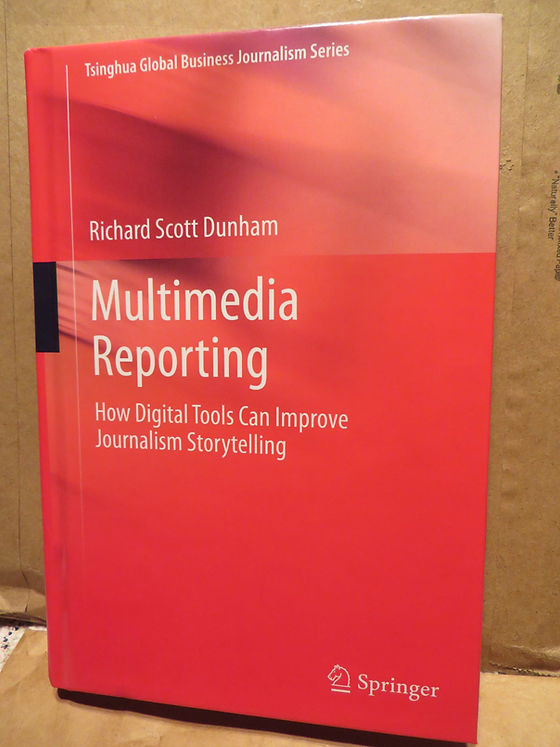
Rick Dunham is co-director emeritus of the Global Business Journalism program at Tsinghua University and a visiting professor in the Tsinghua School of Journalism and Communication. He is the author of the textbook, “Multimedia Reporting,” published globally by Springer, and co-editor of “The Routledge Companion to Business Journalism.”
Mr. Dunham is a veteran Washington journalist, White House correspondent and former president of the National Press Club. He also served as Washington bureau chief of the Houston Chronicle and White House correspondent for Business Week magazine.
Mr. Dunham has offered news analysis for news outlets from countries including the United States, China, Finland, the Philippines, Denmark, Estonia and Russia. He has trained professional journalists, journalism students and journalism educators in locations including the United States, China, Finland, the Netherlands, Hong Kong, Lebanon and the Philippines.
How to nail data journalism with compelling storytelling
Posted: October 17, 2026 Filed under: Journalism Training, Rick's Rules | Tags: audience, Data Journalism, data visualization, SEO, storytelling, writing Leave a comment
By RICK DUNHAM
In today’s digital landscape, data journalism stands as a powerful tool in uncovering truths, engaging audiences, and informing the public. However, presenting data merely as numbers and charts can often lead to dry content that fails to resonate. Effective storytelling in data journalism transforms raw data into compelling narratives that capture attention and inspire action.
Here are some of the essential elements that make storytelling an effective tool in the realm of data journalism.
Understanding the data
The first step in crafting a story from data is to deeply understand the information at hand. This means not just knowing the figures but also grasping their implications and the larger context. Analyzing the data helps in identifying patterns, trends, and anomalies.
When you understand your data, you’re better equipped to explain what it reveals. Think of the journey your readers will take: you want to guide them through the maze of numbers and lead them to meaningful insights.
The power of visuals
Incorporating visuals such as charts, graphs, and infographics can significantly enhance your storytelling. A visual representation can often convey complex data more effectively than paragraphs of text. By integrating visuals, you allow your readers to see the story in a different light, engaging them on both a visual and intellectual level.
Make sure your visuals are clear, relevant, and accurately represent the data. Avoid clutter by focusing on one main idea per visual. A well-designed infographic can distill comprehensive information into digestible bites, allowing the reader to grasp key points quickly.

Finding the human element
One of the most effective storytelling techniques in data journalism is connecting numerical data to real-world human experiences. Data can often seem impersonal, but tying statistics back to individuals or communities makes the data relatable and emotionally engaging.
Consider interviews or testimonials that illustrate the human impact behind the numbers. For instance, a data-driven story about unemployment rates can be strengthened by including personal narratives of individuals who have faced those challenges. Fictionalizing the data with real-life contexts creates a bridge between the cold hard facts and the reader’s heart.
Identifying and crafting a narrative arc
Every good story has a beginning, middle, and end. In data journalism, it’s important to structure your narrative effectively. Start with a compelling hook that draws in your audience and piques their curiosity. This could be an intriguing statistic or a provocative question.
Once you’ve captured their attention, delve into the data, presenting it in a logical flow. Use subheadings, bullet points, and concise paragraphs to make the information easily digestible. Finally, conclude with a powerful ending that reinforces your main message and leaves a lasting impression.
The role of context
Providing context is critical in helping readers understand the significance of the data you’re presenting. Data doesn’t exist in a vacuum; it is affected by numerous factors that shape its meaning.
For example, when reporting on climate change statistics, contextualizing the data with historical trends, related policies, and current events can enrich the story. Ensure you clarify why the data matters and how it relates to broader societal issues.
Engaging your audience
To maintain reader engagement, consider incorporating interactive elements wherever possible. Think about ways to invite the audience to participate, be it through comments, social shares, or surveys about their reactions to your data.
Asking questions can encourage readers to engage with the material more actively. For example, “What do you think about this trend?” or “Have you experienced something similar?” can motivate audience interaction and foster community discussion around your story.
SEO considerations
In the digital era where content is constantly competing for attention, it’s essential to make your posts search-engine optimized (SEO). Use relevant keywords naturally within your content to enhance visibility.
This includes incorporating terms related to data journalism within headings, subheadings, and body text, but remember to maintain the flow of the narrative. The goal is to inform and engage your readers while also making it easier for them to discover your work online.
Data journalism storytelling
Effective storytelling in data journalism is about connecting with your audience on a deeper level, making complex data understandable, and infusing human experiences into statistics. By mastering narrative techniques, embracing visuals, and providing context, you can transform ordinary data reporting into compelling stories that resonate with your readers.
As you continue your journey in data journalism, remember: the magic is not just in the data itself, but in how you tell the story. Strive for clarity, empathy, and engagement, and watch as your data-driven narratives captivate and inform your audiences.
Best practices in multimedia journalism: NY Times video on ‘Dreamers’
Posted: September 6, 2017 Filed under: Journalism Training, U.S. politics | Tags: best practices, DACA, Data Journalism, data visualization, Donald Trump, DREAM Act, Dreamers, immigration, journalism best practices, New York Times, storytelling, video storytelling Leave a commentAs a professor of multimedia journalism, I tell my students about the importance of clear, concise storytelling — in whatever medium they choose. The New York Times has been leading the news industry in its use of multimedia platforms, from data visualization to videos that complement text stories.
This September 5, 2017, video was posted in the immediate aftermath of the Trump administration’s decision to end the so-called “DACA” program that protected children brought illegally into the United States from the threat of immediate deportation. Look at its production qualities. People speaking into the camera, stating their personal stories. The camera is the storyteller. There is a minimum of text on the screens. The storytelling is spare. And powerful.
Take a look.
https://static01.nyt.com/video/players/offsite/index.html?videoId=100000005403642
Experimenting with data visualization: Here are some interactive graphics I have developed
Posted: April 19, 2015 Filed under: Global Business Journalism, Journalism Training, U.S. politics | Tags: 2016 presidential race, Baidu, Ben Carson, British Pound, Chinese RMB, Chris Christie, Data Journalism, data visualization, Euro, GBJ, Global Business Journalism, interactive graphics, Japanese Yen, Journalism Training, multimedia graphics, Paul Ryan, Russian Ruble, Scott Walker, Silk, Swiss Franc, Ted Cruz, Tsinghua University, US Dollar, Zhang Sihan Leave a comment
Teaching Data Journalism at Tsinghua. (Photo by Zhang Sihan)
As part of the new Data Journalism course I have created for the Global Business Journalism Program at Tsinghua University, I am experimenting with data visualization platforms. Here are a few examples. (If my WordPress blog platform will not allow you to open the embedded graphics, you can click on the links to take you to the pages where you can view them.)
I’d love to get your feedback … and some suggestions on platforms that could be useful for data viz projects.
THE VALUE OF THE U.S. DOLLAR OVER THE PAST DECADE PLOTTING AGAINST SIX INTERNATIONAL CURRENCIES
FROM SILK:
FROM SILK:
http://goo.gl/JVSGLH
THE 2016 REPUBLICAN PRESIDENTIAL FIELD: A SAMPLING OF AN UNFORMED CONTEST
FROM BAIDU VIZ PRODUCT:
http://tushuo.baidu.com/p.php?p=dta8dmpds8hkvksww


Recent Comments