Global Business Journalism students are improving the quality of journalism in China and around the world
Posted: July 12, 2015 Filed under: Global Business Journalism, Journalism Training, Rick in the news | Tags: Bank of America, Barrows Dunham, Bloomberg News, CCTV, China, China Daily, Chinese economy, commencement, Data Journalism, Global Business Journalism, graduation, Hang Min, House Un-American Activities Committee, ICFJ, International Center for Journalists, Jin Jianbin, Lee Miller, multimedia journalism, Radio Beijing, Red Scare, Shi Anbin, Tsinghua University, Xinhua, Zhang Sihan Leave a comment
A talented group of global journalists, including the first graduates from Nepal, Jamaica and Ukraine.
I am so excited about the opportunities I have had in China to work with journalism students — both international and Chinese — and professional journalists to improve the caliber of reporting and writing in China, and to prepare us all for the Brave New World of journalism in the Digital Age. Here is a transcript of my speech at the July 10 commencement of the Tsinghua School of Journalism and Communication Global Business Journalism Program.
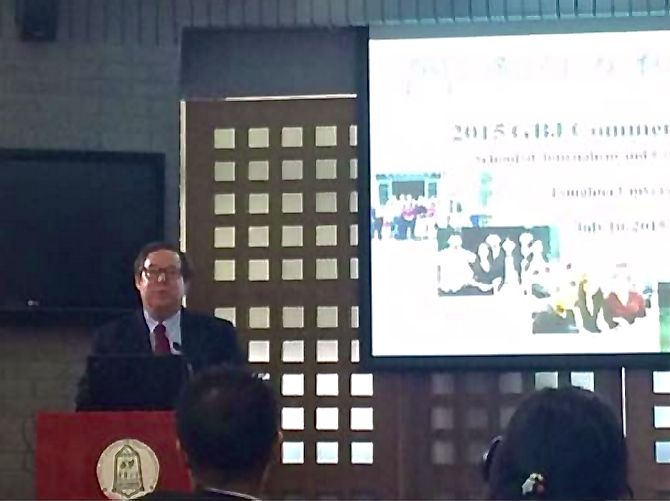
Speaking to the 2015 graduating class of the Global Business Journalism Program at Tsinghua University.
I am honored, on behalf of the faculty of the Global Business Journalism Program, to congratulate you on your successful completion of graduate studies at the Tsinghua School of Journalism and Communication graduation.
It indeed has been an adventure – a voyage of discovery – for all of us. You represent the best of China and the best of the world.
Over the past eight years, students from more than 50 countries have studied together, worked together, gotten to know each other here in the Global Business Journalism Program at Tsinghua University. Ours is a vibrant tapestry of cultures and ideas. You have been exposed to new perspectives, whether they are from the minds of brilliant Chinese professors or veteran international journalists who have plied their trade at the highest levels in the United States and around the world. All of us have gained a better understanding of the rapidly changing world we are inheriting, the rise of China and the rapid transformation of its economy, the complicated dynamics of our interdependent global business world, the rapid transformation of our own world of journalism and the imperative to learn new multimedia and data skills to compete in the emerging journalism marketplace. You have been tested with rigor. You have passed the test. I am so proud of you.
Eight years ago, the Global Business Journalism Master’s Degree Program was just a dream, an idea conceived by some exceptionally creative souls at Tsinghua University in Beijing and at the International Center for Journalists in Washington. In just a few years, it has gained tremendous respect throughout China and around the world, attracting renowned international scholars and Pulitzer Prize winning journalists to work with our students and share their wisdom and their skills.
From the beginning, the GBJ program has been nurtured by the invaluable and incalculable support of Bloomberg News, with its unprecedented gift of ten of its priceless terminals, a series of guest lecturers and events, and a wonderful faculty member named Lee Miller.

One of Tsinghua’s finest, Zhang Sihan, is heading to Columbia University to pursue a dual master’s program in journalism and public policy.
And special thanks to my partner in the program, Dr. Hang Min, for her support, her wisdom and her guidance in making the GBJ program an invaluable resource for global journalism. Under her leadership, we have offered some of the most advanced classes in communication theory, as well as practical, advanced skills that will help our graduates succeed in their chosen field of endeavor, whether that be global business journalism, business, journalism, or something else somewhere on this globe.
By setting exacting standards and requiring rigorous coursework, the GBJ Program has helped to improve business journalism in China by training a new generation of highly qualified journalists specializing in economics and business. Our Chinese graduates now work at some of the most important media outlets in China, such as China Daily, Xinhua News Service, CCTV, and Radio Beijing, as well as at important international media outlets such as Bloomberg News.
That is a testament to the quality of our alumni. It also is a testament to the iron will of friends in the Tsinghua School of Journalism and Communication who have exhibited an unwavering commitment to our success and our continuing growth. Dr. Shi Anbin has been a champion of our cause and a special mentor to me as a newly minted college professor. Thanks, Dean Shi, for everything you have done to make GBJ what it is today, and thanks to Dr. Jin Jianbin and other school officials for their support.
Of course, as all of us know in business journalism, you can’t have an entrepreneurial venture without some venture capital. I would like to thank our founding sponsor, Bank of America, for its steadfast commitment to the program since 2007.
I would like to close by quoting from my favorite philosopher, who happens to be my grandfather, Barrows Dunham. Despite a turbulent professional career that included an unwelcome appearance before the U.S. House Un-American Activities Committee and a spot on the American blacklist during the Red Scare Era of the 1950s, my grandfather, a distinguished philosophy professor and internationally acclaimed author, never lost his sense of patriotism or optimism.
“Even now,” he once wrote, “we ourselves are determining the future, not by knowing what it will be, but by conceiving what it can be.”
None of us know what the future will hold. But with the knowledge we have gained at Tsinghua, the support of our families – and, yes, the Global Business Journalism family – we can conceive that better future.
Congratulations to the Tsinghua Global Business Journalism graduating class. Good luck to all of you. Thank you.
Pulitzer Prize winner Ken Herman encourages Tsinghua journalism students to ‘try different things’
Posted: May 14, 2015 Filed under: Breaking news, Global Business Journalism, Journalism Training, U.S. politics | Tags: Austin, Austin American-Statesman, Beijing, Data Journalism, Forbidden City, George W. Bush, Global Business Journalism, Journalism, journalism education, Journalism Training, Ken Herman, multimedia journalism, Pulitzer Prize, Sharon Jayson, social media, Texas, Tiananmen, tourism, Tsinghua University, U.S. Congress, U.S. military, USA Today Leave a comment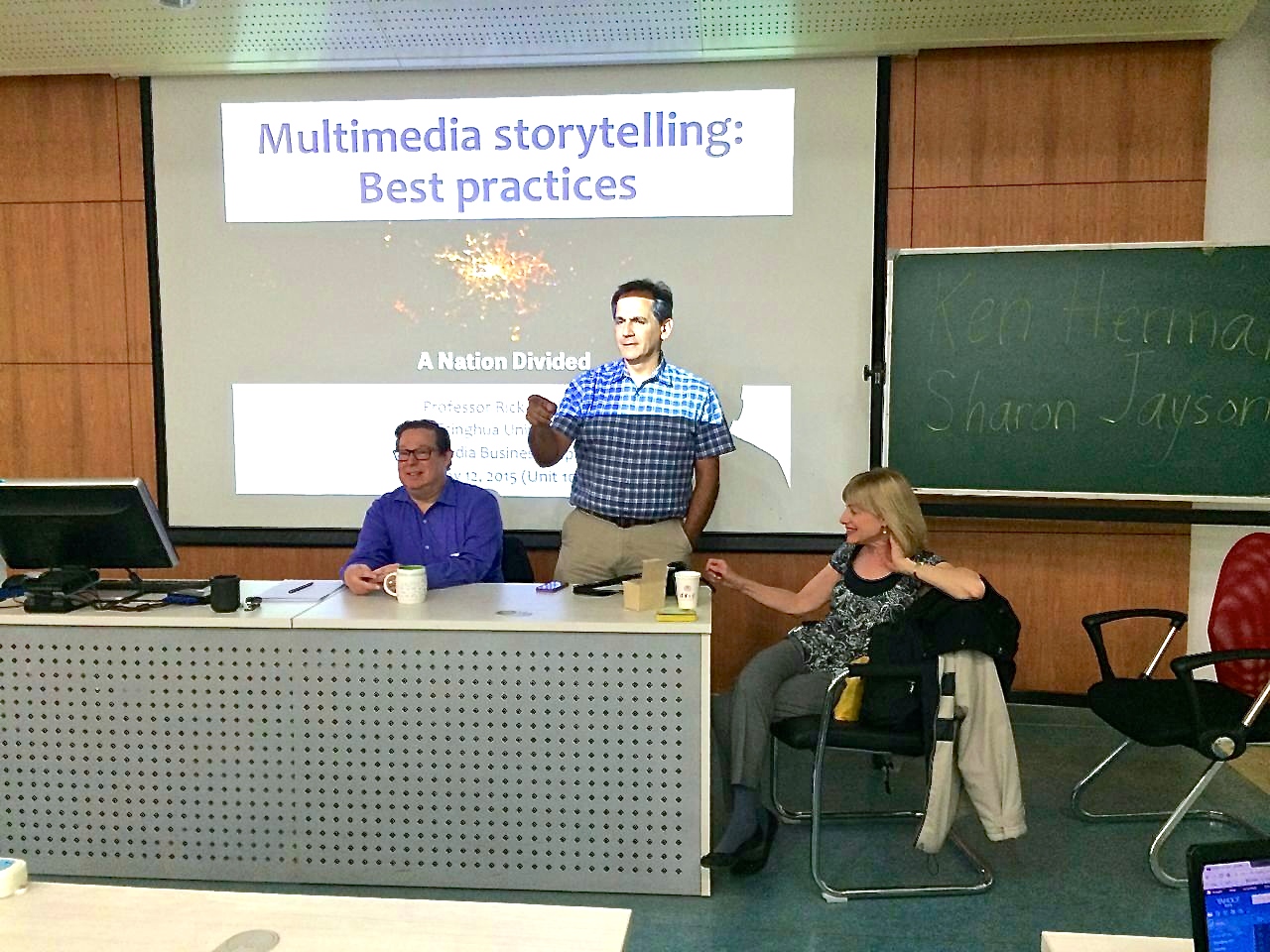
Ken Herman (center) talks to Global Business Journalism Program students, flanked by Rick Dunham (left) and Sharon Jayson (right).
Pulitzer Prize-winning journalist Ken Herman encouraged students in Tsinghua University’s Global Business Journalism Program to experiment with the many new technological tools available to today’s reporters.
“Try different things,” Herman, a columnist at the Austin American-Statesman in Texas, said in a lecture on May 12. “Don’t be afraid to fail. Keep trying and you’ll get better.”
Herman and his wife Sharon Jayson, a longtime reporter for USA Today, spoke to Professor Rick Dunham’s Data Journalism and Multimedia Business Reporting classes at the Tsinghua School of Journalism and Communication. They told the stories of their award-winning journalism careers and advised students to master traditional news writing, audio, video and social media.
Jayson’s three-decade career has included stints as a television news reporter and anchor, a radio station reporter, a radio network Austin bureau chief and a newspaper journalist in Washington and Austin.
“I love journalism,” she said. “I’m glad to go to work every single day.”
Herman, who covered George W. Bush both during his days as governor of Texas and president of the United States, won the Pulitzer Prize for Public Service in 1977 for a series of stories in the Lufkin (Texas) News investigating the death of a young recruit in the U.S. military. The series led to congressional hearings and changes in American military recruiting practices. For the past six years, he has written a newspaper column that sometimes covers serious policy topics and often uses humor to make his points.
“I feel it is important to tell people what is going on in their government – or just entertain them,” he said.
Herman was one of the first print reporters to supplement his reports with multimedia elements such as video and audio. He said that some of his early efforts at video journalism were “pretty bad.”
“Make mistakes,” he said. “I certainly did. But you’ll learn how to do it and you’ll get better.”
Jayson, who specialized in coverage of younger Americans and human relationships during her decade at USA Today, said she knew she wanted to be a reporter from the age of 12, when she worked on a newspaper at her school. She encouraged the students to follow their passion in life, like she did, even if it does not lead to material wealth.
“Don’t just accept something because you think you’re going to get rich,” she said.

Ken and Sharon in Tian’anmen Square, with the Forbidden City in the background.
Ten tips to improve your news photography from a two-time Pulitzer Prize winner
Posted: April 22, 2015 Filed under: Global Business Journalism, Journalism Training, Rick's Rules, Top Ten | Tags: Burkina Faso, child labor, Data Journalism, eBook, Eiffel Tower, Fort Worth Star-Telegram, Gaelle Patricia Chekma, Global Business Journalism, gold mining, Journalism Training, Larry C. Price, Larry Price, Matt Haldane, multimedia journalism, Paris, Philadelphia Inquirer, Philippines, photo composition, photo tips, photography, Pulitzer Center, Pulitzer Center for Crisis Reporting, Pulitzer Prize, Tarnished, Top Ten, Tsinghua University Leave a comment
Larry Price spoke to Global Business Journalism Program students on April 21. (Photo by Gaelle Patricia Chekma)
Every year, the Pulitzer Prizes celebrate some of the world’s best journalism. Just hours after the 2015 Pulitzer winners were announced, my Global Business Journalism Program was fortunate to play host to a two-time recipient of the Pulitzer Prize for photography. Larry C. Price, a University of Texas graduate who won the Pulitzer while working for the Fort Worth Star-Telegram and the Philadelphia Inquirer, dazzled my Multimedia Reporting and Data Journalism students with tales from his latest project, a multi-year investigation into the use of child labor in gold mining. His work — entitled “Tarnished” — was published in eBook form by the Pulitzer Center for Crisis Reporting.
Here are ten tips I culled from Larry’s lectures and the subsequent Q-and-A period. They are not a definitive list of “ten top tips.” They are just a collection of tips that I hope will be useful as you attempt to improve your photographic skills.

One of the many vivid photos from “Tarnished.” This is from Larry Price’s trip to a gold mining area of Burkina Faso.
1. Always remember that you’re a storyteller.
Whatever publishing platform you’re on, and whatever visual medium you’re using, journalism is always about one thing. “It’s all about the stories,” Larry says. “Stories are as old as language. They’re everywhere. And journalism tells them.”
2. Look for something new — or a new take on an old image.
“Find something that hasn’t been done,” Larry says. “Or find a different spin on it.”
He says colleagues have sometimes discouraged him from shooting certain images, saying, “it’s been done.”
“My response is, ‘I haven’t done it,'” he says. “If somebody’s told the story, tell it differently.”
His example: a recent trip to Paris and a photo shoot at the Eiffel Tower.

The eBook “Tarnished” is available online from the Pulitzer Center for Crisis Reporting.
3. Get up early. Stay late.
Larry doesn’t use artificial lighting. As a result, he is looking for the best natural light available. “If you want your multimedia productions to look good, shoot them early in the morning or a few minutes before sunset,” he says.
That means long days of work and short nights of sleep.
4. Get close.
Every photographer has her or his own signature. For Larry, it’s close-ups. “I love tight facial portraits,” he said. “Force yourself to get close.”
Another favorite subject for his close-ups: “Hands and feet. That’s what it’s all about.”
5. Get personal.
To make a subject comfortable with you — especially if you are going to shove your camera into their face — is to develop a personal relationship with them. “I spend a lot of time getting rapport established before I take out a camera,” Larry says. “I develop that rapport so it doesn’t get uncomfortable to your subject.”
Of course, you can’t always do this when news is breaking, but it can help improve your image if you have a bit of time to prepare.
6. Keep shooting.
“When I’m in the field, it’s constant activity,” Larry says. “Digital allows you to shoot, review, delete a lot.” Don’t let your guard down when you’re on duty: You never know when the next great photo opportunity might come. “You can’t ever relax,” he says. “It’s a never-ending cycle of feeling guilty.”
On his most recent trip to Burkina Faso, Larry returned with 37,000 frames. “I always have a lot of failures,” he notes. “I shoot a lot of pictures.”
7. Minimize your vertical shots.
Horizontal photographs work best on digital platforms, whether that’s a mobile device or a computer. And if you’re taking video, make sure it’s horizontal. “Never shoot vertical video,” warns Larry. “It’s useless. Half your space is wasted.” He rarely takes vertical stills, except for portraits. But he likes the square format popularized by Instagram. “Square is a very good portrait format — a little more artsy,” he says.
8. Stay natural.
Great photographers don’t cheat with editing programs that alter reality. “I don’t do a lot of Photoshop with my pictures,” he said. “I don’t exaggerate the colors or anything.”
9. Take good notes.
You need to have the spelling of names, correct ages and the locations of cities or villages. Larry always uses two notebooks. He also records the GPS coordinates of everything.
10. One old-fashioned photo composition rule.
“Don’t ever put people in the middle of the frame,” he says.

Matt Haldane has a front row seat for Larry Price’s lecture at Tsinghua.
Experimenting with data visualization: Here are some interactive graphics I have developed
Posted: April 19, 2015 Filed under: Global Business Journalism, Journalism Training, U.S. politics | Tags: 2016 presidential race, Baidu, Ben Carson, British Pound, Chinese RMB, Chris Christie, Data Journalism, data visualization, Euro, GBJ, Global Business Journalism, interactive graphics, Japanese Yen, Journalism Training, multimedia graphics, Paul Ryan, Russian Ruble, Scott Walker, Silk, Swiss Franc, Ted Cruz, Tsinghua University, US Dollar, Zhang Sihan Leave a comment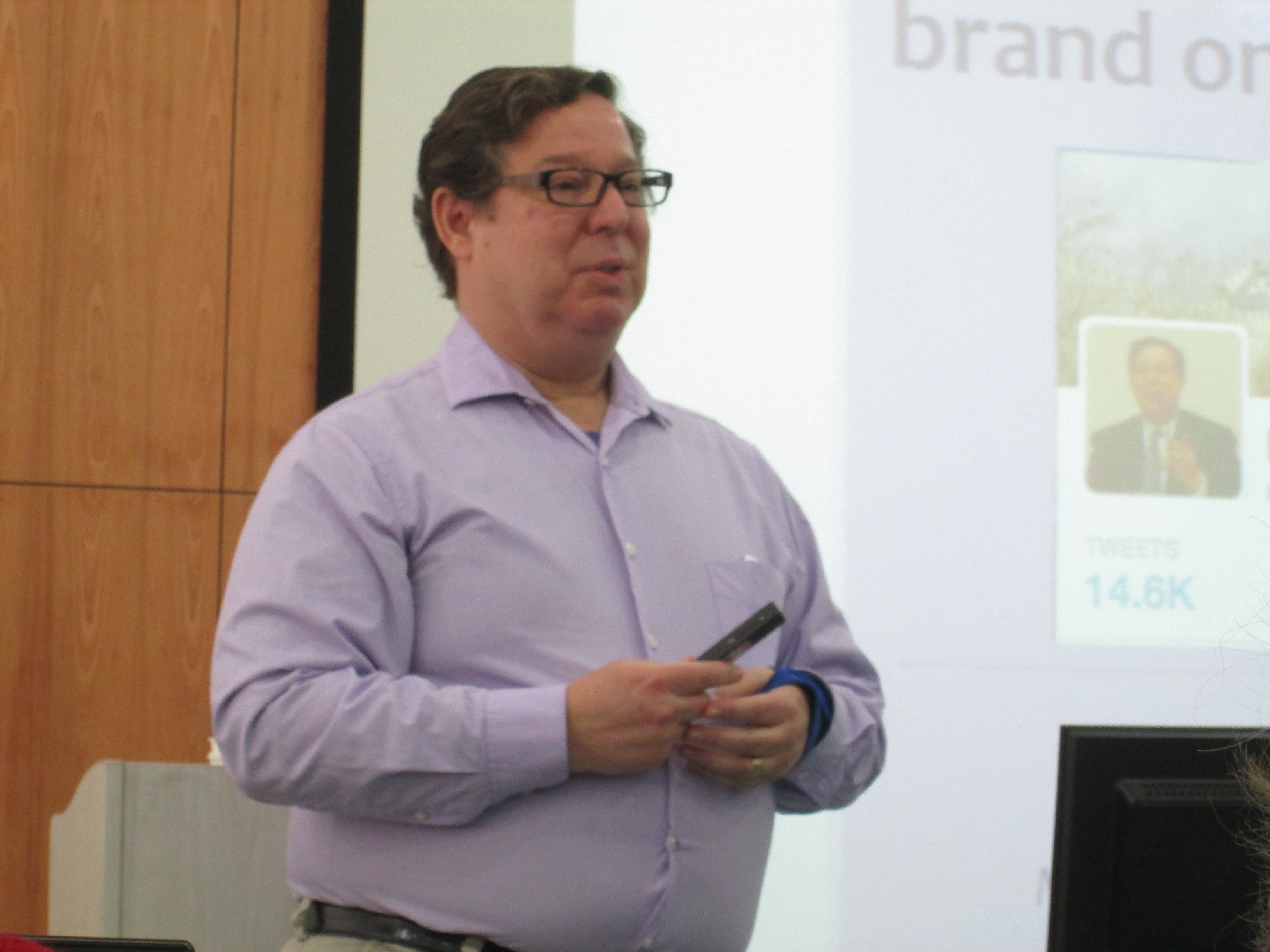
Teaching Data Journalism at Tsinghua. (Photo by Zhang Sihan)
As part of the new Data Journalism course I have created for the Global Business Journalism Program at Tsinghua University, I am experimenting with data visualization platforms. Here are a few examples. (If my WordPress blog platform will not allow you to open the embedded graphics, you can click on the links to take you to the pages where you can view them.)
I’d love to get your feedback … and some suggestions on platforms that could be useful for data viz projects.
THE VALUE OF THE U.S. DOLLAR OVER THE PAST DECADE PLOTTING AGAINST SIX INTERNATIONAL CURRENCIES
FROM SILK:
FROM SILK:
http://goo.gl/JVSGLH
THE 2016 REPUBLICAN PRESIDENTIAL FIELD: A SAMPLING OF AN UNFORMED CONTEST
FROM BAIDU VIZ PRODUCT:
http://tushuo.baidu.com/p.php?p=dta8dmpds8hkvksww
Why you should join the Global Business Journalism Program at Tsinghua — or recommend it to a friend
Posted: December 29, 2014 Filed under: Global Business Journalism, Journalism Training | Tags: Beijing, Bloomberg News, China, Data Journalism, Global Business Journalism, Hang Min, International Center for Journalists, multimedia journalism, Olivia Zhou, Tsinghua University 1 Comment
Our 2014 graduating class
To all of my journalism friends around the world: I invite you to spread the good word about the good work we are doing here at Tsinghua. We’re looking to recruit an exceptional class of graduate students for the upcoming school year and to prove to any skeptics that you can have a world-class journalism program in China. Here’s the pitch. Feel free to share. Comments and questions are welcome.
Are you interested in becoming an expert on the world’s fastest-growing economy?
Do you want to study Asia Pacific business development and report that to the world?
Do you want to have an amazing educational and personal experience in a dynamic country?
Do you want to learn how to share your stories with audiences via print, audio, video and digital media?
Please join in us in the Global Business Journalism Master’s Degree Program at Tsinghua University in China!
2015 Enrollment Instructions
for M.A. in Global Business Journalism
at the School of Journalism and Communication, Tsinghua University, Beijing, China
- Introduction
With China playing a central role in the global economy, there is a soaring demand for trained professionals who can understand the exciting, complicated development of the world’s fastest-growing economy – and can explain it – clearly and in depth — to audiences in China and around the world.

Co-Director Dr. Hang Min with GBJ student
Tsinghua University Master of Arts degree in Global Business Journalism is designed to meet that growing need. The program offers international students the opportunity to master the fine points of business, finance and economics in China. All courses are taught in English — the international language of business — by internationally renowned scholars and accomplished journalists with extensive global experience. The program’s facilities rival those of other leading journalism schools worldwide. The news lab has the largest number of Bloomberg terminals of any college in the world.
Business journalism is one of the fastest growing areas of employment opportunities in the industry today. News audiences are eager to learn about the world of business, while media departments expect PR professionals to understand and analyze the complexities of business issues.
Tsinghua’s Master of Global Business Journalism Program is designed to offer you the opportunity to meet these growing needs and, at the same time, master the fine points of economics, finance and business in China and the world. We welcome you to join in us!
The first English-language graduate business journalism program on the Chinese mainland, created in partnership with the International Center for Journalists, it has sent 171 graduates to news outlets in China and globally over its first seven years.
Launched in 2007, the GBJ program has already been recognized by students and recruiters alike as a world-class program. Academe, the world’s leading journal on higher education, featured a cluster of articles on the program in February 2008. Only the most talented applicants from around the world are accepted, and the student body is culturally and professionally diverse. The full-time program spans two years of intense, fast-paced, rewarding study. Those who complete it successfully emerge with valuable connections, a rich array of opportunities and the business and journalism skills to capitalize on them. It is a two-year experience that will last a lifetime.
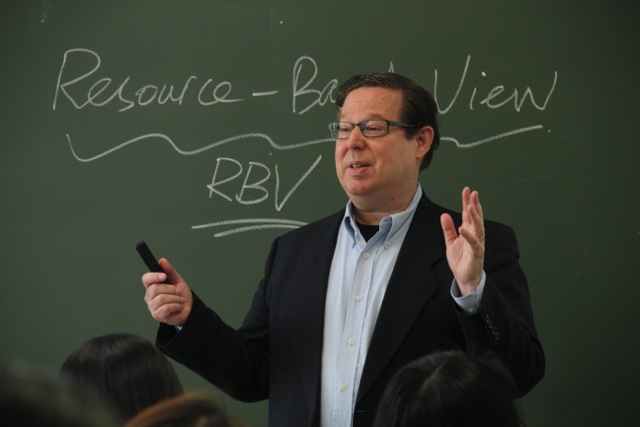
Professor Dunham in the classroom at Tsinghua. (Photo by Zhang Sihan)
The program aims to bring business journalism in China in line with top international reporting standards. The Tsinghua School of Journalism and Communication has a long history of cooperation with major international media and financial-information organizations, and visiting scholars have come from outlets such as Bloomberg, Reuters, Business Week, The New York Times, Financial Times, The Washington Post and CNN.
GBJ offers an array of specialized courses that are at the forefront of global business journalism. Students can learn about international accounting standards, multimedia journalism, data mining, complex financial derivatives, journalism ethics, advanced feature writing techniques and the management of media organizations – knowledge that is transferable to other economies and other professions. At the same time, they gain a deeper knowledge of the Chinese language and economy.
The GBJ program benefits from other academic resources on the Tsinghua campus, including its prestigious School of Economics and Management, as well many Chinese and global media and technology companies in Beijing. Internships, field trips and recruiter visits are integral parts of the program.
GBJ students have opportunities to attend conferences on new media, economic development and other business topics. They benefit from meetings and discussions with guest speakers, including top editors and reporters from leading Chinese and Western news outlets and international business executives. The GBJ has a growing network of smart, sophisticated reporters, editors and public relations professionals who can enhance the world’s understanding of economic and corporate developments in China and globally.
- Program Courses
| Basic Courses | |
| Introduction to Mass Communications and Society in Contemporary China | |
| Chinese Language | |
| Intercultural communication | |
| Media Research Methods | |
| Core Courses | |
| English Financial News Reporting and Writing | |
| Multimedia Business Reporting | |
| Global Business Journalism (advanced) | |
| Economics and Accounting Basics for Journalists | |
| Business Data Mining and Analysis | |
| Elective Courses | |
| Corporate Communication | |
| Opinion and News Commentary | |
| Hot topics in the Global Economy | |
| Feature Writing | |
| Corporate Strategies, Case Studies of Chinese and Global Companies | |
| Personal Finance Reporting | |
| Media Management | |
| Workshop on Film and TV Production | |
| Theory and Practice of Public Diplomacy | |
| Data Journalism | |
| Public Relations: An Introduction | |
| Public Speaking | |
| Other Requirements | |
| Pro-Seminar for Master Candidates in Global Business Journalism | |
| Literature Review and Thesis Proposal | |
| Academic Activities | |
| Internship | |
- Qualification of Applicants
Applicants should have a Bachelor’s degree in related fields and certificate for English proficiency.
- Application Documents
1) The completed Foreigner’s Application Form for Admission to Graduate Programs of Tsinghua University with a 2-inch recent photo, signed by the applicant;
2) Statement of Purpose and resume;
3) The original or the notarial degree certificate or proof of education at an academic institution (you need to submit an original or notarial degree certificate after it was awarded) and an academic transcript. The degree certificate and academic transcript must be officially sealed.
4) Two academic recommendation letters from scholars of associate professorship or higher. They must show referee’s phone number and email address on the letter.
5) For non-English speaking students, please provide English level certificates. e.g. TOEFL, IELTS, etc.
6) A copy of your passport page with personal information (personal and ordinary passport);
7) The completed Application Form for Tsinghua University Scholarship (if applicable, original);
8) A non-refundable application fee of RMB600.
The certificates provided should be the original documents in Chinese or in English, otherwise notarial translations in Chinese or English are required. None of the above application documents will be returned.

Some of the best students from China and around the world.
- Application Procedure
Step 1: Online Application
Complete Online Application on the website of the Foreign Student Affairs Office, Tsinghua University
(http://www.is.tsinghua.edu.cn/EN/online-application/instruction.html). Print and sign the Application Form produced by the system after the application status changes to “verified.”
Step 2: Documents Submission
Submit the application documents listed above to the address indicated below by post mail or in person.
Step 3:Application Fee Payment
There are two ways to pay application fee:
1 . Pay online using a credit card;
After your online application form is verified or the materials are received by Tsinghua University, the staff will make you the online payment draft, and at the same time, an email will be automatically sent out to remind you to pay the application fee via the online application system.
2 . Pay in cash at the Foreign Student Affairs Office (Room 120, Zijing Building 22) on the campus of Tsinghua University.
- Application Deadline
November 1, 2014 — March 20, 2015
Both the Online Application and a complete set of Application documents should be completed and the package should be received by March 20, 2015.
- Tuition and Scholarship
Tuition:Program tuition fee is RMB39000/year.
Accidental Injury and Hospitalization Insurance: RMB 600/year.
Please visit http://is.tsinghua.edu.cn for more information about scholarships.
- Program Website:
For more information about the program, please visit the GBJ website at:
http://gbj.tsjc.tsinghua.edu.cn/publish/jcgbj/index.html
- Application Website:
For an application, please visit the Application Website at:
http://www.is.tsinghua.edu.cn/EN/online-application/instruction.html
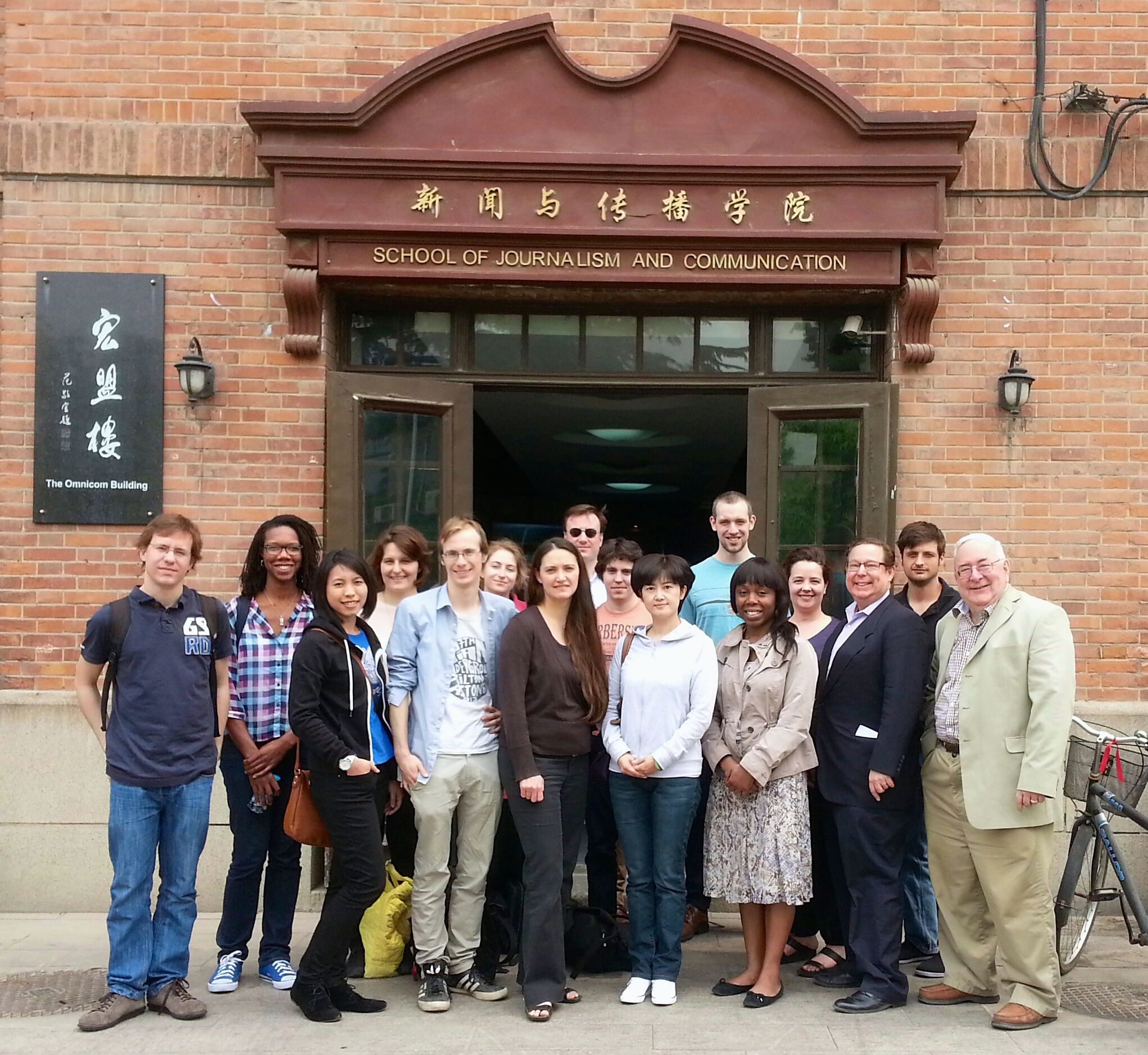
We regularly host international scholars, lecturers from global businesses and exchange students.
10.Contact Information:
Ms. Olivia Xiaoyu Zhou
Room 302, Omnicom Building,
School of Journalism and Communication
Tsinghua University,
Beijing 100084, P. R. China
Tel: +86 10 6279 6842
Fax: +86 10 6277 1410
E-mail: tsjcws@tsinghua.edu.cn
Movie night at Tsinghua: All the President’s Men
Posted: April 28, 2014 Filed under: Dunham's Discourses, Global Business Journalism, Journalism Training, U.S. politics | Tags: All the President's Men, American politics, Arthur Bremer, Bay of Pigs, Ben Bradlee, Bob Woodward, Bobby Kennedy, Carl Bernstein, Central High School, Chappaquiddick, China, CIA, CIA scandals, CREEP, Deep Throat, Democratic National Committee, Dustin Hoffman, Edmund Muskie, FBI, Fidel Castro, George McGovern, George Wallace, John F. Kennedy, John Mitchell, Katharine Graham, Kennedy assassination, Mark Felt, National Press Club, Pam Tobey, Pentagon Papers, Richard Nixon, Robert Redford, Teddy Kennedy, Tom Eagleton, Tsinghua University, Vietnam War, Washington Post, Watergate, White House 6 Comments
An exact replica of the Washington Post newsroom was built in Hollywood.
I held my first “movie night” for my Chinese journalism grad students on Sunday night. After considering a few journalism-related classics (you can probably guess which they are), I chose one that highlights the best of journalism: “All the President’s Men.” It’s not just a journalism movie, of course. It’s a great detective story and an all-around outstanding movie with crisp writing, superb acting and tension-inducing directing. “All the President’s Men” is important journalism history. It’s also important American history. But I discovered as I played the video that many of the uniquely American topics (and 1970s cultural norms) contained in the movie were difficult to understand for my Tsinghua University students. So, in addition to playing the movie with English subtitles (do you realize how quickly Dustin Hoffman speaks, with that nasal accent of his?), I occasionally paused the movie for verbal annotations. Here are some of the important points I needed to explain to the students:
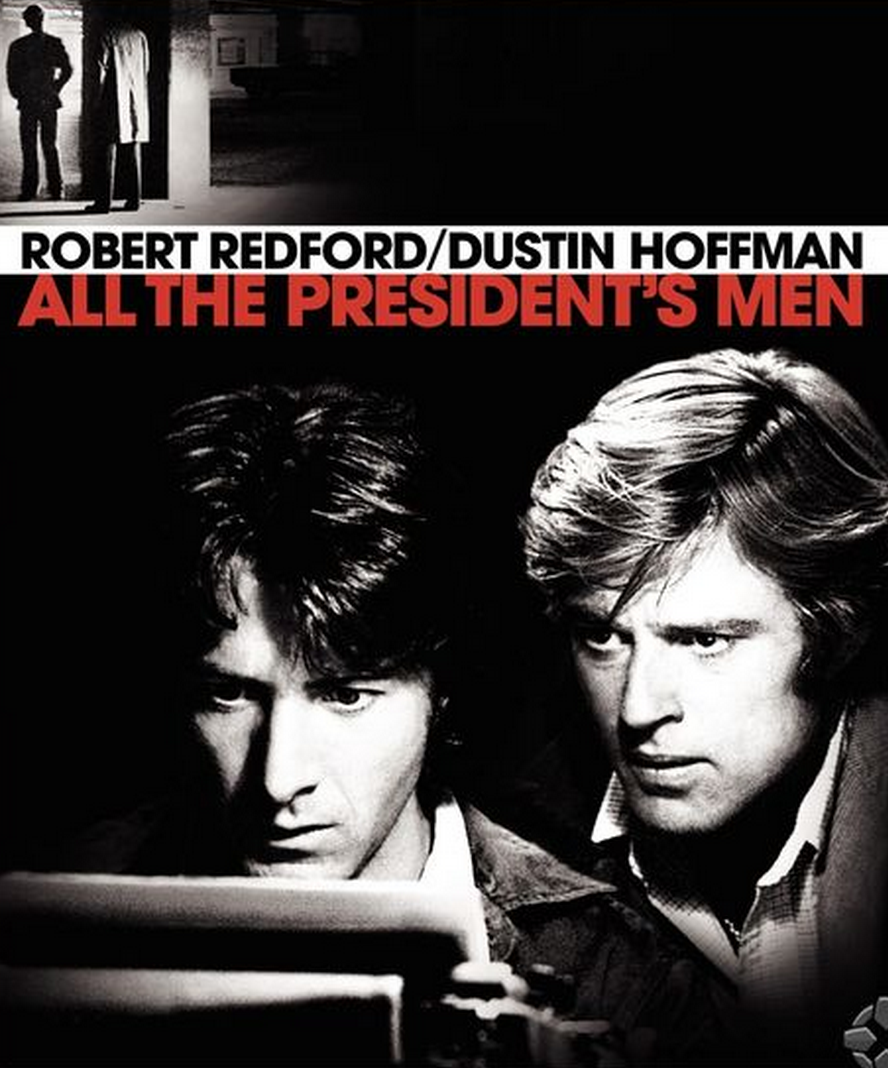
What is that machine those actors are using? And who is Robert Redford?
Newspaper references:
- Why Ben Bradlee and many American journalists curse a lot
- How Ben Bradlee cursed on live national TV when I hosted him as a speaker at a National Press Club luncheon in 2005
- What kind of a boss Ben Bradlee was to my wife Pam Tobey
- Who Deep Throat was and what motivated him to leak
- Where the real Bob Woodward/Mark Felt garage was located
- How the movie’s producers created a replica of the Washington Post’s newsroom in Hollywood for the movie — and the Post newsroom looked exactly the same when my wife Pam began working there in 1984
- Why reporters call the targets of their stories for comment before publishing the story
- Why it was unethical when Carl Bernstein called the secretary in the Miami prosecutor’s office and pretended he was someone he was not
- Why Watergate motivated me (and the entire Woodstein generation) to become reporters
Cultural references:
- Why all of the editors in the Post’s budget meetings were men
- What a manual typewriter is (or was) and why they were all over the newsroom
- Why I took Mrs. Wolin’s typing class at Central High when everybody said that typing was for girls who wanted to become secretaries. (Of course, I wanted to learn to type so I could become a reporter.)
- Who Robert Redford and Dustin Hoffman are
- What the movie “Deep Throat” was about and why Woodward’s editor chose it as a code name for Mark Felt
- What John Mitchell was talking about when he said Katharine Graham would get a certain part of anatomy caught in a wringer
- What a “creep” means and why CREEP became the acronym for the Committee to Re-elect the President
- Why so many people smoked in public spaces
Political references:
- Who John F. Kennedy was and why his photo was in Democratic National Committee headquarters at the Watergate
- The fact that JFK and his brother Bobby were assassinated
- Why the Vietnam War was so unpopular and why American society was torn apart by war, riots and civil rights struggles
- What the Pentagon Papers are
- Richard Nixon’s unique definition of “plumbers”
- Who Daniel Ellsberg is and why he had a psychiatrist
- Who George Wallace and Arthur Bremer were and how Woodward worked with Felt on stories about the Wallace assassination attempt
- Who the anti-Castro Cubans in Miami are
- What the Bay of Pigs is/was
- The long and sordid history of CIA scandals
- Why there is tension between the FBI and the CIA
- Why Nixon hated and feared the Kennedys
- What Chappaquiddick was
- Why George McGovern asked Tom Eagleton to leave the ticket in ’72
- Why Nixon wanted to run against McGovern and not Ted Kennedy or Edmund Muskie
- Why Ed Muskie “cried” in New Hampshire
- What a “Canuck” is
Any suggestions for my next American journalism movie night?
Professor Dunham’s first lecture
Posted: September 20, 2013 Filed under: Global Business Journalism, Journalism Training | Tags: Global Business Journalism, Journalism Training, Tsinghua University Leave a comment


Professor Dunham’s first lecture, a set on Flickr.
My new life is in full swing now. I taught my first multimedia journalism class on Wednesday to my first-year Global Business Journalism students and Tsinghua University’s international journalism students.
The class is big in size and in talent. As a first project, they took photos during the lecture. Here’s their report.
In case you have trouble opening the Flickr slide show in your browser, here’s a direct link:
http://www.flickr.com/photos/95088907@N05/sets/72157635675220655/

 Rick Dunham Blog
Recent Comments