Application for the USA Summer Journalism Training Program
Posted: April 7, 2017 Filed under: Global Business Journalism, Journalism Training | Tags: business journalism, City University of New York, CUNY, GBJ, Global Business Journalism Program, Journalism, journalism education, Journalism Training, Li Chengzhang, top journalism programs, Tsinghua School of Journalism and Communication, Tsinghua University, United States, USA Summer Journalism Training Program, Washington 1 CommentThank you for your interest in the USA Summer Journalism Training Program, organized by Rick Dunham, a veteran of 29 years of Washington journalism experience and co-director of the International Center for Journalists’ Global Business Journalism Program. The two-week program is scheduled to be held in Washington, D.C., from July 24 to August 4, 2017, and is open to university students and recent graduates from China and around the world.
The application form is included in this post. Please copy-and-paste the form and send it via email to the USA Summer Journalism Training Program at SummerProgramDC@gmail.com. You can reach teaching assistant Li Chengzhang at licz15@mails.tsinghua.edu.cn.
- Application deadline: May 31
海外学习短期项目
美国新闻报道夏令营项目申请表
Application form
| 姓名 | Name | 国籍 | Nationality | ||
| 生源地 | Birthplace | ||||
| 本/硕/博 | Bachelor’s/Master’s/Ph.D. | 出生年月 | Date of birth | ||
| 在读学校 | University | 专业 | Major | ||
| 联系电话 | Phone number | 邮箱 | |||
| 是否定向/委培 | 外语水平(种类及成绩) | English language certificate | |||
| 拟毕业时间 | When will you (did you) graduate from your university program? | ||||
| 申请理由:
Please explain the reason why you want to apply to this program: |
|||||
注:请将报名表、个人简历、学生证、外语水平证书的电子版发送至助教邮箱。如有任何疑问,欢迎随时联系助教。邮箱:SummerProgramDC@gmail.com or licz15@mails.tsinghua.edu.cn 电话:+86 13426000951 或 +1(312)468-3257
Note: Please send your application form, CV, English language certificate copy and a photo of your student ID card to SummerProgramDC@gmail.com. If you have any questions, please feel free to contact Teaching Assistant Li Chengzhang at licz15@mails.tsinghua.edu.cn. By telephone: +86 13426000951, +1 (312) 468-3257.
- 费用:
项目费:1500美元
住宿费:600-750美元(由项目方提供统一住宿)
- Estimated costs:
Fees $1,500*
Housing (estimated, double occupancy) $600-$750
Note: Global Business Journalism students and Tsinghua School of Journalism and Communication students are eligible for a scholarship to cover $500 of the costs, making their final fee $1,000.
Note: GBJ and TSJC students who also enroll in the City University of New York Summer Intensive program are eligible for a scholarship to cover $750 of their costs, making their final fee $750.
Note: Visa fee, transportation, travel, meals, insurance are not included.
Note: Housing will be available from Sunday, July 23, to Saturday, August 5.
A completed application does not guarantee acceptance. To guarantee personal attention, the program will have a maximum of 25 participants. Admission is at the discretion of program organizers.
>>> More information on the Global Business Journalism Program
>> More information on the USA Summer Journalism Training Program
>>> Questions? Contact the USA Summer Journalism Training Program by email
>>> More information on CUNY Summer Intensive program
A Pulitzer-winning couple tells GBJ students what it’s like to cover a mass shooting in real time
Posted: March 6, 2017 Filed under: Global Business Journalism, Journalism Training | Tags: Alexis See Tho, Barack Obama, Donald Trump, GBJ, Global Business Journalism Program, Hailey Branson-Potts, Houston Chronicle, Los Angeles Times, Mark Potts, Multimedia Business Reporting, multimedia journalism, New York Times, Oklahoma, Pakistan, Perry Daily Journal, Pulitzer Prize, San Bernardino, Tsinghua School of Journalism and Communication, Tsinghua University 1 Comment
Mark Potts speaks about the L.A. Times’ video editing process for coverage of the San Bernardino shootings at the Tsinghua School of Journalism and Communication. (Photo by Alexis See Tho)
By Alexis See Tho
“It was an organized chaos,” recalled Mark Potts, a video editor at the Los Angeles Times, describing the scene in the newsroom when photographs, videos and Twitter posts poured in from the San Bernardino shootings two years ago.
Potts and his wife Hailey Branson-Potts, who is also a journalist for the L.A. Times shared the drama of covering a breaking news story of global significance with Tsinghua University’s multimedia reporting class. Branson-Potts and Potts were part of the Times team that received the 2016 Pulitzer Prize, the top award in American journalism, for breaking news reporting.
“In the back of your head, you’re thinking, this is what I went to school for. You train and work your whole life so when you get into these situations, you don’t mess it up,” Potts added.
The prize-winning young journalists spoke to Global Business Journalism Program students in Professor Rick Dunham’s Multimedia Business Reporting course on March 1. Branson-Potts worked for Professor Dunham as an intern in the Washington bureau of the Houston Chronicle, where she covered the 2009 inauguration of President Barack Obama, among other national stories.

Professor Dunham uses the coverage of the San Bernardino shootings as a “best practices” case study for using social media in reporting. (Photo by Alexis See Tho)
The December 2015 shootings in San Bernardino, California, made international headlines when 14 people were killed an American man and his Pakistan-born wife. U.S. President Donald Trump has cited the shooting as a reason why he is seeking to restrict immigration to the United States.
Branson-Potts did live reporting on Twitter from the shooting scene, talking to the police and interviewing victims’ family members. And for days she stayed put in San Bernardino to get more information on the ground. It’s important to always be ready for moments like that she said.
“I have a ‘go-bag’ in my car,” Branson-Potts added, where she keeps a pair of jeans, comfortable shoes, make-up and supplies for at least a day.
But there are some areas that cannot be prepared ahead of time and only real-life experiences can be the teacher. Branson-Potts was answering a student’s questions whether news organizations train journalists on how to face situations such as the shooting.
“There’s no psychological training in newsrooms,” said Branson-Potts, who have worked and interned at news organizations such as the New York Times, Chicago Tribune and the
Houston Chronicle.
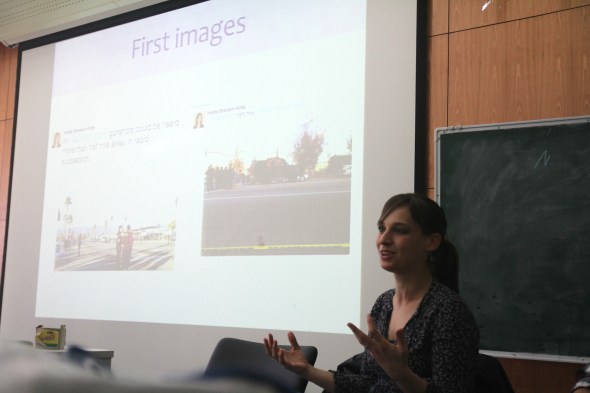
Hailey Branson-Potts explains to the class her first few live tweets from the scene of the San Bernardino shootings. (Photo by Alexis See Tho)
She added that although her editor did ask how she was coping when she was on the ground in San Bernardino for days, the answer would always be “I’m fine.”
“You don’t want to be pulled out of the story,” Branson-Potts said.
Although she has worked for big names in America’s newspaper industry, Branson-Potts’ first taste of the world of journalism came when she was 15 when she worked on the printing press for her hometown newspaper, the Perry Daily Journal, one of Oklahoma’s smallest daily newspapers.
“They only printed 2,000 copies everyday, but it was real experience (for me),” Branson-Potts said. She advised students to find as many opportunities as they could to work in newsrooms.
“When we hire young people at our paper, we don’t care what grades they made at school, we don’t care what classes they took. We care about their resumés and the stories they produced as an intern,” she said.
For shooting and editing videos, Mark Potts’ greatest education came from watching bad movies during his student days while working at a movie theatre.
He added that a journalist’s work attitude is of utmost importance. “I approach things like there’s nothing below me,” he said, “I’ve done videos for subjects that secretly…I don’t want to cover. But I go in there and say, ‘I’m going to make a really good video. I’m going to cover this like I’ve covered the inauguration and a protest.’”
For both of them, they repeat the mantra: There’s no story that you’re too good for.

The Hailey and Mark Show (Photo by Alexis See Tho)
Major shifts in U.S. trade policy make it vitally important to study global business and China’s role in it
Posted: February 2, 2017 Filed under: Global Business Journalism, Journalism Training, U.S. politics | Tags: best business journalism programs, Bloomberg News, business journalism, China, Donald Trump, Global Business Journalism, Global Business Journalism Program, global economy, ICFJ, International Center for Journalists, international trade, master's programs in journalism, National Press Club, New York Times, Sarah Ma, study in China, top journalism programs, trade, Tsinghua School of Journalism and Communication, Tsinghua University, United States Leave a comment
Some of the top international students from the 2016 graduating class.
The global economic order is rapidly changing, and China, with the world’s second-largest economy, is becoming an increasingly important player. As U.S. international and trade policies shift dramatically under a new administration, China is aggressively seeking to bolster its leadership role in the world’s interconnected global economy on trade and other business issues.
If you are interested in pursuing a career in business journalism, now is a great time to study global business in China in the Global Business Journalism Master’s Program at Tsinghua University in Beijing. (Of course, your blog author has a personal stake in this program: I’m co-director.) The extended deadline to apply for admission to the GBJ program is March 20, 2017.
Tsinghua University is the most prestigious university in China, providing a genuine international environment to students from around the world. The Global Business Journalism Program at Tsinghua, founded in 2007, has won international acclaim for teaching global best practices in business journalism and the technical skills needed to succeed in today’s digital news environment.
The program, a partnership between Tsinghua, the International Center for Journalists and Bloomberg News, trains future journalists who can help the public understand the complexities of global business and the economy. Students in the program benefit from a faculty that includes award-winning journalists from prominent media organizations such as Bloomberg News, the National Press Club of Washington and Business Week, as well as renowned Chinese scholars with degrees from prestigious international institutions.
The two-year program is fully taught in English. Enrollment in the courses is about half international, half Chinese. The program provides internship opportunities at major media organizations and offers summer reporting programs in New York and Washington.
Scholarships are available to top applicants. The deadline to apply for scholarships, as well as admission, is February 28.
Graduates of the intensive program emerge with a network of valuable connections that can enrich their careers. You can contact GBJ or ICFJ with any questions.
To share the mini-documentary on GBJ, send your friends this link: https://www.youtube.com/watch?v=VQ6kr_rUeI8&feature=youtu.be
To apply, please visit the application site:
http://gbj.tsjc.tsinghua.edu.cn/publish/jcgbj/370/index.html
For more of the program, please visit the program’s official website:
http://gbj.tsjc.tsinghua.edu.cn/publish/jcgbj/index.html

2016 GBJ grads Jordyn Dahl and Jade Ladal
Contact at Tsinghua School of Journalism and Communication:
Ms. Ma Chengcheng (Sarah)
The GBJ Office
Room 302, Omnicom Building,
School of Journalism and Communication
Tsinghua University,
Beijing 100084, P. R. China
Tel: +86 10 6279 6842
Fax: +86 10 6277 1410
E-mail: tsjcws@mail.tsinghua.edu.cn
Video: Why the Global Business Journalism Program at Tsinghua is a great choice for graduate school
Posted: January 18, 2017 Filed under: Discovering China, Global Business Journalism, Journalism Training | Tags: Anish Pandey, Beijing, best business journalism programs, best journalism programs, Bloomberg News, business journalism, China, documentary, Global Business Journalism, Global Business Journalism Program, graduate journalism programs, Hang Min, ICFJ, International Center for Journalists, Italy, journalism schools, master's programs in journalism, Media, Min Hang, People's Daily, Sarah Taylor Talaat, Simone Martin, Slovakia, Tendekai Finos, top journalism programs, Tsinghua School of Journalism and Communication, Tsinghua University, United States, Viktoria Fricova, Xinhua News Agency, Zimbabwe 4 CommentsThe Global Business Journalism Program is the subject of a documentary film that highlights the program’s unique role in teaching advanced economics reporting skills to Chinese and international graduate students.
The GBJ program, the first graduate business journalism program taught in English on the Chinese mainland, features a rigorous curriculum taught by leading Chinese academics and prominent international journalists.
The five-minute mini-documentary was produced and directed by second-year GBJ student Simone Martin of Italy. It was based on a project he completed for a documentary news course. First-year GBJ student Sarah Taylor Talaat of the United States was the film’s narrator.

2016 GBJ grads Anish Pandey and Jade Ladal
“In its first decade, the GBJ program has been recognized as one of the top international programs in China — and now, students from around the world, together with Chinese students, are learning advanced business writing, corporate strategies, economics, accounting, data mining, multimedia storytelling and other skills,” Talaat says in the documentary.
The film features interviews with current students and GBJ faculty. GBJ student Tendekai Finos from Zimbabwe called the program “an interesting opportunity to learn in China, as well to study in China, where the economy is growing rapidly.” Viktoria Fricova, a second-year student from Slovakia, said she first discovered the program when searching for a high-quality international graduate journalism program. “When I found it on the internet, I knew this was the option for me,” she told the documentarian.
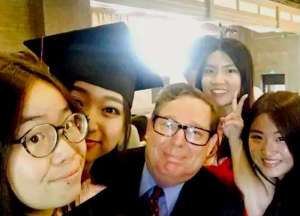
Professor Dunham and GBJ grads celebrate, June 2016
The Tsinghua School of Journalism and Communication will use the documentary to reach out to potential students internationally, to further enhance its reputation in China, and to attract partners and supporters to the program, said GBJ Co-Director Rick Dunham.
“We’d like continue to expand, so that we can be the leaders in training Chinese journalists of the next generation, and become a destination spot for global journalism,” Professor Dunham says in the film.
Launched in 2007 in partnership with the International Center for Journalists and Bloomberg News, the GBJ program has trained more than 400 graduates, many of whom have become journalists at prominent news outlets from Bloomberg to People’s Daily and Xinhua News Agency.
“We wish to welcome the world to join us,” GBJ Co-Director Dr. Hang Min says in the documentary. “We are setting the standard for business journalism education.”
>>> You can also watch the video on YouTube
>> For more information on the application process
>>> Here’s the GBJ website
>>> Here’s how you can begin the application process
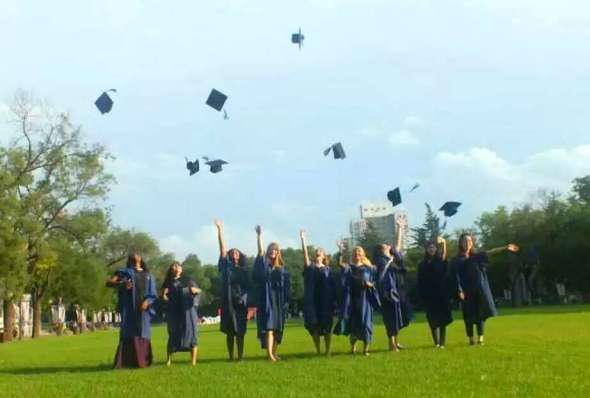
2016 graduation festivities

 Rick Dunham Blog
Recent Comments