What every tourist should know before visiting China
Posted: January 3, 2014 Filed under: Discovering China, Dunham's Discourses | Tags: Beijing, Beijing pollution, Beijing subway, Biking in Beijing, China, Chinese food, National Museum, Summer Palace, the Forbidden City, tourism, traffic 2 Comments
- Check your cultural assumptions with your luggage. Life is different here. Don’t view life in China through the prism of your American or European experiences.
- Beijing is crowded and massive. Don’t be intimidated by the volume of traffic, the human gridlock or the seeming chaos on the streets and in the subways. You’ll get used to it.
- Don’t be afraid to jostle people. There is no sense of personal space here. Don’t take it personally if somebody elbows you or pushes you.
- There is no “walk right, pass left” etiquette here. People walk, bike or drive every which way. Cars DO NOT stop for pedestrians. Bikes DO NOT yield to pedestrians. In fact, nobody yields to anybody.
- Be decisive. Indecisive people get run over by bikes or cars or other pedestrians.
- Don’t get upset when people spit on the street at any time in any place. Spit happens in China.
- Do not expect Western-style toilets. Get used to holes in the ground. Don’t complain about it. Get used to it.
- If there is not a price listed on an item in a market, you are expected to bargain. At tourist-oriented markets (such as the Silk Market), the original prices might be ten times what is reasonable. Don’t be afraid to walk away. Even if you are interested in buying something. Negotiate aggressively. If you don’t want to negotiate, go to a regular store.
Food and drink

Be careful of street food, despite its enticing aroma.
- Don’t drink the water. Use bottled water, even for brushing your teeth.
- Be smart when it comes to street food. Some of it is delicious, but some of it is cooked in oil that is, simply put, poisonous. Unless a Beijinger vouches for a vendor, think twice before trying it. I’m afraid I speak from experience (some bad “stinky tofu”).
- Don’t be afraid to sample the rich variety of tasty regional cooking. Experiment beyond your comfort zone. Try things.
- Don’t expect Chinese food to be the same as American Chinese food. It’s better. Most of all, it’s different.
- Your drinks may be warm or hot when served at restaurants. This includes water, milk and juices. Chinese meals maintain a balance. Cold drinks can throw a hot meal off-balance. If you want cold water (or beer) make sure to order it “bing.”
Getting around
- Fewer people speak English than you might expect. It’s not like traveling in Europe. Younger people are more likely to understand English than older people. Some younger people may want to practice their English on you. Enjoy that – unless they’re trying to sell you something.
- Stay calm. If things go wrong, it won’t do any good to raise your voice. If people don’t understand you, it won’t help you to get agitated.
- Go to the most popular tourist attractions during the week. Earlier is better for places like the Forbidden City, the Summer Palace and the National Museum. They can get very crowded by midday, particularly on weekends or holidays.
- Use the subway. Because of surface traffic gridlock, the subway usually is the fastest way to get from Point A to Point B in Beijing. It is clean, efficient and cheap, in addition to being crowded. Relax and enjoy it.
- If you are taking a taxi, make sure somebody writes down your destination in advance IN CHINESE. Do not assume that you will be able to communicate with a cab driver by trying to pronounce a location in Mandarin. You’re probably mispronouncing it, or worse, saying something embarrassing that you don’t mean to say.
- Try to find a good street map in English (or at least in Pinyin).
- Use Google Maps online to get an idea of where you’re going and a sense of how far it is from the nearest subway stop.
- Make sure you have your passport with you when checking in to hotels or on plane or train journeys. Carry a photocopy of your passport ID page and your visa with you at all times.
Technology
- Get ready for slow, unreliable Internet and spotty WiFi. Do not expect that you will have working Internet 24/7. Internet and WiFi can stop working at any time.
- If you want to use Facebook or Twitter or YouTube or other blocked sites, you will need to have working VPN service before you arrive in China. (Email me if you need information on VPNs.) You also will need a VPN to access the New York Times, Bloomberg and some other news site.
- Bring an electrical converter or a couple of converters designed for use in China. (Not Hong Kong.)
- Bring a multiple-USB recharger for your electronic devices such as cameras and smartphones. You will need an electrical converter for this, along with one for your laptop.
- It may be very expensive to use your U.S. smartphone for calls and data. Check in advance before you leave the U.S. You can always disable the data and use it via WiFi. That’s what I do, which allows me to use email, social media and the Internet for free. I also use my U.S. cell phone for text messages with friends and family in the U.S. (at a cost of 50 cents per text sent and 5 cents per text received).
What to pack
- Dress in layers. Be ready for wind gusts.
- Bring disposable 3M anti-pollution masks. They aren’t very expensive and they can make your life more enjoyable on dangerously polluted days. Don’t be self-conscious about using masks. It’s for your own health.
- Bring toilet paper, napkins, tissues and hand sanitizer. You often will not find these products in public places.
- Make sure you have plenty of prescription medicine and vitamins. It will be hard to find, if you need it, and it may be expensive and questionable in quality.
- Make sure you bring extra medication to combat stomach ailments and flu-liked symptoms such as Pepto Bismol, cold medicine, DayQuil and NyQuil.
- Check in with your credit card companies and banks before you leave to let them know you will be making purchases in China.
Feel free to offer suggestions to make this guide more useful. I will update it with your ideas.
Enjoy China!
How living in China has made me a better person
Posted: December 28, 2013 Filed under: Dunham's Discourses | Tags: Beijing, Beijing pollution, Beijing subway, China, Hearst Newspapers, Houston Chronicle, Joe Biden, Naomi Tumarkin, National Press Club, Pollution, Tsinghua University 2 Comments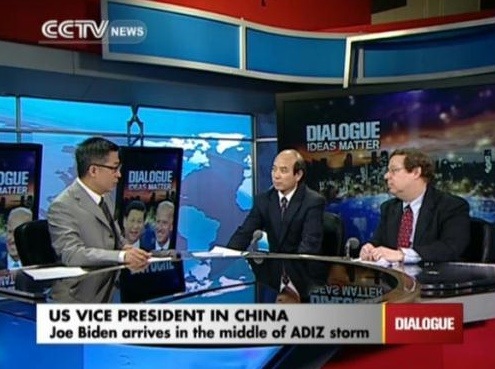
Appearance #7 on CCTV. I’m a big fan of the “Dialogue” program.
My grandmother Naomi and I had a 4-decade-long debate over human nature. Having survived Stalin’s Russia, McCarthy’s America, the Depression and deprivation, she passionately insisted that people don’t change as they age, they only become more like they are (or were). I, on the other hand, a child of the Baby Boom who had evolved from the transistor radio to the smart phone, argued that people can grow or change, for better or for worse.
Our dialogue did not end until Grandmom Naomi’s death three years ago just a few years shy of 100.
I now want to claim victory — at least from personal experience — although I can still hear her arguing with me for being naive and idealistic.
My first semester at Tsinghua University in Beijing has given me plenty of time to contemplate life. After all, I am living alone for the first time in 30 years in a campus apartment, the only English speaker in my building. I chucked my job at the Houston Chronicle for a great leap into the unknown in a country I had never visited.
As I await my graduate students’ final multimedia journalism projects, I can reflect on how living in China has changed me. And it has. Mostly, I hope, for the better.
The biggest change in me is that I have become more accepting of the vagaries of life. In China, you are either patient or you go mad. Internet, WiFi, hot water, heat, electricity: none can be taken for granted at any moment. If you are brave enough to travel on surface roads, you have to expect unexpected delays. You have to let go of the things you can’t control. That’s a big change for me.
You also have to be decisive … or die. (As Joe Biden would say, “literally” die.) Bicyclists pedal every which way. Near misses with another bike … or a pedestrian … or a car … are everyday occurrences. If you don’t push your way out of the crowded subway car, you miss your stop. Don’t think. Act. All in all, I like that philosophy.

I have learned so much from students in China. Here I am in Xi’an with Lu LAN and Jane Sasseen.
At the same time, I feel I have become a lot less materialistic. Americans like to collect things. I like to collect things. Everyone who knows me knows how many things I have collected. In China, I live in a spartan apartment with nothing on the walls, a pot, a pan and enough clothing for ten days. I feel oddly liberated. I realize that I don’t need “things” to make me happy. I need to do things that make me happy. And I have discovered that spending time with friends makes me a lot happier than spending time with “things.”
My professional makeover — new occupation in a new land — also has allowed me to evolve into a different kind of leader. As president of the National Press Club and Washington bureau chief for the Houston Chronicle and Hearst Newspapers, I led by example and governed by consensus. That wasn’t always the formula for success — or effective management — I learned. Too many times, people mistook collegiality for weakness.
Starting over in China, I realized the importance of being a strong, focused, disciplined leader. No more “player-coach.” I hope I have earned the right to be an authority figure both from my knowledge of my subject and my post at the university. Whatever I do in years to come, my time at Tsinghua will have shaped me as a leader.
I’ve also become much more of an environmentalist. Not in the sense of political activism. But in the sense of appreciating clean air, clean water and cooking oil that doesn’t make you sick. It’s a bit spooky to travel around your (new) hometown wearing an anti-particulate mask by 3M. It’s disconcerting to have a thin layer of toxic dust on your bicycle seat in the morning. This is what can happen to the world if we don’t do more to reduce carbon emissions and create green technology — now.
And that brings me to my final thought about the future. My journalism students have made me even more optimistic about the future. After all, they are preparing to enter a business with an uncertain future in a nation where the future of journalism is quite uncertain. But they are some of the smartest young people I’ve ever worked with, and they have a breadth of knowledge and a drive to do well (and do good) that makes me think that they can change the world.
I hope so.
They already have changed me.
Ten things I really miss living in China — and ten I definitely do not
Posted: November 24, 2013 Filed under: Dunham's Discourses, Top Ten, U.S. politics | Tags: Agnes Kneitz, Barbecue, Beijing, Cable TV, Caroline Ward, China, chocolate cake, CNN, Home Plate BBQ, Kennedy assassination, Media, Mengfei Chen, Midnight in Paris, National Press Club, New York, Philadelphia, Rush Limbaugh, Sara Balajthy, Texas politics, Trader Joe's, Troy Hernandez, U.S. Congress, Washington, Washington Redskins, Woody Allen 2 Comments
Birthday barbecue: Plates of tasty food and chocolate cake at Home Plate BBQ in Beijing (with Troy Hernandez, Agnes Kneitz, Sara Balajthy, Caroline Ward and Mengfei Chen)
It’s been nearly three months since I arrived in Beijing, and I’ve finally had my first attack of homesickness.
It started two weeks ago with a trip to a local Western market to pick up the fixings for macaroni and cheese (the real thing, not the Kraft version). It was followed by my birthday dinner of Texas BBQ and chocolate cake with peanut butter frosting. Then I broke down completely yesterday and went to Jenny Loo’s supermarket with my friend Eunice. My haul — a rare taste of Americana — included fresh bagels (“Montreal style”), feta cheese, olives, canned diced tomatoes for pasta sauce, fresh tortillas, tortillas chips, salsa, peanut butter and a Woody Allen movie.
A pretty pricey splurge, all told, except for the Woody Allen movie (“Midnight in Paris”), which cost 13 yuan, or $2.16.
I’m whipping up my famous linguini tonight with some of my big food purchase. But before I do, here’s a quick list of ten things I really miss after 11 weeks in China — and some that I decidedly do not.
What I miss:
1. My wife and family
2. The National Press Club
3. Live NHL hockey
4. Hummus
5. My good friends back home
6. Weekend trips to Philadelphia or New York
7. Trader Joe’s
8. Gossiping with my Texas political sources
9. Good wine at good prices
10. Target
What I Don’t Miss:
1. CNN
2. American cable news in general
3. The newspaper world I left behind
4. Cable TV
5. Congress
6. Driving
7. Texas BBQ (I’ve been surprised by the fine barbecue here.)
8. The Washington football team with the racist name
9. Rush Limbaugh and the vast right wing conspiracy
10. U.S. media coverage of the 50th anniversary of the Kennedy assassination
Top ten losers — and a few winners — in the DC debt ceiling debacle
Posted: October 16, 2013 Filed under: Dunham's Discourses, Top Ten, U.S. politics | Tags: Barack Obama, Beijing, C-SPAN, Harry Reid, Joe Biden, John Boehner, Mitch McConnell, Tea Party, Ted Cruz, U.S. Congress, U.S. economy, United States, Washington 1 Comment
We’re THIS close to a solution, folks.
As the newest American political analyst on Chinese national television, I’ve been asked to explain the U.S. government shutdown and default showdown.
It’s not easy.
How do you explain the farce that Washington has become? Lawmakers shutting down the government because of an issue not directly related to spending. Hostage-taking is for terrorists, not for Republicans.
International observers are even more baffled by the brinkmanship over the debt ceiling. Why, I am asked over and over, would congressional Republicans threaten the full faith and credit of the United States, risk a relapse into recession and jeopardize a very tenuous economic recovery around the world? Why would they, through their illogical enterprise, encourage other nations to replace the dollar as the global reserve currency, which will do nothing but create inflation at home, make borrowing more expensive for the American government and American consumers, and stifle foreign investment in the United States? And why is President Barack Obama incapable of rescuing the nation from the tar pit of Capitol Hill.
It’s a lose-lose proposition.
Are there any winners in the Washington wackiness? Not really, though there are some short-term gainers. Here’s my long list of losers and short list of winners in the continuing congressional catastrophe.
John Boehner
The House Speaker looks like a hostage being forced to read a script by his radical captors. He looks weary. He looks very, very sad.
Barack Obama
He looks weak.
House Republicans
They look extreme. Actually, they look beyond extreme. And incompetent.
The Tea Party
Did we mention extreme? The current situation is reminiscent of the Vietnam War-era saying, “We had to destroy the village in order to save it.”
Senate Republicans
They look weak, too, as the Tea Party tail continues to wag the Republican dog.
The Republican Party
The Grand Old Party is lurching toward the political cliff in the 2014 midterm elections. Its best asset: gerrymandered House districts. Its best ally: discombobulated Democrats.
Joe Biden
Who? Nonexistent.
The United States.
Forget partisan politics. Congress has made the U.S. an international laughingstock. The double showdown has led to grave global doubts about the reliability of the United States and the leadership skill (and power) of its president. So this will hurt the country for a long, long time and its president — whoever that may be, Democrat or Republican.
The U.S. economy
In the short run, thousands of Americans are without paychecks, tourism revenue has plunged and consumer confidence has taken a hit. Businesses have another reason to hold off on hiring. In the long run, interest rates will be higher and loans will be even harder to obtain for individual Americans and corporations alike. And they call Republicans the pro-growth party?
The global economy
The self-induced crisis in Washington has shaken global confidence in the United States If American lawmakers blunder into a default (still unimaginable from my distant vantage point), it would almost certain trigger an international recession as China, Japan, Brazil, the EU and other leading U.S. creditors take a massive hit. The consequences would be so severe that it’s not even worth contemplating.
The U.S. Congress wouldn’t do something so wantonly self-destructive, would they?
Would they?
Remember Smoot-Hawley? Call this modern-day version Cruz-Boehner.
“Winners”
Harry Reid and Mitch McConnell
There really are no winners in Washington, but the closest thing to it are the Senate leaders. Instead of acting like squabbling partisans, they are playing the role of sober cops coming to restore order after a frat party has descended into anarchy and drunken debauchery. Officers Reid and McConnell, your country needs you. Now.
Ted Cruz
In the short term, the freshman senator from Texas has become the hero of the ultraright, the face of Fox News, the Earl Grey of the Tea Party. In the long run, he will have to overcome the first impression of two-thirds of Americans (who know who he is) that he is a right-wing ideologue. Polls show that he’s poison among independent and swing voters outside of the Lone Star State.
House Democrats
They are only winners because House Republicans look so, so bad. The Dems haven’t won any awards for profiles in courage or bipartisan bridge building. Except another Bridge to Nowhere.
C-SPAN
Ratings are way, way up at the nation’s favorite cable channel for nerds and policy wonks. Heck, it’s the most bizarre reality show on television. And, unlike the Kardashians, it has real-world consequences.
China
The government in Beijing has won in two ways (so far). First, President Obama canceled his Asia trip, allowing first-year Chinese President Xi to be the star of the show at APEC. And China-bashing Washington Republicans have succeeded in making Beijing the victim of irresponsible fiscal policies in free-enterprise America that could lead to default. A bizarre lesson in capitalism.
The most prominent American political figures in the global media — and a dozen who get no respect
Posted: October 8, 2013 Filed under: Dunham's Discourses, Top Ten, U.S. politics | Tags: American politics, Barack Obama, China, Chuck Hagel, Eric Cantor, Fox News, Harry Reid, Hillary Clinton, Jack Lew, Jay Carney, Joe Biden, John Boehner, John Kerry, John McCain, Marco Rubio, Mitch McConnell, Nancy Pelosi, Obama, Rush Limbaugh, Sarah Palin, Sean Hannity, Ted Cruz, United States 1 Comment
President Obama at my last White House press conference in August. (Photo by Rick Dunham)
After covering the White House and the U.S. Congress for 29 years — and being inside the 24/7 news bubble — it’s fascinating to be, for the first time, on the outside looking in.
Here’s a new outsider’s perspective on which American politicians figure most prominently around the world, and which DC figures vanish from the media scene when you cross the Pacific.
America’s Face around the World
1. President Barack Obama
The president is the president. He gets global press on some stories that earn barely a ripple in America-centered domestic media.
2. Secretary of State John Kerry
He didn’t get elected president, but his stentorian voice is everywhere on international issues. He comes across as knowledgeable, poised and, well, diplomatic.
3. House Speaker John Boehner
The Ohio Republican is the scowling face of the opposition. His soundbites are almost all partisan and negative. Not much of an image to project.
4. Sen. Ted Cruz
The first-year lawmaker from Texas has exploded onto the international stage as the leader of America’s ultraconservatives, which the global media love to highlight. Even people who don’t understand the concept of a filibuster understand that Cruz is the man who shut down the federal government. And he’s not even president.
5. Treasury Secretary Jack Lew
The American media almost never cover the charismatically challenged Treasury Secretary. Most Americans know him as the man with the illegible signature. But he’s often on TV and Internet news reports around the world. He comes across as measured and authoritative.
6. Hillary Clinton
The former U.S. Secretary of State is treated as America’s president-in-waiting. She’s also covered like the leader of the hawkish wing of the Democratic Party, as opposed to the dove-ish Obama.
The Dead-to-the-World Dozen
1. Vice President Joe Biden
Never mentioned. Well, almost never.
2. Senate Republican Leader Mitch McConnell
Who is less important than the minority leader of a body that has been eclipsed by the hard-right Republicans in the other chamber?
3. House Democratic Leader Nancy Pelosi
Maybe the only person less important than the Senate Minority Leader is the House Minority Leader.
4. Senate Majority Leader Harry Reid
He only appears on international TV when he comes up with his sound-bite zingers tearing into the Republicans.
5. Sen. John McCain
A media darling in the U.S., his mavericky style doesn’t translate to an international audience.
6. Sarah Palin
The only thing people in Asia remember about 2008 Republican vice presidential nominee is the report in Game Change that she didn’t know the Korean peninsula was divided into two countries.
7. Rush Limbaugh, Sean Hannity and the Fox News crowd
They may get good ratings in the USofA, but they don’t exist outside of its borders. And that’s probably fine with them.
8. Sen. Marco Rubio
The Florida freshman’s mystique hasn’t stretched to Asia and Europe, only Latin America and South America.
9. House Majority Leader Eric Cantor
There’s only room for one face of the opposition on international TV, and that’s John Boehner, not his (occasionally) loyal deputy from Virginia.
10. Defense Secretary Chuck Hagel
Barack Obama and John Kerry speak for the U.S. on global issues. The Pentagon chief is a bit player on the international stage.
11. White House press secretary Jay Carney
President Obama’s spokesman, a ubiquituous presence on domestic media, makes only cameo appearances on media outlets outside the U.S.
12. The U.S. Trade Representative
Who is the U.S. trade rep anyway? There are lots of trade stories, but the U.S. Commerce Secretary and U.S. Trade Representative are never quoted. Only Obama or Kerry.
My take on the dysfunction in DC
Posted: October 7, 2013 Filed under: Dunham's Discourses, Rick in the news, U.S. politics | Tags: American politics, Barry Goldwater, Bill Clinton, Democrats, Global Business Journalism, Houston Chronicle, John McCain, Katie Perkowski, Lindsey Graham, Mitt Romney, Rand Paul, Republican Party, Ronald Reagan, Tea Party, Ted Cruz, Texas on the Potomac, Tsinghua University, U.S. Congress, Washington, WBP Online Leave a commentI’m still getting used to be the interviewee and not the interviewer. Here’s a recent Q&A with me conducted by Katie Perkowski, a super-talented former Texas on the Potomac intern who now works and lives in Bratislava.
Katie’s piece first appeared in WBP Online.
—–
Behind Capitol Hill: Q&A with long-time Washington watchdog
Rick Dunham has had eyes and ears on Capitol Hill and in the White House for three decades, giving him a unique view into US politics. In an interview with WBP Online, the former Washington bureau chief for the Houston Chronicle explains how dramatic political party transformations have led to the dysfunction in Congress we are seeing today.

Ted Cruz (Texas Tribune photo)
By Katie Perkowski
WBP Online
Few people understand the inner workings of US politics quite as well as Rick Dunham, who covered the White House and Capitol Hill for three decades, during which time he served as Washington bureau chief for the Houston Chronicle, White House correspondent for BusinessWeek and board president of the National Press Club.
In a Q&A with WBP Online, Dunham explained the dramatic transformations of the two main political parties, Republicans and Democrats, that he saw during his time in Washington, and why those shifts have led to an ever-dived Congress seemingly incapable of getting anything done. The latest evidence of that now all-too-familiar phenomenon? The federal government’s shutdown, now on day four with no sign of stopping.
Here’s what Dunham had to say:
Q: Can you describe the shift in dynamic you noticed in both the Republican and Democrat parties during your time in Washington? What do you think brought about this change in the way things get done (or don’t)?
There has been a tremendous shift, both culturally and politically, over my three decades in Washington.
One is ideological. Both parties’ representatives were far more diverse in the past. Democrats ranged from far left to far right. Republicans ranged from liberal to very conservative. Now there are no liberals and very few moderates left among Republican lawmakers. And there are very few Democrats remaining who are right of the political center. The party is pretty well split between far left, left and center. Republicans are pretty well divided between right and far right, with a tiny group of centrists. The key Republican division is establishment and insurgent. The establishment Republicans still are in the majority but the radical right Republicans control the agenda through mastery of tactics and willingness to “do the unthinkable.”
Culturally, there has been an even bigger shift. When I arrived in Washington in 1984, Congress was controlled by “doers” and not “talkers.” The goal of lawmakers was to make laws. Legislators used to legislate. Now, the vast majority on both sides of the aisle want to posture and play to their ideological core rather than to get things done.
The great lawmakers I have covered were often very liberal or conservative – Ted Kennedy was hard left and Bob Dole was very conservative – but they believed in moving things forward for their country in the end. There are almost none of those left now, and certainly not enough to get things done.
Q: Covering Texas, you followed Ted Cruz in his rise from solicitor general to senator. What kind of change within the Republican party does Cruz represent? There have been numerous reports out about how senior members of his party, like McCain and Graham are not happy with the way he’s doing things. Do you think there could be a party split among Republicans in the near future? What is the Tea Party’s role in all of this?
The key figures representing the three strands of the Republican future are Ted Cruz, Marco Rubio and Rand Paul. All are ultraconservative but only Rubio among them is pragmatic and willing to cut deals. The other two are ideological purists who would rather lose than compromise. Rand Paul is the leader of the libertarian wing of the Republican Party. He is anti-government. Period. Ted Cruz is an ultraconservative in the mold of the 1964 version of Barry Goldwater, who believed that extremism in the defense of liberty (as he saw it) is no vice. Cruz is against government unless government will help him accomplish his ideological ends. He also is against (almost) anything Barack Obama is for. I call him the leader of the nihilist strain of the modern Republican Party.
That’s why old-fashioned conservatives like John McCain and Lindsey Graham don’t like him. They are very conservative – I don’t buy into the revisionist view of McCain and Graham as moderate because they are willing to cut deals and occasionally act like mavericks.
McCain took an instant dislike to Cruz because Cruz has such an authentic dislike for the institution. McCain respects the institution. Cruz despises it. They are both strong personalities, so it is natural that they will clash. Neither of them is phony. They genuinely dislike each other.
McCain and other Republican leaders believe that Cruz is leading the party on a political suicide mission. They believe he is hoping to burn down the village and then claim to be king of the ashes.
Cruz represents the socially conservative strand of Tea Party Republicanism. Rand Paul represents the pure libertarian strand of Tea Party Republicanism. Both are ideologically pure and strongly “pro-liberty” but both philosophies are distinct and different. They have a slightly different definition of what liberty means.
Q: What kind of precedent do you think it would set if Republicans hold to their current stance and hold the debt ceiling “hostage” as some are calling it in an effort to repeal or delay a law that’s already been passed? Could that lead to similar actions by Congress in the future, or even “revenge” acts of a similar manner by Democrats?
I don’t think it will lead to a “tit for tat” reaction from Democrats in the future. Democrats never held the government or the country hostage during George W. Bush’s administration. I’ve always said that the Democrats’ big problem is that they are too “responsible.” I’m not talking about being ideologically moderate. I mean that they won’t take extreme measures in order to prevail.
Filibusters are another matter. Both sides are irresponsible and hypocritical when it comes to filibusters. That’s another big change in the Washington culture. But that’s another story.
In some ways, Democrats are to blame for all of this. It started with the defeat of Robert Bork, who was very qualified for the Supreme Court (in terms of legal qualifications) but was defeated for ideological reasons, because he was out of the judicial mainstream. That has led to the political equivalent of an arms race where each side is willing to become more and more virulent in order to make political points. It’s gotten to the point that Republicans will block Democratic nominations just because the nominees exist, not even for reasons of ideology or the nominee’s personal issues. That is utterly irresponsible and, I am sorry to say, bipartisan.
Q: Do you think the current party structure in Washington can survive, or should it be changed to prevent the type of mess we’re seeing now?
I see the party structure surviving because that is the history of American representative democracy. We have always had two main parties. The two parties have not always been Republican and Democrat. Since we entered the R/D era, the two parties have changed radically. Now, just about anyone who would have been a Republican at the time of slavery and the Civil War is a Democrat, and anybody who would have been a Democrat at that time is a Republican. The two parties have reversed regional bases. One of the only common threads is that immigrants still tend to be Democrats.
I see the Democratic Party becoming more “moderate” in coming years as more disgruntled former Republicans and moderate young people join the party. I see the Republican Party finally having a showdown between the establishment right and the hard right. It probably will take the nomination of a far-right Republican for president and an overwhelming defeat for the party to move back toward the center. The last two nominees, John McCain and Mitt Romney, were not purists. Indeed, Ronald Reagan is the last hard-core conservative to be a presidential nominee. And Reagan would be considered a pragmatic moderate by today’s standards.
One last thought: If the Republicans are to have a future at the presidential level, they cannot afford to continue to lose immigrants, minorities and young voters. Those three blocs are the future. Republicans not only need to maintain their current levels of support, they need to increase them. A similar fate befell Democrats during the 1980s as Ronald Reagan cut into the blue-collar Democratic base, young voters went Republican and old New Deal Democrats died off rapidly. Democrats won just once in 24 years before Bill Clinton started to redefine the Democratic Party with his “New Democrat” movement. We’re at a similar point in reverse now. But I suspect we’ll need a disaster like the Democrats faced in 1980-1984-1988 to convince Republicans to rethink Cruz-ism.
Dunham is now based in Beijing, where he is a professor of multimedia journalism and co-director of the Global Business Journalism program at Tsinghua University. You can follow him at https://rickdunhamblog.com/.
To contact the author of this story, e-mail katherine.perkowski@wbponline.com.
Greetings from China: 5 pleasant discoveries and 5 things that might take some getting used to
Posted: September 9, 2013 Filed under: Discovering China, Dunham's Discourses, Top Ten | Tags: Beijing, China, Chinese food, food, parking, peanut butter, Peking Duck, traffic, Tsinghua University, Walmart 1 Comment
This is where I went hiking … for the history, the exercise, the fellowship and the fresh air.
The eagle has landed. I’ve been in Beijing for four days now — long enough to hike a remote section of the Great Wall, sample the best Peking Duck (Beijing Duck? Just plain roast duck?) of my life and explore every nook and cranny of one of the most beautiful college campuses in the world — but not quite long enough to get over jet lag.
Rather than write the traditional “first impressions” story, I’m going to share five of my pleasant discoveries in Beijing and an equal number of things that will take some time to get used to.
Pleasant discoveries

The campus is stunningly beautiful, an island of serenity in a bustling metropolis.
1. Tsinghua University is one of the most beautiful in the world. It’s made one of those top ten lists for beautiful campuses, and I can see why. From the magnificent gates to the marvelous and varied sculpture, from the breath-taking canals and lily ponds to the impressive architecture and ivy-covered walls, this is a fine environment for teaching and for learning.
2. The high quality of the faculty. They don’t call it the MIT of China for nothing. The professors here are among the best in the world. The journalism faculty is uniformly excellent. I hope to live up to their very high standards.
3. The high quality of the students. I could tell from the moment I began my new student orientation session last Friday morning. These students are the best and the brightest, not just from China but from around the world. They are smart and they are motivated.
4. I can get around town without too much problem. It is a problem that I don’t speak Chinese. (Yet.) But the Beijing subway — most of which was built for the 2008 Olympics — is modern, efficient, inexpensive and very easy to navigate. Crowded? That’s a given. There are more than 20 million people here in the capital.
5. I can communicate with the outside world. Yes, I heard all of the warnings about the Great Firewall of China. And all the blocked sites. The good news, at least at this point, is that I have been able to communicate with all of my old and new friends with only minor problems.

They say everything is bigger in Texas. It’s even bigger in Beijing. Here I am with one of the campus’ lions.
Things that might take some getting used to
1. A fifth-floor walk-up apartment. On the bright side, I’m getting a lot of aerobic exercise every day.
2. Cold showers for four days. Well, I finally have hot water. Actually, I’ve had it all along but haven’t known how to turn it on. You see, the instruction guide to my apartment is in Chinese and I’m linguistically challenged. It means I also couldn’t figure out how to use the satellite TV. Or the apartment internet. The take-away lesson: Keep taking those Mandarin lessons on the Mango app.
3. Can you believe the way people drive around here? Washington drivers are awful. Drivers in Rome are maniacs. Drivers in Naples view traffic signals as suggestions. Drivers in Beijing are all of that and more. U-turns in the middle of traffic. Left turns from the right lane. Turning right on red without stopping or even looking for pedestrians or bike riders.
And while you’re at it, watch out for the bikes coming at you every which way. And the pedestrians darting across highways and major thoroughfares in the middle of traffic.
4. The parking situation. People park any place they can find a space. Not a parking space. Any old space. They park on sidewalks. They park on pedestrian malls. They park where they want, when they want. Just get out of the way when the car is coming at you.
5. Peanut butter is hard to find. I love Chinese food. I could eat it almost every meal. But I am going through peanut butter withdrawal now. Yes, yes, I’ve been told that you can get peanut butter at Walmart and in European grocery stores in Beijing. But I haven’t gone on a scouting mission yet.
Top Ten: My proudest accomplishments at the Houston Chronicle
Posted: August 13, 2013 Filed under: Dunham's Discourses, Top Ten | Tags: Alan Bernstein, Arizona State University, Aurora Losada, Dwight Silverman, George Haj, Houston, Houston Chronicle, Jacquee Petchel, Jeff Cohen, Jennifer Dlouhy, Jesse Awards, Jesse Jones, La Voz, La Voz de Houston, Los Angeles Times, National Press Club, National Press Club Journalism Institute, New York Times, NPC Journalism Institute, Patti Kilday Hart, Peggy Fikac, Perry Presidential, Republican National Convention, Rick Perry, Rick Perry Watch, Silvia Struthers, Stewart Powell, Susan Lucci, Texas, Texas Associated Press Managing Editors, Texas on the Potomac, United States Leave a comment
The superstar intern crew of spring semester 2012. (Photo by Pam Tobey)
I have been fortunate to be able to experiment and innovate over the past six years at the Houston Chronicle. As I look back on my tenure at Texas’ largest newspaper, I am particularly proud of these accomplishments:
 1. Creating Texas on the Potomac
Launched in December 2007, Texas on the Potomac developed into a valued “brand” in Texas journalism — THE place to go for news about Texans in Washington or national news of interest to a Texas audience. We proved that high quality journalism and “clicks” are not mutually exclusive. We built a large and loyal audience not only in our home base of Houston, but in Austin, Washington, Dallas-Fort Worth and in more than 20 countries around the world including Finland, Norway and Korea.
2. Reinventing Washington bureau coverage for a regional newspaper
Chronicle editor-in-chief Jeff Cohen hired me to reinvent the Chron Washington bureau, and I took the challenge to the next level. I reimagined how a regional newspaper should cover the nation’s capital. Rather than duplicate the wires or the national newspapers, we tailored our national stories to our local audience. We offered analytical coverage explaining the importance of the events that were unfolding in Washington. And we covered the Texas delegation and Texans on the Potomac like they had never been covered before. We broke news story after news story on the web and then offered value-added coverage for print. We had a robust social media presence, too, offering comprehensive coverage to readers interested in Houston and Texas politics on whatever platform they preferred. All while seeing our staff shrink. And shrink.
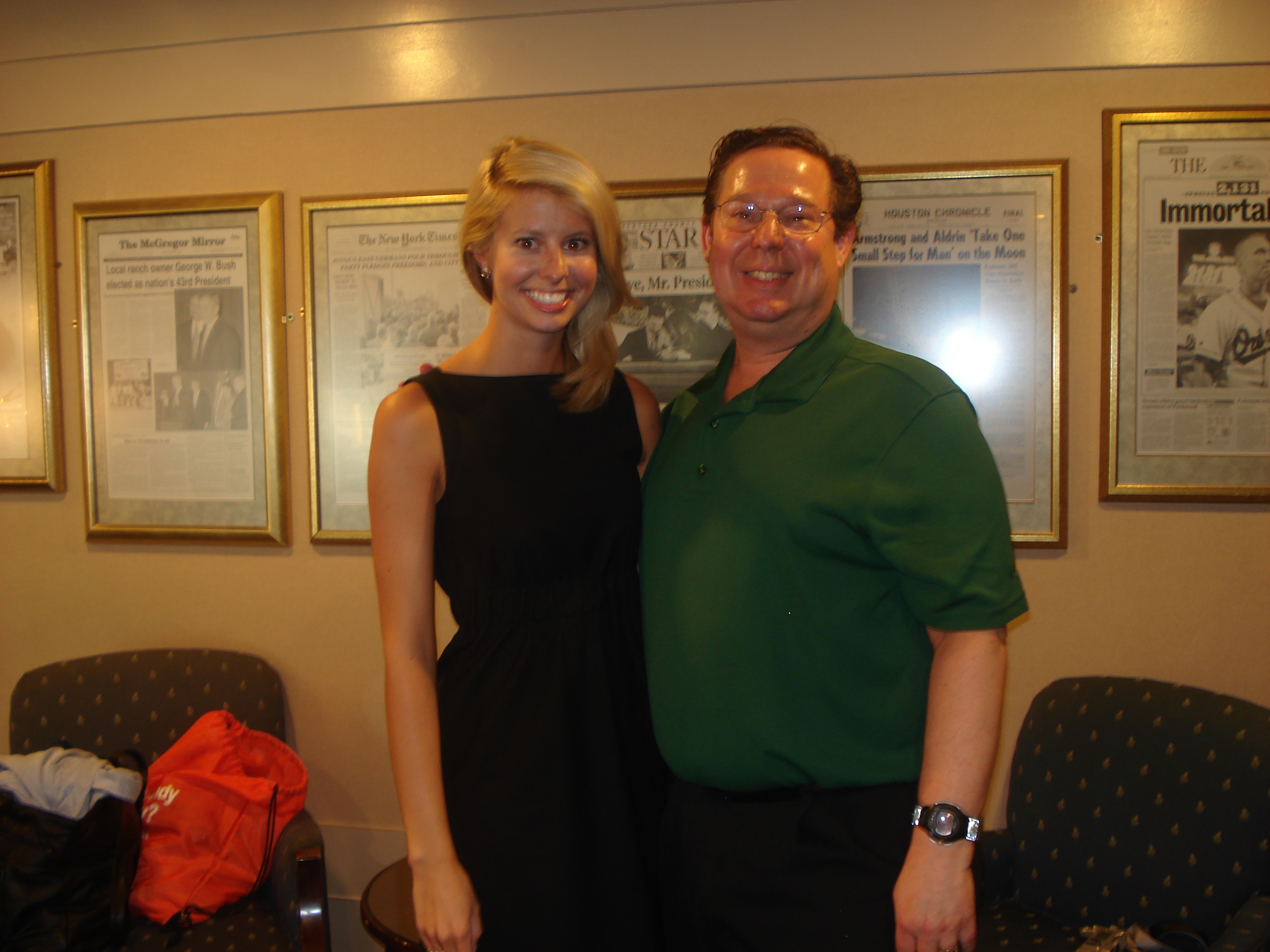
With MacKenzie Warren before she became a famous TV anchor. (Photo by Marco Van Stralen)
3. Helping to launch the careers of so many talented young journalists
It’s been a pleasure and an honor to work with so many talented interns from across the globe. Our former interns have gone on to journalism greatness (already) at the Los Angeles Times, New York Times, Politico, The Hill, Roll Call and many other news outlets, large and small, print and broadcast … and digital. I hope my interns learned as much from me as I learned from them. The interns’ talents and enthusiasm prove to me that there is a future in journalism. To all my interns: You have inspired me.
4. Teaching cutting-edge training programs for journalism students and midcareer professionals
Through my role as president of the National Press Club Journalism Institute — the educational and charitable arm of the National Press Club — I was able to teach thousands of aspiring journalists, midcareer journalists, journalism educators and professional communicators the skills they needed to survive and thrive in today’s rapidly changing multimedia world. Whether the subject was writing for the web or building a community and brand via Twitter, I embraced the turbulent times and tried to help others navigate through rocky seas. That training has trained me for the next chapter in my life.
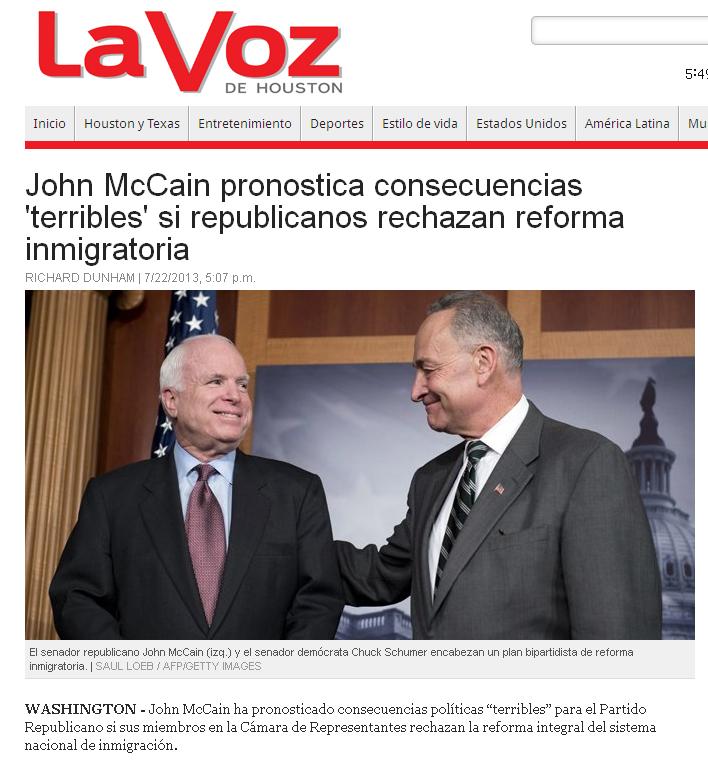 5. Offering robust coverage of issues of importance to our Latino audience
Before Texas on the Potomac came along, there was a void in “mainstream media” coverage of Latino politics and national policy issues of interest to Texas Latinos. With the help of my TxPotomac compatriots and superb La Voz de Houston editors Aurora Losada and Silvia Struthers, we provided comprehensive coverage of important issues such as immigration, health care, border policy, U.S.-Mexico issues, Voter ID, voting rights, redistricting, education and other matters of particular interest to our Latino audience. We gave special attention to Latino elected officials and representatives of heavily Latino districts across Texas. I often wrote stories that appeared in print only in Spanish in La Voz.

Covering Rick Perry in New York (Photo by Andrea Vasquez)
6. Award-winning coverage of Rick Perry’s 2012 presidential campaign
Texas Associated Press Managing Editors gave only one journalism award for coverage of the 2012 elections. It was to our Houston Chronicle team for coverage of Rick Perry’s disastrous White House run. I was proud to have created “Rick Perry Watch” on Texas on the Potomac, the forerunner of our robust “Perry Presidential” web site. Our coverage combined breaking news, ahead-of-the-curve analysis, multimedia storytelling and interesting items culled from other outlets. The result was the most comprehensive daily report on an ill-fated campaign, one that became a must-read for political reporters covering the 2012 campaign.
“First, readers were lucky to have a newspaper willing to dedicate the staff to cover Perry’s bid as an intensely local story,” the Texas Associated Press Managing Editors wrote in their citation. “Just as important, the overall level of work was superb.”
7. Starting a monthly lunch with the Texas delegation
When I arrived as Chronicle Washington bureau chief, there was widespread grumbling in the Houston-area congressional delegation about the Chronicle. To improve lines of communication, I created a monthly, bipartisan lunch with our local lawmakers and the Chronicle reporters and editors. It gave Houston-area House members a chance to tell us what they were working on and what their constituents were talking about, and gave us a chance to ask questions and develop in-depth stories. It also provided opportunities for some bipartisan legislative efforts on issues such as energy, transportation . All in all, it allowed all of us to better serve our joint constituency — the news consumers of Texas and the voters of the Houston area.
I owe bipartisan thanks to Rep. Kevin Brady of The Woodlands and Gene Green of Houston for rounding up lawmakers from Houston — and more recently South Texas — each month.
8. Reaching one million monthly page views on Texas on the Potomac
When I created Texas on the Potomac, I asked how we would judge success. I was told 100,000 page views per month.
Well, we twice hit one million page views — once during the Republican National Convention in August 2012 and again in November, the month of the election. The doubters have been vanquished. Even with very little publicity, we built a franchise. It also helped that I taught our tremendous team of interns the science of search engine optimization.
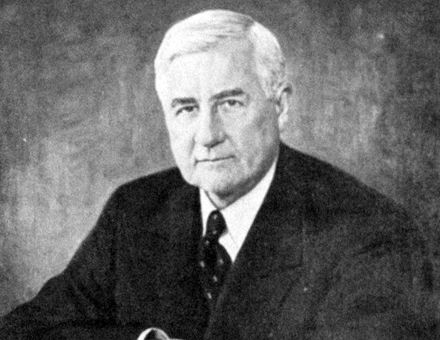
“Mister Houston,” a.k.a., Jesse Jones — publisher of the Houston Chronicle and Commerce Secretary to President Franklin D. Roosevelt
9. Winning all those “Jesse” Award nominations — if not the award itself
I’ve been the Susan Lucci of the Houston Chronicle. Year after year, I’ve been nominated for the “Jesse” Award for outstanding Houston journalism but I never took home the statuette. Reporter of the Year. Editor of the Year. Innovation of the Year. Blog of the Year. Multimedia Journalist of the Year. And some more that I can’t remember right now. Congrats to all the winners! As they say, it’s an honor just to be nominated.
10. An emphasis on teamwork
The Chronicle is one of the ten largest newspapers in America and has drawn, over the years, some of the most talented journalists in America. I hope I contributed to that sense of teamwork — the “we” rather than the “me” — that leads to great journalism. My DC colleague Stewart Powell has been the consummate professional and a willing teammate on Houston stories. Energy expert Jennifer Dlouhy has “taken one for the team” numerous times — I’ll remember those emails at 10:30 on Sunday night as she gets a head start on the week ahead.
Special kudos to super-editor George Haj, who has the best news judgment of any editor I’ve ever worked with, Jacquee Petchel, the best investigative and projects editor in the USA, now teaching the next generation at Arizona State, Ernie Williamson, the best election night editor there ever was, Alan Bernstein, who has a deeper knowledge of Houston politics (and Chron politics) than anybody else in town, Peggy Fikac, the hardest working reporter in Texas, Dwight Silverman, the tech wizard and my favorite web consultant, and Patti Kilday Hart, my partner in journalistic crime in Dallas, Austin and Houston.

 Rick Dunham Blog
Recent Comments