GBJ hosts workshop on global climate change coverage
Posted: November 26, 2018 Filed under: Global Business Journalism, Journalism Training, Rick in the news | Tags: Anthony Kuhn, BBC, British Broadcasting Corporation, climate change, deforestation, Doug Harbrecht, GBJ, Global Business Journalism Program, global challenges, global warming, Hang Min, Indonesia, journalism education, Madagascar, McDonnell Symposium, Mongolia, Morocco, National Geographic, National Public Radio, New York Times, NPR, People's Daily, Pulitzer Center, Sean Gallagher, South China Morning Post, The Paper, Tsinghua Future Media Lab, Tsinghua School of Journalism and Communication, Tsinghua University, Washington University in St. Louis Leave a commentJournalism coverage of issues related to climate change can educate the public and shed light on one of the most important global policy issues of the 21st century, a group of international journalists and educators said during a workshop hosted by the Global Business Journalism Program.
.
The workshop, called “Taking the Heat – Using Journalism for Educational Engagement on China,” was organized by the Tsinghua School of Journalism and Communication in partnership with Washington University in St. Louis, the Pulitzer Center and the Global Business Journalism Program.
The event took place Oct. 14 as part of the 7th International McDonnell Symposium. The symposium, which examined “Global Challenges for Today’s Research Universities,” was held for the first time in China. It was the first workshop held at the new Tsinghua Future Media Lab, which will be used by GBJ for New Media classes.
A recently released United Nations report cautioned that world leaders had just 12 years to avoid catastrophic climate change. Rather than debating the problem, the time has come to discuss solutions, Doug Harbrecht, a visiting professor at Tsinghua School of Journalism and Communication, told the audience of global scholars.
Professor Harbrecht described a trend toward “solutions journalism,” where media outlets around the world not only educate the public about the problems related to climate change but offer constructive solutions.
“They want to know how we can fix it,” he said. “They focus on what works, and why. It’s excellent journalism.”
Professor Rick Dunham, co-director of the Global Business Journalism Program at Tsinghua, highlighted international best practices in climate coverage. He cited extensive reporting in the South China Morning Post, The New York Times and the British Broadcasting Corporation. All of these news organizations used multimedia storytelling to explain the depth of the climate change crisis and focused public attention on innovative attempts to reverse its damaging effects.
Professor Dunham also looked at diverse coverage of the issue on the Chinese mainland. These included an in-depth series of reports in People’s Daily focusing on the government response and a series of documentary videos produced by Shanghai-based The Paper illustrating the effects of climate change in different countries including Mongolia, Madagascar and Morocco and explaining how each nation is adapting to the changing environment. He also highlighted how China’s meteorological administration has produced a series of multimedia reports on climate change in 11 areas of China and has discussed possible solutions.
Speakers at the workshop focused on the need for creative storytelling to make stories of climate change compelling to news consumers. Sean Gallagher, a Beijing-based photographer and filmmaker affiliated with the Pulitzer Center and National Geographic, said that focusing on individuals helps to tell broader stories about climate change.
“Most people do not connect to a story unless you show the people affected by the issue,” he said. “The best way to do it is put a face to that issue.”
Anthony Kuhn, a reporter for U.S. National Public Radio, reported extensively on deforestation in the Asia Pacific region. Deforestation is the second-leading cause of global warming after the burning of fossil fuels, he noted. In his presentation, Kuhn recommended that journalists and educators “go to the scene and explain” what is going on and its impact on society. He explained how he had reported from Indonesia, explaining that the deforested trees eventually were used in everyday consumer products from cookies to lipstick.
“One of my jobs is to connect this to people’s lives,” he said.
Professor Hang Min, TSJC Associate Dean for International Affairs, welcomed the participants and underscored Tsinghua’s role as a global leader in education and journalism innovation.
You’re invited: Here’s why (and how) you should apply to join the Global Business Journalism Program at Tsinghua
Posted: November 12, 2018 Filed under: Global Business Journalism | Tags: Academe, application, Asia Pacific, Beijing, Bloomberg News, business journalism, Business Week, China, CNN, Data Journalism, Facebook, Financial Times, GBJ, Global Business Journalism Program, graduate journalism programs, ICFJ, Instagram, International Center for Journalists, LinkedIn, multimedia journalism, New York Times, Reuters, Sarah Ma, Schartzman Scholars, scholarships, top business journalism programs, top journalism programs, top universities, Tsinghua School of Journalism and Communication, Tsinghua University, Twitter, Washington Post Leave a commentAre you interested in becoming an expert on the world’s fastest-growing economy?
Do you want to study Asia Pacific business development and report that to the world?
Do you want to have an amazing educational and personal experience in a dynamic country?
Do you want to learn how to share your stories with audiences via print, audio, video and digital media?
Please join us in the Global Business Journalism master’s degree program at Tsinghua University in China!
Here are instructions for application for the 2019-2020 academic year. Applications will be accepted after November 1, 2018.
1. Introduction
With China playing a key role in the global economy, there is a soaring demand for trained professionals who can understand the exciting, complicated development of the world’s fastest-growing economy and can explain it clearly and in depth to audiences in China and around the world.
Tsinghua University’s Master of Arts degree in Global Business Journalism is designed to meet that growing need. The program offers international students the opportunity to master the fine points of business, finance and economics in China. All courses are taught in English – the international language of business – by internationally renowned scholars and accomplished journalists with extensive global experience. The program’s facilities rival those of other leading journalism schools worldwide. The news lab has the largest number of Bloomberg terminals sponsored by the company of any college in the world.
Business journalism is one of the fastest growing areas of employment opportunities in the industry today. News audiences are eager to learn about the world of business, while media departments expect PR professionals to understand and analyze the complexities of business issues. Tsinghua’s Master of Global Business Journalism Program is designed to offer you the opportunity to meet these growing needs. We welcome you to join us!

The first English-language graduate business journalism program on the Chinese mainland, created in partnership with the International Center for Journalists, it has sent more than 200 graduates to news outlets in China and globally over its first decade.
Launched in 2007, GBJ has already been recognized by students and recruiters alike as a world-class program. Academe, the world’s leading journal on higher education, has featured a series of articles on the program. The student body is culturally and professionally diverse. The full-time program spans two years of intense, fast-paced, rewarding study. Those who complete it successfully emerge with valuable connections, a rich array of opportunities and the business and journalism skills to capitalize on them. It is a two-year experience that will last a lifetime.
The program aims to bring business journalism in China in line with top international reporting standards. The Tsinghua School of Journalism and Communication has a long history of cooperation with major international media and financial-information organizations, and visiting scholars have come from outlets such as Bloomberg, Reuters, Business Week, The New York Times, Financial Times, The Washington Post and CNN.
GBJ offers an array of specialized courses that are at the forefront of global business journalism. Students can learn about international accounting standards, multimedia journalism, data mining, complex financial derivatives, journalism ethics, advanced feature writing techniques and the management of media organizations – knowledge that is transferable to other economies and other professions. At the same time, they gain a deeper knowledge of the Chinese language and economy.
The GBJ program benefits from other academic resources on the Tsinghua campus, including its prestigious School of Economics and Management, the Schwarzman Scholars Program, as well as many Chinese and global media and technology companies in Beijing. Internships, field trips and recruiter visits are integral parts of the program.
GBJ students have opportunities to attend conferences on new media, economic development, global economics and other business topics. They benefit from meetings and discussions with guest speakers, including top editors and reporters from leading Chinese and Western news outlets and international business executives. The GBJ has a growing network of smart, sophisticated reporters, editors and public relations professionals who can enhance the world’s understanding of economic and corporate developments in China and globally.
2. Program Courses
Basic Courses
Mass Communications and Society in Contemporary China
Chinese Language
Intercultural Communication
Media Research Methods
Workshop for Academic Training and Ethics
Core Courses
Business News Writing and Editing
Multimedia Business Reporting
Economics and Accounting Basics for Journalists
Business News Data Mining and Analysis
Elective Courses
Corporate Communication
Opinion and News Commentary
Hot Topics in the Global Economy
Basic News Writing
Advanced News Writing: Enterprise Journalism
Feature Writing
Corporate Strategies, Case Studies of Chinese and Global Companies
Personal Finance Reporting
Media Management
Workshop on Film and TV Production
Theory and Practice of Public Diplomacy
Data Journalism
Public Relations: An Introduction
Public Speaking
Other Requirements
Professional Seminar for Master’s Candidates in Global Business Journalism
Literature Review and Thesis Proposal
Academic Activities
Internship

3. Qualification Requirements for Applicants
Applicants should have a bachelor’s degree in related fields and a certificate proving English proficiency.
4. Application Documents
1) The completed Foreigner’s Application Form for Admission to Graduate Programs of Tsinghua University with a 2-inch recent photo, signed by the applicant;
2) Statement of Purpose and resume;
3) The original or the notarial degree certificate or proof of education at an academic institution (you need to submit an original or notarial degree certificate after it was awarded) and an academic transcript. The degree certificate and academic transcript must be officially sealed.
4) Two academic recommendation letters from scholars of associate professorship or higher. They must show referee’s phone number and email address on the letter.
5) For non-English speaking students, please provide English level certificates. e.g. TOEFL, IELTS, etc.
6) A copy of your passport page with personal information (personal and ordinary passport);
7) The completed Application Form for Tsinghua University Scholarship (if applicable, original);
8) A non-refundable application fee of RMB800.
The certificates provided should be the original documents in Chinese or in English, otherwise notarial translations in Chinese or English are required. None of the above application documents will be returned.
5. Application Procedure
Step 1: Online Application
Complete Online Application on the Application for Graduate Admission website at http://gradadmission.tsinghua.edu.cn
Step 2: Documents Submission
Submit the application documents listed above to the address indicated below by post mail or in person.
Step 3:Application Fee Payment
There are two ways to pay application fee:
1 . Pay online using a credit card;
After your online application form is verified or the materials are received by Tsinghua University, the staff will make you the online payment draft, and at the same time, an email will be automatically sent out to remind you to pay the application fee via the online application system.
2 . Pay in cash at the Foreign Student Affairs Office (Room 120, Zijing Building 22) on the campus of Tsinghua University.
6. Application Deadline
March 20, 2019
Both the Online Application and a complete set of Application documents should be completed and the package should be received by March 20, 2019.
7. Tuition and Scholarship
Tuition:Program tuition fee for the year 2018-19 is RMB39000/year.
Accidental Injury and Hospitalization Insurance: RMB 600/year for 2018-19.
Please visit Tsinghua International Students and Scholars Center for more details about scholarships: https://is.tsinghua.edu.cn/publish/isscen/index.html
8. Program Website
For more information about the program, please visit the GBJ website at:
http://gbj.tsjc.tsinghua.edu.cn/
Follow us on:
Facebook: https: //www.facebook.com/GlobalBusinessJournalism/
Twitter: https://twitter.com/GBJprogram
Linkedin: https://www.linkedin.com/in/gbj-global-business-journalism-tsinghua-清华-11133657/
Instagram: https://www.instagram.com/gbjprogram/
Read more about the program:
International Center for Journalists website: https://www.icfj.org/our-work/tsinghua-global-business-journalism-program-gbj
Rick Dunham Blog: https://rickdunhamblog.com/category/global-business-journalism/
10.Contact Information:
Ms. Ma Chengcheng (Sarah Ma)
The GBJ Office Room 302, Omnicom Building,
School of Journalism and Communication
Tsinghua University,
Beijing 100084, P. R. China
Tel: +86 10 6279 6842
Fax: +86 10 6277 1410
E-mail: tsjcws@tsinghua.edu.cn
Election Analysis: Trump sacrifices House Republicans to strengthen GOP Senate majority
Posted: November 7, 2018 Filed under: Breaking news, Rick in the news, U.S. politics | Tags: American politics, Brett Kavanaugh, China, China Radio International, Democratic Party, Donald Trump, Europe, George W. Bush, Great Recession, gridlock, international trade, Midterm elections, Mitch McConnell, NATO, nuclear arms, Obamacare, Republican Party, Russia, trade, Tsinghua University, Twitter, U.S. Congress, U.S. politics Leave a comment
A busy week of explaining the U.S. election to Chinese audiences.
China Radio International asked me to analyze the November 6 U.S. midterm elections. Instead of staying up all night watching the results in Washington, as I used to do during my 35 years of covering politics, I spent a day of my midterm (exam) week at Tsinghua University monitoring the returns, taking advantage of the 13-hour time difference to avoid sleep deprivation.
Here is a lightly edited transcript of my CRI Q&A:
Q: What’s your reaction to the election result?
A: It was exactly the result I expected. Donald Trump’s decision to divide the country along class and racial lines helped Republicans make gains in the Senate but it doomed them in the House. And I think Trump made a rational political decision: sacrifice the House to keep the Senate, where his nominees for executive office and the courts must be confirmed. This split verdict of the voters strengthens Trump as far as nominations are concerned, but it will make it hard for him to pass any legislation unless it is truly bipartisan. It also will subject him to aggressive oversight by the new Democratic committee chairmen in the newly Democratic House.
Q: To what extent do you think this is going to reshape the political landscape of America?
A: It confirms that 2016 was not a fluke and that Trump has realigned American politics. On the one hand, some suburban voters are switching to the Democratic Party, and women and younger voters are becoming more and more Democratic. But Trump has consolidated the realignment of white working-class voters and has managed to maintain the support of many educated white men in the suburbs. I think it means at least two more years of deeply divided politics and a focus by both parties on a few states that will determine the 2020 election: Pennsylvania, Michigan, Wisconsin, Minnesota, Iowa, Arizona and probably Florida.
Q: Donald Trump said two days before the elections that he planned to focus on the Senate. He declared the election results a “tremendous success” for Republicans. In what ways could this be a victory for Donald Trump?
A: Well, it’s a victory because he kept control of the Senate, and even strengthened the Republican majority. He is directly responsible for that with his highly charged rhetoric and his aggressive campaigning. Five new senators owe Trump their jobs. It means that Trump will have virtual carte blanche on nominations for administration positions and federal judgeships for the next two years.
Q: Do you think Donald Trump should be given the credit for Republicans keeping the Senate red?
A: Yes, he deserves credit. And so does Senate Majority Leader Mitch McConnell. Trump figured out a way to motivate his base. Democrats were enthusiastic about going to the polls to vote against Republicans. They figured out a way, with the Supreme Court nomination fight over Brett Kavanaugh, to charge up Republican base voters. Trump understands the Trump voters better than the American media does.

The Magic of MAGA? Trump charges up his troops … again.
Q: With divided leadership in Congress and a president who has taken an expansive view of executive power, is Washington going to see even deeper political polarization and legislative gridlock?
A: Because the Democrats control the House, there will either be bipartisanship or gridlock. Judging by Trump’s track record, I would bet on gridlock. Unless Trump completely changes his persona and suddenly becomes a statesman, Washington will devolve into gridlock and recriminations. The House will investigate Trump. The Senate will support Trump. The most likely compromises will come when Congress debates spending bills, because they have to figure out a way to agree to pay for government operations.
Q: The 2018 midterms are viewed by many as a national referendum on President Trump. Why is that? Is that what usually happens in the U.S.?
A: Midterms are rarely a referendum on the president. The 2010 midterms were a referendum on Obamacare and government spending to counteract the Great Recession. The 2006 midterms were not a referendum on George W. Bush but a rejection of the wars in Iraq and Afghanistan. There is a saying in Washington that in Congress, all politics is local. In Donald Trump’s Washington, all politics is all Trump, all the time.
It was a referendum on Trump because he made it a referendum on himself. He could have made it a referendum on a strong economy, but he decided that dividing voters over issues such as immigration and judges would help Republicans keep the Senate. He was right about that, although Democratic Senate candidates got millions more votes than Republican candidates, and House Democratic candidates received a bigger majority of the two-party vote than either party has received since 2008. So the public spoke: Trump and Republicans are unpopular, but the American system, which gives each state two senators, benefits the smaller, more conservative states where Trump is popular.
Q: A survey released on the eve of the election shows that a quarter of Americans have lost friends over political disagreements and are less likely to attend social functions because of politics. What does it tell about the political environment in today’s American society?
A: It is toxic. I stayed off Twitter for much of the past week because there were too many angry people spending their time insulting each other. Social discourse in America is making people angry, depressed and divided. I hope that changes, but I’m not sure where the change will start.
Q: Why are we seeing more far-right activists using violence to express their political views, from the pipe bombs sent to prominent Democratic figures to the shooting at a Jewish synagogue in Pittsburgh that killed 11 people?
A: Far-right activists feel empowered and emboldened by Trump’s rhetoric and his successes. Trump is not responsible for crazed people who commit violent acts, but he does bear some responsibility for the lack of civility in public discourse and a failure to repudiate racial and religious hatred.
Q: Will the election result in any way influence the Trump administration’s trade policies?
A: I am an eternal optimist, and I think there’s a chance that Trump will try to cool down the rhetoric and try to find a negotiated settlement to the trade dispute with China. Election Day polling of voters found that only 25 percent of them believe that Trump’s trade policies are good for the American economy.
But it is also possible that, having declared victory, he will feel emboldened to continue to challenge traditional allies such as the EU and NATO, and get tough with China and even Russia, as we saw recently when he pulled out of the nuclear arms treaty.
Bloomberg Editor John Liu tells GBJ commencement that quality journalism, technological advances offer optimism to battered media industry
Posted: July 9, 2018 Filed under: Global Business Journalism, Journalism Training | Tags: AI, Artificial Intelligence, Bloomberg News, Burundi, CCTV, CGTN, Chen Changfeng, China, Chinese economy, civil rights, Columbia University, discrimination, GBJ, Global Business Journalism, Global Business Journalism Program, global economy, global vision, Grace Shao, Hang Min, Icigumije Brice, John Liu, Korea, Li Chengzhang, Linda Lew, New York Times, Quan Yue, Sarah Taylor Talaat, sex discrimination, sexism, Shi Anbin, Shi Lin, Tsinghua School of Journalism and Communication, TSJC, Zeng Fanxu, Zhu Yuxuan Leave a comment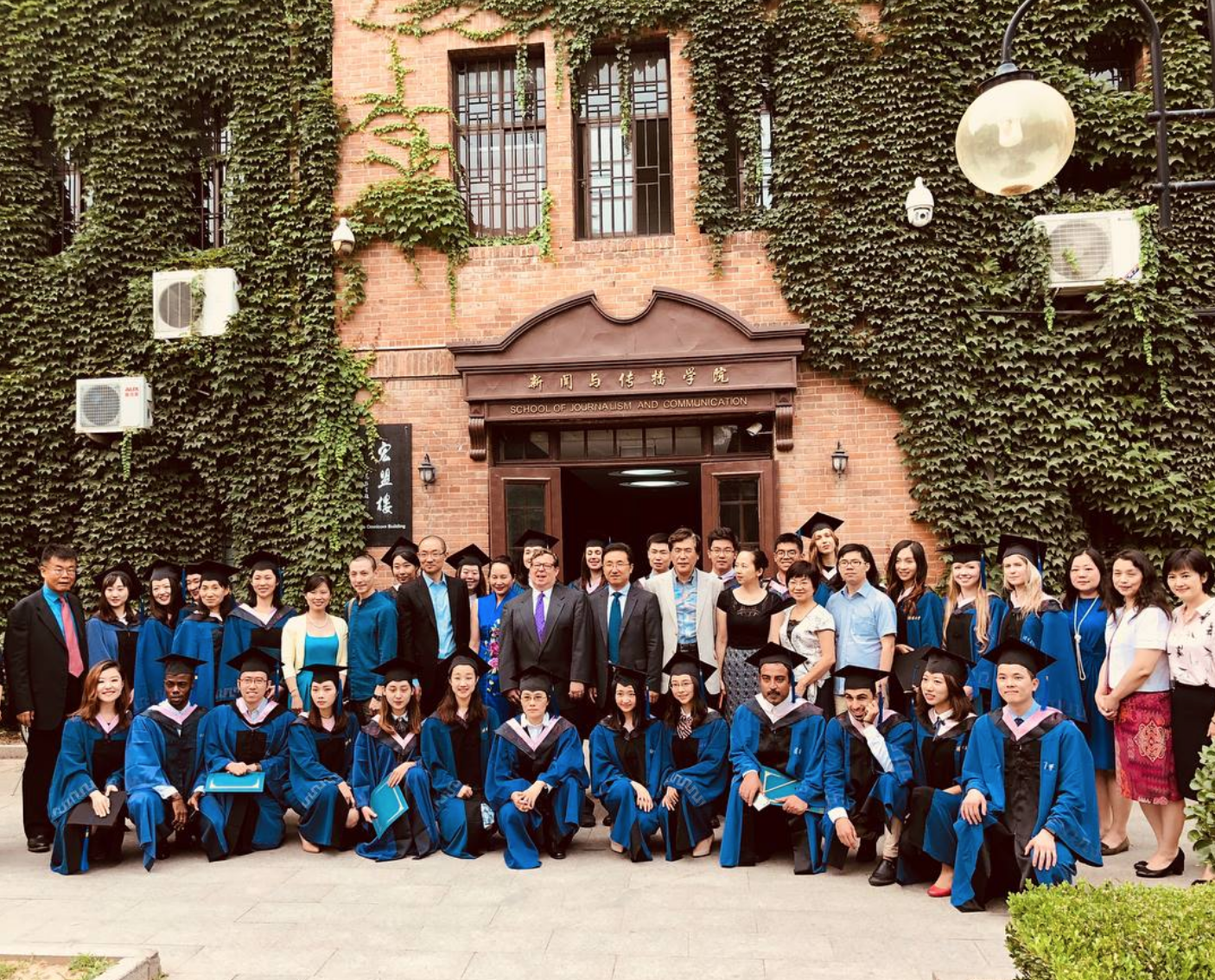
GBJ graduates pose outside of the School of Journalism and Communication
Rapid advances in Artificial Intelligence technology give journalists “great reason to be optimistic about the future” of an industry that has struggled with declining audiences and revenues for the past decade, John Liu, Bloomberg News Executive Editor for Greater China, told 2018 Global Business Journalism Program graduates at the annual commencement ceremony on June 5.

John Liu addresses the 2018 GBJ commencement
Innovative media outlets such as Bloomberg News and The New York Times have harnessed the power of AI to improve the quality of their data analysis and to increase audience engagement by offering digital news stories of particular interest to each news consumer.
“Things are starting to get better know, because people are discovering that consumers are willing to pay for good content,” Liu said in an address at the Tsinghua School of Journalism and Communication. “The next big step, we believe, is AI telling you what you want to read, what you want to watch, before you know it’s there, even translating it into the language you want to read,” he said.
Sixteen international students were awarded master’s degrees in Global Business Journalism in a 90-minute ceremony, while 19 Chinese students received master’s certificates in addition to their master’s degrees from the Tsinghua School of Journalism and Communication.
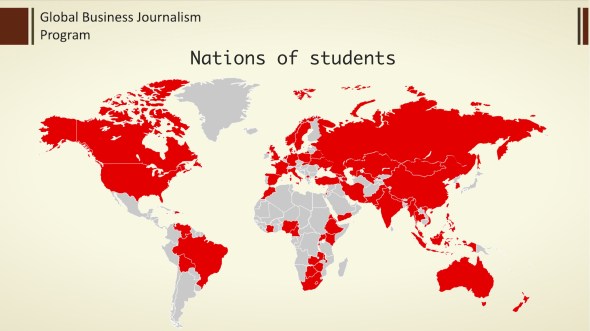
Students from 65 nations and regions have participated in the Global Business Journalism Program since its creation in 2007. This year, Icigumije Brice became the first GBJ graduate from the African nation of Burundi.
Dr. Hang Min, GBJ Co-Director and TSJC Associate Dean for International Affairs, said that at a time of “dramatic change in China and beyond” that it is important for young journalists to have “multiple perspectives” and to offer “constructive solutions and not just destructive criticisms.”
“Stay open,” she urged the graduates. “Never close any window of opportunity and never say no to something because it’s not your planned path.”
GBJ Co-Director Rick Dunham told the students and their families that the media industry needs to do more to boost the careers of women.
“In the GBJ program, about three-fourths of our students are women, and with rare exceptions, women are the top performers in our program. Yet many of these high achievers may face obstacles in the job market. Women suffer discrimination, overt and hidden, in hiring, promotion and pay,” he said. “We must overcome these insidious forms of male discrimination. In the words of the American civil rights anthem of the 1960s, ‘we shall overcome, some day.’”
Professor Dunham noted that TSJC “is leading the way in empowering women,” and Liu noted that five of the six GBJ grads hired by Bloomberg have been women.
“Not only is advancing women in the workplace the right thing to do, it is also good business,” he said.

Yuki Nakajima wrote the top thesis among international students.
Top GBJ students also offered their perspectives on the program. Speaking for the Chinese graduates, Zhu Yuxuan, hailed GBJ as “a great program for us to develop a global vision … while we are gaining professional knowledge.” International student Zhu Yuxuan, of Japan said GBJ “has allowed me to broaden my horizons and meet friends from all over the world.”
“Every day, we met talented and outstanding students from all over the world, and had the chance to interact with local Chinese students,” she said. “All of us played together, learned together, and progressed together over these two years, and I’m sure every one of us emerged as a better person than we were two years ago.”
Sarah Talaat of the United States, chosen as the GBJ speaker at the TSJC ceremony later in the day, said GBJ students were not only taught practical journalism skills, but also “how to pursue a career grounded in truth and patience, brought about by hard work and dedication, and held to the highest standards of our chosen fields.” She predicted that the program’s sponsors “will see a return on your investments in the shape of better journalism and communication for the benefit of the world.”
Speaking for GBJ graduates was Grace Shao of Canada from the Class of 2015, who worked at CGTN for two years and is returning to academia this fall to study data journalism at Columbia University in New York. Shao, who covered top global economic issues and developments in Korea during her time at CGTN, urged graduates to “undersell yourself” and take care of their health.
“This industry isn’t for the meek,” she said. We have to be on our toes at all times; you have to have writing skills, multimedia skills, analytical skills, people skills, presentation skills, and so on, I can’t think of a job that demands a more well-rounded candidate. Believe in your talents and all that you’ve learned here from your Tsinghua professors!”
Top TSJC officials taking part in the ceremony included Executive Dean Chen Changfeng, Administrative Dean Hu Yu and Administrative Dean of Research Shi Anbin. Professor Zeng Fanxu was honored as top academic supervisor. Graduating students Li Chengzhang, Shi Lin, Quan Yue, Yuki Nakajima and Linda Lew received special awards for their contribution to the GBJ program.
GBJ Commencement Address: It’s time to end sexism in journalism. Now.
Posted: July 5, 2018 Filed under: Global Business Journalism, Journalism Training, Rick in the news | Tags: academic freedom, Australia, Azerbaijan, Barrows Dunham, Betty Millard, Burundi, Chen Changfeng, China, civil rights, Confucius, cross-cultural, cross-cultural experiences, Dai Jia, discrimination, Fan Hong, feminism, GBJ, Global Business Journalism, Global Business Journalism Program, Hang Min, hiring, ICFJ, International Center for Journalists, Japan, Journalism, Joyce Barnathan, Korea, Malaysia, Man Against Myth, New Zealand, Pakistan, Rose Li, Russia, sex discrimination, sexism, Singapore, Thailand, Tsinghua University, TSJC, Twitter, United States, We shall overcome, Woman Against Myth 1 Comment
GBJ co-directors Hang Min and Rick Dunham on graduation day, 2018.
Here is the complete text of my commencement address to the Global Business Journalism graduation ceremony at Tsinghua University on July 5, 2018.
大家好。Добрый день. Welcome.
I am honored, on behalf of the International Center for Journalists and the international faculty of the Global Business Journalism Program, to congratulate all of you on your successful completion of your studies.
This special group includes some of the best young journalists in China, along with a diverse mixture of nations: Japan, Russia, Australia, Malaysia, Singapore, Thailand, Korea, Pakistan, Burundi, Azerbaijan, New Zealand, and the United States. Some of you already have made a mark on the world of business journalism during your Tsinghua years. I have great confidence that even more of you will have an impact in the years to come.
Since 2007, the Global Business Journalism program has improved the quality of journalism – and public understanding of business and economic issues – in China and around the world. You have benefited from cross-cultural learning, practical journalism training, and a varied curriculum featuring both Chinese and international professors at one of the world’s great universities.
In the GBJ program, about three-fourths of our students are women, and with rare exceptions, women are the top performers in our program. Yet many of these high achievers may face obstacles in the job market. Women suffer discrimination, overt and hidden, in hiring, promotion and pay. In many countries, it is acceptable to deny jobs or promotions to women because the employer fears they will become wives and mothers, and will not be as committed to their day jobs as men.
Subtle forms of discrimination continue to subvert women’s empowerment even in so-called progressive countries. A recent study of Twitter use by American political reporters found that of the 25 reporters who received the most social media replies from male political reporters in the United States, zero were women. And whose posts did male reporters share? Only three of the 25 most frequently shared reporters were women. It’s no surprise that the vast majority of “experts” quoted by male reporters tend to be male. It’s time for change.
Joyce Barnathan, president of the International Center for Journalists, was one of 10 prominent media leaders who last month proposed 14 steps to combat industry sexism. “It’s time to stop talking about the need for equality and start actively reforming the industry,” Joyce and the other leaders wrote.
We must overcome these insidious forms of male discrimination. In the words of the American civil rights anthem of the 1960s, “we shall overcome, some day.”

Barrows Dunham
My grandfather, Barrows Dunham, a philosopher, author and professor, wrote a book in 1947 entitled “Man Against Myth.” It analyzed social myths that powerful forces employ to maintain their power.
But a feminist author, Betty Millard, was unimpressed by the title, “Man Against Myth,” and produced her own tract in response: “Woman Against Myth.” She decried the cultural and religious customs cited to subjugate women around the world.
As Millard noted, Confucius wrote many centuries ago: “It is a law of nature that women should be kept under the control of men and not allowed any will of their own.” Confucius, without doubt, was a great man. But he was not always right.
Sadly, Millard’s analysis is still relevant today. A GBJ student, in his thesis this year, argued that Islamic feminists believe that “women’s struggle for equality with men is doomed to fail, as women are placed in ‘unnatural settings’ where they are denigrated and burdened with paid work on top of domestic labor.”
I believe in academic freedom, but I do not agree with the sentiments expressed in this quotation.
Fortunately, the Tsinghua School of Journalism and Communication is leading the way in empowering women. Our executive dean, Dr. Chen Changfeng, is a brilliant scholar and inspirational leader. Our associate dean for international affairs, my friend and GBJ co-director Dr. Hang Min, has earned a global reputation for media management and cross-cultural partnerships. Doctors Fan Hong and Dai Jia are popular GBJ professors, and Li Laoshi, Rose Li, is our indispensable international administrator. And more than half of the keynote speakers at our annual Tsinghua Business Journalism Forums have been women.
You see, women can achieve, if given the opportunity and freed of institutional and societal constraints. I hope that all of you in the graduating class of 2018 take inspiration from the accomplishments of your professors and your peers. It is sometimes harder for women to succeed in journalism. That’s the reality. Men still run most news organizations, and men make most of the hiring decisions. But through persistence and sheer excellence, women are gaining ground. I hope to live long enough to see some of you lead the journalistic, economic and even political worlds of the 21st century.
I close by quoting my favorite philosopher, my grandfather, Barrows Dunham. During a lecture in Massachusetts, he expressed optimism about the battle for social progress. “Even now,” he said, “we ourselves are determining the future, not by knowing what it will be, but by conceiving of what it can be.”
I look forward to you determining the future and changing our world. I will cherish your future achievements, unfettered by ancient superstitions and prejudices. Please stay in touch.
谢谢, 大家。Большое спасибо. Thank you.
Come join us! Global Business Journalism students offer tips on navigating the Tsinghua application process
Posted: January 10, 2018 Filed under: Global Business Journalism, Journalism Training | Tags: Beijing, best business journalism programs, best journalism programs, Bloomberg News, Bothle Dikobe, Botswana, China, Come join us, GBJ, Global Business Journalism Program, ICFJ, International Center for Journalists, journalism education, master's programs in journalism, top journalism programs, Tsinghua School of Journalism and Communication, Tsinghua University Leave a commentCome join us!
Global Business Journalism Program student journalist Botlhe Dikobe of Botswana produced this engaging video to celebrate the completion of her first semester in the Global Business Journalism Program. It has tips from current students on how to apply for our English-language master’s program at Tsinghua University, and what’s in store for you if you’re accepted.
Remember, our program is a partnership between the International Center for Journalists, the pre-eminent journalism training organization in the world, Bloomberg News, the most respected source of business news and data, and Tsinghua University, China’s top university.
Please share this with your family and friends as we build our community and seek more great applicants for the 2018-19 academic year. The deadline for early admission applications is January 15. The final deadline is March 1. An earlier application improves your chances of receiving a scholarship.
For more information on the program: https://rickdunhamblog.com/2017/11/20/apply-now-for-the-global-business-journalism-program-tsinghua-university/
Video: Why the GBJ program is a great choice for a master’s program: https://rickdunhamblog.com/2017/01/18/video-why-the-global-business-journalism-program-at-tsinghua-is-a-great-choice-for-graduate-school/comment-page-1/#comment-2301
Meet GBJ’s students (video): https://rickdunhamblog.com/2018/01/08/meet-the-students-who-make-global-business-journalism-the-best-program-of-its-kind-in-the-world/
Apply here: http://gradadmission.tsinghua.edu.cn

Meet the students who make Global Business Journalism the best program of its kind in the world
Posted: January 8, 2018 Filed under: Global Business Journalism, Journalism Training | Tags: Beijing, best business journalism programs, best journalism programs, Bloomberg News, Bloomberg TV, Bloomberg TV Mongolia, China, GBJ, Global Business Journalism Program, ICFJ, International Center for Journalists, journalism education, master's programs in journalism, Naanga Enkhtur, Narantungalag Enkhtur, top journalism programs, Tsinghua School of Journalism and Communication, Tsinghua University 1 CommentGBJ student Narantungalag Enkhtur, a former Bloomberg TV Mongolia reporter, produced a video that allows you to meet current students from Africa, Europe, Asia, Australia and America and hear them explain what that they are learning in this world-class program at China’s top university.
GBJ was created in 2007 by Tsinghua and the International Center for Journalists, a Washington-based nonprofit organization that is committed to journalism excellence and training around the world. Bloomberg News is the program’s chief sponsor.
The first round of applications for September 2018 admission is open until January 15, 2018. The second round of applications runs from January 16, 2018 to March 1, 2018. An earlier application improves your chances of receiving a scholarship.
For more information on the program: https://rickdunhamblog.com/2017/11/20/apply-now-for-the-global-business-journalism-program-tsinghua-university/
Apply here: http://gradadmission.tsinghua.edu.cn
Timeline: Earth’s average temperature since the last Ice Age
Posted: November 30, 2017 Filed under: Journalism Training | Tags: average temperature, climate change, CO2, Earth, Earth's average temperature, GBJ, glaciation, Global Business Journalism, Global Business Journalism Program, global warming, graphics, history, human civilization, Ice Age, industrial revolution, Master of Global Business Journalism, master's programs in journalism, Multimedia Business Journalism, multimedia graphics, multimedia journalism, news graphics, polar melting, Pollution, timeline, timelines, Tsinghua University, world history Leave a commentI teach my multimedia students in the Global Business Journalism Program the importance of using graphics to tell stories. Timelines are one of the most effective narrative storytelling tools. This is one of the best timelines I’ve ever seen. It’s a history of Earth’s average temperature since the last Ice Age glaciation. Scroll to the end for a surprise. (Well, it’ll be a surprise to some of you.)
Thanks to xkcd for creating this ingenious timeline. It is reproduced under a Creative Commons Attribution-NonCommercial 2.5 License.

Apply now for the Global Business Journalism Program, Tsinghua University
Posted: November 20, 2017 Filed under: Global Business Journalism, Journalism Training | Tags: application, Bank of America, best business journalism programs, best journalism programs, best universities, Bloomberg News, business journalism, CCTV, cross-cultural, cross-cultural communication, cross-cultural experiences, GBJ, Global Business Journalism, Global Business Journalism Program, global economy, ICFJ, intercultural communication, International Center for Journalists, International faculty, international relations, international trade, Lee Miller, M.A., M.A. in journalism, Ma Chengcheng, Master of Global Business Journalism, master's programs in journalism, Min Hang, Reuters, Rick Dunham, Sarah Ma, scholarships, Schwarzman College, top business journalism programs, top journalism programs, top universities, Tsinghua application, Tsinghua School of Journalism and Communication, Tsinghua University, Xinhua News Agency 2 Comments
The Global Business Journalism Program at Tsinghua University, a partnership with the International Center for Journalists and Bloomberg News, is the most prestigious English language journalism program on the Chinese mainland.
International graduates of the two-year program receive an M.A. in Global Business Journalism from the Tsinghua School of Journalism and Communication, one of the top journalism schools in Asia.
The program is a cross-cultural educational experience featuring some of the best journalism students in China, along with a selection of elite business, journalism and international relations graduates from around the world. Students from more than 60 nations have participated in the program over its first decade. We welcome your application. The first round of applications is open until January 15, 2018. The second round of applications runs from January 16, 2018 to March 1, 2018. An earlier application improves your chances of receiving a scholarship.
Please contact me at rickdunham@aol.com if you have questions. Here’s the official information from GBJ.
For more information about the program, please visit the GBJ website at:
http://gbj.tsjc.tsinghua.edu.cn/publish/jcgbj/index.html
Application Website:
For an application, please visit the Application Website at:
http://gradadmission.tsinghua.edu.cn
3) Academic transcript.
4) Two academic recommendation letters from scholars of associate professorship or higher. They must include the referee’s phone number and email address on the letter.
5) For non-English speaking students, please provide English level certificates. e.g. TOEFL, IELTS, etc.
6) A copy of your passport page with personal information (personal and ordinary passport).
7) For detailed information about scholarships, please visit: http://is.tsinghua.edu.cn.
8) A non-refundable application fee of RMB600.

Application Procedure
Complete Online Application on the website:http://gradadmission.tsinghua.edu.cn.Step 2: Application Fee Payment
There are two ways to pay the application fee:
1. Pay online using a credit card
After your online application form is verified and the materials are received by Tsinghua University, you will be given a choice to pay the application fee via online payment draft or via the online application system.
2. Pay in cash at the Foreign Student Affairs Office (Room 120,Zijing Building 22) on the campus of Tsinghua University.
Accidental Injury and Hospitalization Insurance: RMB 600/year.Please visit http://is.tsinghua.edu.cn for more information about scholarships.
GBJ’s 2017 incoming class visits Bloomberg News, Beijing
√ Valuable learning experiences. The full-time program spans two years of intense, fast-paced, rewarding study. Those who complete it successfully emerge with valuable connections, a rich array of opportunities and the business and journalism skills to capitalize on them. It is a two-year experience that will last a lifetime.
√ Specialized courses. GBJ offers an array of specialized courses that are at the forefront of global business journalism. Students can learn about international accounting standards, multimedia journalism, data mining, complex financial derivatives, journalism ethics, advanced feature writing techniques and the management of media organizations – knowledge that is transferable to other economies and other professions. At the same time, they gain a deeper knowledge of the Chinese language and economy.
√ International faculty. All GBJ courses are taught in English by internationally renowned scholars and accomplished journalists with extensive global experience.
√ Digital facilities. The program’s facilities rival those of other leading journalism schools worldwide. The news lab has the largest number of Bloomberg terminals donated to any university in the world.
√ Program partners. Tsinghua University has teamed up with the U.S.-based International Center for Journalists (ICFJ) to build GBJ. Other partners include Bloomberg News, Bank of America and the Knight Foundation. Visiting scholars have worked at prominent global media and financial-information companies such as Bloomberg, Reuters, The Wall Street Journal, Business Week, The New York Times, The Financial Times, CNN and The Washington Post.
√ Unique resources. The GBJ program benefits from other academic resources on the Tsinghua campus, including its prestigious School of Economics and Management and the Schwarzman College, as well as many Chinese and global media and technology companies in Beijing. Internships, field trips and recruiter visits are integral parts of the program.
√ Job Opportunities and Networking. Graduates of the program are working in a number of major media organizations such as Bloomberg, Reuters, CCTV and Xinhua News Agency. Others have landed communications positions at companies such as Ogilvy China and Bank of America, as well as technology and financial companies, Chinese government ministries and international organizations.
GBJ students have opportunities to attend conferences on new media, economic development and other business topics. They benefit from meetings and discussions with guest speakers, including top editors and reporters from leading Chinese and Western news outlets and international business executives. The GBJ has developed a growing network of smart, sophisticated reporters, editors and public relations professionals who can enhance the world’s understanding of economic and corporate developments in China and globally.
Ms. Ma Chengcheng (Sarah Ma)
Room 302, Omnicom Building, School of Journalism and Communication
Tsinghua University, Beijing 100084, P. R. ChinaTel: +86 10 6279 6842
Fax: +86 10 6277 1410
E-mail: tsjcws@mail.tsinghua.edu.cn
Website:http://gbj.tsjc.tsinghua.edu.cn
Trump’s NAFTA gamble: A quick cost-benefit analysis
Posted: October 14, 2017 Filed under: Breaking news, Rick in the news, U.S. politics | Tags: Canada, CCTV, CGTN, Donald Trump, Mexico, NAFTA, Tian Wei, trade, U.S. economy, World Insight Leave a commentHere’s my quick take on Donald Trump’s hard-line negotiating style with Canada and Mexico over the future of the North America Free Trade Agreement. Trump thinks that he can wring concessions out of America’s two neighbors that would bring manufacturing jobs back to the United States. It’s a very big gamble: The automakers might just build the cars elsewhere.
Here’s the video clip from CGTN’s World Insight with Tian Wei. Just click on the embedded link:
#Nafta on the chopping block? US President Donald #Trump seeks a better deal for the US from neighbors Canada and Mexico pic.twitter.com/hFQFpJvjVG
— World Insight (@worldinsightTW) October 13, 2017

 Rick Dunham Blog
Recent Comments