Day 3 Analysis: The 2020 GOP race begins
Posted: July 21, 2016 Filed under: U.S. politics | Tags: 2016 presidential race, American politics, Chris Wilson, Cleveland, David Frum, Donald Trump, Erick Erickson, Lee Harvey Oswald, Marco Rubio, Mike Pence, Peter King, Politico, Scott Walker, Sheldon Adelson, Ted Cruz Leave a comment
Cruz in Cleveland: The 2020 campaign begins.
The 2020 Republican presidential race began on a fractious and flummoxing night in Cleveland, one day after a deeply and bitterly divided party formally selected its 2016 nominee.
Four of the most likely contenders for the party’s nomination in four years spoke to the delegates at Donald Trump’s convention and laid out their cases for the post-Trump Republican Party, even before the current nominee is scheduled to deliver his acceptance speech on Thursday.
The quartet — vice presidential nominee Mike Pence, presidential runner-up Ted Cruz, presidential flameout Scott Walker, and remote-control speaker Marco Rubio — all took different paths to the podium and aimed their remarks at different audiences.
Pence was the loyal lieutenant to Donald Trump. The Indiana governor once supported Ted Cruz, but he switched teams after Trump’s triumph and urged other Republicans to do it. His gracious, low-key approach will endear him to die-hard Trump loyalists and to congressional Republicans who are not (and never have been) enamored with Trump.
Walker urged the party to unite, but mostly repeated his pro-business, anti-Washington talk that has made him a hero in anti-union circles but didn’t resonate particularly well with the working-class white voters who this year seized control of the Republican Party. His praise for Trump was tepid. “A vote for anyone other than Donald Trump is a vote for Hillary,” he told the delegates.
Rubio, as has been his style during his single term in the Senate, tried to have it both ways. He didn’t attend the convention — giving him a bit of distance from Trump, in case the GOP nominee eventually self-immolates. But his brief video remarks included all the right touches to win applause from the Trump loyalists in Cleveland. “The time for fighting each other is over,” said Rubio, who famously described Trump as a small-handed “con artist” and “the most vulgar person ever to aspire to the presidency.” That was then, this is now: “It’s time to come together,” he told delegates.
That message didn’t reach Ted Cruz. The Texas senator, dubbed “Lyin’ Ted” by Trump, couldn’t bring himself to endorse the nominee. Cruz, whose father was linked to Kennedy assassin Lee Harvey Oswald by Trump, gave a Reagan-like conservative call to arms. He talked conservative principles. He didn’t talk Trump. He didn’t endorse Trump’s policies or his candidacy. He said to Americans, “Vote your conscience.” He was heckled during his speech. He was booed as he left the stage.
It was a calculated gamble with his national political future hanging in the balance. If Trump manages to win the election, Cruz is going to be a non-person in Donald Trump’s Washington. The Senate leadership, Republican and Democrat, despises him and the president would, too. If Trump loses, Cruz has already volunteered to lead the ragged Republican survivors.
In the meantime, he’s a non-person in Trump World. Even Las Vegas casino magnate Sheldon Adelson disinvited Cruz to his convention suite, with associates telling CNN that he didn’t want to be an anti-Trump prop at this point.
The reaction from Republicans was varied, but it was almost all emotionally charged, positively and negatively.
Of note, Ted Cruz is getting praised from both the left and right of the GOP, but not from the establishment. Perfect set up for 2020.
— Erick Erickson (@EWErickson) July 21, 2016
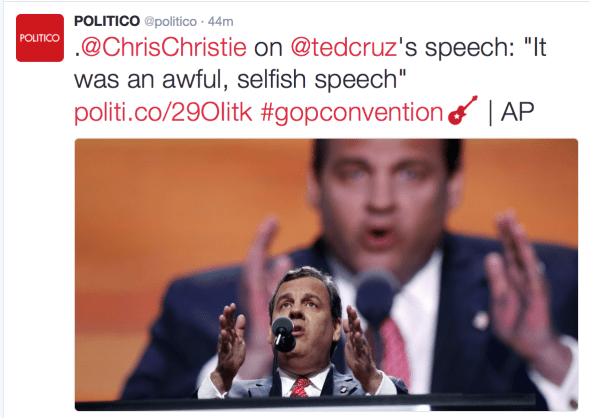
Not hard to find CRUZ delegates who think he lit his career on fire
— Steven Dennis (@StevenTDennis) July 21, 2016
Representative Peter King of New York, an enthusiastic Cruz hater, piled on.
“To me, Ted Cruz showed America what he really is,” King told NBC in a post-speech rant. “He’s a fraud. He’s a liar. He’s self-centered. He disqualified himself from ever being considered for president of the United States.
“He took a pledge to support the nominee. Today the Ted Cruz that I’ve known — he cannot be trusted and he’s not a true Republican. He’s not a true conservative. I never saw as much outrage on the floor as I did tonight.”
King’s views are widely held among moderate Republicans and Trumpistas, but Cruz is confident there is a path to victory following a Trump defeat. Like Ronald Reagan following his 1976 loss to Gerald Ford, Cruz sent a clear signal that he will keep on running, even if it means challenging an incumbent President Trump in four years.
But not every Republican shares King’s contempt for Cruz. The Texas firebrand is hoping that people like David Frum will help him rebuild the Republican Party from the rubble of Trump — if it is indeed rubble come November.
Ted Cruz earned the most honorable boos at a GOP convention since those for Nelson Rockefeller for condemning the John Birch Society.
— David Frum (@davidfrum) July 21, 2016
I have never been more proud to work for Ted Cruz that I was tonight. This speech will survive the test of time-historically courageous.
— Chris Wilson (@WilsonWPA) July 21, 2016
//platform.twitter.com/widgets.js
For one day, at least, Ted Cruz got what he wants. We’re talking about him and not about Donald Trump. And we’re talking about him as the post-Trump voice of the GOP. That’s what most reporters are writing today. But remember the other three 2020 candidates who also auditioned for the next nomination on a crazy night in Cleveland.
Day 2 Analysis: Job One? Beating Clinton
Posted: July 20, 2016 Filed under: U.S. politics | Tags: 2016 presidential race, Amanda Carpenter, American politics, Andrew Sullivan, Barack Obama, Ben Carson, Benghazi, Chris Cox, Cleveland, Donald Trump, Donald Trump Jr., Erick Erickson, Harry Reid, Hillary Clinton, Islam, Nate Silver, National Rifle Association, Nick Confessore, NRA, RedState.org, Reince Preibus, Republican National Convention, Rudy Giuliani, Scott Baio, Shelly Moore Capito, Tiffany Trump Leave a comment
There were some politically effective speeches on Tuesday, but inattention to detail and sloppy clock management hurt Team Trump. (Frame grab from Washington Post livestream)
Day 2 at the Republican National Convention was billed as jobs night: “Make America Work Again,” in Trump-speak.
But there only seemed to be one job that convention speakers cared much about: Donald Trump’s.
More precisely, the theme was to make sure that one American is unemployed come January: Hillary Clinton.
Benghazi, Lucifer, Clinton emails, Harry Reid, Barack Obama, even recycled 1960s radical Saul Alinsky. “Lock her up,” the delegates serenaded Hillary Clinton, again and again.
A long night of primetime speeches, but not a single plan from Trump to create American jobs. Except at Trump Winery in Virginia.
That led a former Ted Cruz staffer to tweet this:
Unless Trump is going to make America work again by making Republicans prison guards for Democrats, I don’t know what the big jobs plan is.
— Amanda Carpenter (@amandacarpenter) July 20, 2016
Some establishment speakers such as Senate GOP leader Mitch McConnell and House Speaker Paul Ryan barely mentioned Trump. (Maybe that’s part of the reason why they were booed by many Trump delegates.)

From New York Times live feed
The ongoings in Cleveland led Erick Erickson, founder of RedState.org, to write that GOP establishment Trump apologists have been reduced to declaring that their nominee is “better than Clinton.”
More to the point, they mean “less bad than Clinton.”
Time management of the convention continues to be dreadful. Some of the most effective speakers — Tiffany Trump (who used anecdotes to humanize her father), National Rifle Association lobbyist Chris Cox (who built a policy case for why electing Trump matters) and McConnell (who skewered Clinton time and again with embarrassing examples from her past) — were pushed out of the live-TV 10 p.m. hour for a soap opera actress and 2016 also-ran Ben Carson. And the winery woman. That looked more like an infomercial than a political convention.
“Whoever organized this event would be fired from a regional sales conference,” tweeted Andrew Sullivan.
By the way, did I forget to tell you that Donald Trump and Mike Pence were officially nominated for president and vice president?
That got lost in the ad hoc scheduling stew.
It’s important to note that candidates are only graded by the media for hewing to political traditions. Trump is unlike any other presidential nominee ever, so it may not be fair to judge him by historical standards. After all, he has turned history on its head over the past year. So I think it’s necessary for all of us to put ourselves inside the heads of undecided voters or reluctant Republicans.
What is the best way for Trump to defeat Hillary? It’s to destroy her. He’s the most unpopular presidential nominee in the history of polling, so he’s not going to convince the doubters that he’s a good guy. That’s why he’s enlisted Rudy Giuliani and Chris Christie and Shelly Moore Capito and Mitch McConnell and Scott Baio and many more, to try to shred what’s left of Clinton’s credibility.
That process takes more than one speech. It is an accumulation of days (or weeks) of disciplined attacks.
Does Team Trump have the skill and the discipline to pull it off? Can establishment figures such as Republican National Committee Chairman Reince Preibus and McConnell play constructive (or is it destructive) roles? That’s what the rest of Trump’s convention week is about.
Day 1 Analysis: What else could go wrong for Trump? (We have 3 days to find out)
Posted: July 19, 2016 Filed under: U.S. politics | Tags: 2016 presidential race, American politics, Cleveland, David Frum, Donald Trump, George W. Bush, Hillary Clinton, Hubert Humphrey, Jodi Ernst, Linda Lingle, Mayor Daley, Melania Trump, Michelle Obama, MSNBC, Paul Manafort, plagiarism, Reince Preibus, Republican National Committee, Republican National Convention, Republican Party, Rob Portman, Rudy Giuliani, Steve King 1 Comment
Empty seats during Senator Joni Ernst’s speech.
A national presidential nominating convention is supposed to help the party’s candidate win the general election.
Since I started watching political conventions in 1968 (and attending at least one each campaign since 1976), there have been only two exceptions: the 1968 Democratic disaster in Chicago, and the 1972 Democratic chaos-fest in Miami.
After one day, I’m prepared to say that the 2016 Republican National Convention in Cleveland could join this short and ignominious list.
Day One of the GOP convention did nothing to help Donald Trump appeal to undecided voters. It did nothing to reassure wavering Republicans or independents who dislike both GOP nominee-to-be Donald Trump and Democratic nominee-in-waiting Hillary Clinton.
And that was before the plagiarism thing.
From the early morning, the Trump campaign seemed to be trying its best to sabotage its stated Day One message of national security. At a breakfast meeting with reporters, its campaign chief picked an unnecessary fight with Ohio Gov. John Kasich by insulting the popular governor of a state he needs to win to have any plausible shot at an Electoral College majority. Paul Manafort’s unforced error drew a fast and furious rebuke from the Ohio Republican Party chair. Suffice it to say that Ohio Republicans will concentrate their efforts and passions on re-electing endangered incumbent Sen. Rob Portman now, rather than the presidential race.

It was “Make America Safe Again” night. Do you think it was effective?
Later in the morning, in an episode I missed until it was pointed out on Twitter by ex-Bush speechwriter David Frum, Team Trump forced the GOP to tear up its platform to excise a section that might ruffle the feathers of one Vladimir Putin. Kowtowing to the Russian leader is not exactly the image of strong American leadership. Hard-core Trumpistas won’t care, but undecided voters won’t be impressed.
To further alienate Jewish voters, the Republican National Committee had to shut down a convention live chat during a speech by former Hawaii Governor Linda Lingle (who happens to be Jewish) when it was bombarded by pro-Trump, pro-Hitler, profanely anti-Jewish ranters, according to a report in the Times of Israel.
And then there was a white supremacist riff from Iowa Congressman Steve King, who belittled all contributions to global civilization from non-white, non-Christian humans. “Where did any other subgroup of people contribute more to civilization?” he asked on MSNBC, setting off a hourlong tweet storm in the Twitterverse.
Before the prime-time speeches, Republicans had a Democrat-like rumble over convention rules. It reminded me a little of Chicago 1968, when Mayor Daley had the microphones turned off on anti-war, anti-Humphrey delegations. Republican National Committee Chairman Reince Preibus’ team played hardball to prevent an actual recorded vote that would have shown the world the level of dissatisfaction with Trump among convention delegates.
You have to divide the evening session into three parts: pre-Melania, Melania and after Melania.
Pre-Melania was red-meat rhetoric for Trump Lovers and Hillary Haters. Also birthers. One speaker said Obama was certainly a Muslim. Several called for throwing Clinton in jail. Rudy Giuliani is passionate, and he hates Hillary Clinton, but there’s nothing he said that would convince wavering voters why they should vote for Trump. Indeed, I didn’t hear a single Trump policy initiative from any speaker.
Post-Melania was a sleeping pill for America. Rising star Senator Joni Ernst of Iowa was pushed out of prime time by a rambling, never-ending speech by an obscure military guy named Flynn. Don’t think this will launch a speaking career for him. And Ernst, speaking to a mostly empty auditorium, gave her normal stump speech, evoking the parallel political worlds Republicans live in. Just watching the early lines to the exits, you can see that this is not a Republican national convention, it is the Trump national convention. Many Trump delegates don’t care about Republican rising stars. Only Trump.
Finally, Melania, the most important speaker of the night. I liked the speech. It was well-written. It was human. It was plagiarized.
The part about honesty.
Oops.
To all the Trump backers who tweeted that Melania will bring class back to the White House after eight years of Michelle Obama, all I can say is … I don’t really have anything to say.
I had forgotten that Mrs. Obama said many of the same words in a similar introduction-to-the-nation speech eight years ago. In the afternoon, Mrs. Trump boasted in an interview that she had written almost all of her speech. By the end of the evening, Team Trump released a curious statement citing a “team” of speechwriters.
As the aforementioned Hubert H. Humphrey once remarked, “To err is human. To blame someone else is politics.”
Day Two. What else could go wrong?
I will be analyzing the convention on CCTV’s World Insight program at 10:15 a.m. EDT/9:15 EDT on Tuesday. Tune in for a live discussion.
Who are the undecided voters in 2016? Mormon women, wealthy Latinos, Midwestern white women
Posted: July 7, 2016 Filed under: Dunham's Discourses, The Index, U.S. politics | Tags: 2016 presidential race, American politics, Bernie Sanders, Democratic Party, Donald Trump, Hillary Clinton, Republican Party, Undecided voters Leave a comment Welcome to the third installment of The Index, a series of posts analyzing the latest polling data through the lens of 100 micro-targeted demographic groups. Today, we look at the voters who can’t make up their minds.
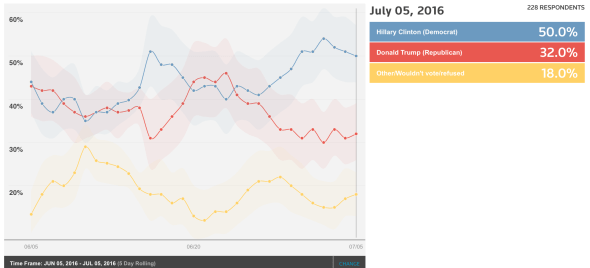
The presidential campaign polling has been remarkable stable over the past month — despite temporary blips — but the number of voters who are not supporting either Hillary Clinton or Donald Trump remains historically high for the summer before a presidential election.
On June 5, Hillary Clinton was leading Donald Trump in Reuters Polling, 40.9 percent to 30.9 percent — a margin of 10 percentage points.
On July 5, Clinton led the presumptive Republican nominee by 40.2 percent to 30.0 percent — a margin of 10.2 percentage points.
Both candidates declined a little over the month. Trump slipped a bit more than his Democratic rival. In some ways, the minuscule decline is good news for Trump. He had a horrendous month in “free media”: Jewish stars and white supremacist message boards; a quick trip to Scotland; a vice presidential search (and rescue) mission; more praise for Saddam Hussein’s murderous efficiency; and more former Reagan and Bush (41 + 43) officials endorsing Democrat Clinton. The controversies dinged Trump temporarily, but each time he seemed to bounce back to his core support, 10 points behind Clinton’s core.
Clinton also weathered a media storm over her email server and the final report of the Republican Benghazi committee. But the clouds over her candidacy are hindering her from pulling away from the most unpopular Republican presidential candidate since the invention of scientific polling.
Amid the two candidates’ troubles, the number of undecided voters — already higher than at comparable times in recent election cycles — continued to grow. These are the people who tell Reuters they support another candidate, favor “none of the above,” plan to stay home on Election Day, or refuse to answer the question. This “other” category ticked up from 28.2 percent to 29.8 percent — within the poll’s margin of error, but still the only number that has gone up since early June.
To get from 30 percent to 50 percent, Trump has to win about two-thirds of these up-for-grabs voters. So let’s look at our 34 “battleground” voting groups and see which of these blocs has the most undecided voters. You can decide for yourself if Trump is likely to win two-thirds of them.
Battleground groups with highest share in the “other” column:
- Mormon women 54% (Clinton leads by 4 points*)
- Latinos earning $100,000 a year and more 39% (Clinton leads by 41 points)
- Midwestern white women 39% (Trump leads by 7)
- Lean conservative 38% (Clinton leads by 4 points)
- Great Lakes states voters 35% (Clinton leads by 6 points)
- All women 33.7% (Clinton leads by 7 points)
- White men under age 30 32% (Clinton leads by 4 points)
- Midwestern voters 31.8% (Clinton leads by 6.5 points)
- White voters under 40 31.1% (Clinton leads by 24.9 points)
- Single whites (never married) 30.9% (Clinton leads by 19)
Analysis: Mormon women can’t decide between two unpalatable choices. Trump has the support of only 10 percent of America’s wealthiest Latinos, but 39 percent still are not committed to either major-party candidate. Midwestern voters are the most volatile, with Midwestern women resisting Clinton but not fully embracing Trump. White men under 30 — the Bernie Sanders demographic — still have not moved to Clinton. But they haven’t gone to Trump, either.
Bottom line: More upside for Clinton among these voters, if she can close the deal. Trump can do very little to win many of these voters. They are there for Clinton to win or lose.
Now here are the battleground groups with lowest share in the “other” column:
- White Catholic men 13% (Clinton leads by 13 points)
- Whites earning between $75K and $100K 18% (Clinton leads by 18 points)
- Southern white men with college degree 20% (Clinton leads by 2 points)
- All men 20.7% (Clinton leads by 8.9 points)
- Voters earning $75K+ 22.2% (Clinton leads by 20.4 points)
Analysis: Men are more likely to have made up their minds already. And Clinton is doing surprisingly well among some unlikely blocs including Southern white men with college degrees and white Catholic men. If she were doing as well among white Catholic women as among men, she would have clinched the battleground states of the industrial heartland. Trump has lost upper-middle-class voters of all races and genders, and he’s losing college-educated voters, even in the South.
Bottom line: Most swing voters who’ve made up their minds have chosen Clinton.
While the overall “horserace” numbers haven’t changed in the past month, some of my 100 key demographic subgroups have shown movement. Here are some examples:

Trump has cratered among white voters under the age of 40. But 31.1 percent of them are in the “other” category.

While young whites despise Trump, white Baby Boomers are keeping Trump in the race with a double-digit edge over Clinton.
Clinton has opened up a big lead among upper-middle-class whites, voters with family incomes of between $75,000 and $100,000.

Trump has pulled ahead among divorced white people.
Previous posts:
>>>A look at 100 key demographic blocs, and how Trump and Clinton are faring among them
Methodology:
The Index analyzes the 2016 presidential election through the voting preferences of 100 different demographic blocs. Thirty-three of them are part of Donald Trump’s Republican base. Thirty-three of them are part of Hillary Clinton’s Democratic base. And 34 of them are battleground groups — keys to both candidates’ paths to the White House.
The information for the feature comes from Reuters’ polling data, which is available, open source, on the internet. I am using Reuters’ rolling five-day averages for most of my analysis. I chose Reuters’ numbers because the poll is respected, but, most of all, because the global news service makes the information available to anyone. You can check behind me to examine my methodology — or to create new searches of your own.
One small asterisk (*): Certain subgroups are too small to have a statistically significant counts on the five-day average. In the cases marked with an asterisk (*), I have included data for these groups from the past 30 days of polling. One warning: Subgroups are, by definition, smaller than the entire survey, so they have a larger margin of error and more volatility from survey to survey.
The changing South, the educational chasm and Latino backlash: 10 takeaways from a deep analysis of polling data
Posted: June 29, 2016 Filed under: The Index, Top Ten, U.S. politics | Tags: 2016 presidential race, American politics, Barack Obama, Democratic Party, Donald Trump, Hillary Clinton, presidential election, Republican Party, U.S. politics 2 CommentsEvery recent national poll agrees: Hillary Clinton is leading Donald Trump as the 2016 presidential campaign enters the sizzling summer convention season.
But, as we all know, because of America’s antiquated Electoral College, the national “horserace” numbers don’t tell us much about what’s happening at the grassroots level, where there are 50 state-by-state contests going on. That’s one of the reasons I launched “The Index” this week. Through a deep analysis of demographic subgroups, we can get a very good idea about the way the race is shaping up in certain regions (or even states) from the ground up.
There are some important findings, and some that may surprise you, about military families, empty-nesters, young white Southerners and prosperous Latinos. I identified big shifts among Latinos, northern working-class whites, and Mormons … not always in the same direction.
>>>A look at 100 key demographic blocs, and how Trump and Clinton are faring among them
Here are ten key takeaways from my analysis of the first round of data (taken from Reuters Polling’s five-day rolling average, June 20-24):
- Education is a key defining demographic in the 2016 election. American presidential election analysis was governed by economic determinism: the higher your income, the more likely you were to vote Republican. That’s not the case this year, when the poorest and the richest are most likely to favor Hillary Clinton over Donald Trump. The divide isn’t one of income in 2016, it’s educational attainment — for white people, at least. College graduates favor Clinton by 32.2 points. That soars to a 45-point lead among Americans with advanced university degrees. Among whites without a degree, Trump leads by 14.3 points, while minority voters without college degrees favor Clinton by 41 points. Trump’s lead among less-educated whites is largest in the industrial Midwest, where millions of manufacturing jobs once filled by Americans without college diplomas have been lost over the past four decades.
- The South is changing, and the way we think about Southern politics should change. There have been far too many stories about the Republicans’ “Solid South,” which is no more solid now than the Democrats’ Dixie was in the middle of the last century. President Barack Obama won Florida and Virginia twice and North Carolina once. Because of racial, educational and generational factors, the South could become even more competitive — and very soon. Yes, Trump is strong with less-educated and older white voters, particularly southern women without college degrees (+26 points). But young white southerners are a swing voting group. White southerners with college degrees, a growing vote bloc, are nearly evenly divided, with women slightly favoring Clinton. Even with Florida’s Cuban-American’s traditional ties to the GOP, Latino voters in the Southeast are strongly Democratic in 2016 (+24 points). With the growth of the Hispanic vote in Florida, Virginia, North Carolina and Georgia, the trend lines in all of these states are likely to move toward Democrats unless Latinos or young voters reverse course. States with smaller minority populations (Arkansas, Tennessee, Kentucky, West Virginia) will remain out of reach for the party of Obama and Clinton. But Florida, North Carolina, Georgia and South Carolina are slowly trending Democratic as a new generation replaces the Confederate flag wavers, and whites from the North migrate to the warmer climes of the Southeast.
- America’s industrial heartland is deeply divided by race, religion and education. As strange as it sounds, Donald Trump might have a better chance to win Pennsylvania this year than Florida. The reason is the changing demographics of the American heartland states running west from Pennsylvania to Iowa. These areas have large, traditionally Democratic Catholic populations, a higher proportion of older voters, and more whites without college degrees. All of those factors play into Trump’s current strengths. He leads among midwestern men without college degrees by 26 points, among white Catholics over the age of 40 by 12 points, and among white Catholic women by 5. Shifts among these groups put the Clinton campaign in the danger zone: She leads in the Midwest by just 4.9 points and in the Great Lakes states by 3 points, well below her national polling numbers. If current trends hold, Trump might “bet the ranch” on winning historically Democratic states such as Pennsylvania, Michigan and Wisconsin, along with Democratic-leaning swing states such as Ohio and Iowa. States with lower minority populations (Pennsylvania, Iowa and Wisconsin) may be particularly attractive to Team Trump. Clinton easily beats Trump among mainstream Protestant denominations here, but older white Catholics are a tougher sell.
- The Latino vote could bury Trump. I have suspected from the day Trump announced — when he called Mexicans criminals and rapists — that he was going to do worse than the 27 percent Mitt Romney received in 2012. After all of his talk of a wall on the U.S. southern border, the electoral reality is sinking in. Trump is losing every kind of Latino voter: young, old, liberal, conservative, Mexican-American, Puerto Rican, Dominican — even Cuban-American, which hasn’t ever happened before. He’s doing worst among Latinos in the Pacific region (California, Nevada), where Clinton has a 60-point edge. Say goodbye to Nevada, Donald. He’s 49 points behind among Latinos in the Southwest (Arizona, New Mexico, Texas) — more than twice the deficit GOP presidential candidates have faced in the past two decades. That takes New Mexico off the table for Trump and puts Arizona into play. Even in the Southeast, with a large bloc of Cuban-Americans in Florida, Trump is down by 24 points. Unless he improves his standing, that’ll make Florida all but impossible for him to win, it’ll complicate his efforts to hold the swing state of North Carolina, and it could even help put Georgia into play. How badly is Trump doing among Hispanic Americans? Latinos earning more than $100,000 per year — a swing voter bloc — now favor Clinton by 24 points. For Latinos, Trump may have done in 2016 what “America First” anti-Semites did for Jewish voters in the 1930s and Barry Goldwater did for African Americans in 1964: unite a voting bloc of disparate national origins and varying political philosophies. If this shift is lasting, it could be profound.
- The Generation Gap is back. There is a chasm between America’s oldest (white) voters and younger voters (of all races and ethnicities). But younger voters are far more anti-Trump than older voters are pro-Trump (or anti-Clinton). Whites over age 50 favor Trump by 5.9 points, while whites under the age of 40 favor Clinton by 1.2 points. The younger the voter, the more Democratic. White men under 30 give Clinton a 10-point edge. Among students of all races, Clinton tops Trump by 33 points. This is a problem for Trump in 2016. It is a problem for Republicans for a generation.
- A wide-open battle for the white middle class. Almost everyone in America claims to be a member of the “middle class.” But when you divide U.S. incomes into numerical ranges, the plurality of voters is between $50,000 and $100,000 a year. The candidate who wins most of these votes usually wins the election. Today, that candidate is Hillary Clinton, leading by 9.3 points (almost the same as her national lead). But among white voters earning $50-100K, Trump’s up by 2.7 points. The reason is his support from the lower half of the middle class, the group earning between $50K and $75K, where he leads by 5. As middle-class incomes rise, so does support for Clinton. Trump’s appeal is stronger to lower-income whites struggling with rising costs and stagnant wages. So it should be no surprise that Trump does better in areas with more lower-middle-class whites and fewer minorities.
- The new “soccer moms”? How about “the empty-nesters”? Political reporters love to humanize swing voter blocs. The soccer moms were the rage at the turn of this century. We haven’t come up with a new one yet, but for 2016, I’ll nominate “empty-nesters.” That’s mothers who don’t have any of their kids living with them. Because all minority moms are overwhelmingly Democratic, we’ll concentrate on white empty-nest moms. They are a swing group because young moms skew Democratic like all young voters. Middle-aged and older white women tend to be a bit more Republican than the entire universe of women voters. According to the late-June Reuters polling, Clinton leads among these “empty-nesters” by 2.8 points, less than her lead among all voters but better than Barack Obama did in his successful 2012 re-election race.
- Democratic dissatisfaction with Clinton and Republican concerns about Trump are canceling themselves out at this point. There have been lots of stories about conservatives angered by Donald Trump’s coarse behavior, his repeated denunciations of Bush-Cheney foreign policy, and his long-enunciated liberal beliefs on issues ranging from abortion to gay rights. There have been stories about moderate Republicans scared off by his xenophobia and racially tinged campaign rhetoric. There have been stories about Bernie Sanders supporters pledging never, ever to vote for Hillary Clinton. But the polling numbers don’t match the stories, at least at this point. Very few hard-core partisans have switched sides. Clinton leads by 68.2 points among Obama voters, and Trump leads by 67.6 points among Romney voters. Almost identical. There appears to be at least a small enthusiasm gap on the ideological extreme: Clinton leads by 59.4 points among very liberal Democrats; Trump’s lead among very conservative Republicans is “just” 45 points, with a large number parking in the undecided column.
- Military families are shifting toward Democrats. This is one trend story that has eluded the American political media. But it makes perfect sense. As more and more of the U.S. military is made up of women and minorities, the share of presidential votes won by Democrats is going up. Trump may have accelerated the shift by his unproven allegations that U.S. troops in Iraq had pocketed stolen loot after the overthrow of Saddam Hussein. Trump hasn’t helped with his repeated assertion that the U.S. military has been incompetent under Presidents Bush and Obama. The Reuters polling shows that active duty military personnel favor Clinton by 9.4 points, and the families of active duty military and veterans lean to Clinton by 9.6 percent. Trump still leads among veterans, a predominantly white group, by 5.7 percent.
- Trump indeed has a Mormon problem. Trump’s ongoing war of words with Romney, a leading Mormon politician, and his demonization of a religion (Islam) clearly contribute to his troubles with one of the most Republican voting blocs in the country. Romney beat Obama among Mormons by some 50 points. Trump’s lead, according to a month of Reuters numbers, is 13 points — and just 8 among Mormon women. This is unlikely to cause Trump to lose heavily Mormon (and very heavily Republican) Utah, but it could prove costly in nearby states with significant Mormon presences like Nevada, Arizona, Colorado and New Mexico.
These polling numbers reflect a snapshot in time, and they could change (again and again) between now and Election Day, November 8. But this kind of data analysis can help us understand what often is oversimplified in the “who’s up, who’s down” world of daily political coverage.
This analysis is part of a series that will continue through the election season.
Click here to see the data for all 100 blocs and demographic subgroups.
Explaining America to the world: I analyze Trump’s populist revolt for a Finnish audience
Posted: March 6, 2016 Filed under: Rick in the news, U.S. politics | Tags: 2016 presidential race, Aamulehti, American politics, Bernie Sanders, Big Business, Bill Clinton, China, Donald Trump, Europe, Finland, Franklin D. Roosevelt, George McGovern, Global Business Journalism, Hillary Clinton, Iran, Japan, Korea, Lannen Media, Matti Posio, Mexico, New Deal, Orson Welles, populism, reality TV, Republican Party, Ronald Reagan, Slovakia, Ted Cruz, Ulkomaat, United States, Vladimir Putin, Wall Street, Watergate, White House Correspondents' Association Dinner Leave a commentWhen I moved to Beijing in 2013 to explain global best practices in journalism to a diverse group of Global Business Journalism Program students, I had not expected that I also would frequently be asked to explain American politics and democracy to a global audience. I’ve been interviewed regularly in Chinese media, but also in European news outlets from Finland to Slovakia (plus the good old USA).
This week, I discussed the rise of Donald Trump with my friend Matti Posio, who heads up the national news operation for a group of Finnish newspapers, Lannen Media. Here’s a transcript of our conversation:
Q: You have met Donald Trump in person. Tell me about it.
I am one of thousands of people who has met Donald Trump at black-tie social events. For me, it was the White House Correspondents’ Association Dinner in Washington several years ago. He was cordial and polite, very different than his public persona. He was clearly a celebrity among celebrities. Reporters were coming up to him an asking if they could pose for photos with him. He was patient, unlike the hot-tempered character on the campaign trail. Nobody I talked to thought he would ever run for president. I really didn’t do more than exchange small talk. He seems comfortable with social conversation and, obviously, he has been going to formal events for a half-century. From my very short glimpse into his life, I would say that he is a very good actor playing certain roles that are expected of him at different times.
Q: I don’t see how anyone can actually be like that. Is his personality the same in real life than portrayed on media?
How many of us get to see him in “real life”? Real life is his life in his big mansion in Florida. Real life is his family. I can imagine Orson Welles playing the role.
Cruz + Trump = Volatile mix
Q: What is it that foreigners / Europeans really don’t get about Trump?
Do you mean, “Why is he getting so many votes? Why would anyone vote for him for president?” Politically, he is the right man at a very strange time in American political history. After two decades of anti-elitist rhetoric on right-wing talk radio and the Rupert Murdoch-owned conservative cable news network Fox, there is a large minority of the country that believes their way of life has been taken from away from them by the faceless “them” — minorities, immigrants, big companies shipping jobs overseas, corrupt speculators, too-big-to-fail banks, gays and lesbians, working women, feminists, or Big Government giving their tax dollars to undeserving others, Donald Trump is a reality TV performer and is playing to that audience. He is playing the role of populist demagogue, race-baiter, keeper of the working-class flame, proud leader of the “poorly educated,” ranter against the system and the elites and Wall Street and Big Business. So what if he is a son of privilege, a highly educated billionaire and someone who has played the system for years to make deals and make money.
Q: What are the main reasons he has become so popular?
He strikes a responsive chord with less-educated, lower-income white voters across the political spectrum. He is winning among moderate Republicans, conservative Republicans and Evangelical Christians.. He is even getting a modest share of higher-educated, higher-income voters. He is bringing new voters into the system, economically struggling people who thought they had no voice until Donald Trump appeared. While Trump moved relentlessly forward in a media frenzy, his opponents spent months destroying each other rather than going after him. His opponents sound like traditional politicians — which they are — at a time American voters yearn for the myth of “authenticity.” Trump is acting the role of “truth-sayer” supremely well, even if the fact-checking web sites say he is lying much of the time.
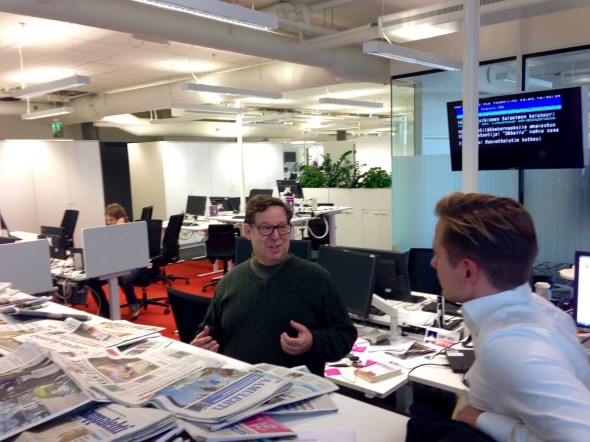
- Talking multimedia innovation at Lannen Media’s Helsinki offices last March
Q: He is behind both Hillary Clinton and Bernie Sanders for the real election. Could he still win?
When it is a one-on-one race, anything could happen. If there are independent candidates dividing the non-Trump vote, anything could happen. There has never been an election like this. Bill Clinton says he expects a close general election. Pundits, who have been wrong all year, are predicting a Trump defeat that costs Republicans control of the U.S. Senate. I’ve been predicting that the public will eventually tire of Trump and “cancel” his election-year reality TV show. But I’ve been wrong for months, along with my fellow political reporters and pundits. So, to repeat an American political cliche, never say never.
Q What would happen if he really became the president? How much would he change?
In recent days, his primary opponent rival Ted Cruz has claimed that Trump told the New York Times editorial board privately that he would act very differently as president than he has during the campaign, as least as far as immigration is concerned. None of us know. As a reporter, I’ve always said that the best way to judge what a politician will do after getting elected to office is to study what he or she promises during the campaign. We can’t read his mind. If he does everything he’s promising to do on the campaign trail, there will be a constitutional crisis and a global economic and diplomatic catastrophe. You’ll have the Putin-Trump axis versus the world. I can’t see it. He would have to change or he would be ineffective domestically and isolated internationally.
Q: Let’s assume he doesn’t become the president. Has he already achieved something, left a lasting mark in the country and its politics? What is it?
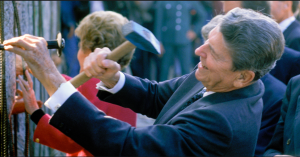
Dismantling the Reagan coalition
Yes, he has achieved something of historical significance. He has destroyed Ronald Reagan’s Republican Party. If he wins the nomination, the party of Reagan will have ceased to exist. It is the same thing that happened to the Democrats in 1972, when George McGovern won the presidential nomination and destroyed the four-decade-old New Deal coalition of Franklin D. Roosevelt. Although Democrats won the White House four years later because of Nixon’s Watergate scandal, it took them two decades to recover institutionally from the crack-up of 1972.
Q: You are currently a professor in China. What is told about Trump there? How much of it is true?
Trump has been portrayed in Chinese media as an eccentric, bombastic showman and celebrity. He’s seen more as a curiosity than a threat, so far, at least. Most people who are savvy about the United States ask me, “Could Trump be elected? Why would Americans vote for Trump?” It’s similar to questions people would ask you in Europe. The coverage of him on Chinese state television is generally straightforward, so far, at least. There has been a bit of negative editorial commentary in traditional state print media, but nothing nearly as inflammatory as what Trump has said about China. And Japan. And Korea. And Mexico. And Iran. And Europe. And Obama.
Q: Would you consider moving to China all together, should Trump be elected?
How about Finland?
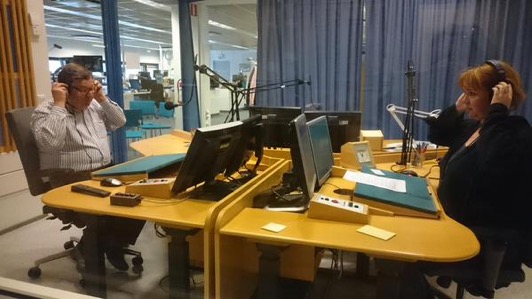
Taping an interview at YLE, the Finnish radio network
What would Reagan do? Here’s what he said about immigration, walls and open borders
Posted: February 29, 2016 Filed under: U.S. politics | Tags: 2016 presidential race, American politics, amnesty, Berlin Wall, Donald Trump, George H.W. Bush, immigration, Republican Party, Ronald Reagan 1 Comment
Reagan signed into law the bipartisan Simpson-Mazzoli Law that granted amnesty to millions of people living illegally in the United States.
Ronald Reagan was all about tearing down walls, as in Berlin.
But he also was against building them, as in Mexico.
With all of the heated political rhetoric about Mexico today, it’s a good time to revisit what presidential candidates Ronald Reagan and George H.W. Bush said about immigration as they debated each other during the 1980 campaign.
“Rather than talking about putting up a fence, why don’t we work out some recognition of our mutual concerns?” Reagan asked.
Bush tried to be even more pro-immigrant, noting at one point, “Part of my family is a Mexican.”
Listen for yourself. And ask yourself, “Would Ronald Reagan be welcome in today’s Trump-guided Republican Party?”


Ten terrible political journalism clichés — it’s a real game-changer
Posted: February 3, 2016 Filed under: Breaking news, Top Ten, U.S. politics | Tags: 2016 presidential race, Al Weaver, Alexandra Jaffe, American politics, Bernie Sanders, Bill Clinton, cable news, Cable TV, Chris Christie, CNN, Donald Trump, Hillary Clinton, Iowa caucuses, Jeb Bush, Jim Gilmore, John Kasich, KFC, Marco Rubio, New Hampshire, Republican establishment, Sarah Palin, Ted Cruz, United States 2 Comments
Ted Cruz’s “lane” is marked “right turn only.”
The 2016 presidential candidates are criss-crossing New Hampshire as they enter the home stretch before the first-in-the-nation primary. Polls show the horse race is too close to call. With candidates running neck-and-neck, the air war is ferocious, but the ground game could be a game-changer. Only time will tell. This tight race is make-or-break for Donald Trump, Bernie Sanders, Hillary Clinton, Ted Cruz, Chris Christie, John Kasich, Jeb Bush, Marco Rubio, Jim Gilmore … well, all of them. It is the most important primary of 2016.
Until the next one in South Carolina.
Watching a presidential primary contest unfold from my living room (for the first time since 1972), I have been impressed by the legion of young reporters following the dozen-plus presidential candidates. (H/T Al Weaver and Alexandra Jaffe) But I also have been less-than-impressed by the cliché-littered coverage by many political reporting veterans and partisan pundits, particularly on cable television.
Here is a list of ten terrible clichés that I would ban from 2016 presidential stories … if I had the power of Donald Trump to shape news coverage.
- LANES. Enough of this garbage about “lanes.” There is no “Establishment lane,” “Evangelical lane,” “moderate lane,” “mainstream lane,” “Kasich lane,” “socialist lane” or “Penny Lane.” This is a really stupid rhetorical device. Average Americans don’t have any idea what you’re yammering about. Enough!
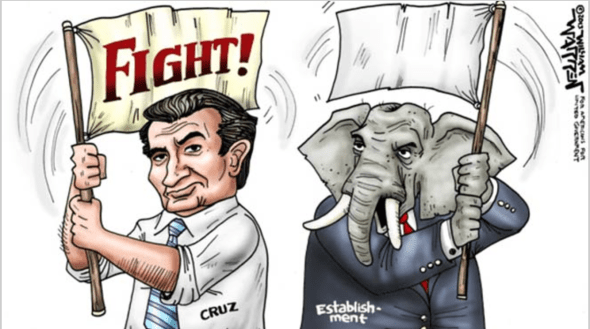
The Establishment “lane”? No such thing.
- SECRET WEAPONS. I’ve seen the story about Ted Cruz’s wife being his secret weapon. And the one about Bernie Sanders’ wife being his secret weapon. And Hillary Clinton’s husband being her secret weapon. That is one over-used cliché. Why are spouses “secret weapons”? They’re not secret. And they’re not weapons. Please retire this sexist, martial metaphor.
- NARRATIVE. As in “controlling the narrative.” Or a campaign’s “narrative.” “Narrative” is a means of storytelling. It is a big stretch to use it as a substitute for “setting the agenda.” To those of us who care about good writing, the word “narrative” is a valuable word that should not be devalued through misuse and overuse.
- -MENTUM. The reporter who talked about “Marco-mentum” this week thought he was being clever. No, sir. A name with the suffix “-mentum” is the new all-purpose cliché for momentum, and it’s not funny or clever. Maybe it was clever in 2004, when Democratic presidential candidate coined the term “Joe-mentum” for the (non-existent) momentum generated by his third-place finish in the Iowa caucuses. In 2016, it’s become such a cliché that it has become a tongue-in-cheek hashtag mocking former Virginia Gov. Jim Gilmore’s Quixotic quest for the GOP nomination. (#Gilmentum).
- GAME CHANGER. If Joe-mentum is a 2004 cliché, “game changer” is a throwback to 2008, when the book (and subsequent movie) “Game Change” chronicled Sarah Palin’s impact on that year’s presidential race. Now it’s used for just about any plot twist in the presidential race. Pundits predict, with dubious reliability, that it may be a “game changer.” How many changes can there be in the game? This year, way too many.
 Colonel Sanders doubles down…
 … as do Las Vegas gamblers. Not candidates.
 - DOUBLE DOWN. The third and final golden-oldie that should be banned from all political coverage: the term “double down.” It seems to be used almost weekly when Donald Trump says something the media considers outrageous and then, rather than apologizing and backing down, he says it again and again and again. Perhaps it is appropriate that Trump, who has made and lost billions in the gambling biz, should be the subject of a gambling-related cliché. This once was a term defining an audacious and risky strategy, but “double down” is so overused that it has lost its journalistic impact, if it ever had any.
- RE-SET THE RACE. This is what happens when a losing candidate hopes to change the dynamics of a presidential contest. The week before the New Hampshire primary, we are hearing that Jeb Bush, Chris Christie, John Kasich and other presidential candidates are trying to “re-set the race.” There is no need for a mechanical metaphor. Why not say that they’re hoping to remain viable?

Polls can be unreliable. The “Poll of Polls” concept is inherently unscientific and dubiously reliable.
- POLL OF POLLS. This concept is a methodologically fraudulent way that a news outlet can create artificial news by averaging a group of polls to develop its own “poll of polls.” News outlets in England used this technique — with disastrous journalistic consequences — during last year’s British parliamentary elections. CNN has resurrected its own “poll of polls” for the 2016 election. How accurate was the CNN Poll of Polls in Iowa? Not very.
- TOO CLOSE TO CALL. This is a legitimate analytical term that is misused by journalists who seek melodramatic effect. It is often used to describe poll results. It should never be used to describe poll results. Polls are not “too close to call.” Elections are only too close to call when, on election night, the margin is so small that the result cannot be predicted until more results are in. However, once 100 percent of the returns are in, and one candidate has won by 0.3 percentage points, the race is not too close to call. It is over, and one candidate has won. By a very tiny margin.
- BREAKING NEWS. This term should be banned on cable news, social media and press releases. News breaks once. It doesn’t break all night, after every commercial break, on television. A candidate dropping out of the race is breaking news. Once. When it happens. Scheduled events — like primary elections, caucuses and State of the Union speeches — are not breaking news. They are scheduled events. If you’re reporting that 16 percent of the precincts are reporting their results (instead of the previous 14 percent), it is not breaking news. It is an update.
This list of clichés is incomplete. Feel free to add your own contributions in the comments section below.
Flashback: My 2013 profile of Ted Cruz, when he was first being compared to Ronald Reagan and Joe McCarthy
Posted: January 12, 2016 Filed under: U.S. politics | Tags: 2016 presidential race, American politics, Barack Obama, Barbara Boxer, Charles E. Coughlin, Chris Matthews, Chuck Hagel, Chuck Schumer, CPAC, Daily Caller, David Bossie, David Dewhurst, Democratic Party, Elizabeth Warren, Fergus Cullen, Frank Bruni, Gilbert Hinojosa, Greg Abbott, Harry Reid, Heritage Foundation, Huey Long, immigration, Jared Woodfill, Jim Manley, Joe McCarthy, John Cornyn, John Kerry, John McCain, L. Brent Bozell III, Marco Rubio, Michael A. Needham, MoveOn.org, NBC, New Hampshire, New York Times, North Korea, Paul Ryan, Raul Reyes, Republican Party, Rohrschach Test, Ronald Reagan, Saudi Arabia, Tea Party, Ted Cruz, Ted Kennedy, Tim Scott, Timothy H. Nagle, U.S. Congress, U.S. politics, Violence Against Women Act, William Rehnquist Leave a commentPresidential campaign bumper sticker: His supporters think Ted Cruz is always right
Thanks to the wonders of social media, Ted Cruz supporters and detractors are still circulating a profile I wrote of him that appeared on Texas on the Potomac on Feb. 21, 2013, six wild weeks into his Senate tenure. I’m glad to say it still holds up today. The most interesting quote in it may come from then-Attorney General Greg Abbott of Texas, when he discusses the futures of Cruz and freshman Florida Sen. Marco Rubio. Here’s the story:
Ted Cruz’s blazing start in the U.S. Senate has proven to be the political equivalent of a Rorschach test.
Cruz is a political Rorschach Test. Everybody sees the same thing — and everybody sees something different.
Cruz’s fans, and there are many, compare him to Ronald Reagan, who happens to be the 42-year-old senator’s boyhood hero. Cruz’s detractors, and there are many, compare him to Joe McCarthy, the controversial Wisconsin senator known for smearing his foes by innuendo and questioning their patriotism. And there are not many in between.
“It’s going to be in the eye of the beholder,” said Timothy M. Hagle, a political scientist at the University of Iowa.
To Cruz, the first Latino senator in Texas history, the swirling controversies of the past two months stem from his credo to “speak the truth,” whatever the consequences.

Official family portrait
The Houston Republican’s first legislative proposal, as promised during his campaign, was a complete repeal of the 2010 health-care law widely known as Obamacare. He was the only senator on the losing side of every key vote in his first month in office. He was one of only three senators to oppose the confirmation of Secretary of State John Kerry, and was one of just 22 to vote against the Violence Against Women Act.
But it’s Cruz’s hard-charging style — and not just his hard-line conservatism — that has attracted national attention.
Texas’ junior senator made a name for himself on Capitol Hill with his hostile grilling of Chuck Hagel, President Barack Obama’s nominee for Secretary of Defense. Showing no deference to his elders, the newcomer also had a tense encounter with Democratic Sen. Chuck Schumer on a usually sedate Sunday talk show.
Liberal New York Times columnist Frank Bruni dismissed him as “an ornery, swaggering piece of work” full of “too much quackery, belligerence and misplaced moralism.” NBC Latino commentator Raul Reyes declared that “Cruz knows no shame” and “it’s time the GOP presses the Cruz-control button.”
At the same time, Cruz has been welcomed as a conquering hero by the grassroots conservatives who fueled his upset victory over establishment Republican favorite David Dewhurst in the 2012 Republican runoff contest. The new senator was picked to deliver the closing address at next month’s Conservative Political Action Conference in Washington, the nation’s largest annual gathering of right-thinking activists.

Conquering hero or dangerous demagogue? (Texas Tribune photo)
“Ted Cruz has not sacrificed his values and beliefs on the altar of political correctness or to become part of the Washington, D.C., circuit,” said Harris County Republican Party chair Jared Woodfill. “Like Ronald Reagan, he can take our conservative values and beliefs and articulate them for the world. He has made a huge mark at the national level in just a few months.”
Republican strategists are particularly pleased that Cruz brings a fresh face — as well as much-needed diversity — to the GOP message machine.
“He’s not a grumpy old white guy like so many of our spokesmen have been,” said Fergus Cullen, a communications consultant and former New Hampshire Republican Party chair. “He comes from the policy/ideas/intellectual wing of the conservative movement, like (2012 vice presidential nominee) Paul Ryan, and we need more of them.”
While assessments of Cruz’s job performance vary widely, there’s one thing everyone can agree on: The former Texas solicitor general is willfully ignoring the age-old adage that in the Senate, freshman are seen but not heard.
“Sen. Ted Cruz came to Washington to advance conservative policies, not play by the same old rules that have relegated conservatives — and their ideas — to the backbench,” said Michael A. Needham, CEO of Heritage Action, the political committee of the conservative Heritage Foundation. “It should come as absolutely no surprise the Washington establishment — be it the liberal media, entrenched special interests or even wayward Republicans — is now attacking him in the press for following through on his promises.”
Some Republicans say that Cruz — as well as Florida Sen. Marco Rubio — are being targeted for tough criticism from the left because of his Hispanic heritage.
“Ted Cruz and Marco Rubio are an existential threat to the liberal status quo,” said Texas Attorney General Greg Abbott, Cruz’s boss for more than five years. “For a long time, liberals assumed that if you were Hispanic and went to Harvard, you’d be a Democrat, not a conservative Republican. Not only that, he embodies the conservative principles that exist in a majority of the Hispanic community.”
Cruz, a champion debater in college and a former law clerk to Supreme Court Chief Justice William Rehnquist, is undaunted by the criticism.
“Washington has a long tradition of trying to hurl insults to silence those who they don’t like what they’re saying,” Cruz said Tuesday as he toured the LaRue Tactical gun-manufacturing plant near Austin. “I have to admit I find it amusing that those in Washington are puzzled when someone actually does what they said they would do.”
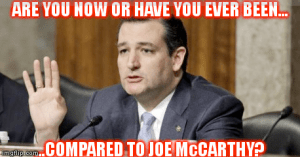
Critics speak: Another McCarthy?
Democrats, however, are decidedly not amused by his introduction to the national stage.
“He’s part of this right-wing, extreme group in the Republican Party,” said Gilbert Hinojosa, the Texas Democratic Party chairman. “He was elected to do the business of all the people of Texas, not just the business of a small group of Tea Party right-wingers. He makes (conservative former Sen.) Phil Gramm look like a progressive.”
Sen. Barbara Boxer, a liberal from California, went so far as to summon the ghost of Joe McCarthy during a discussion of Cruz on the Senate floor. MSNBC commentator Chris Matthews added former Louisiana Gov. Huey Long and Charles E. Coughlin, anti-Semitic radio broadcaster and fiery New Deal critic.
“He’s a potent combination of intellect and demagoguery that really has the potential to light a fire under the freshman Republicans to burn the place down,” said Jim Manley, a long-time Senate staffer who worked for Sen. Ted Kennedy and Senate Majority Leader Harry Reid. “But if you go down that path, you end up as nothing but roadkill in the Senate. If he continues down this path, his base may feel good about it, but he may just become isolated and irrelevant.”
A few Republicans have privately counseled Cruz to tone down his approach. One GOP colleague, Sen. John McCain, went so far as to rebuke him publicly after the Texas senator asked Hagel whether the former Nebraska senator had received payments from Saudi Arabia or North Korea.
“Sen. Hagel is an honorable man who served his country and no one on this committee at any time should impugn his character of his integrity,” McCain said as Cruz sat quietly by.
The two men shared another uncomfortable moment at the State of the Union speech, when McCain responded to Obama’s praise for bipartisan immigration reform with a quick jig while Cruz, two seats away, sat frowning.
Conservative activists are thrilled that Cruz has roiled both Democrats and old-line Republicans.
“We are encouraged that he is standing up to the establishment as a U.S. senator,” said David N. Bossie, president of the conservative group Citizens United. “Fighting the tough fights for conservative principles is why Ted Cruz was elected to the U.S. Senate.”
L. Brent Bozell III, chairman of the conservative group ForAmerica, blamed fellow Republicans for undercutting Cruz.
“The GOP establishment is at it again,” he said. ‘After capitulating to President Obama in negotiations over the fiscal cliff and promising to kneecap conservatives in the 2014 primaries, these moderates are attacking Sen. Ted Cruz for sticking to his conservative principles.”
Cruz’s brand of uncompromising conservatism gives Texas two of the most conservative members of the Senate. New ratings released Wednesday by National Journal indicated that the Lone Star State’s senior senator, John Cornyn of San Antonio, was the Senate’s second most conservative member in 2012.
Cornyn says he looks forward to “working closely” with Cruz “as we fight for a conservative agenda.”
“Ted has quickly proven himself to be among the next generation of leaders of Texas and the Republican Party,” Cornyn said.
It may be a bit early to declare Cruz a leader, but there’s little doubt Cruz is having an impact disproportionate to his seven-week Senate tenure. An editor of the conservative website The Daily Caller recently likened Cruz’s ability to shape the debate over Hagel to the liberal grassroots group MoveOn.org’s impact at the height of the Iraq War.
He’s certainly the most visible freshman senator, appearing on more national TV programs than any of his first-year colleagues, including the much-hyped liberal Sen. Elizabeth Warren of Massachusetts and conservative Republican Tim Scott of South Carolina, the first African American senator from the Deep South since Reconstruction.
With the hype, of course, come the jibes.
“Washington is a rough-and-tumble place, and I certainly don’t mind if some will take shots at me,” Cruz said. “What I do think is unfortunate is if the coverage of the political game overshadows the substance.”
“Ted Cruz and Marco Rubio are an existential threat to the liberal status quo.”
— Greg Abbott
Flashback: My 2013 article on Birtherism 2.0 and Canadian-born Ted Cruz’s eligibility to serve as president
Posted: January 5, 2016 Filed under: U.S. politics | Tags: 2016 presidential race, Alexandra Jaffe, American politics, Barack Obama, Barry Goldwater, Canada, Chester Alan Arthur, Congressional Research Service, Donald Trump, Dred Scott, George Romney, Harold Cook, Jack Maskell, James Garfield, John McCain, Mexico, Paul Begala, Peter Hamby, Philip Rucker, presidential election, South Texas School of Law, Steven E. Schier, Supreme Court, T. Gerald Treece, Tea Party, Texas on the Potomac, U.S. Constitution, U.S. politics, Wong Kim Ark Leave a comment
 I woke up this morning in Beijing to a tweetstorm fomented by Donald Trump’s new birther conspiracy: raising questions about Ted Cruz’s eligibility to be president. Here is a story I posted on Texas on the Potomac in 2013, when it was growing increasingly likely that the Canadian native would seek the U.S. presidency. In case you’re interested, here is what I wrote:
It seems like an obscure court case from a dusty old law book, but if Canadian-born Texas Sen. Ted Cruz ever decides to run for president, you’re likely to hear a lot about the United States v. Wong Kim Ark.
In that 1898 case, the U.S. Supreme Court voted 6-2 to repudiate the exclusive language of the infamous Dred Scott case and create an expansive definition of the Constitution’s “natural-born citizen” clause.
That’s important because the Constitution requires that the U.S. president be a natural-born citizen –and Cruz was born in Calgary, Alberta, in 1970. Cruz, who is being urged to run for president in 2016 by some conservative activists, argues that he is a natural-born citizen because his mother was an American citizen. His father, now a naturalized American, was born in Cuba.
Trump: This is war!
As the Cruz-for-president talk heats up on the right, some bloggers on the left have argued that the strict interpretation of the Founding Fathers’ words that Cruz claims to worship would disqualify a Canadian-born American from serving as president.
Five years after celebrity billionaire Donald Trump and a motley assortment of conservatives raised questions about a liberal Democratic candidate’s American birthplace, the shoe is on the other foot.
Call it Birtherism 2.0.
“It is ironic that a Tea Party favorite might be blocked from serving as president by one of the Tea Party’s favorite constitutional provisions,” said Democratic strategist Paul Begala.
The question of presidential qualifications has never directly reached the Supreme Court. But there is a wide range of jurisprudence on the issue — which overwhelmingly favors the notion that Cruz is eligible to serve as president.
Ironically, the same legal logic that confirms Cruz’s eligibility would have permitted Barack Obama to serve as president even if he had been born in Kenya, because his mother was a U.S. citizen.
The most comprehensive study of the issue was a 2009 report by the nonpartisan Congressional Research Service, which cited English Common Law principles and American legal scholarship dating back to 1833.
“The weight of scholarly and historical opinion appears to support the notion that ‘natural born citizen’ means one who is entitled under the Constitution or laws of the United States to U.S. citizenship ‘at birth’ or ‘by birth,’ including …those born abroad of one citizen parent who has met U.S. residency requirements,” wrote Jack Maskell, a CRS legislative attorney.
So why the controversy?
Because, as in so many cases, the Constitution’s authors were silent on the meaning of the phrase “natural-born citizen,” leaving it to generations of constitutional scholars to divine their thoughts.
T. Gerald Treece, a professor at South Texas College of Law, said that despite the Founders’ silence on the subject, their intentions are easy to understand.
“The Founding Fathers merely did not want any British or other foreign subjects to become naturalized and, therefore, eligible to become president,” said Treece.
He said legal precedents focus on an individual’s status “at time of birth.”
“Most authorities agree that, if at time of birth, you are born to U.S. citizens — where they reside — then you are a U.S. citizen at time of birth,” Treece added.
But because the Supreme Court has never directly addressed the issue, it has been a subject of argument for centuries.
in 1881, some Democrats contended that Republican Vice President Chester A. Arthur was born in Canada and ineligible to succeed assassinated President James A. Garfield. But Arthur insisted he was born in Vermont, had a birth certificate and was sworn in as president.
in 1964, some critics of Republican nominee Barry Goldwater said he was barred from the presidency because he was born in Arizona before the territory gained statehood. The challenges got nowhere.
Four years later, Michigan Gov. George Romney sought the presidency although he was born in Mexico, where his American parents were living in a Mormon colony. The Mexican constitution in effect at the time of Romney’s birth in 1907 restricted citizenship to the children of Mexican nationals. So there was no issue off dual citizenship to cloud Romney’s campaign.
In 2008, both presidential nominees faced lawsuits to disqualify them based on their place of birth.
GOP nominee John McCain, the son of a Naval officer, was born in the Panama Canal Zone, then a U.S. territory, in 1937, months before Congress approved a law guaranteeing birthright citizenship to children of military personnel serving abroad. To erase any doubt, the U.S. Senate approved a bipartisan resolution confirming McCain’s citizenship, and a legal challenge to his eligibility was rejected.
There was far more fuss over false claims that McCain’s Democratic rival, Barack Obama, was born in Africa. A series of lawsuits were tossed out of court.
None of the anti-Obama “birthers” has stepped forward to challenge Cruz.
“I doubt that birthers will go after Cruz because he is ideologically compatible with them,” said Carleton College political scientist Steven E. Schier.
After the “birther” circus of 2008, friends and foes of Cruz say they’re ready to focus on his political positions, not his birthplace.
“The ‘birther’ issue — whether it’s Barack Obama, John McCain or Ted Cruz — has always been nothing more than a pointless hyperpartisan distraction and remains one,” says Democratic consultant Harold Cook.
Here’s the 2009 CRS document:
41131059 MoC Memo What to Tell Your Constituents in Answer to Obama Eligibility

 Rick Dunham Blog
Recent Comments