What’s in and what’s out in 2014
Posted: December 30, 2013 Filed under: Discovering China, Top Ten, U.S. politics | Tags: Barack Obama, Beijing, Beijing pollution, Beijing subway, Biking in Beijing, China, Chinese cuisine, New York Times, Obamacare, People's Daily, Ping pong, Pollution, Rush Limbaugh, Scrapple, Texas on the Potomac, Tiananmen, Tsinghua University, Xi'an 2 Comments
Moonrise over the ancient city wall, Xi’an.
Just a few things have changed in my life this year.
New job. New city. New country. New life.
Teaching journalism in China. It’s almost as much of a challenge as practicing journalism in America.
Here are some of the things that are “in” in my new life at Tsinghua University — and some of the old, familiar things I’ve left behind.
OUT: Texas on the Potomac
IN: Yankee on Tiananmen Square
OUT: Hikes on the National Mall
IN: Hikes on the Great Wall
OUT: Bike helmets
IN: Anti-pollution masks
OUT: Turn signals
IN: Chaos on the road
OUT: The second most congested commute in America
IN: The second most congested commute in the world
OUT: Considering something three days old as new
IN: Considering something three centuries old as new
OUT: Finnish saunas
IN: Chinese massages
OUT: American Chinese food
IN: Real Chinese food
OUT: DC Metro
IN: A subway system with trains every two minutes, polite employees and escalators that actually work
OUT: Dysfunctional democracy
IN: Democracy?
OUT: Taking your shoes off at airports
IN: VPNs to access Facebook, Twitter, YouTube and WordPress
OUT: Rush Limbaugh’s rants against Barack Obama
IN: Chinese media rants against Japanese Prime Minister Abe
OUT: The New York Times
IN: People’s Daily
OUT: The Abraham Lincoln statue at the Lincoln Memorial
IN: The terracotta warriors of Xi’an
OUT: Delicious Chesapeake crab cakes
IN: Delicious Chinese dumplings
OUT: Lobster rolls from food trucks
IN: Stinky tofu from street vendors
OUT: Scrapple
IN: Chicken feet, fish lips and duck brains
OUT: The Washington Redskins
IN: Mao’s little red book
OUT: Obscenely expensive Internet service
IN: Unreliable Internet, spotty WiFi and the Great Firewall of China
OUT: Obamacare
IN: Truly socialized medicine
OUT: Soccer moms
IN: Ping pong dads
OUT: 24/7 deadlines
IN: Monthlong breaks between semesters (We call them “district work periods”)
OUT: Suits and ties
IN: Casual Friday every day

The dress code is a lot more casual — even for a China Radio International appearance.
My local Beijing Walmart isn’t like any you’ve ever visited in the USA
Posted: October 2, 2013 Filed under: Discovering China | Tags: beer, Beijing, Beijing subway, Biking in Beijing, China, Colgate, Crest, Egg Foo Young, Laughing Cow Cheese, Scarlett Caterpillar Fungus, Tsinghua University, United States, Walmart, Wudaokou Leave a comment
You are leaving the Beijing subway and nearing the entrance to Walmart.
I had this vision in my mind of what the Beijing Walmart would look like.
Elderly person at the front door welcoming you to the store. Wide aisles. Bright lighting. A little bit of Middle America in the middle of China’s capital.
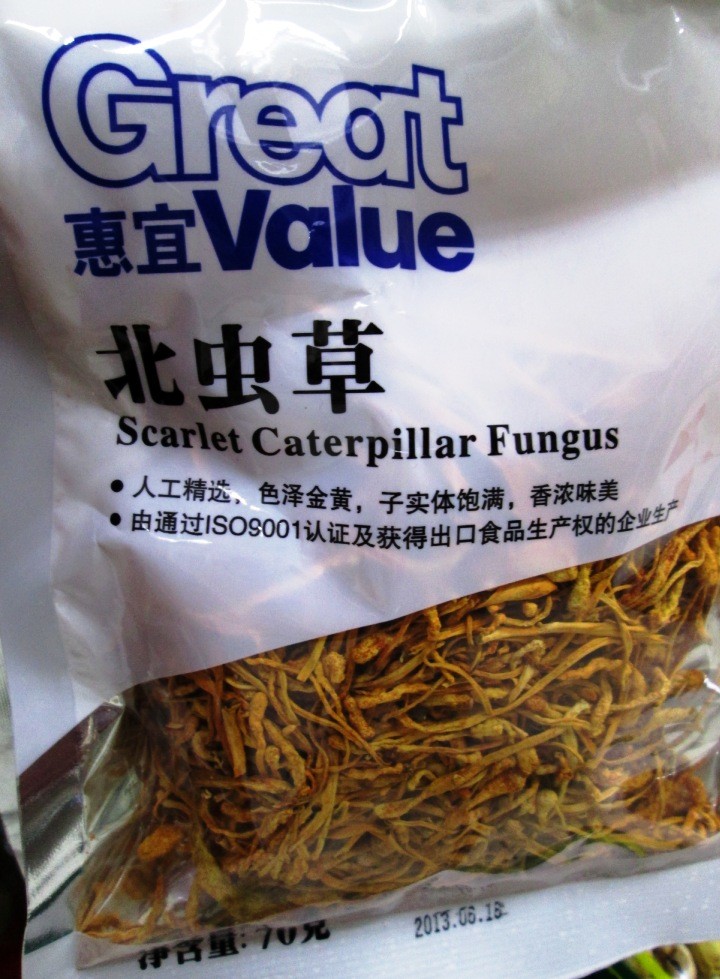
Definitely not on sale in U.S. Walmarts: Scarlet Caterpillar Fungus.
But no…
My local Haidan district Walmart, just one subway stop south of Tsinghua University’s Wudaokou subway station, is a strange sort of American-Chinese hybrid. The Egg Foo Young of Chinese retailing.
First of all, there is no greeter. There isn’t even a front door, just those semi-transparent plastic flaps that substitute for doors all over China.
The store itself doesn’t resemble any Walmart in the USA. It looks more like your local dollar store. On steroids. Three floors of crowded bargains, from washing machines and treadmills to live turtles (not to bring home as pets).
What’s completely different is the product selection. You can buy Crest and Colgate and Laughing Cow cheese, but not much else that you’d buy in the American big box.
When’s the last time you saw the Walmart “Great Value” brand bag of Scarlet Caterpillar Fungus in the USA? Or Marinated Duck Gizzard? Or Prickly Ash Powder? Or Purple Sweet Potato snacks? Or Pineapple-flavored Beer? Or Apple Vinegar Drink?
The list goes on — check it out in my slide show.
I ended up on a shopping spree that cost me more than $40 in yuan. Doesn’t sound like much, does it? Well, think of it this way: That’s the cost of about 25 meals on campus. Or three months of cell phone service. I think I’ve stocked my apartment for a month with everything from loose Chinese tea and two kinds of tofu to, yes, purple sweet potato snacking pieces.
My most expensive purchase was a living room rug for the equivalent of $13. The second most costly purchases was imported almonds (for hiking, of course), at about $4.
My shopping journey took four hours, most of it pure entertainment. After all, how many of you can say that you carried a rug in a backpack while you rode a bicycle home from the subway while balancing two bags of groceries?
An American in Tiananmen on China’s National Day
Posted: October 2, 2013 Filed under: Discovering China | Tags: Beijing, Caroline Ward, China, Forbidden City, Fourth of July, Mao Zedong, National Day, National Mall, Sara Balajthy, Texas on the Potomac, Tiananmen, Tiananmen Square, Washington Leave a comment
An indelible image that changed world history — October 1, 1949.
On Oct. 1, 1949, Mao Zedong read a statement before a bank of microphones and hundreds of thousands of people assembled in Tiananmen Square declaring the formation of the People’s Republic of China.
Sixty-four years later, I was one of the perhaps dozens of “westerners” visiting Beijing’s most famous landmark on China’s National Day holiday. It is a festive celebration, with special decorations, tourist-friendly hats, face painting, parades and family pilgrimmages.
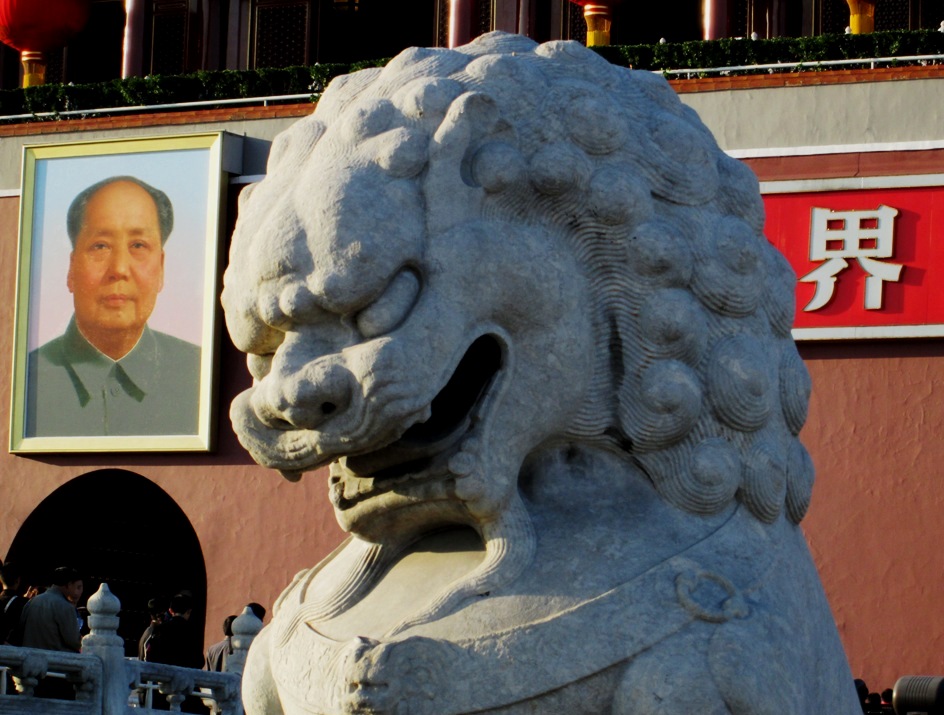
The Lion and Mao. (Photo by Rick Dunham)
The scene, I thought, was very much like the Fourth of July celebrations on the National Mall in Washington. Patriotism, pageantry, family, country.
My small group of three Americans (thanks, Caroline and Sara) tried to blend in with the hundreds of thousands — more probably, millions — of Chinese tourists. Well, we were never going to blend in. Caroline and Sara are striking young blondes, and perhaps a dozen Chinese families asked to have their photos taken with them. (Nobody asked me.)
We walked around Tiananmen, headed inside the main gate toward the Forbidden City, and then wandered through the historic core of old Beijing.
I hope this photo essay gives you a sense of the grandeur and the scope of the day.
Ten ways appearing on TV in China is different than the United States
Posted: September 24, 2013 Filed under: Discovering China, Rick in the news, Top Ten, U.S. politics | Tags: Beijing subway, Biking in Beijing, CCTV, China, Dialogue, East Gate of Peking University subway station, media appearance, Rick in the news, United States 1 Comment
The logo of CCTV English’s current affairs program
I’ve just completed my debut on Chinese TV before what was probably the biggest audience in my 35-year journalism career.
I was a guest on the nightly news show called “Dialogue” on CCTV (China Central TV). It’s a half-hour program where policy experts sit down and debate — freely, in my case — important international issues. No yelling. No screaming.
That alone is a big change from my appearances on — and viewing of — American TV news.
Here are some other differences between being a guest on Chinese TV and American TV:
1. No limo to pick you up.
2. No make-up artist.
3. No green room.
4. All of the anchors know what they’re talking about.
5. All of the anchors speak perfect English.
6. In-depth discussion of international issues.
7. Thirty minutes. No commercial interruptions.
8. No interruptions at all — the host and other panelist let me finish each answer before responding themselves.
9. No limo to drive you home.
10. I rode my bike home from the East Gate of Peking University subway stop after finishing the show.
Adjusting to life in China: Little by little, I’m at home in Beijing
Posted: September 16, 2013 Filed under: Discovering China | Tags: Beijing, Beijing subway, Biking in Beijing, Caroline Ward, CCTV, China, Chinese language, Internet, Philadelphia Eagles, Philadelphia Phillies, President Xi, Shanghai, Texas, Tsinghua University, Turkmenistan, Twitter, Washington Nationals, Weibo 1 Comment
It’s easy to adjust to the serenity and natural beauty of the Tsinghua University campus.
Little by little, there are signs that I’m adjusting to life in China. I still speak terrible Chinese, but I’m making (slow) progress. Some other signs point to a shorter-than-expected period of adjustment in my new country. A few examples:
- At my apartment, I’m eating more meals with chopsticks than with forks, knives or spoons.
- I take the subway and wander the streets of Beijing without fear of getting lost.
- I venture off campus on my bicycle into the chaotic swirl of Chinese traffic.
- I add money to my subway fare card without the help of my Teaching Assistant.
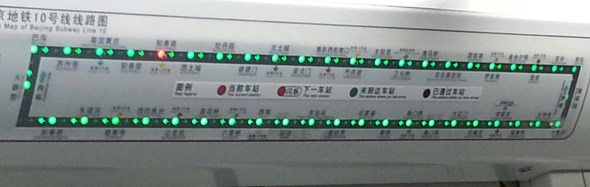
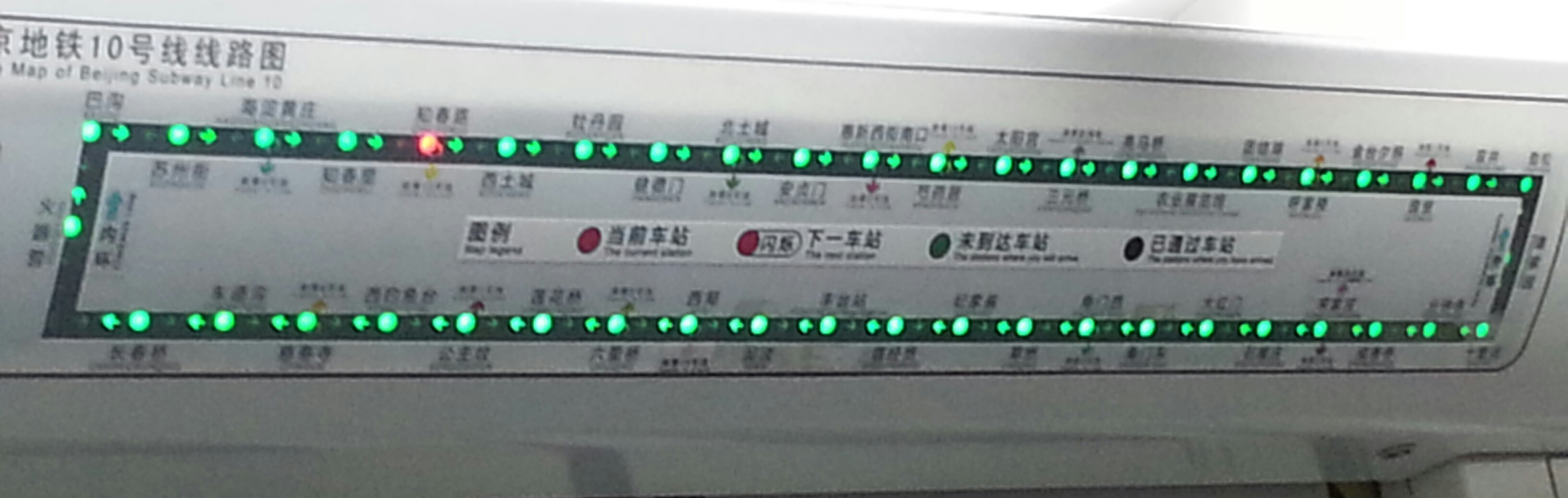
I can take subway line #10 clockwise or counterclockwise and not get lost.
- I price things in yuan and don’t convert to dollars anymore.
- I leave my passport at home when I go out.
- I don’t get upset when the Internet connection is really slooooooooooooooooooow. Like the Texas weather, just wait an hour and it’ll change.
- I don’t get upset when a car is driving down the wrong side of the road and appears to be heading straight for my bike.
- I’m posting on Weibo as often as on Twitter.
- I’m beginning to understand the difference between the four Chinese speech tones.
- I’m beginning to understand a few street signs. In Chinese.
- I’m starting to get the hang of sign language. Or maybe charades.
- I’m starting to think it’s normal to ride your bike after dark without any lights.
- I’m starting to say “ni hao” to people rather than “hello.” (With Caroline Ward, it’s still “ni howdy!”)
- I can introduce myself as “DOO-NUH REE-KUH” rather than “RICK DUNHAM.” (I’ll pass along my real Chinese name when my colleagues show me the spelling.)
- I don’t check the Internet every day to see what’s happened to the Phillies … or Nats … or Eagles … or Redskins.
- I come home every night and turn on CCTV in English to discover what good deeds President Xi has done today. And what’s new in Turkmenistan.
- I thank my lucky stars that I took this job.
Beijing by the numbers: Random observations from my first week in China
Posted: September 13, 2013 Filed under: Discovering China, Top Ten, Uncategorized | Tags: Beijing, Beijing pollution, Beijing subway, Biking in Beijing, Caroline Ward, Dallas Cowboys, Houston Texans, Jane Sasseen, Kentucky Fried Chicken, Nancy Pelosi, Pennsylvania, Philadelphia Eagles, Pollution, Tea Party, Ted Cruz, Texas A&M University, Texas on the Potomac, U.S. Congress, Washington Redskins Leave a comment
Everything at Tiananmen seems to be undergoing restoration — except for Chairman Mao
I’m not one of those often-wrong, never-in-doubt Americans who visits a city for a week and decides he knows everything about its history, culture and politics.
That having been said, I do have a few first impressions through the eyes of a China newbie. Here are some random observations of life in Beijing by the numbers:
7
Number of Beijingers wearing anti-pollution face masks
5
Number of Beijingers wearing bike helmets
0
Number of Beijingers who have used hand signals while riding bikes
2

Cornering the market on blondes in Beijing: with Caroline Ward (left) and Jane Sasseen (right)
Number of Beijingers holding a cell phone while biking in traffic
8
Number of blonde people sighted in Beijing
5
Number of blonde people sighted in Beijing who are not friends or students of mine
5
Number of European-origin people seen on the subway
0
Number of people speaking English on the subway
9
Number of Kentucky Fried Chicken restaurants seen around town
0
Number of people who have asked me about the Cowboys, Redskins, Eagles, Texans, Ted Cruz, the Tea Party, Mitch McConnell, Nancy Pelosi or Capitol Hill gridlock
1
Number of students who have asked me about the American government’s lies leading up to the invasion of Iraq
8
Number of universities in this section of northwest Beijing
3
Number of Texas on the Potomac alumni now living and working in Beijing
3
Number of people I’ve met who have worked or studied in Pennsylvania
1
Number of Texas Aggies I’ve run across. (Gig ’em, Caroline!)
Greetings from China: 5 pleasant discoveries and 5 things that might take some getting used to
Posted: September 9, 2013 Filed under: Discovering China, Dunham's Discourses, Top Ten | Tags: Beijing, China, Chinese food, food, parking, peanut butter, Peking Duck, traffic, Tsinghua University, Walmart 1 Comment
This is where I went hiking … for the history, the exercise, the fellowship and the fresh air.
The eagle has landed. I’ve been in Beijing for four days now — long enough to hike a remote section of the Great Wall, sample the best Peking Duck (Beijing Duck? Just plain roast duck?) of my life and explore every nook and cranny of one of the most beautiful college campuses in the world — but not quite long enough to get over jet lag.
Rather than write the traditional “first impressions” story, I’m going to share five of my pleasant discoveries in Beijing and an equal number of things that will take some time to get used to.
Pleasant discoveries

The campus is stunningly beautiful, an island of serenity in a bustling metropolis.
1. Tsinghua University is one of the most beautiful in the world. It’s made one of those top ten lists for beautiful campuses, and I can see why. From the magnificent gates to the marvelous and varied sculpture, from the breath-taking canals and lily ponds to the impressive architecture and ivy-covered walls, this is a fine environment for teaching and for learning.
2. The high quality of the faculty. They don’t call it the MIT of China for nothing. The professors here are among the best in the world. The journalism faculty is uniformly excellent. I hope to live up to their very high standards.
3. The high quality of the students. I could tell from the moment I began my new student orientation session last Friday morning. These students are the best and the brightest, not just from China but from around the world. They are smart and they are motivated.
4. I can get around town without too much problem. It is a problem that I don’t speak Chinese. (Yet.) But the Beijing subway — most of which was built for the 2008 Olympics — is modern, efficient, inexpensive and very easy to navigate. Crowded? That’s a given. There are more than 20 million people here in the capital.
5. I can communicate with the outside world. Yes, I heard all of the warnings about the Great Firewall of China. And all the blocked sites. The good news, at least at this point, is that I have been able to communicate with all of my old and new friends with only minor problems.

They say everything is bigger in Texas. It’s even bigger in Beijing. Here I am with one of the campus’ lions.
Things that might take some getting used to
1. A fifth-floor walk-up apartment. On the bright side, I’m getting a lot of aerobic exercise every day.
2. Cold showers for four days. Well, I finally have hot water. Actually, I’ve had it all along but haven’t known how to turn it on. You see, the instruction guide to my apartment is in Chinese and I’m linguistically challenged. It means I also couldn’t figure out how to use the satellite TV. Or the apartment internet. The take-away lesson: Keep taking those Mandarin lessons on the Mango app.
3. Can you believe the way people drive around here? Washington drivers are awful. Drivers in Rome are maniacs. Drivers in Naples view traffic signals as suggestions. Drivers in Beijing are all of that and more. U-turns in the middle of traffic. Left turns from the right lane. Turning right on red without stopping or even looking for pedestrians or bike riders.
And while you’re at it, watch out for the bikes coming at you every which way. And the pedestrians darting across highways and major thoroughfares in the middle of traffic.
4. The parking situation. People park any place they can find a space. Not a parking space. Any old space. They park on sidewalks. They park on pedestrian malls. They park where they want, when they want. Just get out of the way when the car is coming at you.
5. Peanut butter is hard to find. I love Chinese food. I could eat it almost every meal. But I am going through peanut butter withdrawal now. Yes, yes, I’ve been told that you can get peanut butter at Walmart and in European grocery stores in Beijing. But I haven’t gone on a scouting mission yet.

 Rick Dunham Blog
Recent Comments