The ten best political campaigns of 2014
Posted: November 3, 2014 Filed under: Top Ten, U.S. politics | Tags: American politics, Andrew Cuomo, Ann Richards, Barack Obama, Bill Clinton, Bob Graham, Boston Globe, Brian Sandoval, Brian Schatz, Charlie Baker, Chris Gibson, Colleen Hanabusa, Cory Gardner, Daniel Inouye, Deval Patrick, Ed Gillespie, Elections, George P. Bush, George W. Bush, Greg Abbott, Guns, Gwen Graham, Harry Reid, Jay Rockefeller, Jeb Bush, John Warner, Kay Hagan, Kyle Kondike, Mark Pryor, Mark Udall, Mark Warner, Martha Coakley, Mary Landrieu, Mitt Romney, President Obama, Rick Perry, Sharron Angle, Shelley Moore Capito, Steve Southerland, Texas, Texas politics, Thom Tillis, U.S. Congress, University of Virginia, Wendy Davis 3 Comments
It’s been a good year for very bad campaigns. But there also have been some very, very good efforts put forth by candidates across the United States, including a few who have surprised the political establishment and the Pundit Elite.
Here are my picks for the ten best campaigns of 2014 — whether they win on Election Night or not.
1. Hawaii Sen. Brian Schatz
How would you like to have been the interim senator appointed by a governor so unpopular that he was defeated in his party’s primary by more than two to one? And how would you like to have been forced to run in that same primary election against the anointed successor of the late and much-loved Democrat you replaced, Daniel Inouye?
Well, that was the predicament faced by Brian Schatz, Hawaii’s former lieutenant governor and now the second-youngest senator at age 42. He worked smart, worked hard, and won — barely — in the primary against Rep. Colleen Hanabusa.
“I was not overconfident that we were going to be successful,” he said after escaping the primary by seven-tenths of one percentage point. Now he’s coasting to a general election win against Republican Cam Cavasso.
2. Massachusetts gubernatorial candidate Charlie Baker
The Bay State may have voted Democratic in every presidential race except one in modern times, but it has an independent streak when it comes to picking its governors. Republican Mitt Romney was chosen by Massachusetts voters back when he was a moderate. And this time a Republican healthcare executive with business bona fides and an independent streak from his party on abortion and same-sex marriage is poised to win a surprising victory.
Charlie Baker, who was defeated by outgoing Gov. Deval Patrick four years ago, has run a campaign so steady that he won the endorsement of the iconically liberal Boston Globe. Indeed, the Globe praised his track record of “steady management and proven results.” He’s also been helped by the mistakes of Democratic nominee Martha Coakley, who is poised for another come-from-ahead defeat.
3. New York Rep. Chris Gibson
It’s not comfortable being a Republican congressman representing a New York district carried twice by President Obama. But two-term Republican Chris Gibson has done it through hard work, skillful constituent service and strategic moderation on issues such as arts funding and gay rights. (The retired Army officer is a Republican co-sponsor of the Employment Non-Discrimination Act designed to protect GLBT Americans from workplace discrimination.) One recent poll shows him 20 percentage points ahead of his Democratic rival in a district that Democratic Gov. Andrew Cuomo will win handily.

4. Texas gubernatorial candidate Greg Abbott
The Texas Attorney General has run the most disciplined governor’s campaign the Lone Star State has seen since George W. Bush toppled Ann Richards in 1994. Abbott has not veered off script, and that script is designed to maximize support among swing voters and motivate hard-core Republicans. With the national press corps hoping against hope for a dramatic storyline this year — Texas is “turning blue” or famous filibusterer Wendy Davis pulls off a miracle in the Land of Bush and Perry — Abbott has taken all of the drama out of Democratic dreams.
5. Colorado Senate candidate Cory Gardner
The Colorado Senate seat held by freshman Democrat Mark Udall wasn’t on many lists of vulnerable seats at the beginning of 2014. But Republican congressman Cory Gardner has been a nightmare for Democrats from Denver to Washington. He’s run an anti-Washington campaign designed to appeal to the swing state’s large bloc of disquieted independents, as well as populists peeved at the sophisticated population of the state capital. Gardner’s campaign site boasts that he is running “to represent all of Colorado, not just those from a particular city or political party.” Take that, Denver.
Democrats have tried to paint Gardner as an extremist and a harsh partisan. But it hasn’t seemed to stick to a candidate known for his high energy and hailed by DC media outlets as a Republican rising star.
6. North Carolina Sen. Kay Hagan
From all the Republican TV commercials, you’d think that “Barack Obama” is the name of the Democratic nominee for Senate in North Carolina. But rather than accept southern-fried doom in an anti-Obama year, the first-term Democratic senator has turned the tables on Republican nominee Thom Tillis, and has put him on the defensive about his role as state House Speaker in the extremely unpopular ongoings in the state capital of Raleigh. Contrast Hagan’s competitiveness in final pre-election polls with the flailing efforts of the two other Democratic Senate incumbents in the South, Mark Pryor of Arkansas and Mary Landrieu of Louisiana.
7. West Virginia Senate candidate Shelley Moore Capito
The last Republican to win a Senate seat in West Virginia was six decades ago. That’s going to change this year as longtime Rep. Shelley Moore Capito sweeps to victory to succeed Democratic legend Jay Rockefeller.
While West Virginia has swung Republican at the presidential level in the past four election cycles, it has favored Democrats for most statewide offices. The 60-year-old Capito, an influential House member, is considered by many to be a pragmatist, conservative on social policies, strong on guns but not hostile to organized labor. Her campaign has been pitch perfect. No wonder Kyle Kondike, the managing editor of the University of Virginia’s Sabato’s Crystal Ball, calls her the “best Republican Senate candidate this cycle.”
8. Virginia Senate candidate Ed Gillespie
Win or lose — and he will probably lose — Republican Ed Gillespie has run an exceptionally good Senate campaign in Virginia against a popular Democratic incumbent, Mark Warner. Gillespie has worked harder than just about any candidate in the country, has highlighted a future-oriented set of issues, and has built a statewide organization out of the ashes of Republican defeats in recent years. His efforts have paid off as he has trimmed Warner’s lead significantly over the past two months.
Sen. Warner, you may recall, also was defeated in his first Senate campaign by a venerable incumbent, Republican John Warner, before going on to win the governorship. Gillespie’s excellent campaign should move him to the front of the line of GOP candidates for governor in 2017.
9. Florida congressional candidate Gwen Graham
This is a year of promise for the children of former Florida governors, In Texas, Republican Jeb Bush’s son George is about to become the Lone Star State’s land commissioner. And in the Sunshine State, Democrat Bob Graham’s daughter Gwen is in a tight race with incumbent Republican Rep. Steve Southerland.
Graham has learned the basics of political campaigning from her masterful dad. She has raised more money than the Republican — something very few Democratic challengers have done this year. She has out-organized the incumbent and has mobilized early voting that favors Democrats by 14 percentage points. She has called in dad’s chits and got a campaign visit from former President Bill Clinton. Victory is far from assured, but a strong campaign has given Graham a decent chance in a tough Democratic year.
10. Nevada Gov. Brian Sandoval
Senate Majority Leader Harry Reid’s worst nightmare is coming true.
Yes, he may lose his job as Majority Leader if Republicans can pick up at least six seats. But he might be seeing the specter of 2016 defeat in Nevada in the person of Republican Gov. Brian Sandoval. The incumbent governor is running 25 percentage points ahead of his 2014 Democratic opponent. He may just keep on running.
Sandoval, the first Latino to serve as a federal judge in Nevada, would be a good bet to roll the dice against Reid. It would be hard for the Democratic senator to convince voters that Sandoval, who has presided over education reform and a slowly improving economy, is a fringe extremist like 2010 GOP nominee Sharron Angle.
The ten worst political campaigns of 2014
Posted: October 11, 2014 Filed under: Top Ten, U.S. politics | Tags: American Hustle, American politics, Ann Richards, Anthony Weiner, Anything Goes, Army War College, Ben Dreyfuss, Carl DeMaio, Carl Levin, Chris Frates, CNN, Ed FitzGerald, Eric Cantor, Fox & Friends, Fox News, Frank Luntz, Greg Abbott, John Kasich, John Walsh, KHOU, Kinky Friedman, Larry Pressler, Laura Bush, Max Baucus, Mike Rounds, Mother Jones, New York Times, Pat Roberts, Penn State, Rick Santorum, Scott Peters, TalkingPointsMemo, Ted Cruz, Texas politics, Tim Johnson, Todd Bosnich, Tom Corbett, Tom Wolf, Wall Street, Wendy Davis Leave a comment
Pat Roberts has been working overtime to show how he understands the problems of his Kansas constituents.
From pornographic emails to pervasive plagiarism, this has been a good year for bad candidates. We’ve seen hubris, laziness and monumental incompetence.
That’s not really something new in American politics.
What may be new is that some of the campaigns are so bad that even partisan news outlets like Mother Jones and Fox News have called out the perpetrators.
So who has run the worst campaign of 2014? There are lots of candidates in contention for runner-up status but we already have a clear winner of that dubious achievement:
1. Former House Majority Leader Eric Cantor

Biggest loser: The former #2 man in the House of Representatives. Soon to be a very rich nobody.
A Hall of Shame horrible campaign. Overconfident. Out of touch. The future House Speaker became a former House member with the help of an obscure but spirited Tea Party activist. Cantor is crying all the way to the bank as he cashed in on the capital’s revolving door culture by getting a nice Wall Street-ish job.
2. Kansas Sen. Pat Roberts
Win or lose, the veteran Kansas senator, who lives in Washington, was caught napping. He survived a primary scare that he didn’t see coming and then trailed badly against an independent in early general election polls. With the GOP establishment circling the wagons — and hardline conservatives like Texas Sen. Ted Cruz seizing the moment — Roberts has finally gained some momentum, at least for the time being. But win or lose, he’s evidence of what happens when you catch Potomac Fever and don’t keep up with the folks back home.
3. Montana Sen. John Walsh
Democrats were on the defensive from the moment longtime Montana Sen. Max Baucus resigned his seat to become envoy to Beijing. But Dems had high hopes for John Walsh, an Iraq veteran, former adjutant general of the Montana National Guard and former lieutenant governor. Those hopes evaporated when the New York Times reported that Walsh had “plagiarized large sections of the final paper he completed to earn his master’s degree at the prestigious Army War College in Carlisle, Pa.”
Walsh quickly made a bad situation a lot worse. According to the Times, Walsh initially “expressed no contrition for the plagiarism.” Even when withdrawing from the race two weeks later, he remained in denial, saying that the paper “has become a distraction from the debate you expect and deserve.” The Army War College thought it was much more serious, revoking his master’s degree. But he’s still a senator, however lame a duck he may be.
4. Texas gubernatorial nominee Wendy Davis
National Democrats thought they had found an instant superstar when the telegenic Fort Worth state senator staged a filibuster against a draconian Republican anti-abortion law in 2013. The party raised tons of money from her pro-choice passion and pink sneakers and shipped almost all of it out of state. It then somehow convinced the celebrity senator that she could be elected governor in one of the most reliably Republican states in the Union. All you had to do was read my 2012 statistical analysis of Texas demographic and electoral trends to know that true partisan competitiveness was from eight to 12 years away.
To make a difficult situation worse, Davis’ campaign has been inexplicably tone-deaf. They seem to be running the kind of a campaign a Democrat would run in Massachusetts or Illinois, not Texas. (In contrast, the last Texas Democrat to be elected governor, Ann Richards, knew how to appeal to the good-ole-boy and good-ole-girl vote without sacrificing her basic principles.)
Final exclamation point, a new television ad that tried to paint Republican Greg Abbott as a hypocrite but ended up making him a victim. Even liberal standard-bearer Mother Jones called it, “to be blunt, bullshit.”
“If Wendy Davis Thinks She Can Win an Election by Pointing Out Her Opponent’s Disability, She’s Wrong,” declared the MoJo headline.
“It’s offensive and nasty and it shouldn’t exist,” wrote Ben Dreyfuss. “She’s basically calling Abbott a cripple.”
That’s what her friends are saying. Texas Democrats should be saying, “Wait ’til next year.” Or is it “next decade”?
5. Pennsylvania Gov. Tom Corbett
This is not the kind of headline you want on Fox News’ web site if you are a Republican incumbent:
Porn scandal involving former staff puts Pa. governor on defense in already-tough race
It’s not a question of whether Tom Corbett will lose, it’s by how much he will lose. In a very good year for Republican candidates, the GOP incumbent is a very bad candidate. Whether it’s his ties to the Penn State football program’s child sexual abuse cover-up or the scandal involving pornographic emails sent by staffers, the news is relentlessly negative for the embattled incumbent. Democratic nominee Tom Wolf is breezing to victory. The only question is whether Corbett’s margin of defeat is larger than the 20 percentage point repudiation of then-Senator Rick Santorum in 2006.
It’s a hard time to be a GOP spinner in the Keystone State. “This is not an Anthony Weiner situation,” one Republican consultant said on Fox News, trying to put the best face on a very bad situation.
Cold comfort.
6. Ohio gubernatorial nominee Ed FitzGerald
It’s never good when a headline in the Washington Post declares:
The remarkable implosion of Ed FitzGerald
Especially not if you are an Ohio Democrat and Ed FitzGerald is your nominee for governor. Democrats had high hopes for unseating Ohio Gov. John Kasich, whose edgy personality and hard-driving policy agenda had alienated a fair number of voters. But their candidate, a local elected official with precious little big league experience, proved truly minor league. A typical lowlight was the revelation of a 2012 incident when he was approached by a police officer while in a parked car with a woman who was not his wife.
How bad have things gotten? With the campaign winding down, the Cleveland Plain Dealer reports that “the beleaguered Democrat is altering his strategy in an attempt to ensure his troubles don’t doom his party’s entire statewide ticket.” At least he’s not playing stupid “spin” games and trying to convince us that he still is in contention.
7. South Dakota Senate nominee Mike Rounds
Republicans thought this was a sure thing when Democratic Sen. Tim Johnson announced his retirement. Red state. Popular ex-governor. Anti-Obama electorate. Good Republican year. Can’t lose.
Well, yes you can.
Rounds has exhibited a severe case of overconfidence and has run a lackluster campaign (to be generous). Toss in a wild card — the independent candidacy of former Republican Sen. Larry Pressler, the only politician to say no to the “American Hustle” hustlers — and you have the South Dakota road show version of the venerable musical “Anything Goes.”
I’ll still be shocked if Rounds loses. But he’s trying his best.
8. Michigan Senate nominee Terri Lynn Land
Like Texas Democrats, Michigan Republicans thought they had a chance to pull an upset on hostile partisan turf by nominating Terri Lynn Land for the Senate seat long held by retiring Democrat Carl Levin. Now, national Republicans will tell you it is one of their biggest disappointments of the year. Land’s campaign has been mediocre, at best, lacking imagination, energy and an overarching strategy. She’s been on the defensive, like her attempts to counter perceptions that her policy positions were “anti-women.” She aired an ad that was described by Republican political consultant Frank Luntz as the worst of the election season (which is saying a lot). In the ad, she drank coffee and looked at her watch and said that, as a woman, she knows more about women than her male opponent. No discussion of any issues.
The “Really?” ad, aired in May, sought to reject claims that Land is anti-woman because of her opposition to abortion and federal legislation known as the Paycheck Fairness Act.
Luntz criticized the commercial on “Fox & Friends” for failing to “give any message” or “communicate any sense of substance.”
No wonder Democrat Gary Peters — once considered a “tough sell” — has been consistently leading in the polls for months.
9. California congressional candidate Carl DeMaio
In the category of snatching defeat from the jaws of victory, we take you to San Diego, where Republicans have been talking all year about their strong candidate against endangered Democratic incumbent Scott Peters.
Let’s just say the talk has shifted all of a sudden. After all, how many candidates for the House of Representatives find themselves in the bizarre position of denying that they masturbated in front of a staff member? Or groped his genitals?
That’s the plight of Carl DeMaio, a highly touted Republican candidate who had been leading in many polls in California’s 52nd Congressional District. Let’s just cut to the Oct. 10 CNN interview with his former aide, Todd Bosnich.
Bosnich: “I saw his hand —— his penis in his hand. He had a smile on his face. And as soon as I came over, he was looking at me.”
CNN reporter Chris Frates: “So there was no mistaking what was happening?”
Bosnich: “There was no mistaking whatsoever.”
According to TalkingPointsMemo, Bosnich has accused his ex-boss of “making inappropriate advances, massaging and kissing his neck, and groping.”
I should note that DeMaio categorically denies his ex-aide’s account and held a press conference to condemn it as “an outrageous lie” that has been dismissed by law enforcement authorities.
“This is an individual that was let go by our campaign manager for plagiarism, a well-documented plagiarism incident of taking a report from the National Journal and passing it off as his own work,” the candidate told CNN. “He was terminated. He admitted that he plagiarized.”
At his press conference, DeMaio went further: “It’s absolutely untrue and it’s unfortunate that an individual who is the prime suspect in the break-in at our campaign office would manufacture such an outrageous lie.”
Someone is lying. But no candidate wants to be denying this kind of thing in the final weeks of a campaign. Or ever.
http://www.cnn.com/video/api/embed.html#/video/politics/2014/10/10/lead-pkg-frates-gop-sexual-harassment-claims.cnn
10. Texas Agriculture Commission loser Kinky Friedman
Once considered a serious (or at least semi-serious) candidate for governor of Texas, this singer/songwriter/author has been failing downward. This year, he ran an erratic campaign for Texas Agriculture Commissioner and was defeated in the Democratic runoff by “not Kinky Friedman,” a.k.a., an unknown guy who was the other name on the ballot. Kinky’s top campaign issue this year was legalization of marijuana.
“I want to make this election into a referendum on lifting the prohibition on pot and hemp,” Friedman told KHOU 11 News during a campaign event in Houston. “This is about the future of Texas.”
It certainly wasn’t about Kinky’s political future.
Learning about China’s health-care system the hard way
Posted: October 7, 2014 Filed under: Discovering China | Tags: Biking in Beijing, Boris Karloff, Chinese health-care system, hospital, Joan Rivers, Peking University Hospital Number Three, President Barack Obama, socialized medicine, Tsinghua University 2 Comments
Students brought good food and good cheer.
“I did the best I could,” the surgeon said in his best English. He paused, a bit awkwardly, for a few moments then repeated, “I did the best I could.”
I really didn’t want to look. After about an hour of surgery below the right eye, nearly half of my face was covered by a gauze bandage and surgical tape that made me look something like a character in a SciFi flick, “Dr. Frankenstein’s Monster Meets the Mummy.”
Through my out-of-focus eyes, the clock seemed to say a few minutes after one in the morning. It had been six and a half hours since I fell off my bicycle on September 23 in a driving rainstorm on an invisibly slick surface on a dark campus pathway. I fell face-first onto a brick pavement, trying unsuccessfully to break my fall with both hands.
In the tenth floor surgical suite in Peking University Hospital Number 3, I felt even worse than I looked. My broken left wrist was in a newly created, hard-plastic cast. My jammed right thumb was throbbing. My left leg near the knee had been sewn up from what, at first, looked like a war wound after something (I still don’t know what) pierced my skin. My face was lacerated for about 6 centimeters where my glasses frames were thrust into my flesh. I hurt everywhere. I couldn’t see clearly, and I’m not sure if that’s because my glasses were missing or because my head was swirling.
I don’t remember much in the immediate aftermath of the crash except the blood and the pain. Three students came to my rescue and one let me borrow her mobile phone to call my office manager. Somehow, I managed to hobble about 1 kilometer to Tsinghua University’s hospital emergency room, where my experience with the Chinese health-care system began. Two hospitals. Two surgeries. A half-dozen x-rays, a CT scan and a tetanus shot. And some very dedicated, highly skilled doctors who are under constant pressure from seemingly never-ending waves of patients.
Republicans derided U.S. President Barack Obama’s 2010 health insurance law as socialized medicine. Well, this really was socialized medicine, with all of its benefits (universal care, low cost) and its liabilities (longer waits and greater bureaucracy).
®®®®®®®®®®®
I knew I had broken my wrist as I shuffled slowly westward to the hospital over the uneven pavement of Tsinghua’s beautiful lake district, which had become an instant obstacle course of puddles and tree roots. My non-professional diagnosis was quickly confirmed by a battery of x-rays. That was the easy part.
We shuttled up and down the corridors of Tsinghua’s hospital from department to department. The emergency room doctor had me take off my pants to examine the knee area. I’ll never forget the look on his face. Translated into English by my colleagues, he said: “We can’t treat injuries that serious at this hospital.”

One week after the injury.
It is 8 p.m., 90 minutes after the crash. The swelling is getting worse, as is the pain. And I have gotten no treatment, save the tetanus shot.
My colleagues paid the bill for hospital services in cash — under $100 — and called a taxi to go PUH3, one of the biggest — and, I was told, best — hospitals in the capital, with emergency surgeons on duty 24 hours a day.
Arriving at Peking University Hospital Number 3 at about 8:30, I was overwhelmed by the smell of cigarette smoke outside the front door, where nervous relatives of patients — and more than a few doctors — went for treatment of their nicotine addiction.
Inside the hospital, I was overwhelmed by the sea of humanity. There were lines everywhere, as relatives and friends queued up to sign up for emergency appointments or to pay their bills on the spot. In cash.
(Sidebar remark: My three colleagues used up all 2100 yuan they were carrying with them, the equivalent of about $350. I gave them my ATM card and they emptied another 400 yuan from my Bank of Beijing account so we could pay our debts before my discharge.)
The mass of humanity and the slightly aged facility reminded me of Parkland Hospital in Dallas, circa 1978, or an inner-city Washington, D.C., hospital — except that there were no gunshot injuries or knife wounds. I quickly learned that there were many more people hurting a lot more than me. In a strange way, it calmed me down as I awaited treatment.
My injuries were handled one at a time, slowly but surely. First, 20 minutes of knee surgery. I don’t remember anything after my leg was pierced by several needles with anesthetics. Then came the CT scan, followed by a visit to the specialist who crafted a hard plastic cast to protect my broken wrist while leaving me with some limited mobility of the arm and fingers. I remember a brief trip outside in my antique wheelchair — which got stuck in a water-filled rut — as we navigated through the massive hospital complex in a steady drizzle. Finally, the facial surgeon. Under four layers of gauze for an hour, to protect me from infection, I had a nightmarish thought about Joan Rivers as I occasionally struggled for air. I am definitely not getting a face lift in 25 years.
At long last, I was done for the evening. We returned the well-worn wheelchair and got our deposit back. We paid all of the bills, which totaled a bit under $500. I was thinking that the single CT scan would have cost more than that back home in the U.S. of A. I consider my care a true bargain.
The doctors were young. Some seemed harried. All seemed to be quite competent. The specialists were compassionate. Maybe it was because I am a foreigner. Maybe it was because they care about more than paychecks, wrangling with insurance companies, liability lawsuits or golf tee times.

Chinese hospitals underscore the “waiting” in
“waiting room.”
®®®®®®®®®®®
The news over the past two weeks has been uniformly good:
- I am healing surprisingly quickly. No eye bandage anymore. Hardly any scar. I will not be the next Boris Karloff. I can bend my damaged knee and jammed thumb. The cast could come off my arm in a few more weeks.
- I have had an outpouring of assistance from my students. Twenty-six students volunteered for two-a-day visits for two weeks. They have helped me with meals, laundry and dish-washing. We have had enlightening and stimulating conservations on topics ranging from linguistics to American and Chinese history. If I haven’t told you before, I love the students at Tsinghua.
- My fellow professors have supplied everything from flowers to sweets to wine. My co-director, Hang Min, even sprung me from my apartment to go to a delicious Sichuan restaurant in Zhongguancun. Other angels with cars have included Eunice Song and Jiao Jie’s family.
- I have had time to catch up with family members via Skype. And now that I can type again, I will be able to connect more easily with the rest of my friends. I also can prepare lesson plans and PowerPoint presentations for my classes.
- Finally, I am planning to return to the classroom tomorrow. Because of the Chinese National Day holiday, I only missed one class in both my Multimedia Journalism grad course and my U.S. Media Culture undergrad course.
This is not the kind of adventure I had in mind when I came to China last year. But we all live and learn, and this has indeed been an interesting learning experience.
Eric Cantor not only joins the list of most shocking House primary losers ever, he tops the list
Posted: June 11, 2014 Filed under: U.S. politics | Tags: Bill Green, China, Congress, Dan Rostenkowski, Elizabeth Holtzman, Emanuel Celler, Eric Cantor, Fiorello LaGuardia, Greg Laughlin, James A. Byrne, Jim Wright, John F. Kennedy, Larry Neal, Michael Patrick Flanagan, New York Times, Ralph Hall, Richard Nixon, Ron Paul, Ross Perot, Tea Party, Tom Foley, U.S. Congress, Wingate Lucas 6 CommentsSometimes, the hyperbole is right.
The New York Times calls House Majority Leader Eric Cantor’s lopsided primary loss to an underfunded Tea Party challenger “one of the most stunning primary election upsets in congressional history.”
It sounded like hyperbole to me, so I started to think. And think. And think. And I couldn’t think of a comparable repudiation of a House powerhouse by his own party’s voters.
Then I called out the search engines — even the ones blocked here in China — and I soon concluded that Cantor, the first House Majority Leader to be ousted by his own party since the post was created 115 years ago, topped the list.
It’s a short list, because so few primary defeats come out of nowhere. There was a bit of a buzz a couple of weeks ago when Rep. Ralph Hall of Texas, a former committee chairman and the oldest man ever to serve in the House, was ousted by a Tea Party insurgent. But few among the Pundit Elite were shocked.
This one was different. I was thinking back and I thought all the way back to the dark days of the Vietnam War, when anti-war insurgent Elizabeth Holtzman stunned longtime House Judiciary Committee Chairman Emanuel Celler in the 1972 New York Democratic primary. Celler was the longest-serving member of the House, a 50-year veteran, and his defeat rocked the House leadership almost as much as George McGovern’s landslide presidential loss did two months later.
General election shockers are nothing new in wave election years or special circumstances. House Speaker Tom Foley was toppled in the 1994 Republican Revolution that ended four decades of Democratic dominance. People were shocked when Dan Rostenkowski, the Ways and Means Committee chairman, lost after getting in trouble with the law over postage stamps and a few other low crimes and misdemeanors. After all, it was Chicago, and what Daley Machine pol loses … to a Republican?
Chicago’s Michael Patrick Flanagan (the Rosty Slayer) isn’t the only challenger to see lightning strike. New York sent Republican Fiorello LaGuardia to Congress in a shocker over Tammany Hall’s own incumbent Democrat, Michael F. Farley, in 1916. LaGuardia went on to become a legendary New York mayor and the subject of a Pulitzer Prize winning musical, “Fiorello!” Farley died in 1921 of exposure to anthrax from his shaving brush.
Rostenkowski’s general election defeat was a final ripple from the the biggest anti-incumbent primary wave in modern history, when 19 lawmakers were purged by constituents angered by the House bank scandal and the lingering aftereffects of recession. The biggest name to fall in a primary that year was Michigan Rep. Guy Vander Jagt, chairman of the National Republican Congressional Commitee, who was beaten by conservative insurgent Peter Hoekstra.
The next biggest wave of incumbent House member defeats in primaries came in 1946, when 18 sitting House members were ousted so that a group of World War Two vets could come to power. None rivaled Cantor in star power.
Among the newcomers: Richard Nixon and John F. Kennedy, neither of whom ousted incumbents in primaries. Nixon shocked five-term California Democrat Jerry Voorhis in the general election, while Kennedy earned his way to DC by dispatching nine Democrats (including two named Joseph Russo — one of them recruited by his dad to split the opposition vote).
Many of the biggest primary surprises have come after reapportionment and redistricting, when party leaders try to eliminate upstarts by “pairing” them against powerful veterans. Sometimes, it backfires, like when anti-machine Philadelphia Democrat Bill Green buried ten-term incumbent (and former funeral director) James A. Byrne in 1972.
Party-switchers also have been prime targets for primary defeats, even with the support of their new party. Such was the fate of Texas Rep. Greg Laughlin, who was toppled in a 1996 GOP primary by a supposedly washed-up former congressman (and Libertarian Party presidential candidate) named Ron Paul, a man who lives to bedevil the Pundit Elite.
Occasionally — very, very occasionally — a grassroots insurgent takes out the Establishment favorite. How many of you remember when a young upstart from Weatherford, Texas, named James Claude Wright Jr. unseated four-term incumbent Wingate Lucas, the favorite of Fort Worth publisher and power broker Amon Carter, in the 1954 Democratic primary? (Former Star-Telegram political reporter and DC veteran Larry Neal does.) Wright went on to become one of the most powerful House members of the second half of the 20th century, serving as House Majority Leader and House Speaker.
Does anybody have any other nominees for biggest primary election surprises? As Ross Perot said famously, “I’m all ears.”
An evening bike ride through Tian’anmen Square on June 3, 2014
Posted: June 4, 2014 Filed under: Discovering China | Tags: Beijing, Biking in Beijing, China, Facebook, Felicia Sonmez Leave a commentThis guest blog was written as a Facebook post by Felicia Sonmez, one of the best journalists in Beijing. Many thanks to Felicia for giving me permission to share it with you.

First you get a hunch you’re being followed. Then you think you must be crazy. Why would an old man on a bike be doing a thing like that, on a leafy Beijing street, on such a pleasant spring night?
Then you slow down, and so does he. You start up again and bike faster, and so does he. Finally he gets ahead of you and stops at a corner. You hesitate for a moment, then turn right, back toward the long road to the Square. And before you know it, he’s approaching you on your left side, and suddenly, he’s crashed into you.
“Sorry!” he says.
“What are you doing?” you ask, as he stumbles off his bike.
Rather than stick around to find out the answer, you hurry to get back on your bike and pedal away as fast as you can, without looking back.
Ordinarily, you might be worried about the chance of some stranger following you back to your house. But in this case, you’re almost relieved to get home. He probably works for the government. And they already know where you live.
It’s June 3, 2014, the eve of the 25th anniversary of the Tiananmen massacre, and also a year to the day since I moved back to Beijing. The visit last month from black-clad plainclothes security agents to our bureau — as well as most every foreign news outlet in Beijing — warning us not to do any newsgathering related to the anniversary has had several weeks to sink in. So have the various warnings that have come down from the Chinese foreign ministry.
Dozens of Chinese activists, rights lawyers, artists, journalists and others with even the most tenuous of links to Tiananmen have been detained over the past few months — enough to make it clear that any reporter would be foolish to think of heading down to the Square on June 3 or 4 and expect to get any reporting done, let alone avoid getting detained.
So, after a day spent in the office, I decided on a whim to hop on my bike and just go for an evening ride around town, to see what I could see. I left my recorder and notebook and home, bringing only my pocketbook, a deactivated smartphone I use for taking photos, and a few H&M shopping bags, which I threw in the basket of my bike.
I was only gone for an hour, and I wasn’t sure what I’d encounter.
I biked down Dongdan North Street until I got to East Chang’an Avenue, about four big blocks away from Tiananmen Square. Central Beijing usually has a fair police presence to begin with, but tonight felt different. Every police car or van that passed was silently flashing blue and red lights, as was every police box on the street, and officers were stationed at every main intersection. I must have passed more than 100 police over the course of my bike ride.
As I approached the corner, there was suddenly a lot of yelling. I looked on as four uniformed police officers dragged a young man across the street and toward the accordion gate that was blocking part of the bike lane.
About a dozen bikers waiting for the light to change watched as the police forced the man onto his knees and yelled at him. I couldn’t make out what the man had done wrong. But a woman with him was making a phone call, and one of the bikers next to me was recording the confrontation on his smartphone. I snapped a few photos, then turned onto Chang’an Avenue and kept biking to avoid causing a scene myself.
The police presence on Chang’an Avenue has been ramping up steadily over the past few weeks, with dogs and armed officers gradually being added to the mix. But tonight was unlike anything I’ve seen. Officers and police vehicles were stationed all along the giant east-west thoroughfare, which has seven lanes of traffic on each side. A few other bikers were riding along like me, including a few guys clad in racing gear and spandex (not like me). Even among those pro-looking riders, there was a palpable tension as they sped down the road under the officers’ watchful gaze.
I approached the Square. It was unlike any time I’ve ever seen it in the eight years since I first came to China. It’s normally a pretty festive place, teeming with tourists snapping photos, as well as a fair amount of police and vendors. That’s how it was two days ago, when I came by with some friends visiting from out of town.
Tonight, it was completely empty. Not a single person was on the Square as I biked by, just a lone white police van parked in front of the Monument to the People’s Heroes, facing against traffic.
I recalled a conversation with a Beijing lawyer I met recently. Hundreds of thousands of police officers being mobilized across the city — for what? he asked. Just to ensure that a non-commemoration of a non-anniversary remains that way? He thought it was not only a waste, but a shameful one.
I thought, also, of a story the lawyer had told me about a friend of his. It was last year, and news had just broken of the arrest of venture capitalist Wang Gongquan. Wang was outspoken, but his surprising arrest was taken as a sign that the neither the wealthy nor the well-known would be spared in Beijing’s new crackdown on dissent.
Many were spooked. But perhaps that was the intention. Regardless, the day Wang’s arrest was reported, the lawyer said, was the day his friend decided to pack up and leave China.
I kept biking down Chang’an Avenue, slowing down to snap a few photos with my smartphone, and suddenly something struck me. In clearing out the Square and deploying thousands of police across the city to quell any potential disturbances, the authorities had created a spectacle — a memorial, almost — of their own. The vast emptiness at the heart of the capital was a manifestation of the void that has existed since 1989, and of which the world is reminded — though perhaps not quite so vividly — every June.
That was the thought I was planning to end my night on, until I turned north onto Nanchang Jie. I realized after a few minutes that the old man was following me, and he kept pace with me all the way up the street past the Zhongnanhai leadership compound, across the north end of the Forbidden City and to the corner of Beichizi Street.
The bizarre run-in with him, which echoed stories I’d heard from other reporters during sensitive periods in China, quickly turned my mood tonight from pensive to spooked. But perhaps that was the intention. I left before I could find out more — and before my phone, press card, or other belongings could potentially be snatched.
Movie night at Tsinghua: All the President’s Men
Posted: April 28, 2014 Filed under: Dunham's Discourses, Global Business Journalism, Journalism Training, U.S. politics | Tags: All the President's Men, American politics, Arthur Bremer, Bay of Pigs, Ben Bradlee, Bob Woodward, Bobby Kennedy, Carl Bernstein, Central High School, Chappaquiddick, China, CIA, CIA scandals, CREEP, Deep Throat, Democratic National Committee, Dustin Hoffman, Edmund Muskie, FBI, Fidel Castro, George McGovern, George Wallace, John F. Kennedy, John Mitchell, Katharine Graham, Kennedy assassination, Mark Felt, National Press Club, Pam Tobey, Pentagon Papers, Richard Nixon, Robert Redford, Teddy Kennedy, Tom Eagleton, Tsinghua University, Vietnam War, Washington Post, Watergate, White House 6 Comments
An exact replica of the Washington Post newsroom was built in Hollywood.
I held my first “movie night” for my Chinese journalism grad students on Sunday night. After considering a few journalism-related classics (you can probably guess which they are), I chose one that highlights the best of journalism: “All the President’s Men.” It’s not just a journalism movie, of course. It’s a great detective story and an all-around outstanding movie with crisp writing, superb acting and tension-inducing directing. “All the President’s Men” is important journalism history. It’s also important American history. But I discovered as I played the video that many of the uniquely American topics (and 1970s cultural norms) contained in the movie were difficult to understand for my Tsinghua University students. So, in addition to playing the movie with English subtitles (do you realize how quickly Dustin Hoffman speaks, with that nasal accent of his?), I occasionally paused the movie for verbal annotations. Here are some of the important points I needed to explain to the students:
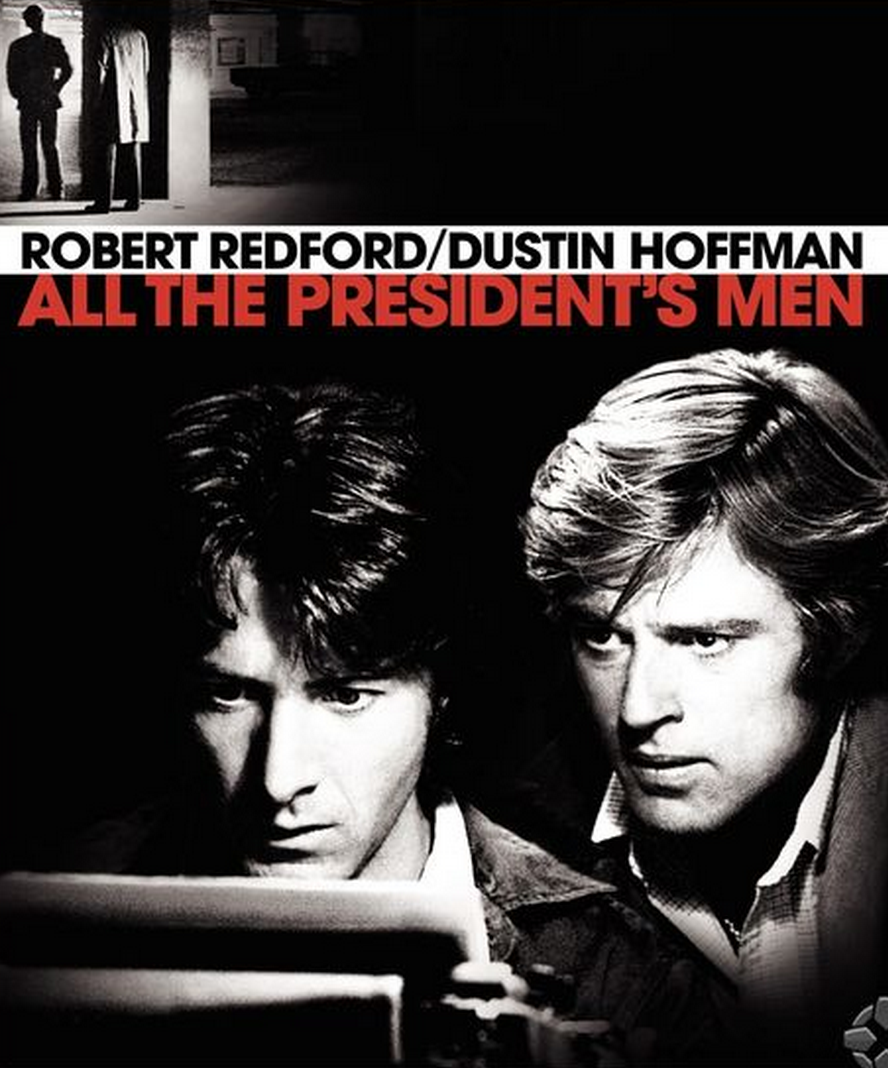
What is that machine those actors are using? And who is Robert Redford?
Newspaper references:
- Why Ben Bradlee and many American journalists curse a lot
- How Ben Bradlee cursed on live national TV when I hosted him as a speaker at a National Press Club luncheon in 2005
- What kind of a boss Ben Bradlee was to my wife Pam Tobey
- Who Deep Throat was and what motivated him to leak
- Where the real Bob Woodward/Mark Felt garage was located
- How the movie’s producers created a replica of the Washington Post’s newsroom in Hollywood for the movie — and the Post newsroom looked exactly the same when my wife Pam began working there in 1984
- Why reporters call the targets of their stories for comment before publishing the story
- Why it was unethical when Carl Bernstein called the secretary in the Miami prosecutor’s office and pretended he was someone he was not
- Why Watergate motivated me (and the entire Woodstein generation) to become reporters
Cultural references:
- Why all of the editors in the Post’s budget meetings were men
- What a manual typewriter is (or was) and why they were all over the newsroom
- Why I took Mrs. Wolin’s typing class at Central High when everybody said that typing was for girls who wanted to become secretaries. (Of course, I wanted to learn to type so I could become a reporter.)
- Who Robert Redford and Dustin Hoffman are
- What the movie “Deep Throat” was about and why Woodward’s editor chose it as a code name for Mark Felt
- What John Mitchell was talking about when he said Katharine Graham would get a certain part of anatomy caught in a wringer
- What a “creep” means and why CREEP became the acronym for the Committee to Re-elect the President
- Why so many people smoked in public spaces
Political references:
- Who John F. Kennedy was and why his photo was in Democratic National Committee headquarters at the Watergate
- The fact that JFK and his brother Bobby were assassinated
- Why the Vietnam War was so unpopular and why American society was torn apart by war, riots and civil rights struggles
- What the Pentagon Papers are
- Richard Nixon’s unique definition of “plumbers”
- Who Daniel Ellsberg is and why he had a psychiatrist
- Who George Wallace and Arthur Bremer were and how Woodward worked with Felt on stories about the Wallace assassination attempt
- Who the anti-Castro Cubans in Miami are
- What the Bay of Pigs is/was
- The long and sordid history of CIA scandals
- Why there is tension between the FBI and the CIA
- Why Nixon hated and feared the Kennedys
- What Chappaquiddick was
- Why George McGovern asked Tom Eagleton to leave the ticket in ’72
- Why Nixon wanted to run against McGovern and not Ted Kennedy or Edmund Muskie
- Why Ed Muskie “cried” in New Hampshire
- What a “Canuck” is
Any suggestions for my next American journalism movie night?
Professor Dunham’s Ten Commandments for journalism ethics in a multimedia world
Posted: April 11, 2014 Filed under: Dunham's Discourses, Journalism Training, Rick's Rules | Tags: BusinessWeek, ethics, journalism ethics, Journalism Training, Multimedia Business Journalism, National Public Radio, Pew Research Center, plagiarism, Society of Professional Journalists, Ten Commandments, TMZ, Tsinghua University 3 Comments
In the classroom at Tsinghua. (Photo by Zhang Sihan)
Journalism ethics are universal. But some ethical issues take on an added dimension on multimedia platforms.
After spending nearly two decades in digital journalism — writing an online column for BusinessWeek, creating two blogs and teaching multimedia journalism — I have boiled down my advice for my Tsinghua University Global Business Journalism students to ten commandments. Here they are:
•1. Thou shalt not steal
- Don’t lift other people’s posts. Or quotations. Or photographs.
- Intellectual property is intellectual property. If you don’t have the right to reproduce a photo or an article – even with attribution – don’t do it!
- Make sure to properly attribute any quotation you pull from another source. Every single time!
- If the original published source of your item turns out to be incorrect, you can be held liable for civil penalties in courts of law if you republish the falsehood.
•2. Thou shalt get it right.
- 24/7 deadlines are no excuse to get it wrong.
- Carefully attribute all facts you cannot confirm.
- Just because somebody else published it on the Internet or sent it out by social media doesn’t make it true.
- Just because somebody told you something doesn’t make it true. As the old journalism saying goes, even if your mother told you, check it out.
- Better to wait a few minutes to confirm or disprove a post than to get it wrong, wrong, wrong.
- As the Pew Research Journalism Project wrote: “Even in a world of expanding voices, accuracy is the foundation upon which everything else is built.”
•3. Thou shalt repent with speed and sincerity.
- If you get something wrong, or link to another source who got it wrong, make sure you correct the mistake. Pronto. Your credibility is on the line.
- Make sure to send corrections to your followers via social media. Falsehoods can go viral and it’s very hard to reel them back in.
- If you made a mistake and others linked to your post, inform them of your mistake. Pronto.
- Apologize.
- Learn from your mistake.
- Because of the instantaneous nature of digital communication, correcting errors is more important – and difficult — than ever.
•4. Thou shalt avoid gratuitous personal attacks.
- Multimedia journalism provides you a basketful of communications options. Don’t use them to be childish, petulant or rude.
- The same rules of fair play apply online as apply in traditional media.
- Don’t mistake “snark” and “attitude” for wit and cleverness.
•5. Thou shalt be fair and balanced.
- It’s not a partisan slogan. It’s our goal as journalists.
- Fairness should never be sacrificed at the altar of an artificial deadline.
- Efforts should be made to contact public figures referred to or criticized in multimedia reports.
- Avoid sensationalism or distortion that is designed to win you “clicks” or “page views.”
- A few tips from the Society of Professional Journalists:
- “Make certain that headlines, news teases and promotional material, photos, video, audio, graphics, sound bites and quotations do not misrepresent. They should not oversimplify or highlight incidents out of context.”
- “Never distort the content of news photos or video.”
•6. Thou shalt not use unnamed sources to attack others.
- It’s a sure sign of a journalism amateur or poseur.
- People have a right to know who your sources are, with rare exceptions.
- People have a right to know your sources’ motives.
- If someone is too cowardly to attach their name to an attack quote, it tells you something about the person.
- As SPJ writes, “The public is entitled to as much information as possible on sources’ reliability.”
•7. Thou shalt live in a glass house.
- Don’t do anything you would criticize someone else for doing.
- Journalists are public figures. Hypocrisy is news, whether the hypocrite is a politician or a reporter.
- From National Public Radio’s Ethics Handbook: •“We hold those who serve and influence the public to a high standard when we report about their actions. We must ask no less of ourselves.”
•8. Thou shalt never give false witness about who you are.
- It is always unethical to pose as someone else to collect information for stories.
- You should identify who you are and for whom you work.
- You should never identify yourself simply as a “citizen,” a “constituent” or a “consumer.”
9. Thou shalt not pay sources for information.
- Or interviews.
- It’s unethical. It separates infotainment sites from journalism sites. Let TMZ.com get the paid-for celebrity scandal scoop. Better to keep your soul.
•10. Thou shalt not be paid off.
- Don’t take money to post, publish or air something.
- Don’t show favoritism toward sponsors, advertisers or donors.
- Disclose any conflicts of interest you or your publication may have.
- Transparency allows your audience to weigh your credibility.
As SPJ’s code of ethics declares, “Professional integrity is the cornerstone of a journalist’s credibility.”
We owe it to the public. And ourselves.
Toxic White House water might have killed three U.S. presidents — Harrison, Polk and Taylor
Posted: April 2, 2014 Filed under: Dunham's Discourses, U.S. politics | Tags: Alexis de Tocqueville, antebellum, Civil War, Dallas, deadly bacteria, enteric fever, Franklin D. Roosevelt, Franklin Pierce, gastroenteritis, George Mifflin Dallas, immigration, indoor plumbing, James Buchanan, James K. Polk, Jane McHugh, Know Nothing Party, Manifest Destiny, Mexican War, Millard Fillmore, New York Times, Philadelphia, Philip A. Mackowiak, pneumonia, Ronald Reagan, San Antonio, septic shock, tainted water, Texas, Tippecanoe, U.S. Congress, U.S. presidents, United States, University of Maryland, University of Pennsylvania, Warren Harding, water, White House, William Henry Harrison, Zachary Taylor 2 CommentsTippecanoe … and Taylor, too?
As a history major, I’ve always struggled for an explanation for the surprisingly bad string of American presidents who served between 1840 and 1860.
This motley crew was politically inept. Think Millard Fillmore. James Buchanan. Franklin Pierce. Zachary Taylor.
The group also had a very high mortality rate. William Henry Harrison died one month after assuming office in March 1841. James Polk (he of Texas annexation and “Manifest Destiny”) died shortly after leaving office. And Zachary Taylor, the old (and I emphasize old) Mexican War hero died less than a year into his term, leaving Americans saddled with Fillmore, who later unsuccessfully sought to return to the presidency as the nominee of the aptly named Know Nothing Party.

He would have become president. Philadelphia’s only vice president, George Mifflin Dallas, one of the subjects of my master’s thesis.
I will claim some academic expertise in this period of history. My master’s thesis at the University of Pennsylvania was on the 1844 Philadelphia economic elite, which included Polk’s vice president, George Mifflin Dallas. The city of Dallas, Texas, is named after this Philadelphian who might — just might — have become the nation’s 12th president if Polk had died a few months earlier, while still in office.
With apologies to Alexis de Tocqueville, the stretch of dysfunctional democracy in America had many causes, including the implacable division between North and South over fundamental social issues, the rise of anti-immigrant sentiment and the triumph of extremism (and mediocrity) on Capitol Hill.
Sound familiar to your 2014 ears?
Historians have written lots about the political debacle in ante-bellum America. But they haven’t written as much about the health debacle in the White House. That’s why the story that appeared in the April 1 edition of the New York Times (it’s no April Fool’s joke) is so important.
The piece outlined speculation about the cause of William Henry Harrison’s death. Conventional wisdom has held (for 173 years) that old Tippecanoe, the oldest man to be sworn in as president until Ronald Reagan, died of pneumonia after catching cold while delivering the longest inaugural address in American history. (I think it may have equalled all four of Franklin D. Roosevelt’s speeches combined. He had nothing to fear but pneumonia itself.)
But it turns out that pneumonia may not have caused Harrison’s death. The Times article casts a credible finger of blame at the potentially toxic supply of drinking water consumed by American presidents during the time before indoor plumbing:
In those days the nation’s capital had no sewer system. Until 1850, some sewage simply flowed onto public grounds a short distance from the White House, where it stagnated and formed a marsh; the White House water supply was just seven blocks downstream of a depository for “night soil,” hauled there each day at government expense.
That field of human excrement would have been a breeding ground for two deadly bacteria, Salmonella typhi and S. paratyphi, the causes of typhoid and paratyphoid fever — also known as enteric fever, for their devastating effect on the gastrointestinal system.
According to the Times piece, Harrison’s eventual case of pneumonia is consistent with enteric fever and may just have been one of the manifestations of acute poisoning.
“As he lay dying, Harrison had a sinking pulse and cold, blue extremities, two classic manifestations of septic shock,” Jane McHugh and Philip A. Mackowiak wrote in the Times. “Given the character and course of his fatal illness, his untimely death is best explained by enteric fever.”
Harrison was the first of three U.S. presidents to die in office (or shortly after leaving office) within a span of only nine years. I’d say that’s reason for some serious “cold case” sleuthing.
Mackowiak, a scholar-in-residence at the University of Maryland and author of “Diagnosing Giants: Solving the Medical Mysteries of Thirteen Patients Who Changed the World,” took up the challenge, joined by San Antonio writer McHugh.
They made a strong case for tainted water as being the cause of Harrison’s death, and suggested that Polk and Taylor may have been its victims, too. They noted that the 11th and 12th presidents “developed severe gastroenteritis while living in the White House. Taylor died, while Polk recovered, only to be killed by what is thought to have been cholera a mere three months after leaving office.”
There’s further evidence to suspect that Mackowiak and McHugh are onto something. The president’s quarters on the second floor of the White House did not get running water until 1853 — Fillmore is given credit by some history books for this major technological advance. After Millard’s move, no president contracted gastroenteritis or died of natural causes. (We’ll leave the mysterious 1923 death of Warren Harding to another blog post.)
So we can’t blame the failure of Fillmore, Pierce and Buchanan on tainted water. Just tainted politics.
Communicating from China: My five lifelines to the world
Posted: March 28, 2014 Filed under: Dunham's Discourses | Tags: Africa, China, email, Facebook, Iran, National Press Club, Pakistan, Skype, Texas, Thailand, Twitter, University of Pennsylvania, WeChat, Y2K 2 Comments
Facebook is my #1 communications tool.
One of the realities of living in China is that I must communicate differently with friends and family.
No more drinks at the National Press Club. Cell phone calls and individual emails are an inefficient way to communicate with a large number of people.
So how have my communications methods evolved? Here are my five most frequently used sources — dominated by social media.
1. Facebook.
It is my lifeline. It is how I share my life experiences and travelogue through words and images. It reaches a large audience instantaneously. And it is my primary method of chatting with friends in America and Europe. The only problem is that Facebook is blocked by the Chinese government, so it is necessary to climb the Great Firewall of China to use it. That occasionally means some unplanned days of Facebook blackout.
2. WeChat.
I had never heard of WeChat when I arrived in China. I knew that Weibo was the Chinese combination of Facebook and Twitter. But I quickly learned (taught by my students) that WeChat is far superior. Almost nobody uses email in China. WeChat is the preferred means of communicating. Its “moments” feature allows you to post updates and photos like Facebook. And group chats allow me to communicate instantaneously with everyone in my class — or with a group of friends heading to dinner. It’s great. And there’s nothing in the U.S. quite like it. Yet.
3. Twitter.
I hadn’t realized just how much drivel gets posted on Twitter until I left the United States. So many American political reporters post so many unimportant updates. So many politicians have nothing to say. So many words (140 characters at a time). So little value. When I came to China, I spent a month “unfollowing” people who offered little insight and added some of the best tweeters in China. Now, once again, Twitter has value to me. But it is no longer my number one social media source, like it was when I was a reporter in search of breaking news, 24/7.
4. Skype.
In the past week, I have Skyped with people in Africa, Iran, Pakistan, Malaysia, Thailand, Texas and France. It is the most cost-effective way for me to do my job as an academic. The quality is usually decent, though, as with everything in China, technology is hit or miss. But Skype allows me to see Pam regularly and to communicate with friends from America to Europe to Asia. I also spend less on long-distance calls today than I did as a college student at the University of Pennsylvania. Thank you, Skype.
5. Email.
My students don’t use email. My colleagues rarely use email. Email is a very “Y2K” thing. But I still use it. It’s the best way to send documents or memos. And it’s the best way to have lengthy exchanges. It’s the only “old-fashioned” way I communicate.
Funny thing: None of these five methods of communication had been invented when I started my career as a journalist. My, oh my, how technology has changed our world.
Viewing the American media through fresh eyes
Posted: January 17, 2014 Filed under: Dunham's Discourses | Tags: cable news, CNN, Fox News, MSNBC, multimedia journalism, New York Times, Tsinghua University, Wall Street Journal, Washington Post 2 CommentsFor at least a decade, I was a 24/7 news addict.
Then I went to China and went cold turkey. Surprisingly, there were no withdrawal pains. Indeed, I actually enjoyed life more and had a lot more time for useful pursuits without the pain of my addiction to CNN, MSNBC, Fox and Twitter.
So what happens when I return from Tsinghua University for winter break?
A short relapse.
One day of CNN was enough to cure me permanently. Here are a few thoughts on the disastrous state of U.S. cable news and the rays of hope for the rest of the U.S. media:
Back to vacation. With the TV turned off.

 Rick Dunham Blog
Recent Comments