Analysis: How Big Will the Blue Wave Be in the Upcoming Midterms?
Posted: November 2, 2026 Filed under: U.S. politics | Tags: 2026 Election, American history, American politics, Blue Wave, Congress, Democrats, Donald Trump, history, news, politics, Republicans, trump, U.S. Congress Leave a comment
By RICK DUNHAM
The Democrats appear poised for a midterm victory. But the size of that victory — and whether it extends to the Senate —will depend on a surprisingly small number of highly competitive races.

The question is not whether the political environment favors Democrats in Tuesday’s midterm elections. By almost every analytical model and historical measure, it does. The question is how much of that advantage translates into seats in the House and particularly the Senate — and how many Republicans who have been considered safe discover, too late, that they were standing in the path of a big blue wave.
I covered the Republican revolutions of 1994 and 2010 and the Democratic takeover of Congress in 2006. One lesson from those elections is that waves often grow larger than the experts expect. A district that looks safely Republican in October can become competitive in November. That does not mean a Democratic landslide is inevitable in 2026. It means we should be careful about treating our final lists of toss-up races as the outer boundary on Election Day.
A referendum on Donald Trump
President Donald Trump has gotten his opt-repeated wish: This election a referendum on him. While Trump would defiantly disagree, that is a serious problem for Republican candidates. A late October Reuters/Ipsos poll placed his approval rating at 32%, near a record low. In the same survey, registered voters preferred Democratic control of Congress by 47% to 36%; among likely voters, the margin was 53% to 44%. One note of caution: While those are substantial leads, national preferences do not necessarily distribute themselves evenly across congressional districts.
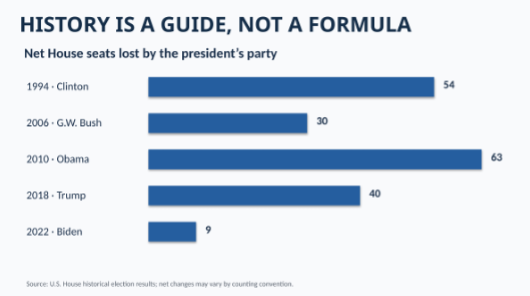
I can say from nearly five decades of covering American politics that history is not kind to the party occupying the White House in a midterm. The president’s party lost 54 House seats in 1994, 30 in 2006, 63 in 2010 and 40 in 2018. But huge setbacks are not guaranteed, even with an unpopular president. Republicans gained just nine in 2022 amid widespread unhappiness with President Joe Biden and rising prices — an important reminder that a predicted wave can become a ripple. Political conditions matter. But so does candidate quality, turnout, gerrymandering and events peculiar to individual races.
The pocketbook problem
Americans do not vote on gross domestic product. They vote on their own economic circumstances and their expectations for their families. In the polling cited in my presentation, 73% said the cost of living was moving in the wrong direction. Trump received just 26% approval for his handling of the economy and 17% for the cost of living. An AP-NORC finding cited in the deck indicated that 65% blamed his policies for driving up prices.
Democrats learned this lesson painfully in 2024. Inflation had multiple causes, including pandemic-era supply disruptions and the energy and grain shocks following Russia’s invasion of Ukraine. Many of those forces were beyond President Joe Biden’s control, but voters held his administration responsible. Trump promised to lower prices, some by 200%. (That’s definitely New Math.)
Instead, his tariffs and trade conflicts have made affordability a central political vulnerability. The precise contribution of any one policy to inflation is debatable.The electoral importance of voters’ perceptions is not. A key number: A majority of American voters now say they are dissatisfied with their own personal financial situation — for the first time since NBC News began asking this question in 1994. Eight years ago, when Republicans lost 40 House seats, more than 70% of Americans reported being satisfied with their own financial outlook midway through Donald Trump’s first term.
Health care, immigration, abortion, government competence and questions about corruption also matter. But the most useful early exit-poll numbers may not be which issue voters rank first. They may be which party voters trust to handle that issue — particularly the economy — and whether voters believe their own circumstances are stable or improving.
The popular vote is not the seat count
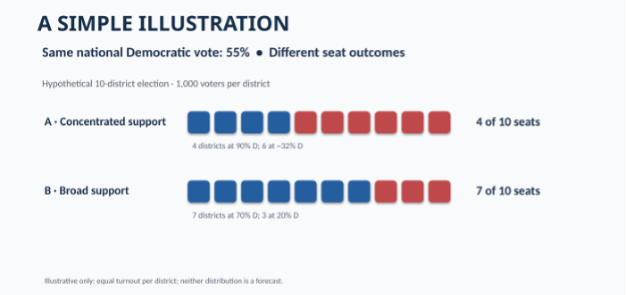
Democrats’ biggest challenge may be to translate a popular vote landslide nationally into victories in heavily gerrymandered House districts. This is the paradox at the heart of this election: Democrats could win a decisive nationwide House vote and still emerge with only a modest majority. Or they could win roughly the same vote share and capture dozens more seats. What matters most is whether Democrats win slim victories in Republican districts or mostly win landslides on heavily Democratic turf.
Imagine ten equally populated districts. In one model, Democrats win four districts overwhelmingly but lose the other six by relatively narrow margins. In another, they win seven districts by more modest margins. The national Democratic vote share can be identical in both examples, yet the seat totals are dramatically different. Votes piled up in a landslide district count in the national total, but they cannot elect additional representatives.
Three forces explain the disconnect: gerrymandering, the geographic concentration of like-minded voters and the decline of split-ticket voting. Mid-decade redistricting has added another complication. The Cook Political Report suggested a net Republican benefit of roughly three seats from the latest map changes, down from GOP’s best case scenario of 10 pickups. The lesson to greedy Republicans is that a favorable map is not a seawall. In a strong enough wave, seats drawn to be safe can suddenly become vulnerable.
Where the wave could reach
Start with the suburbs. Watch Northern Virginia, the Philadelphia suburbs, northern New Jersey, the areas around Detroit and Grand Rapids, and the growing metropolitan regions around Charlotte, Raleigh, Atlanta, Tampa, Orlando, Dallas and Houston. Are Democrats merely holding their previous margins, or are they expanding them? That distinction could determine control of the House and shape several Senate contests.
Then move outward. The signature of a truly broad wave would be smaller Republican margins in exurbs, working-class communities and rural counties — not just bigger Democratic majorities in already-blue cities. Watch places around Columbus, Cincinnati and Cleveland, Pennsylvania’s Lehigh Valley, the industrial Midwest and South Texas. Compare similar counties and districts with 2024, when Donald Trump made major inroads among Latino voters, young men and Black men. A caution: remember that partisan gerrymandering makes some congressional district comparisons to 2024 imperfect.
Population movement adds uncertainty. New arrivals from California, the Northeast and the Midwest have changed parts of Texas, the Carolinas, Florida, Arizona and Nevada. But migration alone does not tell us how people vote. New residents can be more conservative or more liberal than their neighbors, and they can be more shocked by corruption at the state level than longtime residents. Their states of origin are less important than their response to political shenanigans in their adopted state.

The Senate is a different battlefield
The House reflects a national political swing across hundreds of districts. The Senate reflects a much smaller collection of statewide contests, often in territory that voted for Trump in 2024. Democrats need a net gain of four seats from the 53–47 Republican starting point, because the vice president breaks ties for Republicans. Winning the House, even comfortably, would not guarantee control of the Senate.
Maine, Ohio, Iowa, Kansas, South Carolina and Texas deserve close attention, along with Republican-held seats in other states where high quality Democratic candidates have made races unexpectedly competitive. Example: Mississippi.
Democrats must also defend Michigan, where a Sunday morning endorsement of Republican nominee Mike Rogers by the Democratic primary loser, Haley Stevens, scrambled things. An unexpectedly close result in a state considered safely Republican such as Louisiana or Florida would be meaningful even if the Democrat loses: it could suggest that the wave is spreading beyond the expected battlegrounds.
Candidate quality can amplify or blunt the national tide. A strong local incumbent such as Maine Republican Susan Collins may survive a difficult year (although there is little protection against a tidal wave). A weak candidate such as Mississippi’s Cindy Hyde-Smith may lose a seat that should have been secure. Campaign money, advertising and turnout operations matter, too. That’s why we’re all looking at Texas, where sometimes-trillionaire Elon Musk has pumped in tens of millions of dollars in a rescue mission to save Republican Ken Paxton by sliming Democrat James Talarico on the issue of trans rights.
Information, enthusiasm and the unknown
Voters increasingly inhabit different information worlds. Cable television, partisan websites, podcasts, social video and political influencers can present sharply different versions of the same presidency. Republicans benefited from an influential podcast and online ecosystem in 2024. The balance may be changing, especially when podcast superstar Joe Rogan has become a sometimes-critic of Donald Trump and has welcomed Democrats including Texas’ Talarico to share his platform. Still, individual appearances or criticisms by disgruntled former MAGA acolytes are not, by themselves, proof of a nationwide shift.
Enthusiasm is another potential advantage for Democrats. Reuters/Ipsos figures showed 46% of Democrats, compared with 30% of Republicans, describing themselves as very enthusiastic wabout the midterms. While enthusiasm and early-voting statistics heavily favoring Democrats are not final turnout counts, they are important warning signs to Republican operatives. Without an extra-strong Election Day turnout, Republicans are facing major electoral challenges.
How big is the wave?
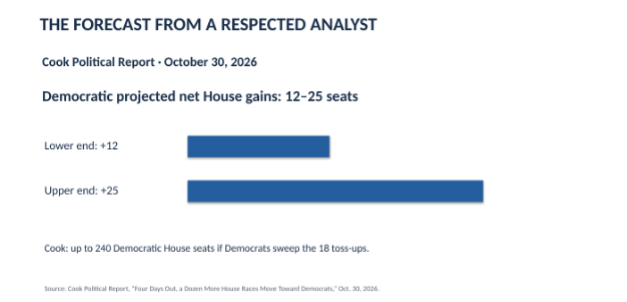
The authoritative, independent Cook Political Report’s October 30 forecast projected Democratic House gains of 12 to 25 seats, with a scenario reaching 240 Democratic seats if the party swept the toss-ups. A true blue tidal wave like the 1994 Newt Gingrich revolution could increase that total. The Cook estimate of 12 to 25 seats is a useful benchmark, not a ceiling or a guarantee. Polls have errors. Turnout models rely on assumptions. But as I always say, it’s better to be ahead in polls than behind. And it’s important to note that no respected independent polling analysts are predicting that Republicans maintain control of the House. So it’s only the size of the coming Democratic majority that’s uncertain.
There are several plausible endings. Democrats could win a narrow House majority while Republicans retain the Senate. They could sweep most competitive seats and win both chambers. A much larger wave could topple Republican incumbents in places nobody expected to be competitive. Or a pro-Republican riptide in most close districts could leave the GOP clinging to a tiny House majority despite a Democratic advantage in the national vote.
I will be watching one question above all others Tuesday night: Are Democrats winning only the races they were expected to win, or are supposedly safe Republican seats suddenly becoming toss-ups? The answer will tell us whether the blue wave is a torrent or a trickle.
>>> Read Rick Dunham’s 2026 Election Night cheat sheet


Recent Comments