Analysis: How Big Will the Blue Wave Be in the Upcoming Midterms?
Posted: November 2, 2026 Filed under: U.S. politics | Tags: 2026 Election, American history, American politics, Blue Wave, Congress, Democrats, Donald Trump, history, news, politics, Republicans, trump, U.S. Congress Leave a comment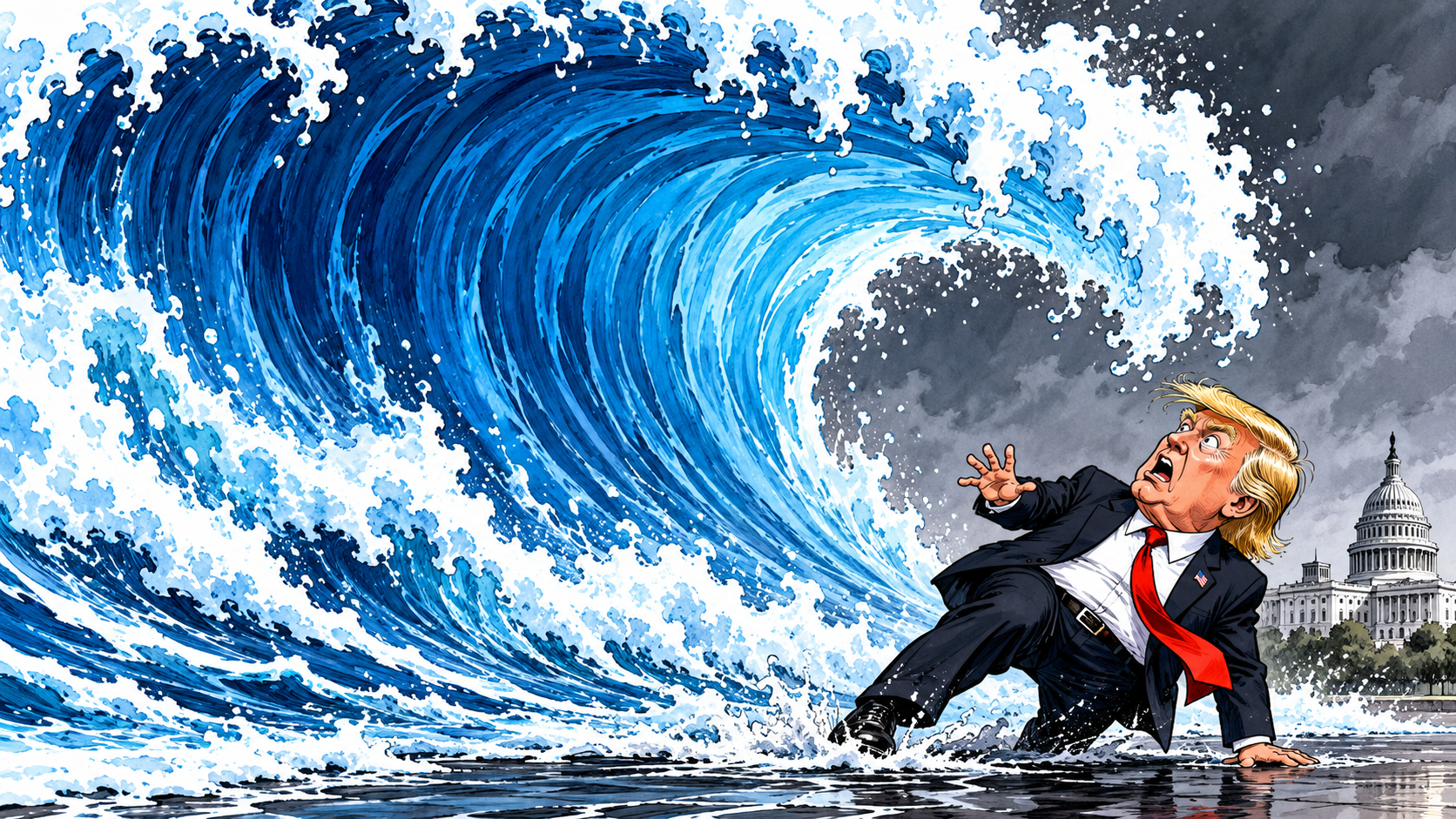
By RICK DUNHAM
The Democrats appear poised for a midterm victory. But the size of that victory — and whether it extends to the Senate —will depend on a surprisingly small number of highly competitive races.

The question is not whether the political environment favors Democrats in Tuesday’s midterm elections. By almost every analytical model and historical measure, it does. The question is how much of that advantage translates into seats in the House and particularly the Senate — and how many Republicans who have been considered safe discover, too late, that they were standing in the path of a big blue wave.
I covered the Republican revolutions of 1994 and 2010 and the Democratic takeover of Congress in 2006. One lesson from those elections is that waves often grow larger than the experts expect. A district that looks safely Republican in October can become competitive in November. That does not mean a Democratic landslide is inevitable in 2026. It means we should be careful about treating our final lists of toss-up races as the outer boundary on Election Day.
A referendum on Donald Trump
President Donald Trump has gotten his opt-repeated wish: This election a referendum on him. While Trump would defiantly disagree, that is a serious problem for Republican candidates. A late October Reuters/Ipsos poll placed his approval rating at 32%, near a record low. In the same survey, registered voters preferred Democratic control of Congress by 47% to 36%; among likely voters, the margin was 53% to 44%. One note of caution: While those are substantial leads, national preferences do not necessarily distribute themselves evenly across congressional districts.
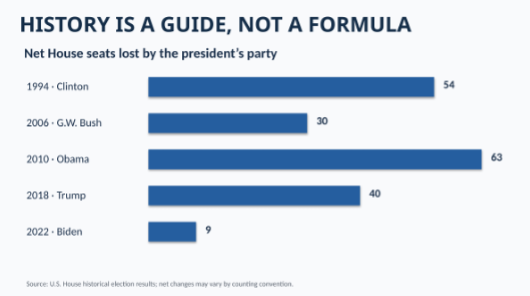
I can say from nearly five decades of covering American politics that history is not kind to the party occupying the White House in a midterm. The president’s party lost 54 House seats in 1994, 30 in 2006, 63 in 2010 and 40 in 2018. But huge setbacks are not guaranteed, even with an unpopular president. Republicans gained just nine in 2022 amid widespread unhappiness with President Joe Biden and rising prices — an important reminder that a predicted wave can become a ripple. Political conditions matter. But so does candidate quality, turnout, gerrymandering and events peculiar to individual races.
The pocketbook problem
Americans do not vote on gross domestic product. They vote on their own economic circumstances and their expectations for their families. In the polling cited in my presentation, 73% said the cost of living was moving in the wrong direction. Trump received just 26% approval for his handling of the economy and 17% for the cost of living. An AP-NORC finding cited in the deck indicated that 65% blamed his policies for driving up prices.
Democrats learned this lesson painfully in 2024. Inflation had multiple causes, including pandemic-era supply disruptions and the energy and grain shocks following Russia’s invasion of Ukraine. Many of those forces were beyond President Joe Biden’s control, but voters held his administration responsible. Trump promised to lower prices, some by 200%. (That’s definitely New Math.)
Instead, his tariffs and trade conflicts have made affordability a central political vulnerability. The precise contribution of any one policy to inflation is debatable.The electoral importance of voters’ perceptions is not. A key number: A majority of American voters now say they are dissatisfied with their own personal financial situation — for the first time since NBC News began asking this question in 1994. Eight years ago, when Republicans lost 40 House seats, more than 70% of Americans reported being satisfied with their own financial outlook midway through Donald Trump’s first term.
Health care, immigration, abortion, government competence and questions about corruption also matter. But the most useful early exit-poll numbers may not be which issue voters rank first. They may be which party voters trust to handle that issue — particularly the economy — and whether voters believe their own circumstances are stable or improving.
The popular vote is not the seat count
Democrats’ biggest challenge may be to translate a popular vote landslide nationally into victories in heavily gerrymandered House districts. This is the paradox at the heart of this election: Democrats could win a decisive nationwide House vote and still emerge with only a modest majority. Or they could win roughly the same vote share and capture dozens more seats. What matters most is whether Democrats win slim victories in Republican districts or mostly win landslides on heavily Democratic turf.
Imagine ten equally populated districts. In one model, Democrats win four districts overwhelmingly but lose the other six by relatively narrow margins. In another, they win seven districts by more modest margins. The national Democratic vote share can be identical in both examples, yet the seat totals are dramatically different. Votes piled up in a landslide district count in the national total, but they cannot elect additional representatives.
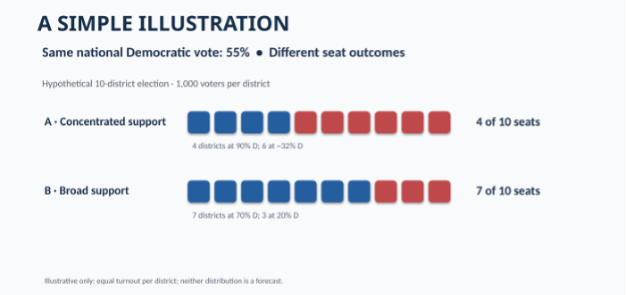
Three forces explain the disconnect: gerrymandering, the geographic concentration of like-minded voters and the decline of split-ticket voting. Mid-decade redistricting has added another complication. The Cook Political Report suggested a net Republican benefit of roughly three seats from the latest map changes, down from GOP’s best case scenario of 10 pickups. The lesson to greedy Republicans is that a favorable map is not a seawall. In a strong enough wave, seats drawn to be safe can suddenly become vulnerable.
Where the wave could reach
Start with the suburbs. Watch Northern Virginia, the Philadelphia suburbs, northern New Jersey, the areas around Detroit and Grand Rapids, and the growing metropolitan regions around Charlotte, Raleigh, Atlanta, Tampa, Orlando, Dallas and Houston. Are Democrats merely holding their previous margins, or are they expanding them? That distinction could determine control of the House and shape several Senate contests.
Then move outward. The signature of a truly broad wave would be smaller Republican margins in exurbs, working-class communities and rural counties — not just bigger Democratic majorities in already-blue cities. Watch places around Columbus, Cincinnati and Cleveland, Pennsylvania’s Lehigh Valley, the industrial Midwest and South Texas. Compare similar counties and districts with 2024, when Donald Trump made major inroads among Latino voters, young men and Black men. A caution: remember that partisan gerrymandering makes some congressional district comparisons to 2024 imperfect.
Population movement adds uncertainty. New arrivals from California, the Northeast and the Midwest have changed parts of Texas, the Carolinas, Florida, Arizona and Nevada. But migration alone does not tell us how people vote. New residents can be more conservative or more liberal than their neighbors, and they can be more shocked by corruption at the state level than longtime residents. Their states of origin are less important than their response to political shenanigans in their adopted state.

The Senate is a different battlefield
The House reflects a national political swing across hundreds of districts. The Senate reflects a much smaller collection of statewide contests, often in territory that voted for Trump in 2024. Democrats need a net gain of four seats from the 53–47 Republican starting point, because the vice president breaks ties for Republicans. Winning the House, even comfortably, would not guarantee control of the Senate.
Maine, Ohio, Iowa, Kansas, South Carolina and Texas deserve close attention, along with Republican-held seats in other states where high quality Democratic candidates have made races unexpectedly competitive. Example: Mississippi.
Democrats must also defend Michigan, where a Sunday morning endorsement of Republican nominee Mike Rogers by the Democratic primary loser, Haley Stevens, scrambled things. An unexpectedly close result in a state considered safely Republican such as Louisiana or Florida would be meaningful even if the Democrat loses: it could suggest that the wave is spreading beyond the expected battlegrounds.
Candidate quality can amplify or blunt the national tide. A strong local incumbent such as Maine Republican Susan Collins may survive a difficult year (although there is little protection against a tidal wave). A weak candidate such as Mississippi’s Cindy Hyde-Smith may lose a seat that should have been secure. Campaign money, advertising and turnout operations matter, too. That’s why we’re all looking at Texas, where sometimes-trillionaire Elon Musk has pumped in tens of millions of dollars in a rescue mission to save Republican Ken Paxton by sliming Democrat James Talarico on the issue of trans rights.
Information, enthusiasm and the unknown
Voters increasingly inhabit different information worlds. Cable television, partisan websites, podcasts, social video and political influencers can present sharply different versions of the same presidency. Republicans benefited from an influential podcast and online ecosystem in 2024. The balance may be changing, especially when podcast superstar Joe Rogan has become a sometimes-critic of Donald Trump and has welcomed Democrats including Texas’ Talarico to share his platform. Still, individual appearances or criticisms by disgruntled former MAGA acolytes are not, by themselves, proof of a nationwide shift.
Enthusiasm is another potential advantage for Democrats. Reuters/Ipsos figures showed 46% of Democrats, compared with 30% of Republicans, describing themselves as very enthusiastic wabout the midterms. While enthusiasm and early-voting statistics heavily favoring Democrats are not final turnout counts, they are important warning signs to Republican operatives. Without an extra-strong Election Day turnout, Republicans are facing major electoral challenges.
How big is the wave?
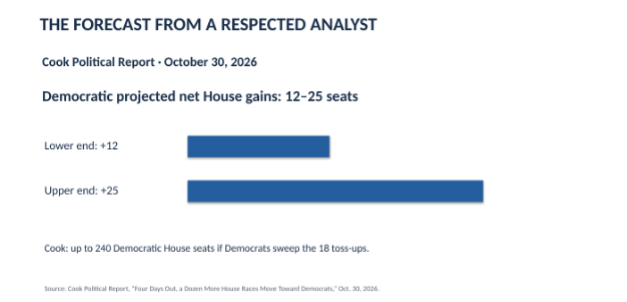
The authoritative, independent Cook Political Report’s October 30 forecast projected Democratic House gains of 12 to 25 seats, with a scenario reaching 240 Democratic seats if the party swept the toss-ups. A true blue tidal wave like the 1994 Newt Gingrich revolution could increase that total. The Cook estimate of 12 to 25 seats is a useful benchmark, not a ceiling or a guarantee. Polls have errors. Turnout models rely on assumptions. But as I always say, it’s better to be ahead in polls than behind. And it’s important to note that no respected independent polling analysts are predicting that Republicans maintain control of the House. So it’s only the size of the coming Democratic majority that’s uncertain.
There are several plausible endings. Democrats could win a narrow House majority while Republicans retain the Senate. They could sweep most competitive seats and win both chambers. A much larger wave could topple Republican incumbents in places nobody expected to be competitive. Or a pro-Republican riptide in most close districts could leave the GOP clinging to a tiny House majority despite a Democratic advantage in the national vote.
I will be watching one question above all others Tuesday night: Are Democrats winning only the races they were expected to win, or are supposedly safe Republican seats suddenly becoming toss-ups? The answer will tell us whether the blue wave is a torrent or a trickle.
>>> Read Rick Dunham’s 2026 Election Night cheat sheet
A short history of tariffs — and why Trump’s actions mark a radical break from global trade history
Posted: September 27, 2026 Filed under: Dunham's Discourses, Journalism Training, U.S. politics | Tags: Adam Smith, Alexander Hamilton, China, Donald Trump, economy, international economics, international relations, Milton Friedman, politics, Smoot-Hawley, tariffs, trade, trade war, trump, Tsinghua University, United States, William McKinley Leave a comment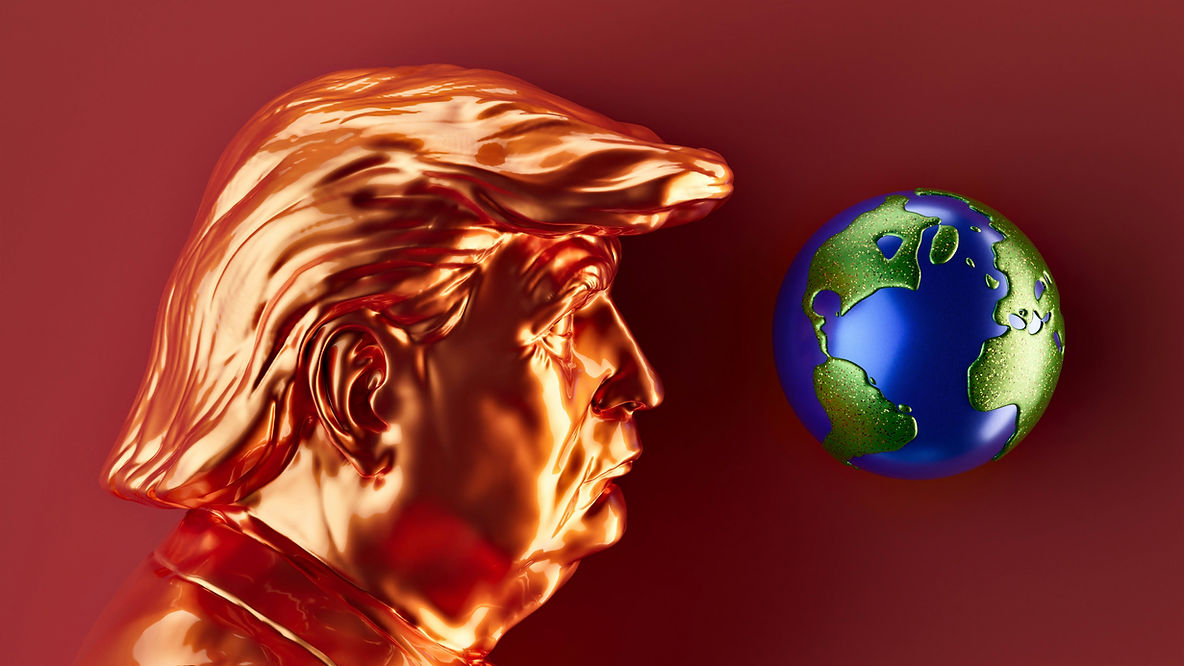
By RICK DUNHAM
For most of human history, governments have taxed goods crossing their borders. Tariffs — taxes levied on imports or exports — have financed empires, protected domestic industries, and punished foreign rivals. They’ve sparked wars, crashed economies, and redefined alliances.
Yet the ongoing tariff war between the United States and the world doesn’t fit neatly into any of the old molds. Rather than being a tool to nurture domestic industry or fill government coffers, tariffs are now being wielded as weapons in a sprawling contest over global power and economic dominance.
“We are seeing an upending of the whole economic order,” said Robert Blecker, an American University economist, “and the rules-based trading system that has been in effect since 1945.”
In its place, he told Global Business Journalism students at Tsinghua University, is “a Hobbesian war of all against all,” referring to the 17th century English social and political philosopher who wrote that people are inherently selfish.
With American President Donald Trump aiming at China as the top target in his massive global tariff offensive, the stakes have grown even higher — signaling a deepening rift that could reshape the global economy for decades.
“China must fail — Trump knows this,” pro-Trump influencer Benny Johnson tweeted to his 3.7 million followers on April 10. “This is more than just a trade war.”
Trump began his sprawling trade wars as soon as he took office on January 20, 2025, by targeting hemispheric allies Mexico and Canada. He took his tariff wars global on April 2 — a date he dubbed “Liberation Day” — with massive levies on dozens of jurisdictions, including some uninhabited islands. After backing down temporarily following a sharp dive in American and global stock markets, Trump restarted his tariff push in early July with daily social media missives targeting trading partners that had incurred his wrath, from Brazil to the European Union, Mexico to Myanmar.
The mercurial president’s reasons ranged far beyond traditional economic excuses for tariffs. For example, he threatened Brazil for prosecuting his close friend, former president Jair Bolsonaro, for staging a failed coup in an attempt to maintain power after losing a reelection race.
Trump believed that his threats would convince nations around the world to line up to follow Great Britain and Vietnam to negotiate trade pacts on terms favorable to the American administration. But most economists, historians and foreign policy experts instead predict more economic chaos and reality show psycho-drama.
“Under Trump’s stewardship, American trade diplomacy has ceased to be a tool of engagement and become a weapon of spectacle,” international affairs analyst Imran Khalid wrote recently in The Hill.
As much as Trump’s actions pleased his strongest supporters at home, many nonpartisan analysts say the passions unleashed by the American president’s on-again, off-again tariffs — which have increased global trade levies to their highest levels in a century — jeopardize the stability of the world’s economy.
“The [Trump] administration is playing with fire,” said Joe Brusuelas, chief economist at RSM.
Already, consumers and businesses have been burned. Around the world, companies are blaming tariffs for depressed consumer demand and lower-than-expected profits. Trump’s unilateral tariffs were struck down by the U.S. Supreme Court as unconstitutional, but the president responded by imposing another round of tariffs, daring the high court to swat him down again. The impact, for business, is unsettling.
“I don’t know what to put for this next headline, so I just kept it simple: tariffs, tariffs and the possibility of more tariffs,” the CEO of luxury furniture retailer RH, Gary Friedman, said on an earnings call while explaining forecasts of declining sales.
From Mesopotamia to McKinley: A brief history of tariffs
To understand why Trump’s tariff obsession is historically unusual, we first have to understand how tariffs evolved.
Start with this historical anomaly: Trump is the first leader of a state to use tariffs to destabilize the global economy or create economic chaos as a political strategy. Let’s go to the history books…
Tariffs — taxes on imported goods — have been around as long as nations have traded. The earliest tariffs were essentially tolls. In ancient Mesopotamia, merchants moving goods through city-states paid taxes at gates and ports. Ancient Athens imposed customs duties on goods entering its harbors; medieval European towns taxed merchants entering city gates. Small kingdoms collected duties at rivers and bridges, not out of economic strategy but because those rulers needed revenue.
Mercantilism, the dominant economic philosophy from the 16th to 18th centuries, gave tariffs a political purpose. Under mercantilist thinking, national wealth was measured by the accumulation of gold and silver. Exporting goods brought money in; importing drained it. Thus, heavy tariffs on imports became common.
One example is Britain’s Navigation Acts of the 17th century. To enrich itself and weaken rivals, Britain required that goods imported to its colonies come via British ships — often with tariffs that discouraged buying from foreign competitors.
Tariffs: American policy tool
However, tariffs were also key to early American economic development. After independence, the United States — lacking an income tax — used tariffs as its primary revenue source. As Alexander Hamilton, the United States’ first Treasury Secretary, argued in his 1791 “Report on Manufactures,” tariffs could protect the fledgling American industry from dominant British manufacturers.
“In countries where there is great private wealth, the public revenue may be derived, in a considerable degree, from it,” Hamilton wrote. “But in a country where there is little capital, taxes on consumption… are more convenient.”
Tariffs are often embraced by politicians, but they are widely despised by free-market capitalists. Adam Smith, in his 1776 classic “The Wealth of Nations,” wrote that tariffs foster economic inefficiency and complacency among protected industries. Two centuries later, Nobel Prize-winning economist Milton Friedman complained that “tariffs protect a few producers at the expense of a much larger number of consumers.”
In the decades leading up to the American Civil War, tariffs became a political flashpoint. The so-called “Tariff of Abominations” of 1828, which sharply raised duties on raw materials and manufactured goods, enraged Southern politicians and business elites, who saw themselves as victims of Northern industrial power. It triggered the Nullification Crisis, a constitutional confrontation over states’ rights between South Carolina and the federal government.
Abraham Lincoln’s Republican Party platform in 1860 was explicitly protectionist, arguing that tariffs “secure to the American laborer the full rewards of his industry.” Lincoln reflected the world mindset. Globally, tariff walls defined commerce until well into the 20th century. Many nations used tariffs to promote “infant industries,” a concept formalized by German economist Friedrich List in the 1840s. Protection, he argued, was necessary to allow industries in developing nations to catch up with more advanced economies.
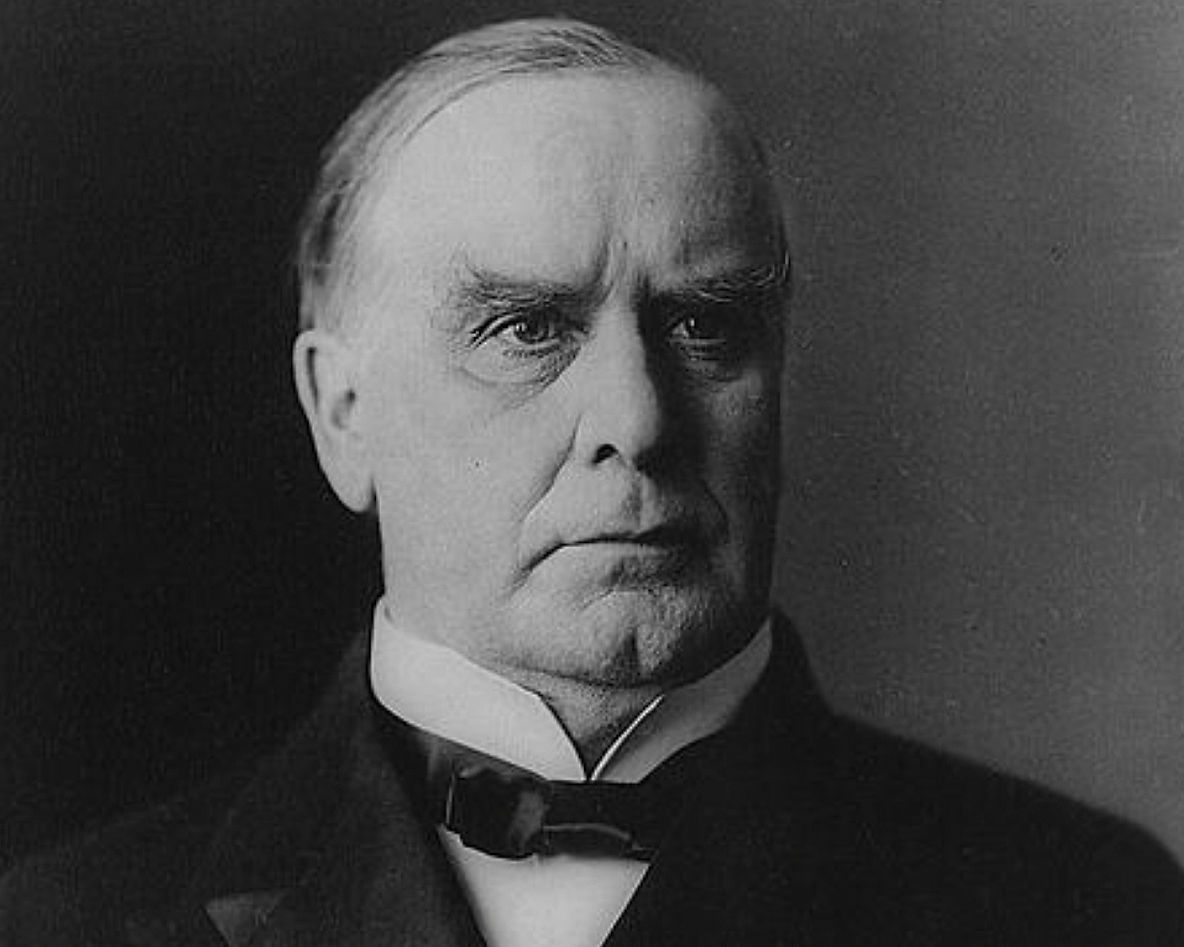
Donald Trump’s historical hero, William McKinley, created a tariff war in 1890 with neighbor Canada and Europe by writing a law as an Ohio congressman raising tariffs to 50% at the behest of American “robber baron” industrialists. The ensuing economic depression and political backlash cost Republicans 93 House seats and the White House in the 1892 mid-term elections. As president four years later, McKinley found a new use for tariff revenue: to fund a war with Spain that created a nascent American Empire from Puerto Rico to the Philippines.
Toward freer trade
In the United States, the creation of the income tax in 1913 ended the need for tariff revenue to fund federal government spending. But as the world spiraled into the Great Depression in 1930, President Herbert Hoover signed into law the infamous Smoot-Hawley Tariff Act, which raised U.S. tariffs on more than 20,000 goods, prompting retaliatory tariffs from other countries and a global collapse in trade. Tariffs were blamed for deepening the worldwide depression and abetting the rise of fascism. After the devastation of World War II, the world shifted toward lower trade barriers and fewer tariffs.
In the post-war world, nations established a new trade order. The General Agreement on Tariffs and Trade (often shortened to GATT), signed in 1947, sought to gradually reduce tariffs and other barriers. Over the next decades, through successive “rounds” of GATT negotiations, tariffs fell dramatically among developed nations.
This period of liberalization culminated in the creation of the World Trade Organization in 1995, giving the world its first comprehensive, enforceable set of trade rules. Tariffs trended downward, global trade trended upward, and extreme poverty dropped significantly around the world. Benefits to the new world order were widespread, but there were many losers, particularly in wealthier countries like the United States and stagnant nations like Russia, where manufacturing facilities shuttered or shifted to other places.
Through successive “rounds” of negotiations, countries agreed to reduce tariffs drastically. In the United States, average tariffs fell from about 20% in the 1930s to less than 5% by the 1990s. Globally, the pattern was similar. Trade exploded, and prosperity (though unevenly) followed.
China’s story fit neatly into this narrative — for a while. After decades of isolation, Beijing joined the WTO in 2001, promising reforms in exchange for access to global markets. U.S. leaders at the time believed that integrating China into the world trading system would encourage political liberalization and bind it to international norms. China’s economic system liberalized, to some degree, but its political system did not.
U.S. consumers benefited from the influx of inexpensive Chinese-produced goods, from toys to toasters, sneakers to solar panels. At the same time, American political leaders in both parties accused China of ignoring international trade rules, breaking bilateral agreements to open markets to American products and services, violating human rights, and stealing intellectual property. China accused the U.S. of bullying and interference in its domestic affairs.

The tariff wars, 2018 to 2025
Tensions between Washington and Beijing simmered for years, but they boiled over during the first Trump administration. In 2018, President Donald Trump imposed $350 billion of tariffs on Chinese goods, citing unfair trade practices, intellectual property theft, and massive trade imbalances.
China retaliated with tariffs of its own, matching U.S. tariffs almost dollar-for-dollar. Suddenly, two of the world’s largest economies were locked in a tit-for-tat spiral that affected industries from agriculture to technology.
The stakes weren’t just economic. Rather than fighting over sales of soybeans or jets, the tariffs were part of a struggle over controlling the rules of trade for the 21st century. Trump administration officials argued that tariffs were a necessary weapon against Chinese-style mercantilism, a system where state-owned enterprises received massive subsidies, foreign companies were forced into technology transfers, and markets were systematically distorted.
While there was a brief thaw — notably the 2020 “Phase One” trade deal, in which China agreed to buy more American products — underlying tensions never truly eased. American officials accused China of failing to comply with its promises to purchase those U.S. products.
When Joe Biden defeated Trump in 2020, many expected a tariff rollback. Instead, Biden kept most levies in place, while introducing new targeted measures on Chinese technology and semiconductors, emphasizing national security concerns.
But domestic political pressure ahead of the 2024 presidential election created a news flashpoint. In May Biden announced a 100% tariff on all Chinese electric vehicles and a 50% levy on solar cells. The move came after U.S. automakers warned that a flood of inexpensive Chinese EVs was threatening their survival, and unions, environmentalists and human rights organizations pressed Biden to punish China.
“We cannot trade a dependency on foreign oil for a clean energy future reliant upon China,” Ben Jealous, then the executive director of the environmentalist Sierra Club said at a 2024 White House event.
China responded swiftly. Within days, Beijing imposed tariffs of up to 50% on U.S. agricultural exports, including soybeans, corn, beef, and dairy products. The Chinese Ministry of Commerce accused the U.S. of “naked economic bullying” and filed a formal complaint with the World Trade Organization.
Why this war is different — and more dangerous
Trump returned to office in 2025, declaring that “tariffs” was his favorite word. He wasn’t joking. He began implementing tariffs in his first day in office and took only two months to target China.
Compared to past tariff disputes, like the Smoot-Hawley Tariff Act of 1930 or the U.S.-Japan trade tensions of the 1980s, the current situation is more expansive, more ideological, and more deeply entwined with national security.
- In the 1930s, tariffs were mainly about protectionism amid a global depression.
- In the 1980s, disputes with Japan focused on market access, with eventual negotiated settlements.
- Today, tariffs are instruments in a struggle over who controls the technologies and supply chains of the 21st century.
Historically, the American Congress maintains power to levy tariffs. But Congress in the 1970s delegated that power to the president in specific emergency situations. Presidents Trump and Biden have used the power in unprecedented ways over the past decade to impose new tariffs without the approval of Congress.
There are four other major reasons why the Trump tariff wars are more dangerous than the escalations of the past 150 years:
- They are no longer confined to particular industries like steel or solar panels. Entire sectors — especially in green technology, digital goods, and agriculture — are now battlegrounds.
- Tariffs are being paired with non-tariff weapons: export controls on critical technology, bans on Chinese apps, investment restrictions, and visa limits on scientists and engineers.
- In one of the starkest breaks from historical norms, tariffs are now intertwined with national security concerns. The Trump and Biden administrations alike have cited China’s control over critical supply chain, from rare earth minerals to semiconductors, as reasons for tariffs and investment restrictions. Biden’s national security adviser, Jake Sullivan, said in 2023 that American trade policy was about “safeguarding national security” and protecting “the very foundations of our economic future.”
- The trade wars are being framed explicitly as a clash of economic systems, not only about unfair trade practices.
“I’m really excited that we are rallying Americans to be anti-China,” self-proclaimed America First journalist Laura Loomer, an informal Trump adviser, posted on the social media platform X. “We need more anti-CCP energy in our country,” she added, referring to the Chinese Communist Party. “It’s about time that we wake people up to the fact that the CCP is our enemy.”
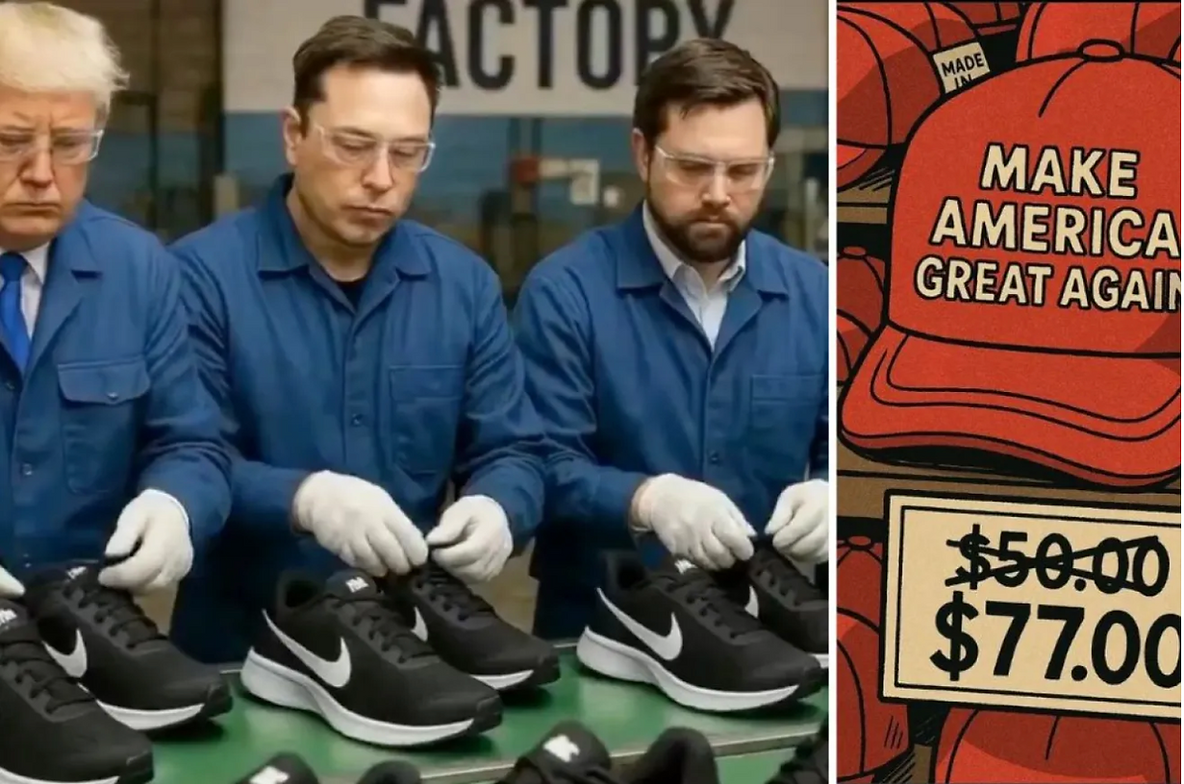
American politicians are heating up the rhetoric in a bipartisan frenzy. Congress in March passed the American Supply Chains Protection Act, mandating that critical goods (like semiconductors, pharmaceuticals, and rare earth elements) must be manufactured either domestically or in “trusted partner nations.” Chinese firms were explicitly excluded.
“To achieve a strong, resilient, supply chain, we must have a coordinated, national strategy that decreases dependence on our adversaries, like Communist China, and leverages American ingenuity,” said Senator Marsha Blackburn, a Tennessee Republican.
China’s state media responded by ratcheting up its rhetoric to levels reminiscent of the Cold War.
“The U.S. should stop whining about itself being a victim in global trade and put an end to its capricious and destructive behavior,” the Communist Party’s China Daily wrote in an editorial. “It has outsourced its manufacturing and borrowed money in order to have a higher standard of living than it’s entitled to based on its productivity. Rather than being ‘cheated,’ the U.S. has been taking a free ride on the globalization train.”
Trump compounded the economic damage by picking trade wars with his country’s two other largest trading partners, Canada and Mexico. He repeatedly declared his interest in making Canada America’s 51st state and unilaterally imposed 50% tariffs on a wide range of Canadian imports without provocation. Canada’s government responded with measured retaliation, but Canadian citizens retaliated with a wide-ranging boycott of the U.S. tourism market in 2026.
Amid this political psychodrama, and the economic uncertainty it creates, there has been real economic damage:
- U.S. inflation spiked in early 2025, as higher tariffs on EVs and electronics drove up consumer prices. As tariffs came and went, the affects on inflation varied, but economists estimated that they were responsible for continuing higher levels of consumer costs into late 2026. The U.S.-Israeli war on Iran created an energy price spike and a further inflationary spiral around the world.
- U.S. farmers face a second major hit, eerily reminiscent of the 2018–2019 pain, as Chinese buyers pivoted to Brazil, Argentina, and Russia for agricultural imports. Even after the China-U.S. truce went into effect and Chinese began small purchases of U.S. soybeans, Trump’s trade wars with Canada, Mexico and Europe had caused even more damage to American agricultural exports.
- Global supply chains are scrambling again. Companies that once thought they had weathered the U.S.-China trade storms are now exploring further diversification to India, Vietnam, Mexico, and Eastern Europe.
China, meanwhile, accelerated its “dual circulation” strategy — focusing on domestic production and internal consumption to lessen reliance on U.S. technology and markets. Chinese manufacturers have shut down production, at least temporarily, in factories in Guangdong and other provinces. Some companies are exploring outsourcing to lower-cost labor markets.
The Chinese government has reached out to nations around the world, from ASEAN countries in Southeast Asia to the European Union, to renew its commitment to the pre-Trump global trading order. But most countries are responding warily, as Trump seeks to negotiate bilateral deals.
“Nothing is certain but uncertainty when it comes to Trump tariffs!” Tengku Zafrul Aziz, Malaysia’s Minister of Investment, Trade and Industry, posted on LinkedIn.
The WTO estimated in April that reciprocal tariffs would slash the 2025 global GDP by 0.6%. The World Bank warned in an April 2025 report that a fully decoupled global economy could shave 2% off world GDP by 2030 — trillions of dollars in lost wealth. The current situation has been described as a “slow-motion fracture of the world trading system.” With Trump insistent on a permanent tariff regime, it is difficult to tell if his administration, which ends in January 2029, is an aberration or a herald of a permanently fractured system.
Global consequences
Tariffs have always been about more than just economics. They are tools of power and leverage, expressions of national priorities and fears.
But the 2025 U.S.-China tariff war marked a profound shift. It is not just a fight over trade imbalances, but a battle over the very future of global order and the hegemonic ambitions of the world’s two largest economies.
Each twist and turn in the war — each up and down in stock markets — is the subject of social media trolling and government spin. Chinese nationalists were particularly gleeful when Trump retreated from 145% to 30% tariffs on May 12. Beijing dropped its levies on U.S. goods to 10%. There have been a series of truces agreed to by both sides, the latest lasting until after the 2026 midterm elections in the United States.
“This is called, ‘victory,’” Hu Xijin, the retired editor of the state-controlled Global Times, reveled on the Weibo social media platform. “Today we have definitely driven the Americans back to the 38th parallel! [a reference to the pre-war Korean border].”
Hu’s allusion resonates deeply among Chinese superpatriots. More than 1 million Chinese troops famously drove American and other United Nations troops to retreat to near the 38th parallel after the UN forces had conquered nearly all of North Korea in the fall of 1950 in a counteroffensive following the North’s summertime invasion of the South. The war ended in 1953 after more than two additional years of bloody stalemate.
Today’s war is not being fought by soldiers but by lawyers and customs agents. Whether the world moves toward deeper fragmentation or finds a new equilibrium will depend on political will, economic realities, and, perhaps, a willingness to learn from the lessons of history.
“It is an enduring lesson of history: protectionism may feel good in the short term, but it inevitably isolates and impoverishes in the long run,” says Imran Khalid.
If the United States and China do not reach a permanent cease fire in their trade war — and Trump does not back down on universal tariffs — the entire global economy will suffer, says Callum Glennen of the World Finance website.
“No one wins,” Glennen wrote. “It will be challenging to identify a winner from the fallout of the rounds of sanctions that China and the U.S. are throwing at one another, since there is not a clearly defined goal for either side. Both economies will suffer from the tariffs, and neither is likely to see a significant redevelopment of their local industries.
“The concerns of the U.S. regarding alleged intellectual property theft by Chinese firms may be addressed, but whether that will result in a reduction of the trade deficit is unknown. Based on the U.S.’ history, the damage from a fully fledged trade war could be significant.”
This story was originally written for the Global Business Journalism program website. It was part of a series of articles created by the Global Business Journalism program to help reporters worldwide cover trade and other economic policy issues. Access the business journalism toolkit here.
Note: Economist Robert Blecker, quoted above, died after his guest lecture at Tsinghua University.


Recent Comments