Why you should join the Global Business Journalism Program at Tsinghua — or recommend it to a friend
Posted: December 29, 2014 Filed under: Global Business Journalism, Journalism Training | Tags: Beijing, Bloomberg News, China, Data Journalism, Global Business Journalism, Hang Min, International Center for Journalists, multimedia journalism, Olivia Zhou, Tsinghua University 1 Comment
Our 2014 graduating class
To all of my journalism friends around the world: I invite you to spread the good word about the good work we are doing here at Tsinghua. We’re looking to recruit an exceptional class of graduate students for the upcoming school year and to prove to any skeptics that you can have a world-class journalism program in China. Here’s the pitch. Feel free to share. Comments and questions are welcome.
Are you interested in becoming an expert on the world’s fastest-growing economy?
Do you want to study Asia Pacific business development and report that to the world?
Do you want to have an amazing educational and personal experience in a dynamic country?
Do you want to learn how to share your stories with audiences via print, audio, video and digital media?
Please join in us in the Global Business Journalism Master’s Degree Program at Tsinghua University in China!
2015 Enrollment Instructions
for M.A. in Global Business Journalism
at the School of Journalism and Communication, Tsinghua University, Beijing, China
- Introduction
With China playing a central role in the global economy, there is a soaring demand for trained professionals who can understand the exciting, complicated development of the world’s fastest-growing economy – and can explain it – clearly and in depth — to audiences in China and around the world.

Co-Director Dr. Hang Min with GBJ student
Tsinghua University Master of Arts degree in Global Business Journalism is designed to meet that growing need. The program offers international students the opportunity to master the fine points of business, finance and economics in China. All courses are taught in English — the international language of business — by internationally renowned scholars and accomplished journalists with extensive global experience. The program’s facilities rival those of other leading journalism schools worldwide. The news lab has the largest number of Bloomberg terminals of any college in the world.
Business journalism is one of the fastest growing areas of employment opportunities in the industry today. News audiences are eager to learn about the world of business, while media departments expect PR professionals to understand and analyze the complexities of business issues.
Tsinghua’s Master of Global Business Journalism Program is designed to offer you the opportunity to meet these growing needs and, at the same time, master the fine points of economics, finance and business in China and the world. We welcome you to join in us!
The first English-language graduate business journalism program on the Chinese mainland, created in partnership with the International Center for Journalists, it has sent 171 graduates to news outlets in China and globally over its first seven years.
Launched in 2007, the GBJ program has already been recognized by students and recruiters alike as a world-class program. Academe, the world’s leading journal on higher education, featured a cluster of articles on the program in February 2008. Only the most talented applicants from around the world are accepted, and the student body is culturally and professionally diverse. The full-time program spans two years of intense, fast-paced, rewarding study. Those who complete it successfully emerge with valuable connections, a rich array of opportunities and the business and journalism skills to capitalize on them. It is a two-year experience that will last a lifetime.
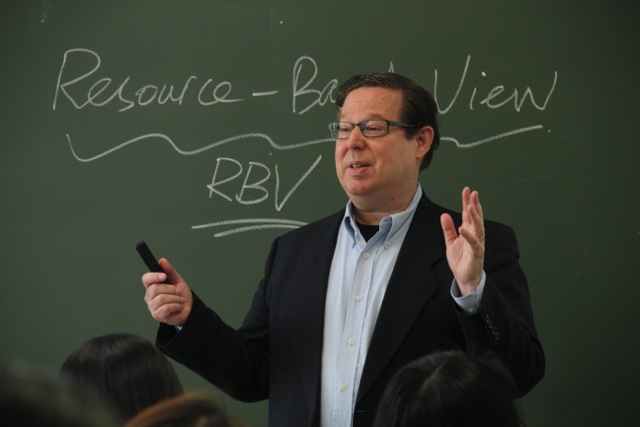
Professor Dunham in the classroom at Tsinghua. (Photo by Zhang Sihan)
The program aims to bring business journalism in China in line with top international reporting standards. The Tsinghua School of Journalism and Communication has a long history of cooperation with major international media and financial-information organizations, and visiting scholars have come from outlets such as Bloomberg, Reuters, Business Week, The New York Times, Financial Times, The Washington Post and CNN.
GBJ offers an array of specialized courses that are at the forefront of global business journalism. Students can learn about international accounting standards, multimedia journalism, data mining, complex financial derivatives, journalism ethics, advanced feature writing techniques and the management of media organizations – knowledge that is transferable to other economies and other professions. At the same time, they gain a deeper knowledge of the Chinese language and economy.
The GBJ program benefits from other academic resources on the Tsinghua campus, including its prestigious School of Economics and Management, as well many Chinese and global media and technology companies in Beijing. Internships, field trips and recruiter visits are integral parts of the program.
GBJ students have opportunities to attend conferences on new media, economic development and other business topics. They benefit from meetings and discussions with guest speakers, including top editors and reporters from leading Chinese and Western news outlets and international business executives. The GBJ has a growing network of smart, sophisticated reporters, editors and public relations professionals who can enhance the world’s understanding of economic and corporate developments in China and globally.
- Program Courses
| Basic Courses | |
| Introduction to Mass Communications and Society in Contemporary China | |
| Chinese Language | |
| Intercultural communication | |
| Media Research Methods | |
| Core Courses | |
| English Financial News Reporting and Writing | |
| Multimedia Business Reporting | |
| Global Business Journalism (advanced) | |
| Economics and Accounting Basics for Journalists | |
| Business Data Mining and Analysis | |
| Elective Courses | |
| Corporate Communication | |
| Opinion and News Commentary | |
| Hot topics in the Global Economy | |
| Feature Writing | |
| Corporate Strategies, Case Studies of Chinese and Global Companies | |
| Personal Finance Reporting | |
| Media Management | |
| Workshop on Film and TV Production | |
| Theory and Practice of Public Diplomacy | |
| Data Journalism | |
| Public Relations: An Introduction | |
| Public Speaking | |
| Other Requirements | |
| Pro-Seminar for Master Candidates in Global Business Journalism | |
| Literature Review and Thesis Proposal | |
| Academic Activities | |
| Internship | |
- Qualification of Applicants
Applicants should have a Bachelor’s degree in related fields and certificate for English proficiency.
- Application Documents
1) The completed Foreigner’s Application Form for Admission to Graduate Programs of Tsinghua University with a 2-inch recent photo, signed by the applicant;
2) Statement of Purpose and resume;
3) The original or the notarial degree certificate or proof of education at an academic institution (you need to submit an original or notarial degree certificate after it was awarded) and an academic transcript. The degree certificate and academic transcript must be officially sealed.
4) Two academic recommendation letters from scholars of associate professorship or higher. They must show referee’s phone number and email address on the letter.
5) For non-English speaking students, please provide English level certificates. e.g. TOEFL, IELTS, etc.
6) A copy of your passport page with personal information (personal and ordinary passport);
7) The completed Application Form for Tsinghua University Scholarship (if applicable, original);
8) A non-refundable application fee of RMB600.
The certificates provided should be the original documents in Chinese or in English, otherwise notarial translations in Chinese or English are required. None of the above application documents will be returned.

Some of the best students from China and around the world.
- Application Procedure
Step 1: Online Application
Complete Online Application on the website of the Foreign Student Affairs Office, Tsinghua University
(http://www.is.tsinghua.edu.cn/EN/online-application/instruction.html). Print and sign the Application Form produced by the system after the application status changes to “verified.”
Step 2: Documents Submission
Submit the application documents listed above to the address indicated below by post mail or in person.
Step 3:Application Fee Payment
There are two ways to pay application fee:
1 . Pay online using a credit card;
After your online application form is verified or the materials are received by Tsinghua University, the staff will make you the online payment draft, and at the same time, an email will be automatically sent out to remind you to pay the application fee via the online application system.
2 . Pay in cash at the Foreign Student Affairs Office (Room 120, Zijing Building 22) on the campus of Tsinghua University.
- Application Deadline
November 1, 2014 — March 20, 2015
Both the Online Application and a complete set of Application documents should be completed and the package should be received by March 20, 2015.
- Tuition and Scholarship
Tuition:Program tuition fee is RMB39000/year.
Accidental Injury and Hospitalization Insurance: RMB 600/year.
Please visit http://is.tsinghua.edu.cn for more information about scholarships.
- Program Website:
For more information about the program, please visit the GBJ website at:
http://gbj.tsjc.tsinghua.edu.cn/publish/jcgbj/index.html
- Application Website:
For an application, please visit the Application Website at:
http://www.is.tsinghua.edu.cn/EN/online-application/instruction.html
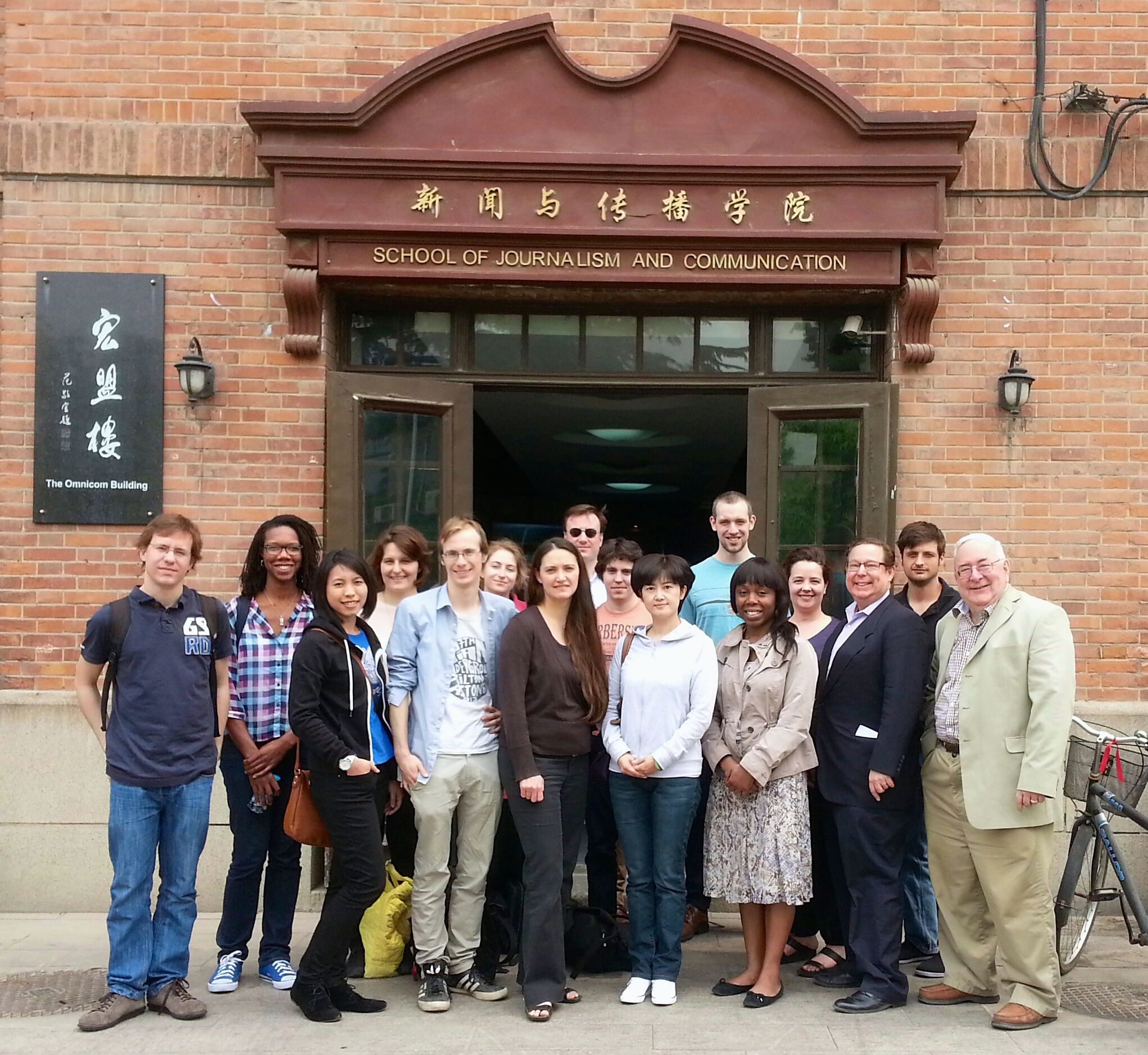
We regularly host international scholars, lecturers from global businesses and exchange students.
10.Contact Information:
Ms. Olivia Xiaoyu Zhou
Room 302, Omnicom Building,
School of Journalism and Communication
Tsinghua University,
Beijing 100084, P. R. China
Tel: +86 10 6279 6842
Fax: +86 10 6277 1410
E-mail: tsjcws@tsinghua.edu.cn
Want the latest analysis of U.S. politics? In China, I’m your guy.
Posted: October 12, 2013 Filed under: Rick in the news, U.S. politics | Tags: Asia Pacific, Asia-Pacific Economic Cooperation, Barack Obama, Beijing, CCTV, China, China Central Television, Dialogue, Global Business Journalism, global economy, media appearance, Tian Wei, Tsinghua University, U.S. economy, United States Leave a comment
Appearance #2.
I didn’t come to China to be a talking head.
I was thrilled to join the faculty of Tsinghua University this September to teach multimedia journalism and co-direct the Global Business Journalism program. The TV gig has been an unexpected pleasure.
Four times during my first month in Beijing, I’ve been called upon to analyze American economic, diplomatic and political issues for China Central Television’s English-language news show “Dialogue.” The show is blessed with one of the smartest hosts in global TV, Tian Wei, and allows guests to engage in an in-depth dialogue on important international issues.
No yelling. No screaming. Instead, viewers watch a briskly paced discussion with smart questions.
In case you missed my appearances, here are links to the four shows. (I tried to embed the videos from the CCTV web site but WordPress is acting finnicky.
The first show is a discussion of the emerging U.S.-China “major power relationship” in diplomacy. The second is a review of the United Nations resolution on Syria. The third focuses on the Asia Pacific economic summit (APEC) skipped by President Obama because of the government shutdown in DC. And the fourth was — guess what? — about the government shutdown itself and its impact on America, America’s place in the world, and the U.S. and global economies.
You may have better things to do than watching me talk for four hours. But in case you want to take a look … enjoy!
9/24/13
DIRECT LINK: http://english.cntv.cn/program/dialogue/20130925/100634.shtml
9/28/13
DIRECT LINK: http://english.cntv.cn/program/dialogue/20130929/100452.shtml
10/7/13
DIRECT LINK: http://english.cntv.cn/program/dialogue/20131008/100695.shtml
10/10/13
DIRECT LINK: http://english.cntv.cn/program/dialogue/20131011/100593.shtml
My take on the dysfunction in DC
Posted: October 7, 2013 Filed under: Dunham's Discourses, Rick in the news, U.S. politics | Tags: American politics, Barry Goldwater, Bill Clinton, Democrats, Global Business Journalism, Houston Chronicle, John McCain, Katie Perkowski, Lindsey Graham, Mitt Romney, Rand Paul, Republican Party, Ronald Reagan, Tea Party, Ted Cruz, Texas on the Potomac, Tsinghua University, U.S. Congress, Washington, WBP Online Leave a commentI’m still getting used to be the interviewee and not the interviewer. Here’s a recent Q&A with me conducted by Katie Perkowski, a super-talented former Texas on the Potomac intern who now works and lives in Bratislava.
Katie’s piece first appeared in WBP Online.
—–
Behind Capitol Hill: Q&A with long-time Washington watchdog
Rick Dunham has had eyes and ears on Capitol Hill and in the White House for three decades, giving him a unique view into US politics. In an interview with WBP Online, the former Washington bureau chief for the Houston Chronicle explains how dramatic political party transformations have led to the dysfunction in Congress we are seeing today.

Ted Cruz (Texas Tribune photo)
By Katie Perkowski
WBP Online
Few people understand the inner workings of US politics quite as well as Rick Dunham, who covered the White House and Capitol Hill for three decades, during which time he served as Washington bureau chief for the Houston Chronicle, White House correspondent for BusinessWeek and board president of the National Press Club.
In a Q&A with WBP Online, Dunham explained the dramatic transformations of the two main political parties, Republicans and Democrats, that he saw during his time in Washington, and why those shifts have led to an ever-dived Congress seemingly incapable of getting anything done. The latest evidence of that now all-too-familiar phenomenon? The federal government’s shutdown, now on day four with no sign of stopping.
Here’s what Dunham had to say:
Q: Can you describe the shift in dynamic you noticed in both the Republican and Democrat parties during your time in Washington? What do you think brought about this change in the way things get done (or don’t)?
There has been a tremendous shift, both culturally and politically, over my three decades in Washington.
One is ideological. Both parties’ representatives were far more diverse in the past. Democrats ranged from far left to far right. Republicans ranged from liberal to very conservative. Now there are no liberals and very few moderates left among Republican lawmakers. And there are very few Democrats remaining who are right of the political center. The party is pretty well split between far left, left and center. Republicans are pretty well divided between right and far right, with a tiny group of centrists. The key Republican division is establishment and insurgent. The establishment Republicans still are in the majority but the radical right Republicans control the agenda through mastery of tactics and willingness to “do the unthinkable.”
Culturally, there has been an even bigger shift. When I arrived in Washington in 1984, Congress was controlled by “doers” and not “talkers.” The goal of lawmakers was to make laws. Legislators used to legislate. Now, the vast majority on both sides of the aisle want to posture and play to their ideological core rather than to get things done.
The great lawmakers I have covered were often very liberal or conservative – Ted Kennedy was hard left and Bob Dole was very conservative – but they believed in moving things forward for their country in the end. There are almost none of those left now, and certainly not enough to get things done.
Q: Covering Texas, you followed Ted Cruz in his rise from solicitor general to senator. What kind of change within the Republican party does Cruz represent? There have been numerous reports out about how senior members of his party, like McCain and Graham are not happy with the way he’s doing things. Do you think there could be a party split among Republicans in the near future? What is the Tea Party’s role in all of this?
The key figures representing the three strands of the Republican future are Ted Cruz, Marco Rubio and Rand Paul. All are ultraconservative but only Rubio among them is pragmatic and willing to cut deals. The other two are ideological purists who would rather lose than compromise. Rand Paul is the leader of the libertarian wing of the Republican Party. He is anti-government. Period. Ted Cruz is an ultraconservative in the mold of the 1964 version of Barry Goldwater, who believed that extremism in the defense of liberty (as he saw it) is no vice. Cruz is against government unless government will help him accomplish his ideological ends. He also is against (almost) anything Barack Obama is for. I call him the leader of the nihilist strain of the modern Republican Party.
That’s why old-fashioned conservatives like John McCain and Lindsey Graham don’t like him. They are very conservative – I don’t buy into the revisionist view of McCain and Graham as moderate because they are willing to cut deals and occasionally act like mavericks.
McCain took an instant dislike to Cruz because Cruz has such an authentic dislike for the institution. McCain respects the institution. Cruz despises it. They are both strong personalities, so it is natural that they will clash. Neither of them is phony. They genuinely dislike each other.
McCain and other Republican leaders believe that Cruz is leading the party on a political suicide mission. They believe he is hoping to burn down the village and then claim to be king of the ashes.
Cruz represents the socially conservative strand of Tea Party Republicanism. Rand Paul represents the pure libertarian strand of Tea Party Republicanism. Both are ideologically pure and strongly “pro-liberty” but both philosophies are distinct and different. They have a slightly different definition of what liberty means.
Q: What kind of precedent do you think it would set if Republicans hold to their current stance and hold the debt ceiling “hostage” as some are calling it in an effort to repeal or delay a law that’s already been passed? Could that lead to similar actions by Congress in the future, or even “revenge” acts of a similar manner by Democrats?
I don’t think it will lead to a “tit for tat” reaction from Democrats in the future. Democrats never held the government or the country hostage during George W. Bush’s administration. I’ve always said that the Democrats’ big problem is that they are too “responsible.” I’m not talking about being ideologically moderate. I mean that they won’t take extreme measures in order to prevail.
Filibusters are another matter. Both sides are irresponsible and hypocritical when it comes to filibusters. That’s another big change in the Washington culture. But that’s another story.
In some ways, Democrats are to blame for all of this. It started with the defeat of Robert Bork, who was very qualified for the Supreme Court (in terms of legal qualifications) but was defeated for ideological reasons, because he was out of the judicial mainstream. That has led to the political equivalent of an arms race where each side is willing to become more and more virulent in order to make political points. It’s gotten to the point that Republicans will block Democratic nominations just because the nominees exist, not even for reasons of ideology or the nominee’s personal issues. That is utterly irresponsible and, I am sorry to say, bipartisan.
Q: Do you think the current party structure in Washington can survive, or should it be changed to prevent the type of mess we’re seeing now?
I see the party structure surviving because that is the history of American representative democracy. We have always had two main parties. The two parties have not always been Republican and Democrat. Since we entered the R/D era, the two parties have changed radically. Now, just about anyone who would have been a Republican at the time of slavery and the Civil War is a Democrat, and anybody who would have been a Democrat at that time is a Republican. The two parties have reversed regional bases. One of the only common threads is that immigrants still tend to be Democrats.
I see the Democratic Party becoming more “moderate” in coming years as more disgruntled former Republicans and moderate young people join the party. I see the Republican Party finally having a showdown between the establishment right and the hard right. It probably will take the nomination of a far-right Republican for president and an overwhelming defeat for the party to move back toward the center. The last two nominees, John McCain and Mitt Romney, were not purists. Indeed, Ronald Reagan is the last hard-core conservative to be a presidential nominee. And Reagan would be considered a pragmatic moderate by today’s standards.
One last thought: If the Republicans are to have a future at the presidential level, they cannot afford to continue to lose immigrants, minorities and young voters. Those three blocs are the future. Republicans not only need to maintain their current levels of support, they need to increase them. A similar fate befell Democrats during the 1980s as Ronald Reagan cut into the blue-collar Democratic base, young voters went Republican and old New Deal Democrats died off rapidly. Democrats won just once in 24 years before Bill Clinton started to redefine the Democratic Party with his “New Democrat” movement. We’re at a similar point in reverse now. But I suspect we’ll need a disaster like the Democrats faced in 1980-1984-1988 to convince Republicans to rethink Cruz-ism.
Dunham is now based in Beijing, where he is a professor of multimedia journalism and co-director of the Global Business Journalism program at Tsinghua University. You can follow him at https://rickdunhamblog.com/.
To contact the author of this story, e-mail katherine.perkowski@wbponline.com.
Professor Dunham’s first lecture
Posted: September 20, 2013 Filed under: Global Business Journalism, Journalism Training | Tags: Global Business Journalism, Journalism Training, Tsinghua University Leave a comment


Professor Dunham’s first lecture, a set on Flickr.
My new life is in full swing now. I taught my first multimedia journalism class on Wednesday to my first-year Global Business Journalism students and Tsinghua University’s international journalism students.
The class is big in size and in talent. As a first project, they took photos during the lecture. Here’s their report.
In case you have trouble opening the Flickr slide show in your browser, here’s a direct link:
http://www.flickr.com/photos/95088907@N05/sets/72157635675220655/
The big announcement: How the Twittersphere reacted to my new job in China
Posted: August 14, 2013 Filed under: Rick in the news | Tags: Aaron Pena, Al Weaver, Alan Blinder, Ayman Mhanna, Carla Marinucci, Dallas Times Herald, Daniel Wright, Dwight Silverman, Elizabeth Traynor, Emily Wilkins, Global Business Journalism, Hailey Branson-Potts, Harold Cook, Houston Chronicle, Jane Sasseen, Jay Root, John Cornyn, John Weaver, Joyce Barnathan, Kay Bailey Hutchison, Kristiina Helenius, Lisa Falkenberg, Mackenzie Warren, Matt Mackowiak, Melissa Aguilar, Priya Anand, Rebecca Acuna, Ricardo Ramirez, Rich Galen, Samuel Rubenfeld, Steve Stockman, Ted Cruz, Texas, Tsinghua University, United States, Wayne Slater Leave a comment
Tsinghua, here I come! (University web site)
People who know me well know that I don’t possess one of the larger egos in American journalism. So I’m a tad apologetic for the blatant boosterism that follows. But I wanted to do it to thank all of my friends and the public officials who took to social media to respond to this announcement.
Breaking news, Twitter friends: I’m leaving the @HoustonChron to run a graduate journalism program at Tsinghua University in Beijing.
— Rick Dunham (@rickdunham) August 13, 2013
My co-director job at Tsinghua’s Graduate Business Journalism program will allow me to pursue my love of multimedia journalism and training.
— Rick Dunham (@rickdunham) August 13, 2013
I am thrilled to be reunited with friends from @BW days: Joyce Barnathan, president of @ICFJ, and @janesasseen, who is joining me on faculty
— Rick Dunham (@rickdunham) August 13, 2013
The overwhelming — and rapid — response reminded me of the power of social media. Twitter and Facebook have transformed our means of communication in just a few years. (Six years ago, when I left Business Week for the Houston Chronicle, I had to send emails to all of my friends just to let them know what had happened.)
Just like we do on Texas on the Potomac, I’ll start with Capitol Hill reaction:
Best wishes in your next journey @rickdunham Thank you for the years of professionalism
— JohnCornyn (@JohnCornyn) August 13, 2013
Congratulations to @rickdunham and thanks for your years of service! Wishing you all the best in your next endeavor.
— Senator Ted Cruz (@SenTedCruz) August 14, 2013
Even former Sen. Kay Bailey Hutchison, who’s had to deal with my questions since my days as a young pup at the Dallas Times Herald, weighed in:
@rickdunham – you did a great job reporting for the @houstonchron! Tsinghua is one of the top univ. in china; an exciting challenge for you.
— Kay Bailey Hutchison (@kaybaileyhutch) August 14, 2013
In the polarized American political world, there was bipartisan agreement — for once.
.@RickDunham, TX & DC are losing a great reporter and a true pro with your departure. You’ll be missed. All the best in your new adventure.
— Ricardo A. Ramírez (@rramirez44) August 14, 2013
.@rickdunham @HoustonChron Whaaattt?!? I want to say congratulations but you will be so missed!!! Ok…congrats!
— Rebecca Acuna (@racunatx) August 14, 2013
@rickdunham @MattMackowiak @HoustonChron Wow! Great news for you and your soon-to-be students! Best of luck, Rick.
— Rich Galen (@richgalen) August 13, 2013
.@rickdunham Best of luck on your new journey. Thanks for your service to our community. Keep us informed.
— Aaron For Texas (@AaronForTexas) August 14, 2013
@rickdunham Rick, going to miss your coverage & insight! But, can you do all of us a favor and take Steve Stockman, among others, with you?
— John Weaver (@JWGOP) August 14, 2013
Reaction poured in from around the world, Helsinki to Beirut to Shanghai:
@rickdunham @HoustonChron Congrats. Thanks for great reporting. In the age of social media – and easy air travel – I’ll keep following you.
— Kristiina Helenius (@AmChamKristiina) August 14, 2013
Congratulations @rickdunham. Lucky students.
— Ayman Mhanna (@AymanMhanna) August 13, 2013
@nycjim @rickdunham @HoustonChron Sell America, Buy China
— Daniel Wright (@DanSWright) August 13, 2013
In Austin and Manhattan journalism circles, disbelief:
@rickdunham Nooooo!
— Jay Root (@byjayroot) August 13, 2013
@rickdunham Wow. Just wow.
— Harold Cook (@HCookAustin) August 14, 2013
@rickdunham @joiechen @HoustonChron Whoa! Amazing! Congrats!
— Andrea Stone (@andreastonez) August 13, 2013
It was nice to hear from my colleagues:
@rickdunham Bummer for us, good for you! Congratulations!
— dwight silverman (@dsilverman) August 13, 2013
@rickdunham @houstonchron A grumpy goodbye to the least curmudgeon political reporter I know. I’ll miss ur wit, ur energy and ur Rolodex.
— Lisa Falkenberg (@ChronFalkenberg) August 14, 2013
@rickdunham Congrats to a true pro & great @Hearst colleague who will be so missed!! Onto great adventure at Tsinghua University in Beijing!
— Carla Marinucci (@cmarinucci) August 14, 2013
@rickdunham @HoustonChron You will be sorely missed! Can we visit you in Beijing?
— Melissa Aguilar (@MelissAguilar) August 13, 2013
Yes, Melissa. Definitely.
I’m especially grateful for the kind words from my former interns who have made me proud over the past six years.
Congrats to @rickdunham on his move to Beijing’s Tsinghua U. Those journalism grad students are lucky they’ll get to learn from him. I was.
— Priya Anand (@Priyasideas) August 13, 2013
One of my greatest mentors. Congratulations. MT @RickDunham I’m leaving the @HoustonChron to run a graduate journalism program in Beijing.
— Alan Blinder (@alanblinder) August 13, 2013
big loss for DC print scene. will miss you rick! RT @rickdunham I’m leavingto run a graduate journalism program at Tsinghua University
— Elizabeth Traynor (@ektraynor) August 13, 2013
@rickdunham Congrats!!! What an adventure. You will be missed.
— Mackenzie Warren (@MackWarrenTV) August 13, 2013
我希望这次是最好的! RT @rickdunham: I’m leaving the @HoustonChron to run a graduate journalism program at Tsinghua University in Beijing.
— Emily Wilkins (@emrwilkins) August 13, 2013
Congratulations to @rickdunham, who I met as a rising college senior covering the DNC and RNC in 2008, and let me work at @txpotomac in 09
— Samuel Rubenfeld (@srubenfeld) August 13, 2013
All the best to @rickdunham and his move to China. Mentored me at my first real world gig at the @HoustonChron. Enjoy it, I know you will
— Al Weaver (@alweaver22) August 14, 2013
@rickdunham Thank you. And — OK! Sounds fun. Don’t ever forget our inaugural use of video (with giant flashcards) at @TxPotomac!
— Hailey Branson-Potts (@haileybranson) August 13, 2013
And I’ll leave you with the words of that ancient Chinese philosopher Wayne Slater:
@rickdunham Wow, sorry to see u leave but what a great opportunity. A great reporter. Like the proverb: May you live in interesting times.
— Wayne Slater (@WayneSlater) August 14, 2013


Recent Comments