5 tips to create an addictive podcast experience (video)
Posted: October 30, 2026 Filed under: Journalism Training | Tags: audio journalism, journalism tips, Journalism Training, podcasts Leave a comment
Podcasts have become a popular way to share stories, ideas, and information. But with so many options available, how do you make your podcast stand out and keep listeners coming back episode after episode?
Creating an addictive podcast experience means building a connection that feels personal, engaging, and rewarding. This video presents five practical ways to make your podcast more addictive and keep your audience hooked.
12 essentials for creating effective digital stories
Posted: October 21, 2026 Filed under: Journalism Training, Rick's Rules | Tags: Journalism Training, multimedia journalism, data visualization, Multimedia Reporting, audience, journalism tips Leave a comment
By RICK DUNHAM
Writing for digital platforms requires different writing styles than the legacy news platforms it has eclipsed.
Readers who consume news on their phones or laptops prefer writing that is briefer and livelier than traditional print articles. Yet they want greater depth and insight than contained in a traditional television news report.
Here are 12 essential elements that will help you succeed in the digital news world.

1. No wasted words
There is no room for self-indulgence in digital writing. Every word matters. People click away from stories if they get bored or annoyed. If you write something and no one reads it, you are not an effective journalist in the digital age.
2. Think short
Short sentences. Write like you speak to a friend, not the way you’d write a report for a government agency or for a thesis.
Short leads. Don’t pack too many words into the first sentence. And don’t write it like a routine wire story lead: “Something happened today in our city, officials said.” Boring!
Short paragraphs. A screen containing one paragraph of dull, gray type is deadly. Vary paragraph lengths, but keep them to a maximum of three sentences.
One thought per paragraph. Don’t try to say everything all at once. Flow naturally from idea to idea. Keep the structure simple.
“A general rule of thumb: Web content should have about half as many words as its printed equivalent,” journalism trainer Tony Rogers has written.
3. Think visually
Don’t just think of the words you will write. Think of how it will look on the screen. You want it to be attractive visually. That means white space (and not just text). It means attractive and easy-to-understand graphics. And it means engaging and, ideally, shareable images.
4. Know your audience
Your writing may differ in subtle or significant ways based on your audience’s profile. Is it older? younger? more educated? more conservative? What is the audience’s nationality (or nationalities)? Is it regional or national within a country? Is it global? Does it have a particular interest in certain subject matter (economics, commerce, the environment, diplomacy)? , may write differently
5. Focus most items around a single theme
Forget about the traditional “kitchen sink” round-up story that deals with a number of developments on a single topic. Pick an important or engaging development and write a narrowly focused, compelling piece. If two or three developments are newsworthy and interesting to your audience, you can write multiple posts. Many news outlets combine these single-topic articles under the banner “the latest news on” today’s big story.
6. Be direct
Always use active sentence structure. Be conversational. Use strong verbs, precise nouns and as few adjectives and adverbs as possible. (Examples: Avoid wasted words like “very,” “a few” or “unfortunately.”) Never use stilted language or flowery prose. Get to the point. Always stay on point.
7. Be immediate
Make it clear quickly why someone would want to read your story now. Unless you are writing a long narrative that someone can bookmark and return to, you want to be immediate. Your target audience will either read it now – or never. Make it now!
8. Be more analytical
Try to add value, even in short stories. Provide analysis, context and even a bit of relevant history. Explain why something happened or what might happen next. Always consider what you might include that would make the reader leave you story thinking that they learned something interesting.
9. Use more lists and “bullet points”
Articles made up of lists, or structured to include a list of “bullet points” (the big dots that resemble bullets), are easier on the eye. They also save space by eliminating transition sentences from one thought to the next. Another plus: Younger audiences (age 35 and under) are particularly drawn to these so-called “listicles.”
10. Liberally insert links
Your digital stories can be easier to find on search engines if you include embedded links in your story. Embedded links have an added advantage: They save space by allowing you to link to background material rather than describing it in your own story. In addition to embedded links, keep people on your app or website by linking to related stories or other articles by the author.
11. Consider embedding social media posts and videos in your stories
Digital stories don’t have to be use a single storytelling medium. By embedding social media posts, short videos or even mini-documentaries in your post, you create a user-friendly multimedia melange.
12. Find your voice
Write like a person, not like a computer. Sound like you are someone the reader would like to know. It’s OK to include some “personality” in the story, as long as the personality is inviting. But don’t let that personality interfere with – or overwhelm – the main points of your article.
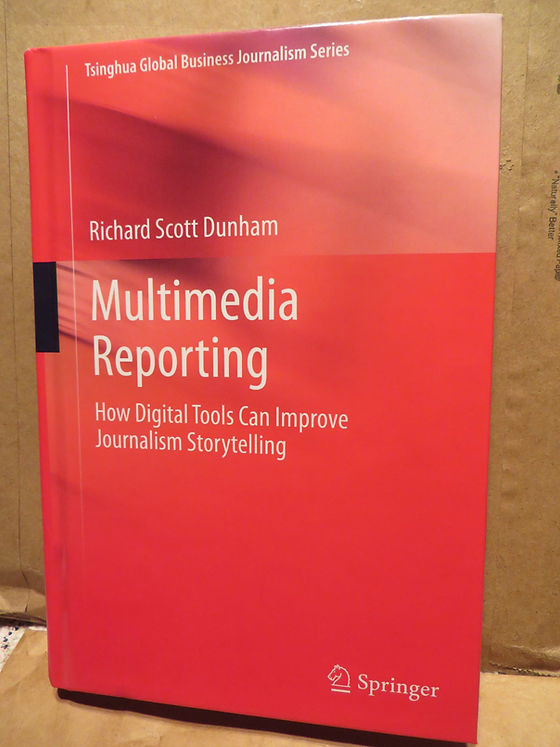
Rick Dunham is co-director emeritus of the Global Business Journalism program at Tsinghua University and a visiting professor in the Tsinghua School of Journalism and Communication. He is the author of the textbook, “Multimedia Reporting,” published globally by Springer, and co-editor of “The Routledge Companion to Business Journalism.”
Mr. Dunham is a veteran Washington journalist, White House correspondent and former president of the National Press Club. He also served as Washington bureau chief of the Houston Chronicle and White House correspondent for Business Week magazine.
Mr. Dunham has offered news analysis for news outlets from countries including the United States, China, Finland, the Philippines, Denmark, Estonia and Russia. He has trained professional journalists, journalism students and journalism educators in locations including the United States, China, Finland, the Netherlands, Hong Kong, Lebanon and the Philippines.
The 10 essentials of news writing
Posted: October 15, 2026 Filed under: Journalism Training, Rick's Rules | Tags: balance, fairness, journalism tips, Journalism Training, news reporting, storytelling, writing Leave a comment
By RICK DUNHAM
No matter how good a writer you are, you cannot be a good journalist without a solid grounding in journalism basics. After 35 years in journalism and a decade in journalism education, I have boiled down the basics to 10 essential traits. Here they are:
1. Truth
Journalism is nothing without a solid bedrock of truth. Your writing must be accurate. But accuracy is not enough: Your stories must be true. If you accurately report an untrue or misleading statement, you are doing a disservice to your audience.
2. Clarity
Make sure your audience understands clearly what you are saying. The words you use should convey the meaning you intend. Be specific. Use active voice. Put numbers into context – particularly large numbers. Avoid long, disjointed sentences shackled with confusing dependent clauses.

3. Completeness
Make sure you have included all of the most important and relevant details. Make sure you placed the main facts of the story into context. Don’t just report on “what’s new” – mention “what’s next” or “why.” Don’t include irrelevant and unimportant details. But make sure you have not misled you audience through omission.
4. Compelling storytelling
You are competing for your audience’s attention in a cluttered information world. Readers are easily distracted, especially when they are consuming your story on a mobile device. To keep their attention, your story must be better than good. There is no substitute for compelling storytelling. Hook the reader from the first sentence. Demonstrate quickly why the story is interesting and important. Make sure that fresh information and strong details are at the top of the story. All of your quotations should add value. The story should move briskly. Every sentence should enrich the reader’s experience.
5. Tight writing
As Strunk and White wrote more than a century ago, “Omit needless words.” Be concise. Keep your sentences short. Keep your first paragraph short (usually under 35 words). Avoid superfluous adverbs and adjectives. When in doubt, leave it out. But remember this: Tight writing does not mean leaving out important details or analytical points. It means trimming the merely ordinary to leave more room for the extraordinary.
6. Precision
Use the right word to convey the right meaning. Avoid vague verbs such as “to have,” “to be,” “to do” or “to get” when you can be more specific. Avoid over-general words such as “some” or “many” or “a lot.” If you have trouble with precise word choice, you need to expand your English vocabulary.
7. Timeliness
You always want a time peg for your news story. On breaking news, that’s easy: News is happening now and I am writing about it. But news features and enterprise projects should be timely now. You might “peg” your story to an anniversary date, an upcoming event or the release of a book or movie. Always be able to answer this question: “Why is this story of interest to my audience right now?”

8. Fairness, balance and responsibility
Ethics are a core value of journalism. Your stories, even opinion pieces, should be fair. You should provide context for breaking news. Multiple points of view should be considered, although you have no obligation to give equal space to everyone. The “target” of a critical story should be given an opportunity to respond before publication. Fairness sometimes includes truth-telling and fact-checking. It is your responsibility to report the truth, not to repeat the assertions of powerful people.
9. Transparency and honesty
You must be straight with your audience if you expect them to trust you. Don’t steal material from others. Properly attribute all material (facts and quotations) that you found on other platforms. Avoid conflicts of interest. Never take money or gifts in exchange for writing a story (or not writing a story).
10. Real reporting
Don’t expect to write a complete report if you have not done some first-hand reporting. A pandemic is not an excuse: You owe it to your readers to gather facts yourself. Don’t just repeat what you saw in a report or a press release. Don’t “curate” the best work of other journalists. In the old days, engaged in what old-timers called “shoe-leather reporting.” Today, you might be wearing slippers in your home office. But get to work and do some real reporting!
More information on Rick Dunham’s textbook, “Multimedia Reporting”


Recent Comments