Global Business Journalism Program: Leading the next generation of journalism around the world
Posted: July 4, 2016 Filed under: Discovering China, Dunham's Discourses, Global Business Journalism, Journalism Training, Uncategorized | Tags: Bank of America, Barrows Dunham, Bloomberg News, China, commencement, Cynthia Chen, Gaelle Patricia Chekma, Global Business Journalism, Global Business Journalism Program, ICFJ, International Center for Journalists, Jade Ladal, Jarchine Zhou, Jiao Jie, Jordyn Dahl, Journalism, journalism education, journalism ethics, Journalism Training, Knight Foundation, Media Economics, philosophy, Tsinghua University, Zhou Jaxin Leave a commentIt has been a honor to serve as international co-director of the Global Business Journalism Program at Tsinghua University for the past three years. Here is a transcript of my remarks at the 2016 commencement on June 30:
This is a very special day for all of us. To you, the graduating class of 2016, it is the culmination of a multicultural, global experience that is certain to benefit you personally and professionally. For me, this day is very special, too.
This is the first group of Chinese students I taught at Tsinghua, and you have made this veteran journalist into a better professor and a better person. Jiao Jie, Cynthia, Jarchine. I could go on and on. I have such respect and affection for you. I am so proud of all of you.
This is the first group of international students I interviewed, taught and mentored from beginning to end. Jade: you may not remember it, but I recall asking you in your interview: Who was your favorite character from En Attendant Godot? (I bet you didn’t prepare for that question.)
From the beginning, I can remember being supremely impressed by the qualifications and enthusiasm of Lauren and Gaelle, who have been leaders and high achievers since the day they arrived.
And I can remember recruiting Jordyn as if she were a star athlete in the United States and I were an eager coach. I knew she would be an invaluable addition to our program. Even while she’s still in school, she’s published superb articles in Forbes and Beijing Review, respected global news outlets.
I am honored, on behalf of the faculty of the Global Business Journalism Program and the International Center for Journalists, to congratulate all of you on your successful completion of graduate studies at the Tsinghua School of Journalism and Communication.
You are entering an uncertain world of journalism … of business and economics … of geopolitics and global conflict. I guess any commencement speaker could have said that at any time. But the pace of technological change, the immediacy brought by social media and 24/7 news, and the interconnectedness of the world, have made it easier for human beings to create positive things — or sow destruction anywhere, anytime.
The disruption created by the digital communications revolution has affected businesses from Dallas to Da Tong. In our world of journalism and communication, traditional forms of communication are collapsing – rapidly in America and Europe, more slowly in China. But make no mistake about it, the old world is gone and will never be revived, despite the antediluvian longings of ultranationalists and isolationists and technophobes.
The good news is that there are so many opportunities for people who embrace change and embrace the latest technologies. You are among the fortunate few. You have been trained in the latest technologies, but you also understand the enduring basics of journalism: accuracy, fairness, accountability, ethics and compelling storytelling. The Global Business Journalism program is a combination of a rigorous academic education taught by some of the finest professors in China, and a real-world journalism newsroom where students learn from distinguished journalists from around the world and create professional multimedia projects and data journalism reports.
With the skills you have learned, and the intelligence and drive you bring to your work, I have no doubt some of you are going to be journalism industry leaders and innovators, in China and around the world.
The Global Business Journalism Program is about to begin its tenth academic year this fall. In its first decade — with the support of Bloomberg News, ICFJ, the Knight Foundation and Merrill Lynch/Bank of America — it has brought together students from about 60 countries to experience a diversity of cultures and ideas.
The GBJ program has been indispensable in creating a new generation of business journalists who are reshaping and improving journalism in China. Not only does Chinese journalism benefit from our superbly trained alumni, but international journalism benefits because the next generation of reporters from Cameroon to California have a more accurate and sophisticated view of the Chinese economy and its role in global growth – and an understanding of the highest standards in global reporting.
What’s more, GBJ has created de facto goodwill ambassadors for China in dozens of countries throughout Africa, Asia, Europe and the Americas. It could not come at a more important time.
The journalism industry is facing an era of limits. In the United States and Europe, those limits are mostly economic: the profit imperative at a time of declining revenues, the mistaken choice of click bait journalism over quality. In China, those limits are mostly political.
But neither the journalism establishments of China nor the rest of the world can afford to be reactive. Traditional news outlets, whether in Beijing or Great Britain, are at risk of losing the next generation of information consumers to social media or alternative sources of information. We must – and we will –adapt, to create innovative new ways to share news.

Barrows Dunham, 1947
I would like to close by quoting from my favorite philosopher, who happens to be my grandfather, Barrows Dunham. Seventy years ago, as the world emerged from the destruction wrought by fascists, he wrote in his book Man Against Myth that the peoples of our planet faced “ambiguous gloom, which may perhaps be twilight and may perhaps be dawn.”
Sounds like today. Looking at the pace of change, he wrote in 1947:
“In our day, indeed, events have attained so formidable a tempo that a single lifetime … will seem to contain more than there once appeared to be in history itself.”
Sounds like today.
Every generation sees an unprecedented pace of social change. That is the reality of human accomplishment, and human nature. There are always those who see the dawn and those who see the sunset. In the dawn of our new era, many in our chosen line of work will resist the changes that are needed.
This challenge reminds me of the Season 6 finale of Game of Thrones – specifically, the reaction of the receptionist at the Citadel, who, in response to a message delivered by Samwell Tarly, told our hero: “This is highly irregular.”
“Well,” Samwell responded, “I suppose that life is irregular.”
Indeed, life is irregular. But we can’t respond to occasional irregularities by retreating or taking the safe path. We must pursue the ambitious vision we learned in GBJ.
As all of you know, I am an optimist. I choose to see the dawn. I don’t fear the future, and you should not, either. You are uniquely prepared to be the change – to lead the change – as we approach the third decade of the 21st century.
To quote Dr. Dunham one last time: “Even now, we ourselves are determining the future, not by knowing what it will be, but by conceiving what it can be.”
Congratulations to the GBJ graduating class. Good luck to all of you. Thank you.
Explaining America to the world: I analyze Trump’s populist revolt for a Finnish audience
Posted: March 6, 2016 Filed under: Rick in the news, U.S. politics | Tags: 2016 presidential race, Aamulehti, American politics, Bernie Sanders, Big Business, Bill Clinton, China, Donald Trump, Europe, Finland, Franklin D. Roosevelt, George McGovern, Global Business Journalism, Hillary Clinton, Iran, Japan, Korea, Lannen Media, Matti Posio, Mexico, New Deal, Orson Welles, populism, reality TV, Republican Party, Ronald Reagan, Slovakia, Ted Cruz, Ulkomaat, United States, Vladimir Putin, Wall Street, Watergate, White House Correspondents' Association Dinner Leave a commentWhen I moved to Beijing in 2013 to explain global best practices in journalism to a diverse group of Global Business Journalism Program students, I had not expected that I also would frequently be asked to explain American politics and democracy to a global audience. I’ve been interviewed regularly in Chinese media, but also in European news outlets from Finland to Slovakia (plus the good old USA).
This week, I discussed the rise of Donald Trump with my friend Matti Posio, who heads up the national news operation for a group of Finnish newspapers, Lannen Media. Here’s a transcript of our conversation:
Q: You have met Donald Trump in person. Tell me about it.
I am one of thousands of people who has met Donald Trump at black-tie social events. For me, it was the White House Correspondents’ Association Dinner in Washington several years ago. He was cordial and polite, very different than his public persona. He was clearly a celebrity among celebrities. Reporters were coming up to him an asking if they could pose for photos with him. He was patient, unlike the hot-tempered character on the campaign trail. Nobody I talked to thought he would ever run for president. I really didn’t do more than exchange small talk. He seems comfortable with social conversation and, obviously, he has been going to formal events for a half-century. From my very short glimpse into his life, I would say that he is a very good actor playing certain roles that are expected of him at different times.
Q: I don’t see how anyone can actually be like that. Is his personality the same in real life than portrayed on media?
How many of us get to see him in “real life”? Real life is his life in his big mansion in Florida. Real life is his family. I can imagine Orson Welles playing the role.

Cruz + Trump = Volatile mix
Q: What is it that foreigners / Europeans really don’t get about Trump?
Do you mean, “Why is he getting so many votes? Why would anyone vote for him for president?” Politically, he is the right man at a very strange time in American political history. After two decades of anti-elitist rhetoric on right-wing talk radio and the Rupert Murdoch-owned conservative cable news network Fox, there is a large minority of the country that believes their way of life has been taken from away from them by the faceless “them” — minorities, immigrants, big companies shipping jobs overseas, corrupt speculators, too-big-to-fail banks, gays and lesbians, working women, feminists, or Big Government giving their tax dollars to undeserving others, Donald Trump is a reality TV performer and is playing to that audience. He is playing the role of populist demagogue, race-baiter, keeper of the working-class flame, proud leader of the “poorly educated,” ranter against the system and the elites and Wall Street and Big Business. So what if he is a son of privilege, a highly educated billionaire and someone who has played the system for years to make deals and make money.
Q: What are the main reasons he has become so popular?
He strikes a responsive chord with less-educated, lower-income white voters across the political spectrum. He is winning among moderate Republicans, conservative Republicans and Evangelical Christians.. He is even getting a modest share of higher-educated, higher-income voters. He is bringing new voters into the system, economically struggling people who thought they had no voice until Donald Trump appeared. While Trump moved relentlessly forward in a media frenzy, his opponents spent months destroying each other rather than going after him. His opponents sound like traditional politicians — which they are — at a time American voters yearn for the myth of “authenticity.” Trump is acting the role of “truth-sayer” supremely well, even if the fact-checking web sites say he is lying much of the time.
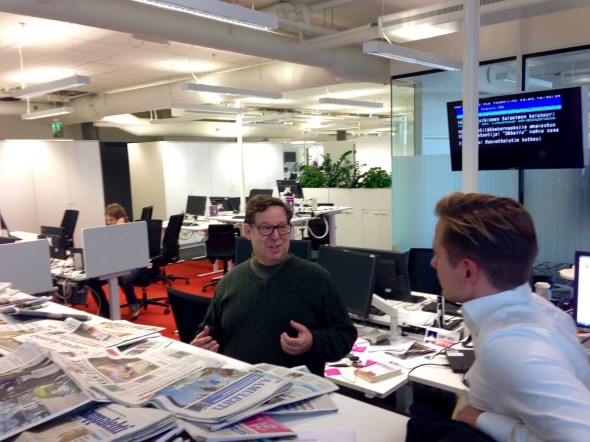
- Talking multimedia innovation at Lannen Media’s Helsinki offices last March
Q: He is behind both Hillary Clinton and Bernie Sanders for the real election. Could he still win?
When it is a one-on-one race, anything could happen. If there are independent candidates dividing the non-Trump vote, anything could happen. There has never been an election like this. Bill Clinton says he expects a close general election. Pundits, who have been wrong all year, are predicting a Trump defeat that costs Republicans control of the U.S. Senate. I’ve been predicting that the public will eventually tire of Trump and “cancel” his election-year reality TV show. But I’ve been wrong for months, along with my fellow political reporters and pundits. So, to repeat an American political cliche, never say never.
Q What would happen if he really became the president? How much would he change?
In recent days, his primary opponent rival Ted Cruz has claimed that Trump told the New York Times editorial board privately that he would act very differently as president than he has during the campaign, as least as far as immigration is concerned. None of us know. As a reporter, I’ve always said that the best way to judge what a politician will do after getting elected to office is to study what he or she promises during the campaign. We can’t read his mind. If he does everything he’s promising to do on the campaign trail, there will be a constitutional crisis and a global economic and diplomatic catastrophe. You’ll have the Putin-Trump axis versus the world. I can’t see it. He would have to change or he would be ineffective domestically and isolated internationally.
Q: Let’s assume he doesn’t become the president. Has he already achieved something, left a lasting mark in the country and its politics? What is it?
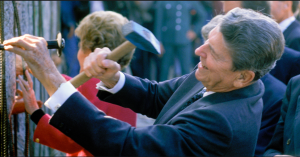
Dismantling the Reagan coalition
Yes, he has achieved something of historical significance. He has destroyed Ronald Reagan’s Republican Party. If he wins the nomination, the party of Reagan will have ceased to exist. It is the same thing that happened to the Democrats in 1972, when George McGovern won the presidential nomination and destroyed the four-decade-old New Deal coalition of Franklin D. Roosevelt. Although Democrats won the White House four years later because of Nixon’s Watergate scandal, it took them two decades to recover institutionally from the crack-up of 1972.
Q: You are currently a professor in China. What is told about Trump there? How much of it is true?
Trump has been portrayed in Chinese media as an eccentric, bombastic showman and celebrity. He’s seen more as a curiosity than a threat, so far, at least. Most people who are savvy about the United States ask me, “Could Trump be elected? Why would Americans vote for Trump?” It’s similar to questions people would ask you in Europe. The coverage of him on Chinese state television is generally straightforward, so far, at least. There has been a bit of negative editorial commentary in traditional state print media, but nothing nearly as inflammatory as what Trump has said about China. And Japan. And Korea. And Mexico. And Iran. And Europe. And Obama.
Q: Would you consider moving to China all together, should Trump be elected?
How about Finland?

Taping an interview at YLE, the Finnish radio network
Photo gallery: A new semester begins for Global Business Journalism students
Posted: February 25, 2016 Filed under: Global Business Journalism, Journalism Training | Tags: Chen Weiyue, China, Cynthia Chen, GBJ, Global Business Journalism, Global Business Journalism Program, Great Britain, ICFJ, International Center for Journalists, Iran, Israel, journalism education, Michigan State, Multimedia Business Journalism, Multimedia Business Reporting, multimedia journalism, Russia, South Africa, South Korea, Tsinghua University, Ukraine, United States, Vietnam, Zimbabwe Leave a commentA new beginning. There’s nothing like the first day of class each semester. Meeting smart young students who are eager to learn. My 35 years as a reporter were exciting and eventful, but my time in the classroom is personally rewarding in a very different way.
My Global Business Journalism Program has trained students from China and 58 other nations of the world, from the U.S. to Vietnam, Russia to Ukraine, Zimbabwe to Great Britain, Israel to Iran, South Africa to South Korea. It is an exciting incubator for the next generation of journalism leaders around the globe.
Tuesday was the first class in my spring semester course, “Multimedia Business Reporting.” Thanks to Weiyue Cynthia Chen, one of the best students I’ve ever taught, for creating this photo gallery of the Global Business Journalism Program in action. (And congrats to Cynthia for getting accepted to Michigan State for her Ph.D. studies!)
For more information, check out the International Center for Journalists’ web link. The deadline for 2016-2017 applications has been extended until March 20. Scholarship deadline is March 10. You can contact me directly if you have any questions.
Chris Roush: There is hope for journalism … in business journalism
Posted: December 7, 2015 Filed under: Breaking news, Global Business Journalism, Journalism Training | Tags: Atlanta Journal-Constitution, Auburn University, Beijing, bizjournalismhistory.org, Bloomberg News, BusinessWeek, Buzzfeed, CNBC, Coca Cola, collegebizjournalism.org, Financial Times, Global Business Journalism, Hurricane Andrew, MarketWatch, Multimedia Business Journalism, Reuters, TalkingBizNews.com, Tsinghua University, University of Florida, University of North Carolina, Wall Street Journal, Washington and Lee University Leave a commentChris Roush, a distinguished American journalism professor and author of two prominent business journalism textbooks, told Tsinghua students on Dec. 2 that the future of business journalism is bright, despite the economic woes gripping much of the news industry.
“If you can write about business and the economy, then they’re really interested in you,” he told 45 students in the Global Business Journalism Program at the Tsinghua School of Journalism and Communication.
Roush, a former reporter for Bloomberg News, Business Week and other U.S. publications, said there is a worldwide demand for young journalists who can explain complex economic topics “in a coherent way so that people can understand.” He told the students from more than a dozen countries enrolled in Professor Rick Dunham’s Multimedia Business Reporting class that their ability to tell journalism stories in multiple languages and on multiple media platforms would make them a valuable asset to news organizations in China and around the world.
“Your language skills are a big deal,” he said.
Unlike the students he was addressing, Roush said he had not planned to be a business journalist.
“After grad school, I needed a job,” he told the students. “The first job I found was as a business reporter in Florida.”
A history major at Auburn University who earned an M.A. in journalism from the University of Florida, Roush quickly made a name for himself in his first job and was recruited by a larger Florida newspaper. After distinguishing himself with his coverage of the deadly Hurricane Andrew in 1992, he was recruited by Business Week, the nation’s top weekly business news magazine. He later covered Coca Cola for the Atlanta Journal-Constitution and Bloomberg News before working for a dot-com start-up. His next stop was academia, as a professor at Washington and Lee University and then at the University of North Carolina.
At UNC, Roush has created a major in business journalism and runs a website called TalkingBizNews.com. He is the author of “Show Me the Money: Writing Business and Economics Stories for Mass Communication” (2010) and “Profits and Losses: Business Journalism and its Role in Society” (2011). He is the co-author of “The Society of American Business Editors and Writers’ Stylebook: 2,000 Business Terms Defined and Rated” (2012). He also has created the websites collegebizjournalism.org and bizjournalismhistory.org.
Like Tsinghua’s Global Business Journalism Program, Roush’s program at UNC has been very successful at placing its graduates at top media outlets, including The Wall Street Journal, Bloomberg News, Reuters, the Financial Times, CNBC, MarketWatch, BuzzFeed and Business Insider.
Roush advised the GBJ students to “find an area or topic where you are the expert” and practice their news writing.
“I really believe the best way to become a good writer is to write a lot,” he said. “Write one story a week.”
Roush said it was important for young journalists to bring both practical skills and a positive attitude to their jobs.
“No matter what you are passionate about, if you are good at it, good things will come your way,” he said.
Global Business Journalism students are improving the quality of journalism in China and around the world
Posted: July 12, 2015 Filed under: Global Business Journalism, Journalism Training, Rick in the news | Tags: Bank of America, Barrows Dunham, Bloomberg News, CCTV, China, China Daily, Chinese economy, commencement, Data Journalism, Global Business Journalism, graduation, Hang Min, House Un-American Activities Committee, ICFJ, International Center for Journalists, Jin Jianbin, Lee Miller, multimedia journalism, Radio Beijing, Red Scare, Shi Anbin, Tsinghua University, Xinhua, Zhang Sihan Leave a comment
A talented group of global journalists, including the first graduates from Nepal, Jamaica and Ukraine.
I am so excited about the opportunities I have had in China to work with journalism students — both international and Chinese — and professional journalists to improve the caliber of reporting and writing in China, and to prepare us all for the Brave New World of journalism in the Digital Age. Here is a transcript of my speech at the July 10 commencement of the Tsinghua School of Journalism and Communication Global Business Journalism Program.
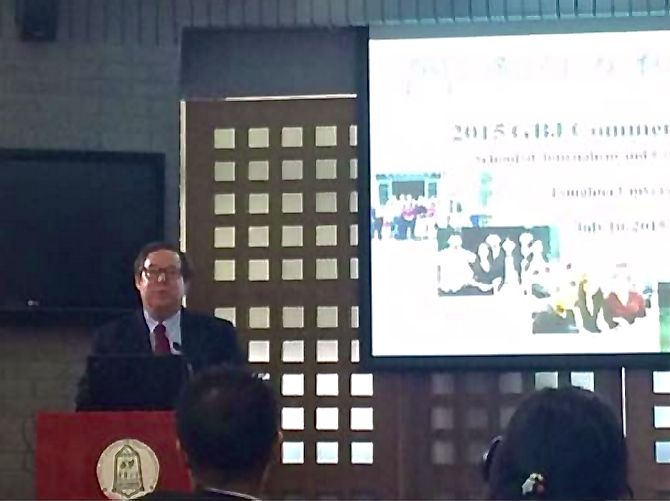
Speaking to the 2015 graduating class of the Global Business Journalism Program at Tsinghua University.
I am honored, on behalf of the faculty of the Global Business Journalism Program, to congratulate you on your successful completion of graduate studies at the Tsinghua School of Journalism and Communication graduation.
It indeed has been an adventure – a voyage of discovery – for all of us. You represent the best of China and the best of the world.
Over the past eight years, students from more than 50 countries have studied together, worked together, gotten to know each other here in the Global Business Journalism Program at Tsinghua University. Ours is a vibrant tapestry of cultures and ideas. You have been exposed to new perspectives, whether they are from the minds of brilliant Chinese professors or veteran international journalists who have plied their trade at the highest levels in the United States and around the world. All of us have gained a better understanding of the rapidly changing world we are inheriting, the rise of China and the rapid transformation of its economy, the complicated dynamics of our interdependent global business world, the rapid transformation of our own world of journalism and the imperative to learn new multimedia and data skills to compete in the emerging journalism marketplace. You have been tested with rigor. You have passed the test. I am so proud of you.
Eight years ago, the Global Business Journalism Master’s Degree Program was just a dream, an idea conceived by some exceptionally creative souls at Tsinghua University in Beijing and at the International Center for Journalists in Washington. In just a few years, it has gained tremendous respect throughout China and around the world, attracting renowned international scholars and Pulitzer Prize winning journalists to work with our students and share their wisdom and their skills.
From the beginning, the GBJ program has been nurtured by the invaluable and incalculable support of Bloomberg News, with its unprecedented gift of ten of its priceless terminals, a series of guest lecturers and events, and a wonderful faculty member named Lee Miller.

One of Tsinghua’s finest, Zhang Sihan, is heading to Columbia University to pursue a dual master’s program in journalism and public policy.
And special thanks to my partner in the program, Dr. Hang Min, for her support, her wisdom and her guidance in making the GBJ program an invaluable resource for global journalism. Under her leadership, we have offered some of the most advanced classes in communication theory, as well as practical, advanced skills that will help our graduates succeed in their chosen field of endeavor, whether that be global business journalism, business, journalism, or something else somewhere on this globe.
By setting exacting standards and requiring rigorous coursework, the GBJ Program has helped to improve business journalism in China by training a new generation of highly qualified journalists specializing in economics and business. Our Chinese graduates now work at some of the most important media outlets in China, such as China Daily, Xinhua News Service, CCTV, and Radio Beijing, as well as at important international media outlets such as Bloomberg News.
That is a testament to the quality of our alumni. It also is a testament to the iron will of friends in the Tsinghua School of Journalism and Communication who have exhibited an unwavering commitment to our success and our continuing growth. Dr. Shi Anbin has been a champion of our cause and a special mentor to me as a newly minted college professor. Thanks, Dean Shi, for everything you have done to make GBJ what it is today, and thanks to Dr. Jin Jianbin and other school officials for their support.
Of course, as all of us know in business journalism, you can’t have an entrepreneurial venture without some venture capital. I would like to thank our founding sponsor, Bank of America, for its steadfast commitment to the program since 2007.
I would like to close by quoting from my favorite philosopher, who happens to be my grandfather, Barrows Dunham. Despite a turbulent professional career that included an unwelcome appearance before the U.S. House Un-American Activities Committee and a spot on the American blacklist during the Red Scare Era of the 1950s, my grandfather, a distinguished philosophy professor and internationally acclaimed author, never lost his sense of patriotism or optimism.
“Even now,” he once wrote, “we ourselves are determining the future, not by knowing what it will be, but by conceiving what it can be.”
None of us know what the future will hold. But with the knowledge we have gained at Tsinghua, the support of our families – and, yes, the Global Business Journalism family – we can conceive that better future.
Congratulations to the Tsinghua Global Business Journalism graduating class. Good luck to all of you. Thank you.
Pulitzer Prize winner Ken Herman encourages Tsinghua journalism students to ‘try different things’
Posted: May 14, 2015 Filed under: Breaking news, Global Business Journalism, Journalism Training, U.S. politics | Tags: Austin, Austin American-Statesman, Beijing, Data Journalism, Forbidden City, George W. Bush, Global Business Journalism, Journalism, journalism education, Journalism Training, Ken Herman, multimedia journalism, Pulitzer Prize, Sharon Jayson, social media, Texas, Tiananmen, tourism, Tsinghua University, U.S. Congress, U.S. military, USA Today Leave a comment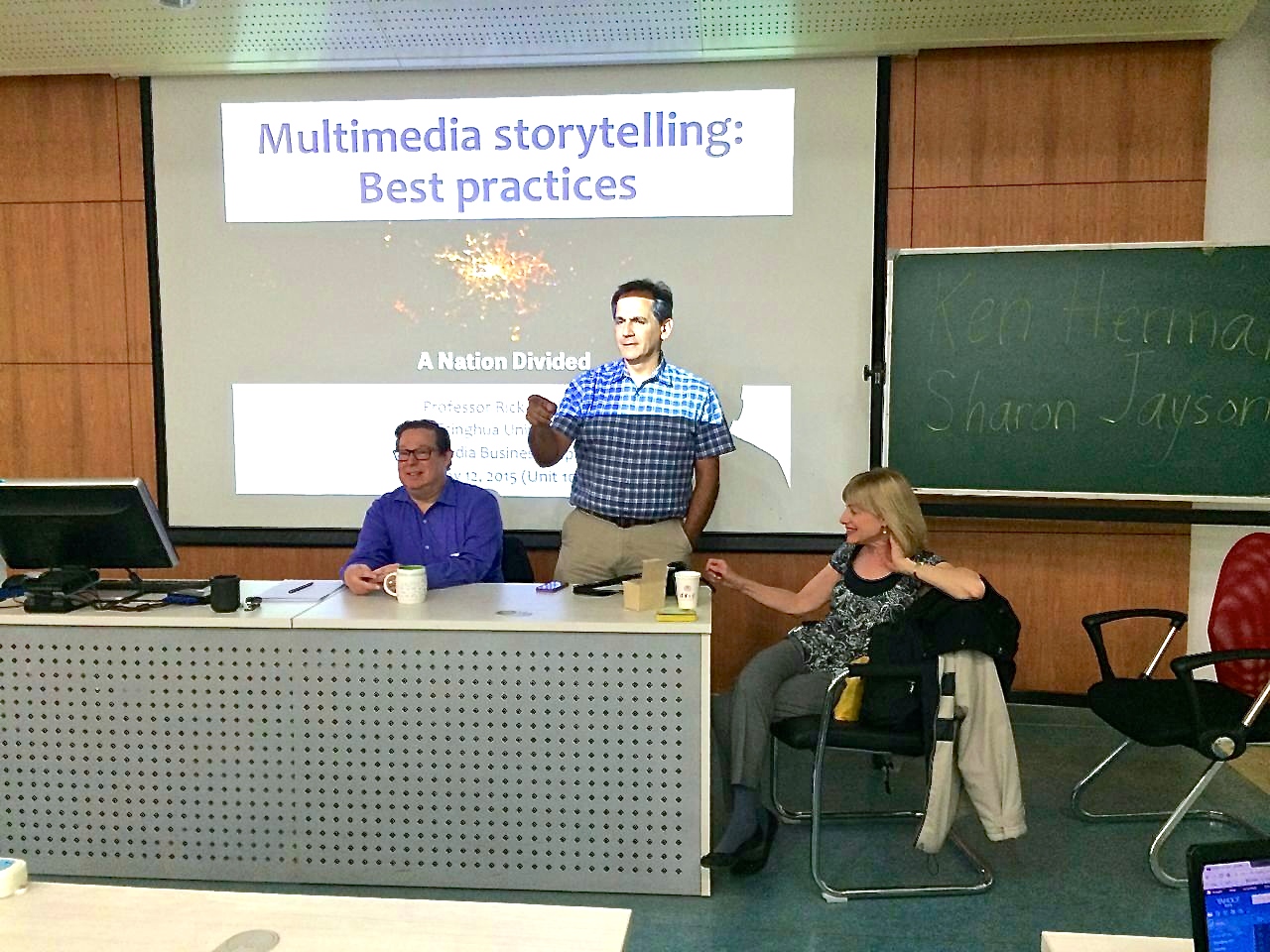
Ken Herman (center) talks to Global Business Journalism Program students, flanked by Rick Dunham (left) and Sharon Jayson (right).
Pulitzer Prize-winning journalist Ken Herman encouraged students in Tsinghua University’s Global Business Journalism Program to experiment with the many new technological tools available to today’s reporters.
“Try different things,” Herman, a columnist at the Austin American-Statesman in Texas, said in a lecture on May 12. “Don’t be afraid to fail. Keep trying and you’ll get better.”
Herman and his wife Sharon Jayson, a longtime reporter for USA Today, spoke to Professor Rick Dunham’s Data Journalism and Multimedia Business Reporting classes at the Tsinghua School of Journalism and Communication. They told the stories of their award-winning journalism careers and advised students to master traditional news writing, audio, video and social media.
Jayson’s three-decade career has included stints as a television news reporter and anchor, a radio station reporter, a radio network Austin bureau chief and a newspaper journalist in Washington and Austin.
“I love journalism,” she said. “I’m glad to go to work every single day.”
Herman, who covered George W. Bush both during his days as governor of Texas and president of the United States, won the Pulitzer Prize for Public Service in 1977 for a series of stories in the Lufkin (Texas) News investigating the death of a young recruit in the U.S. military. The series led to congressional hearings and changes in American military recruiting practices. For the past six years, he has written a newspaper column that sometimes covers serious policy topics and often uses humor to make his points.
“I feel it is important to tell people what is going on in their government – or just entertain them,” he said.
Herman was one of the first print reporters to supplement his reports with multimedia elements such as video and audio. He said that some of his early efforts at video journalism were “pretty bad.”
“Make mistakes,” he said. “I certainly did. But you’ll learn how to do it and you’ll get better.”
Jayson, who specialized in coverage of younger Americans and human relationships during her decade at USA Today, said she knew she wanted to be a reporter from the age of 12, when she worked on a newspaper at her school. She encouraged the students to follow their passion in life, like she did, even if it does not lead to material wealth.
“Don’t just accept something because you think you’re going to get rich,” she said.

Ken and Sharon in Tian’anmen Square, with the Forbidden City in the background.
Ten tips to improve your news photography from a two-time Pulitzer Prize winner
Posted: April 22, 2015 Filed under: Global Business Journalism, Journalism Training, Rick's Rules, Top Ten | Tags: Burkina Faso, child labor, Data Journalism, eBook, Eiffel Tower, Fort Worth Star-Telegram, Gaelle Patricia Chekma, Global Business Journalism, gold mining, Journalism Training, Larry C. Price, Larry Price, Matt Haldane, multimedia journalism, Paris, Philadelphia Inquirer, Philippines, photo composition, photo tips, photography, Pulitzer Center, Pulitzer Center for Crisis Reporting, Pulitzer Prize, Tarnished, Top Ten, Tsinghua University Leave a comment
Larry Price spoke to Global Business Journalism Program students on April 21. (Photo by Gaelle Patricia Chekma)
Every year, the Pulitzer Prizes celebrate some of the world’s best journalism. Just hours after the 2015 Pulitzer winners were announced, my Global Business Journalism Program was fortunate to play host to a two-time recipient of the Pulitzer Prize for photography. Larry C. Price, a University of Texas graduate who won the Pulitzer while working for the Fort Worth Star-Telegram and the Philadelphia Inquirer, dazzled my Multimedia Reporting and Data Journalism students with tales from his latest project, a multi-year investigation into the use of child labor in gold mining. His work — entitled “Tarnished” — was published in eBook form by the Pulitzer Center for Crisis Reporting.
Here are ten tips I culled from Larry’s lectures and the subsequent Q-and-A period. They are not a definitive list of “ten top tips.” They are just a collection of tips that I hope will be useful as you attempt to improve your photographic skills.

One of the many vivid photos from “Tarnished.” This is from Larry Price’s trip to a gold mining area of Burkina Faso.
1. Always remember that you’re a storyteller.
Whatever publishing platform you’re on, and whatever visual medium you’re using, journalism is always about one thing. “It’s all about the stories,” Larry says. “Stories are as old as language. They’re everywhere. And journalism tells them.”
2. Look for something new — or a new take on an old image.
“Find something that hasn’t been done,” Larry says. “Or find a different spin on it.”
He says colleagues have sometimes discouraged him from shooting certain images, saying, “it’s been done.”
“My response is, ‘I haven’t done it,'” he says. “If somebody’s told the story, tell it differently.”
His example: a recent trip to Paris and a photo shoot at the Eiffel Tower.

The eBook “Tarnished” is available online from the Pulitzer Center for Crisis Reporting.
3. Get up early. Stay late.
Larry doesn’t use artificial lighting. As a result, he is looking for the best natural light available. “If you want your multimedia productions to look good, shoot them early in the morning or a few minutes before sunset,” he says.
That means long days of work and short nights of sleep.
4. Get close.
Every photographer has her or his own signature. For Larry, it’s close-ups. “I love tight facial portraits,” he said. “Force yourself to get close.”
Another favorite subject for his close-ups: “Hands and feet. That’s what it’s all about.”
5. Get personal.
To make a subject comfortable with you — especially if you are going to shove your camera into their face — is to develop a personal relationship with them. “I spend a lot of time getting rapport established before I take out a camera,” Larry says. “I develop that rapport so it doesn’t get uncomfortable to your subject.”
Of course, you can’t always do this when news is breaking, but it can help improve your image if you have a bit of time to prepare.
6. Keep shooting.
“When I’m in the field, it’s constant activity,” Larry says. “Digital allows you to shoot, review, delete a lot.” Don’t let your guard down when you’re on duty: You never know when the next great photo opportunity might come. “You can’t ever relax,” he says. “It’s a never-ending cycle of feeling guilty.”
On his most recent trip to Burkina Faso, Larry returned with 37,000 frames. “I always have a lot of failures,” he notes. “I shoot a lot of pictures.”
7. Minimize your vertical shots.
Horizontal photographs work best on digital platforms, whether that’s a mobile device or a computer. And if you’re taking video, make sure it’s horizontal. “Never shoot vertical video,” warns Larry. “It’s useless. Half your space is wasted.” He rarely takes vertical stills, except for portraits. But he likes the square format popularized by Instagram. “Square is a very good portrait format — a little more artsy,” he says.
8. Stay natural.
Great photographers don’t cheat with editing programs that alter reality. “I don’t do a lot of Photoshop with my pictures,” he said. “I don’t exaggerate the colors or anything.”
9. Take good notes.
You need to have the spelling of names, correct ages and the locations of cities or villages. Larry always uses two notebooks. He also records the GPS coordinates of everything.
10. One old-fashioned photo composition rule.
“Don’t ever put people in the middle of the frame,” he says.

Matt Haldane has a front row seat for Larry Price’s lecture at Tsinghua.
Congratulations to 2015 Pulitzer Prize winner Lisa Falkenberg, who exposed injustice in Texas justice
Posted: April 21, 2015 Filed under: Breaking news, Dunham's Discourses | Tags: criminal justice, Global Business Journalism, Houston Chronicle, Larry Price, Lisa Falkenberg, Mizanur Rahman, Pulitzer Prize, Steve Gonzales, Tony Freemantle, Tsinghua University Leave a comment
Lisa Falkenberg gets a hug from Chron colleague Tony Freemantle after winning the Pulitzer Prize for commentary. (Photo by Steve Gonzales)
What a thrilling way to start the day! On the morning I will host two-time Pulitzer Prize winner Larry Price in my Global Business Journalism classes at Tsinghua University, I wake up to news that my longtime Houston Chronicle colleague Lisa Falkenberg has won the 2015 Pulitzer for commentary.
Thoroughly deserved. Lisa’s compelling columns exposed deep injustices in the justice system. The scales of justice in Texas are weighted … and not in favor of the individual.
Many in Houston will note that this is the first Pulitzer Prize in the history of the Houston Chronicle. Yes, that is a historical footnote worth noting. But let’s not forget that this prize was given because Lisa described in a compelling and clear nature the deep, systemic flaws in the local criminal justice system. To honor Lisa, let’s have more than champagne. Let’s fix the perversions of justice that take place in Texas.
I can now say that I once covered an election from the cluttered cubicle of a Pulitzer Prize winner, when she was on maternity leave.
Have a great celebration with Mizanur and the family, Lisa. And let’s see if we can do something about the ills you exposed.
Experimenting with data visualization: Here are some interactive graphics I have developed
Posted: April 19, 2015 Filed under: Global Business Journalism, Journalism Training, U.S. politics | Tags: 2016 presidential race, Baidu, Ben Carson, British Pound, Chinese RMB, Chris Christie, Data Journalism, data visualization, Euro, GBJ, Global Business Journalism, interactive graphics, Japanese Yen, Journalism Training, multimedia graphics, Paul Ryan, Russian Ruble, Scott Walker, Silk, Swiss Franc, Ted Cruz, Tsinghua University, US Dollar, Zhang Sihan Leave a comment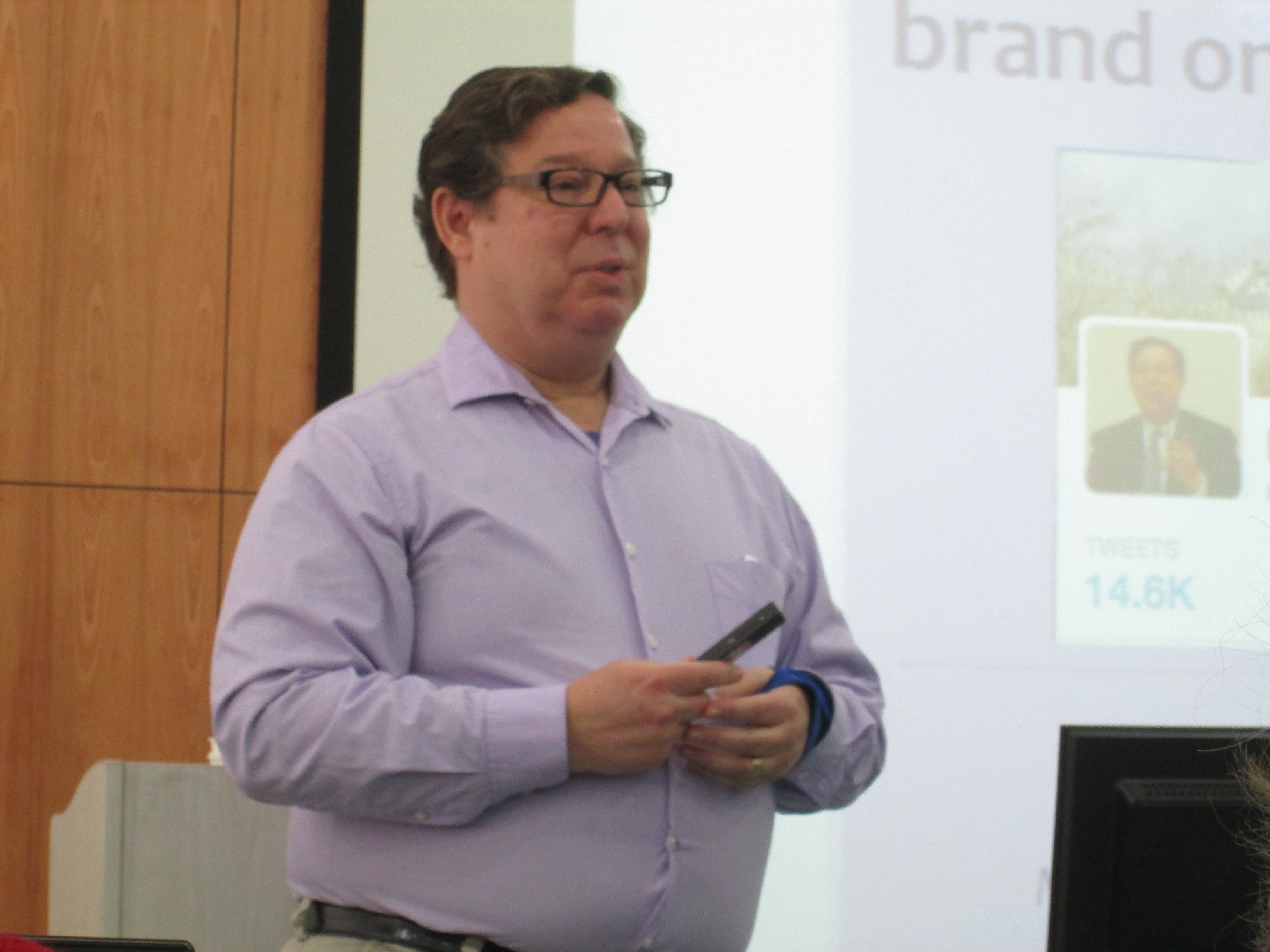
Teaching Data Journalism at Tsinghua. (Photo by Zhang Sihan)
As part of the new Data Journalism course I have created for the Global Business Journalism Program at Tsinghua University, I am experimenting with data visualization platforms. Here are a few examples. (If my WordPress blog platform will not allow you to open the embedded graphics, you can click on the links to take you to the pages where you can view them.)
I’d love to get your feedback … and some suggestions on platforms that could be useful for data viz projects.
THE VALUE OF THE U.S. DOLLAR OVER THE PAST DECADE PLOTTING AGAINST SIX INTERNATIONAL CURRENCIES
FROM SILK:
FROM SILK:
http://goo.gl/JVSGLH
THE 2016 REPUBLICAN PRESIDENTIAL FIELD: A SAMPLING OF AN UNFORMED CONTEST
FROM BAIDU VIZ PRODUCT:
http://tushuo.baidu.com/p.php?p=dta8dmpds8hkvksww
Why you should join the Global Business Journalism Program at Tsinghua — or recommend it to a friend
Posted: December 29, 2014 Filed under: Global Business Journalism, Journalism Training | Tags: Beijing, Bloomberg News, China, Data Journalism, Global Business Journalism, Hang Min, International Center for Journalists, multimedia journalism, Olivia Zhou, Tsinghua University 1 Comment
Our 2014 graduating class
To all of my journalism friends around the world: I invite you to spread the good word about the good work we are doing here at Tsinghua. We’re looking to recruit an exceptional class of graduate students for the upcoming school year and to prove to any skeptics that you can have a world-class journalism program in China. Here’s the pitch. Feel free to share. Comments and questions are welcome.
Are you interested in becoming an expert on the world’s fastest-growing economy?
Do you want to study Asia Pacific business development and report that to the world?
Do you want to have an amazing educational and personal experience in a dynamic country?
Do you want to learn how to share your stories with audiences via print, audio, video and digital media?
Please join in us in the Global Business Journalism Master’s Degree Program at Tsinghua University in China!
2015 Enrollment Instructions
for M.A. in Global Business Journalism
at the School of Journalism and Communication, Tsinghua University, Beijing, China
- Introduction
With China playing a central role in the global economy, there is a soaring demand for trained professionals who can understand the exciting, complicated development of the world’s fastest-growing economy – and can explain it – clearly and in depth — to audiences in China and around the world.

Co-Director Dr. Hang Min with GBJ student
Tsinghua University Master of Arts degree in Global Business Journalism is designed to meet that growing need. The program offers international students the opportunity to master the fine points of business, finance and economics in China. All courses are taught in English — the international language of business — by internationally renowned scholars and accomplished journalists with extensive global experience. The program’s facilities rival those of other leading journalism schools worldwide. The news lab has the largest number of Bloomberg terminals of any college in the world.
Business journalism is one of the fastest growing areas of employment opportunities in the industry today. News audiences are eager to learn about the world of business, while media departments expect PR professionals to understand and analyze the complexities of business issues.
Tsinghua’s Master of Global Business Journalism Program is designed to offer you the opportunity to meet these growing needs and, at the same time, master the fine points of economics, finance and business in China and the world. We welcome you to join in us!
The first English-language graduate business journalism program on the Chinese mainland, created in partnership with the International Center for Journalists, it has sent 171 graduates to news outlets in China and globally over its first seven years.
Launched in 2007, the GBJ program has already been recognized by students and recruiters alike as a world-class program. Academe, the world’s leading journal on higher education, featured a cluster of articles on the program in February 2008. Only the most talented applicants from around the world are accepted, and the student body is culturally and professionally diverse. The full-time program spans two years of intense, fast-paced, rewarding study. Those who complete it successfully emerge with valuable connections, a rich array of opportunities and the business and journalism skills to capitalize on them. It is a two-year experience that will last a lifetime.
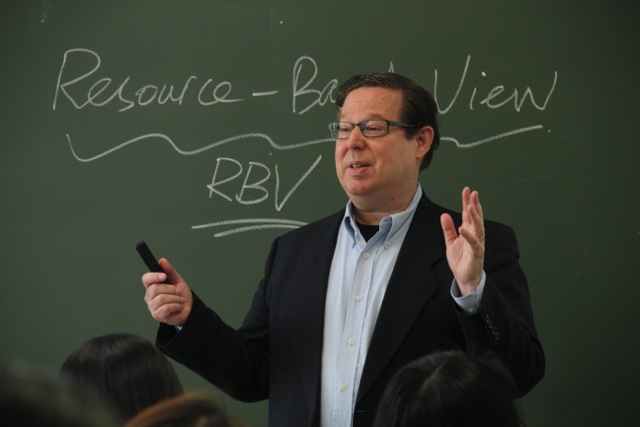
Professor Dunham in the classroom at Tsinghua. (Photo by Zhang Sihan)
The program aims to bring business journalism in China in line with top international reporting standards. The Tsinghua School of Journalism and Communication has a long history of cooperation with major international media and financial-information organizations, and visiting scholars have come from outlets such as Bloomberg, Reuters, Business Week, The New York Times, Financial Times, The Washington Post and CNN.
GBJ offers an array of specialized courses that are at the forefront of global business journalism. Students can learn about international accounting standards, multimedia journalism, data mining, complex financial derivatives, journalism ethics, advanced feature writing techniques and the management of media organizations – knowledge that is transferable to other economies and other professions. At the same time, they gain a deeper knowledge of the Chinese language and economy.
The GBJ program benefits from other academic resources on the Tsinghua campus, including its prestigious School of Economics and Management, as well many Chinese and global media and technology companies in Beijing. Internships, field trips and recruiter visits are integral parts of the program.
GBJ students have opportunities to attend conferences on new media, economic development and other business topics. They benefit from meetings and discussions with guest speakers, including top editors and reporters from leading Chinese and Western news outlets and international business executives. The GBJ has a growing network of smart, sophisticated reporters, editors and public relations professionals who can enhance the world’s understanding of economic and corporate developments in China and globally.
- Program Courses
| Basic Courses | |
| Introduction to Mass Communications and Society in Contemporary China | |
| Chinese Language | |
| Intercultural communication | |
| Media Research Methods | |
| Core Courses | |
| English Financial News Reporting and Writing | |
| Multimedia Business Reporting | |
| Global Business Journalism (advanced) | |
| Economics and Accounting Basics for Journalists | |
| Business Data Mining and Analysis | |
| Elective Courses | |
| Corporate Communication | |
| Opinion and News Commentary | |
| Hot topics in the Global Economy | |
| Feature Writing | |
| Corporate Strategies, Case Studies of Chinese and Global Companies | |
| Personal Finance Reporting | |
| Media Management | |
| Workshop on Film and TV Production | |
| Theory and Practice of Public Diplomacy | |
| Data Journalism | |
| Public Relations: An Introduction | |
| Public Speaking | |
| Other Requirements | |
| Pro-Seminar for Master Candidates in Global Business Journalism | |
| Literature Review and Thesis Proposal | |
| Academic Activities | |
| Internship | |
- Qualification of Applicants
Applicants should have a Bachelor’s degree in related fields and certificate for English proficiency.
- Application Documents
1) The completed Foreigner’s Application Form for Admission to Graduate Programs of Tsinghua University with a 2-inch recent photo, signed by the applicant;
2) Statement of Purpose and resume;
3) The original or the notarial degree certificate or proof of education at an academic institution (you need to submit an original or notarial degree certificate after it was awarded) and an academic transcript. The degree certificate and academic transcript must be officially sealed.
4) Two academic recommendation letters from scholars of associate professorship or higher. They must show referee’s phone number and email address on the letter.
5) For non-English speaking students, please provide English level certificates. e.g. TOEFL, IELTS, etc.
6) A copy of your passport page with personal information (personal and ordinary passport);
7) The completed Application Form for Tsinghua University Scholarship (if applicable, original);
8) A non-refundable application fee of RMB600.
The certificates provided should be the original documents in Chinese or in English, otherwise notarial translations in Chinese or English are required. None of the above application documents will be returned.

Some of the best students from China and around the world.
- Application Procedure
Step 1: Online Application
Complete Online Application on the website of the Foreign Student Affairs Office, Tsinghua University
(http://www.is.tsinghua.edu.cn/EN/online-application/instruction.html). Print and sign the Application Form produced by the system after the application status changes to “verified.”
Step 2: Documents Submission
Submit the application documents listed above to the address indicated below by post mail or in person.
Step 3:Application Fee Payment
There are two ways to pay application fee:
1 . Pay online using a credit card;
After your online application form is verified or the materials are received by Tsinghua University, the staff will make you the online payment draft, and at the same time, an email will be automatically sent out to remind you to pay the application fee via the online application system.
2 . Pay in cash at the Foreign Student Affairs Office (Room 120, Zijing Building 22) on the campus of Tsinghua University.
- Application Deadline
November 1, 2014 — March 20, 2015
Both the Online Application and a complete set of Application documents should be completed and the package should be received by March 20, 2015.
- Tuition and Scholarship
Tuition:Program tuition fee is RMB39000/year.
Accidental Injury and Hospitalization Insurance: RMB 600/year.
Please visit http://is.tsinghua.edu.cn for more information about scholarships.
- Program Website:
For more information about the program, please visit the GBJ website at:
http://gbj.tsjc.tsinghua.edu.cn/publish/jcgbj/index.html
- Application Website:
For an application, please visit the Application Website at:
http://www.is.tsinghua.edu.cn/EN/online-application/instruction.html
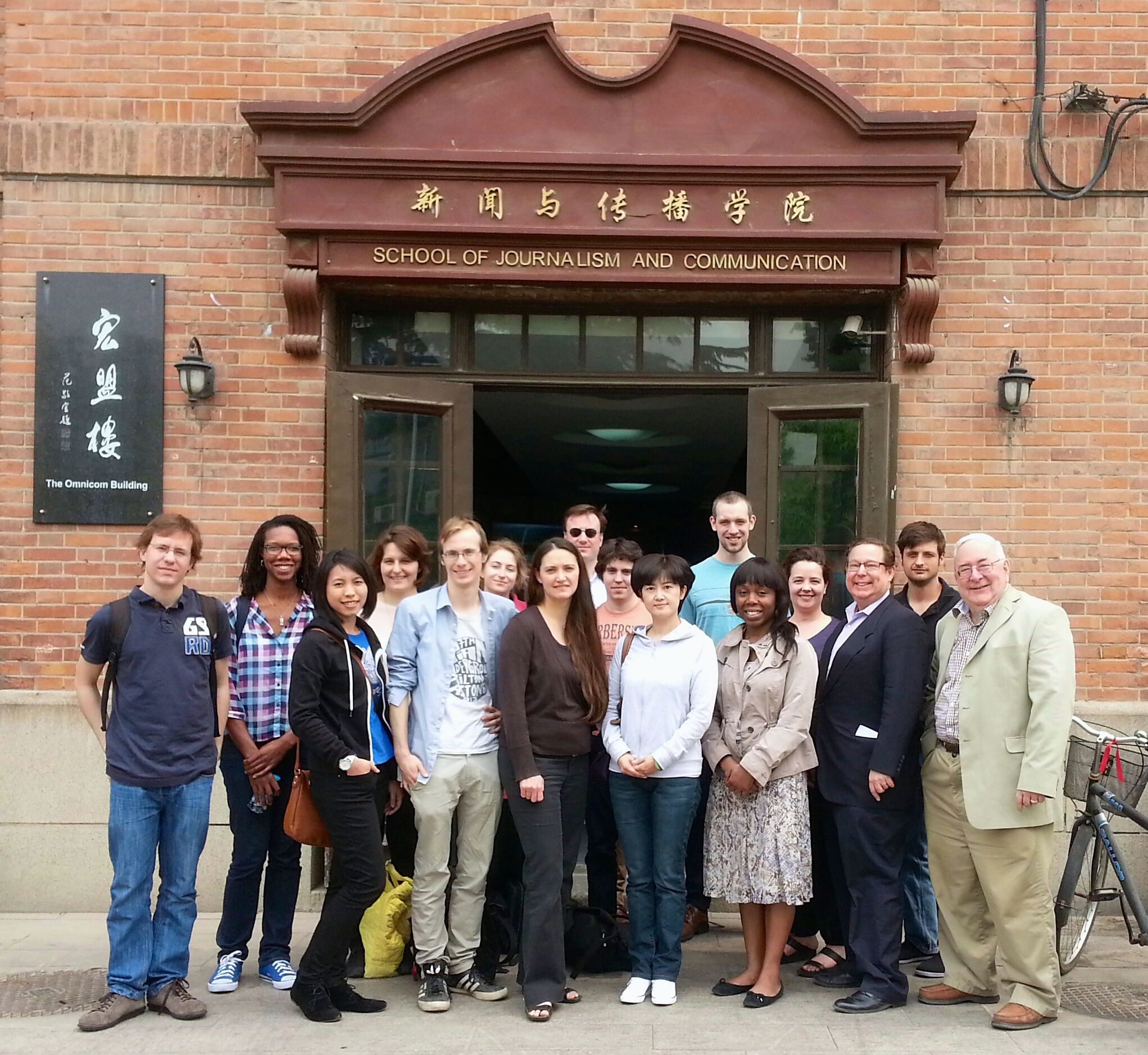
We regularly host international scholars, lecturers from global businesses and exchange students.
10.Contact Information:
Ms. Olivia Xiaoyu Zhou
Room 302, Omnicom Building,
School of Journalism and Communication
Tsinghua University,
Beijing 100084, P. R. China
Tel: +86 10 6279 6842
Fax: +86 10 6277 1410
E-mail: tsjcws@tsinghua.edu.cn

 Rick Dunham Blog
Recent Comments