Analysis: Confrontation inevitable as Republicans test a ‘weak’ Obama
Posted: November 7, 2014 Filed under: Rick in the news, U.S. politics | Tags: American politics, Barack Obama, Bill Clinton, CCTV, CNN, Democratic National Committee, Dialogue, Elections, Fox News, Francis Fukuyama, government shutdown, Hillary Clinton, Jade Ladal, National Public Radio, Newt Gingrich, Obamacare, President Barack Obama, Republican Party, The End of History, U.S. Congress, United States, White House, Yang Rui Leave a comment
Live on CCTV as a Beijing-based expert on U.S. politics.
Yang Rui: How do these midterm elections damage what President Obama wants to do in the remaining two years?
Rick Dunham: Well, I think right now we’re in for a period of tension, we’re in for a period of confrontation between Congress and the President. The Republicans in Congress think President Obama is weak and they’re going to push very hard for their agenda. They’re going to see how far they can push him. I think the White House will want to reach out a bit more, but I think it’s going to be much harder for the White House to reach out because Republicans think he is weak.
Yang Rui: I believe you must have followed the midterm elections very closely. Anything that surprised you despite the results themselves that are not so surprising?
Rick Dunham: No, I actually was not surprised at the Republicans’ sweep of the Senate. Historically, you look back at almost every big wave election year and you have one party winning almost all the close elections, and Republicans only lost one of them –in New Hampshire. What I was surprised at in this election was the incompetent campaign run by the Democratic National Committee and the White House. There were never on the offensive and they let the Republicans attack President Obama. They almost had no positive message during the campaign. That really surprised me. I haven’t seen a campaign this bad since 1980.
Yang Rui: Exactly 20 years ago, President Clinton was facing the majority that Republicans enjoyed in the two chambers of the Congress. What happened was the shutdown of the federal government and the standoff between Newt Gingrich, Speaker of the House, and the president himself. Now, last year we saw the partial shut down of the federal government, do you think we are likely to see it another repeat of the shutdown?
Rick Dunham: I think it’s highly likely. We saw a short shutdown last year but I think the Republicans are going to push the president to the brink and see if he capitulates. I think it’s almost certain that we’re going to see a shutdown. President Obama is going to have to veto Republican legislation and then force a compromise.
Yang Rui: What are the major obstacles or issues that may be a test of the bipartisan wrangling?
Rick Dunham: I think that number one will be government spending. The Republicans will try to cut the amount of government spending and particularly programs the president likes. The second big one is health care — the president’s health reform law of 2010. House Republicans voted 40 times already to repeal it. I think that the Senate Republicans will try now to push the president and force him to veto.
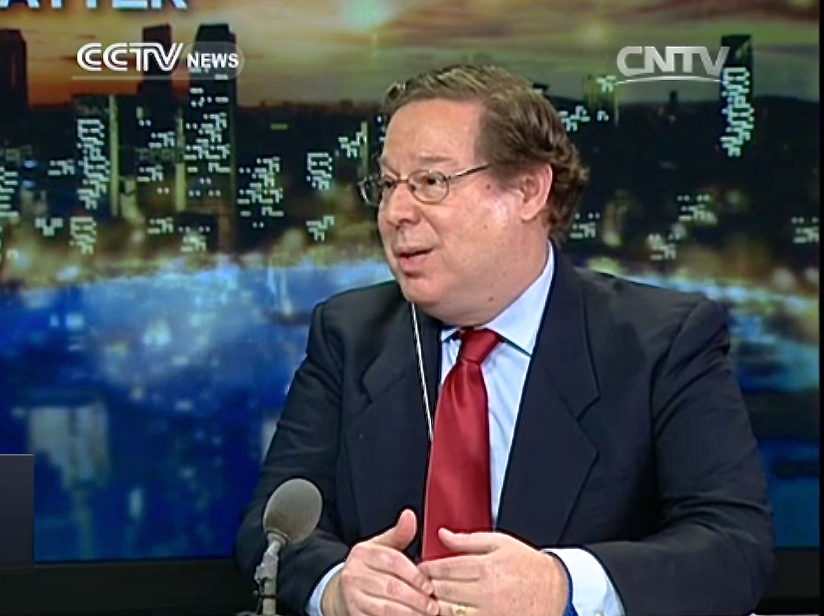
A government shutdown is likely.
Yang Rui: Well that’s very bad. Now I start thinking about what I read from Francis Fukuyama, the guy who is the author of The End of History. Now, ironically he wrote in another book, it’s about political decay in U.S. domestic politics, meaning the architect of American constitution was able to restrict powers but they have not been able to create powers, and that has delivered a lot of friction and frustrations between the two parties. And the efficiency of the government, all at different levels, has been seriously compromised.
Rick Dunham: Well, I agree with the conclusion, but not necessarily his reasoning to get to the conclusion. I think that we see this kind of gridlock in the United States and dysfunctional democracy largely for two reasons. One is the amount out of money in politics that is making it difficult to pass anything. And the second issue is that you have partisan media in the United States. You have a fracture of the traditional media and you have people who get information that’s based on their own preconceived notions. So the country is deeply divided now and it’s very hard to have commonality because you have people on one side going to Fox News and on the other side going to CNN or National Public Radio, and you don’t really have a common area where they can reach agreement.
Yang Rui: And there are very serious disagreements between couples under the same roof.
Rick Dunham: Huge gender gap. Men overwhelmingly voted for Republican this election, women voted just about evenly, Democrat and Republican.
Yang Rui: Then there is the situation with the low turnout.
Rick Dunham: There has been a problem with turnout in America starting in 1990s. There was a spike up when Barack Obama ran in 2008. Turnout was the highest in 20 years but it has gone back down to its pre-2008 levels, and the biggest drop of was minority voters, black Americans and Hispanic voters, both of them heavily Democratic.
Black voters voted nine to one for Democrats but the turnout was far down from where it was, which cost the Democrats the governorship of Florida, it cost them the Senate seat in North Carolina. Those very narrow losses in those states were result of very low minority turnout.

A durable Democratic majority after 2008? Nope.
Yang Rui: What do you think of the impact of the midterm upheavals on the presidential election two years from now?
Rick Dunham: Well, I think it’s a mixed blessing for Hillary Clinton, the presumptive Democratic nominee. Now there’s no guarantee that she will be the nominee but if she is, the good news for her is that now people are going to be looking at the Republicans, and probably if there’s a backlash in two years it could be against the Republican Congress as opposed to focusing all about President Obama.
The bad news for Democrats is that this election proves that the Democratic electoral majority that elected Barak Obama twice is not strong and is not permanent. The Democrats have to go back and convince minority voters to turn out and they have to go back and convince more women to vote Democratic.
Yang Rui: Thank you very much for joining us.
Here’s a link to the video of the full interview: http://english.cntv.cn/2014/11/06/VIDE1415219400635230.shtml
Thanks to Jade Ladal for her work on the transcript.
Toxic White House water might have killed three U.S. presidents — Harrison, Polk and Taylor
Posted: April 2, 2014 Filed under: Dunham's Discourses, U.S. politics | Tags: Alexis de Tocqueville, antebellum, Civil War, Dallas, deadly bacteria, enteric fever, Franklin D. Roosevelt, Franklin Pierce, gastroenteritis, George Mifflin Dallas, immigration, indoor plumbing, James Buchanan, James K. Polk, Jane McHugh, Know Nothing Party, Manifest Destiny, Mexican War, Millard Fillmore, New York Times, Philadelphia, Philip A. Mackowiak, pneumonia, Ronald Reagan, San Antonio, septic shock, tainted water, Texas, Tippecanoe, U.S. Congress, U.S. presidents, United States, University of Maryland, University of Pennsylvania, Warren Harding, water, White House, William Henry Harrison, Zachary Taylor 2 CommentsTippecanoe … and Taylor, too?
As a history major, I’ve always struggled for an explanation for the surprisingly bad string of American presidents who served between 1840 and 1860.
This motley crew was politically inept. Think Millard Fillmore. James Buchanan. Franklin Pierce. Zachary Taylor.
The group also had a very high mortality rate. William Henry Harrison died one month after assuming office in March 1841. James Polk (he of Texas annexation and “Manifest Destiny”) died shortly after leaving office. And Zachary Taylor, the old (and I emphasize old) Mexican War hero died less than a year into his term, leaving Americans saddled with Fillmore, who later unsuccessfully sought to return to the presidency as the nominee of the aptly named Know Nothing Party.

He would have become president. Philadelphia’s only vice president, George Mifflin Dallas, one of the subjects of my master’s thesis.
I will claim some academic expertise in this period of history. My master’s thesis at the University of Pennsylvania was on the 1844 Philadelphia economic elite, which included Polk’s vice president, George Mifflin Dallas. The city of Dallas, Texas, is named after this Philadelphian who might — just might — have become the nation’s 12th president if Polk had died a few months earlier, while still in office.
With apologies to Alexis de Tocqueville, the stretch of dysfunctional democracy in America had many causes, including the implacable division between North and South over fundamental social issues, the rise of anti-immigrant sentiment and the triumph of extremism (and mediocrity) on Capitol Hill.
Sound familiar to your 2014 ears?
Historians have written lots about the political debacle in ante-bellum America. But they haven’t written as much about the health debacle in the White House. That’s why the story that appeared in the April 1 edition of the New York Times (it’s no April Fool’s joke) is so important.
The piece outlined speculation about the cause of William Henry Harrison’s death. Conventional wisdom has held (for 173 years) that old Tippecanoe, the oldest man to be sworn in as president until Ronald Reagan, died of pneumonia after catching cold while delivering the longest inaugural address in American history. (I think it may have equalled all four of Franklin D. Roosevelt’s speeches combined. He had nothing to fear but pneumonia itself.)
But it turns out that pneumonia may not have caused Harrison’s death. The Times article casts a credible finger of blame at the potentially toxic supply of drinking water consumed by American presidents during the time before indoor plumbing:
In those days the nation’s capital had no sewer system. Until 1850, some sewage simply flowed onto public grounds a short distance from the White House, where it stagnated and formed a marsh; the White House water supply was just seven blocks downstream of a depository for “night soil,” hauled there each day at government expense.
That field of human excrement would have been a breeding ground for two deadly bacteria, Salmonella typhi and S. paratyphi, the causes of typhoid and paratyphoid fever — also known as enteric fever, for their devastating effect on the gastrointestinal system.
According to the Times piece, Harrison’s eventual case of pneumonia is consistent with enteric fever and may just have been one of the manifestations of acute poisoning.
“As he lay dying, Harrison had a sinking pulse and cold, blue extremities, two classic manifestations of septic shock,” Jane McHugh and Philip A. Mackowiak wrote in the Times. “Given the character and course of his fatal illness, his untimely death is best explained by enteric fever.”
Harrison was the first of three U.S. presidents to die in office (or shortly after leaving office) within a span of only nine years. I’d say that’s reason for some serious “cold case” sleuthing.
Mackowiak, a scholar-in-residence at the University of Maryland and author of “Diagnosing Giants: Solving the Medical Mysteries of Thirteen Patients Who Changed the World,” took up the challenge, joined by San Antonio writer McHugh.
They made a strong case for tainted water as being the cause of Harrison’s death, and suggested that Polk and Taylor may have been its victims, too. They noted that the 11th and 12th presidents “developed severe gastroenteritis while living in the White House. Taylor died, while Polk recovered, only to be killed by what is thought to have been cholera a mere three months after leaving office.”
There’s further evidence to suspect that Mackowiak and McHugh are onto something. The president’s quarters on the second floor of the White House did not get running water until 1853 — Fillmore is given credit by some history books for this major technological advance. After Millard’s move, no president contracted gastroenteritis or died of natural causes. (We’ll leave the mysterious 1923 death of Warren Harding to another blog post.)
So we can’t blame the failure of Fillmore, Pierce and Buchanan on tainted water. Just tainted politics.
Top ten losers — and a few winners — in the DC debt ceiling debacle
Posted: October 16, 2013 Filed under: Dunham's Discourses, Top Ten, U.S. politics | Tags: Barack Obama, Beijing, C-SPAN, Harry Reid, Joe Biden, John Boehner, Mitch McConnell, Tea Party, Ted Cruz, U.S. Congress, U.S. economy, United States, Washington 1 Comment
We’re THIS close to a solution, folks.
As the newest American political analyst on Chinese national television, I’ve been asked to explain the U.S. government shutdown and default showdown.
It’s not easy.
How do you explain the farce that Washington has become? Lawmakers shutting down the government because of an issue not directly related to spending. Hostage-taking is for terrorists, not for Republicans.
International observers are even more baffled by the brinkmanship over the debt ceiling. Why, I am asked over and over, would congressional Republicans threaten the full faith and credit of the United States, risk a relapse into recession and jeopardize a very tenuous economic recovery around the world? Why would they, through their illogical enterprise, encourage other nations to replace the dollar as the global reserve currency, which will do nothing but create inflation at home, make borrowing more expensive for the American government and American consumers, and stifle foreign investment in the United States? And why is President Barack Obama incapable of rescuing the nation from the tar pit of Capitol Hill.
It’s a lose-lose proposition.
Are there any winners in the Washington wackiness? Not really, though there are some short-term gainers. Here’s my long list of losers and short list of winners in the continuing congressional catastrophe.
John Boehner
The House Speaker looks like a hostage being forced to read a script by his radical captors. He looks weary. He looks very, very sad.
Barack Obama
He looks weak.
House Republicans
They look extreme. Actually, they look beyond extreme. And incompetent.
The Tea Party
Did we mention extreme? The current situation is reminiscent of the Vietnam War-era saying, “We had to destroy the village in order to save it.”
Senate Republicans
They look weak, too, as the Tea Party tail continues to wag the Republican dog.
The Republican Party
The Grand Old Party is lurching toward the political cliff in the 2014 midterm elections. Its best asset: gerrymandered House districts. Its best ally: discombobulated Democrats.
Joe Biden
Who? Nonexistent.
The United States.
Forget partisan politics. Congress has made the U.S. an international laughingstock. The double showdown has led to grave global doubts about the reliability of the United States and the leadership skill (and power) of its president. So this will hurt the country for a long, long time and its president — whoever that may be, Democrat or Republican.
The U.S. economy
In the short run, thousands of Americans are without paychecks, tourism revenue has plunged and consumer confidence has taken a hit. Businesses have another reason to hold off on hiring. In the long run, interest rates will be higher and loans will be even harder to obtain for individual Americans and corporations alike. And they call Republicans the pro-growth party?
The global economy
The self-induced crisis in Washington has shaken global confidence in the United States If American lawmakers blunder into a default (still unimaginable from my distant vantage point), it would almost certain trigger an international recession as China, Japan, Brazil, the EU and other leading U.S. creditors take a massive hit. The consequences would be so severe that it’s not even worth contemplating.
The U.S. Congress wouldn’t do something so wantonly self-destructive, would they?
Would they?
Remember Smoot-Hawley? Call this modern-day version Cruz-Boehner.
“Winners”
Harry Reid and Mitch McConnell
There really are no winners in Washington, but the closest thing to it are the Senate leaders. Instead of acting like squabbling partisans, they are playing the role of sober cops coming to restore order after a frat party has descended into anarchy and drunken debauchery. Officers Reid and McConnell, your country needs you. Now.
Ted Cruz
In the short term, the freshman senator from Texas has become the hero of the ultraright, the face of Fox News, the Earl Grey of the Tea Party. In the long run, he will have to overcome the first impression of two-thirds of Americans (who know who he is) that he is a right-wing ideologue. Polls show that he’s poison among independent and swing voters outside of the Lone Star State.
House Democrats
They are only winners because House Republicans look so, so bad. The Dems haven’t won any awards for profiles in courage or bipartisan bridge building. Except another Bridge to Nowhere.
C-SPAN
Ratings are way, way up at the nation’s favorite cable channel for nerds and policy wonks. Heck, it’s the most bizarre reality show on television. And, unlike the Kardashians, it has real-world consequences.
China
The government in Beijing has won in two ways (so far). First, President Obama canceled his Asia trip, allowing first-year Chinese President Xi to be the star of the show at APEC. And China-bashing Washington Republicans have succeeded in making Beijing the victim of irresponsible fiscal policies in free-enterprise America that could lead to default. A bizarre lesson in capitalism.
Want the latest analysis of U.S. politics? In China, I’m your guy.
Posted: October 12, 2013 Filed under: Rick in the news, U.S. politics | Tags: Asia Pacific, Asia-Pacific Economic Cooperation, Barack Obama, Beijing, CCTV, China, China Central Television, Dialogue, Global Business Journalism, global economy, media appearance, Tian Wei, Tsinghua University, U.S. economy, United States Leave a commentAppearance #2.
I didn’t come to China to be a talking head.
I was thrilled to join the faculty of Tsinghua University this September to teach multimedia journalism and co-direct the Global Business Journalism program. The TV gig has been an unexpected pleasure.
Four times during my first month in Beijing, I’ve been called upon to analyze American economic, diplomatic and political issues for China Central Television’s English-language news show “Dialogue.” The show is blessed with one of the smartest hosts in global TV, Tian Wei, and allows guests to engage in an in-depth dialogue on important international issues.
No yelling. No screaming. Instead, viewers watch a briskly paced discussion with smart questions.
In case you missed my appearances, here are links to the four shows. (I tried to embed the videos from the CCTV web site but WordPress is acting finnicky.
The first show is a discussion of the emerging U.S.-China “major power relationship” in diplomacy. The second is a review of the United Nations resolution on Syria. The third focuses on the Asia Pacific economic summit (APEC) skipped by President Obama because of the government shutdown in DC. And the fourth was — guess what? — about the government shutdown itself and its impact on America, America’s place in the world, and the U.S. and global economies.
You may have better things to do than watching me talk for four hours. But in case you want to take a look … enjoy!
9/24/13
DIRECT LINK: http://english.cntv.cn/program/dialogue/20130925/100634.shtml
9/28/13
DIRECT LINK: http://english.cntv.cn/program/dialogue/20130929/100452.shtml
10/7/13
DIRECT LINK: http://english.cntv.cn/program/dialogue/20131008/100695.shtml
10/10/13
DIRECT LINK: http://english.cntv.cn/program/dialogue/20131011/100593.shtml
The most prominent American political figures in the global media — and a dozen who get no respect
Posted: October 8, 2013 Filed under: Dunham's Discourses, Top Ten, U.S. politics | Tags: American politics, Barack Obama, China, Chuck Hagel, Eric Cantor, Fox News, Harry Reid, Hillary Clinton, Jack Lew, Jay Carney, Joe Biden, John Boehner, John Kerry, John McCain, Marco Rubio, Mitch McConnell, Nancy Pelosi, Obama, Rush Limbaugh, Sarah Palin, Sean Hannity, Ted Cruz, United States 1 Comment
President Obama at my last White House press conference in August. (Photo by Rick Dunham)
After covering the White House and the U.S. Congress for 29 years — and being inside the 24/7 news bubble — it’s fascinating to be, for the first time, on the outside looking in.
Here’s a new outsider’s perspective on which American politicians figure most prominently around the world, and which DC figures vanish from the media scene when you cross the Pacific.
America’s Face around the World
1. President Barack Obama
The president is the president. He gets global press on some stories that earn barely a ripple in America-centered domestic media.
2. Secretary of State John Kerry
He didn’t get elected president, but his stentorian voice is everywhere on international issues. He comes across as knowledgeable, poised and, well, diplomatic.
3. House Speaker John Boehner
The Ohio Republican is the scowling face of the opposition. His soundbites are almost all partisan and negative. Not much of an image to project.
4. Sen. Ted Cruz
The first-year lawmaker from Texas has exploded onto the international stage as the leader of America’s ultraconservatives, which the global media love to highlight. Even people who don’t understand the concept of a filibuster understand that Cruz is the man who shut down the federal government. And he’s not even president.
5. Treasury Secretary Jack Lew
The American media almost never cover the charismatically challenged Treasury Secretary. Most Americans know him as the man with the illegible signature. But he’s often on TV and Internet news reports around the world. He comes across as measured and authoritative.
6. Hillary Clinton
The former U.S. Secretary of State is treated as America’s president-in-waiting. She’s also covered like the leader of the hawkish wing of the Democratic Party, as opposed to the dove-ish Obama.
The Dead-to-the-World Dozen
1. Vice President Joe Biden
Never mentioned. Well, almost never.
2. Senate Republican Leader Mitch McConnell
Who is less important than the minority leader of a body that has been eclipsed by the hard-right Republicans in the other chamber?
3. House Democratic Leader Nancy Pelosi
Maybe the only person less important than the Senate Minority Leader is the House Minority Leader.
4. Senate Majority Leader Harry Reid
He only appears on international TV when he comes up with his sound-bite zingers tearing into the Republicans.
5. Sen. John McCain
A media darling in the U.S., his mavericky style doesn’t translate to an international audience.
6. Sarah Palin
The only thing people in Asia remember about 2008 Republican vice presidential nominee is the report in Game Change that she didn’t know the Korean peninsula was divided into two countries.
7. Rush Limbaugh, Sean Hannity and the Fox News crowd
They may get good ratings in the USofA, but they don’t exist outside of its borders. And that’s probably fine with them.
8. Sen. Marco Rubio
The Florida freshman’s mystique hasn’t stretched to Asia and Europe, only Latin America and South America.
9. House Majority Leader Eric Cantor
There’s only room for one face of the opposition on international TV, and that’s John Boehner, not his (occasionally) loyal deputy from Virginia.
10. Defense Secretary Chuck Hagel
Barack Obama and John Kerry speak for the U.S. on global issues. The Pentagon chief is a bit player on the international stage.
11. White House press secretary Jay Carney
President Obama’s spokesman, a ubiquituous presence on domestic media, makes only cameo appearances on media outlets outside the U.S.
12. The U.S. Trade Representative
Who is the U.S. trade rep anyway? There are lots of trade stories, but the U.S. Commerce Secretary and U.S. Trade Representative are never quoted. Only Obama or Kerry.
My local Beijing Walmart isn’t like any you’ve ever visited in the USA
Posted: October 2, 2013 Filed under: Discovering China | Tags: beer, Beijing, Beijing subway, Biking in Beijing, China, Colgate, Crest, Egg Foo Young, Laughing Cow Cheese, Scarlett Caterpillar Fungus, Tsinghua University, United States, Walmart, Wudaokou Leave a comment
You are leaving the Beijing subway and nearing the entrance to Walmart.
I had this vision in my mind of what the Beijing Walmart would look like.
Elderly person at the front door welcoming you to the store. Wide aisles. Bright lighting. A little bit of Middle America in the middle of China’s capital.

Definitely not on sale in U.S. Walmarts: Scarlet Caterpillar Fungus.
But no…
My local Haidan district Walmart, just one subway stop south of Tsinghua University’s Wudaokou subway station, is a strange sort of American-Chinese hybrid. The Egg Foo Young of Chinese retailing.
First of all, there is no greeter. There isn’t even a front door, just those semi-transparent plastic flaps that substitute for doors all over China.
The store itself doesn’t resemble any Walmart in the USA. It looks more like your local dollar store. On steroids. Three floors of crowded bargains, from washing machines and treadmills to live turtles (not to bring home as pets).
What’s completely different is the product selection. You can buy Crest and Colgate and Laughing Cow cheese, but not much else that you’d buy in the American big box.
When’s the last time you saw the Walmart “Great Value” brand bag of Scarlet Caterpillar Fungus in the USA? Or Marinated Duck Gizzard? Or Prickly Ash Powder? Or Purple Sweet Potato snacks? Or Pineapple-flavored Beer? Or Apple Vinegar Drink?
The list goes on — check it out in my slide show.
I ended up on a shopping spree that cost me more than $40 in yuan. Doesn’t sound like much, does it? Well, think of it this way: That’s the cost of about 25 meals on campus. Or three months of cell phone service. I think I’ve stocked my apartment for a month with everything from loose Chinese tea and two kinds of tofu to, yes, purple sweet potato snacking pieces.
My most expensive purchase was a living room rug for the equivalent of $13. The second most costly purchases was imported almonds (for hiking, of course), at about $4.
My shopping journey took four hours, most of it pure entertainment. After all, how many of you can say that you carried a rug in a backpack while you rode a bicycle home from the subway while balancing two bags of groceries?
Ten ways appearing on TV in China is different than the United States
Posted: September 24, 2013 Filed under: Discovering China, Rick in the news, Top Ten, U.S. politics | Tags: Beijing subway, Biking in Beijing, CCTV, China, Dialogue, East Gate of Peking University subway station, media appearance, Rick in the news, United States 1 Comment
The logo of CCTV English’s current affairs program
I’ve just completed my debut on Chinese TV before what was probably the biggest audience in my 35-year journalism career.
I was a guest on the nightly news show called “Dialogue” on CCTV (China Central TV). It’s a half-hour program where policy experts sit down and debate — freely, in my case — important international issues. No yelling. No screaming.
That alone is a big change from my appearances on — and viewing of — American TV news.
Here are some other differences between being a guest on Chinese TV and American TV:
1. No limo to pick you up.
2. No make-up artist.
3. No green room.
4. All of the anchors know what they’re talking about.
5. All of the anchors speak perfect English.
6. In-depth discussion of international issues.
7. Thirty minutes. No commercial interruptions.
8. No interruptions at all — the host and other panelist let me finish each answer before responding themselves.
9. No limo to drive you home.
10. I rode my bike home from the East Gate of Peking University subway stop after finishing the show.
The big announcement: How the Twittersphere reacted to my new job in China
Posted: August 14, 2013 Filed under: Rick in the news | Tags: Aaron Pena, Al Weaver, Alan Blinder, Ayman Mhanna, Carla Marinucci, Dallas Times Herald, Daniel Wright, Dwight Silverman, Elizabeth Traynor, Emily Wilkins, Global Business Journalism, Hailey Branson-Potts, Harold Cook, Houston Chronicle, Jane Sasseen, Jay Root, John Cornyn, John Weaver, Joyce Barnathan, Kay Bailey Hutchison, Kristiina Helenius, Lisa Falkenberg, Mackenzie Warren, Matt Mackowiak, Melissa Aguilar, Priya Anand, Rebecca Acuna, Ricardo Ramirez, Rich Galen, Samuel Rubenfeld, Steve Stockman, Ted Cruz, Texas, Tsinghua University, United States, Wayne Slater Leave a comment
Tsinghua, here I come! (University web site)
People who know me well know that I don’t possess one of the larger egos in American journalism. So I’m a tad apologetic for the blatant boosterism that follows. But I wanted to do it to thank all of my friends and the public officials who took to social media to respond to this announcement.
Breaking news, Twitter friends: I’m leaving the @HoustonChron to run a graduate journalism program at Tsinghua University in Beijing.
— Rick Dunham (@rickdunham) August 13, 2013
My co-director job at Tsinghua’s Graduate Business Journalism program will allow me to pursue my love of multimedia journalism and training.
— Rick Dunham (@rickdunham) August 13, 2013
I am thrilled to be reunited with friends from @BW days: Joyce Barnathan, president of @ICFJ, and @janesasseen, who is joining me on faculty
— Rick Dunham (@rickdunham) August 13, 2013
The overwhelming — and rapid — response reminded me of the power of social media. Twitter and Facebook have transformed our means of communication in just a few years. (Six years ago, when I left Business Week for the Houston Chronicle, I had to send emails to all of my friends just to let them know what had happened.)
Just like we do on Texas on the Potomac, I’ll start with Capitol Hill reaction:
Best wishes in your next journey @rickdunham Thank you for the years of professionalism
— JohnCornyn (@JohnCornyn) August 13, 2013
Congratulations to @rickdunham and thanks for your years of service! Wishing you all the best in your next endeavor.
— Senator Ted Cruz (@SenTedCruz) August 14, 2013
Even former Sen. Kay Bailey Hutchison, who’s had to deal with my questions since my days as a young pup at the Dallas Times Herald, weighed in:
@rickdunham – you did a great job reporting for the @houstonchron! Tsinghua is one of the top univ. in china; an exciting challenge for you.
— Kay Bailey Hutchison (@kaybaileyhutch) August 14, 2013
In the polarized American political world, there was bipartisan agreement — for once.
.@RickDunham, TX & DC are losing a great reporter and a true pro with your departure. You’ll be missed. All the best in your new adventure.
— Ricardo A. Ramírez (@rramirez44) August 14, 2013
.@rickdunham @HoustonChron Whaaattt?!? I want to say congratulations but you will be so missed!!! Ok…congrats!
— Rebecca Acuna (@racunatx) August 14, 2013
@rickdunham @MattMackowiak @HoustonChron Wow! Great news for you and your soon-to-be students! Best of luck, Rick.
— Rich Galen (@richgalen) August 13, 2013
.@rickdunham Best of luck on your new journey. Thanks for your service to our community. Keep us informed.
— Aaron For Texas (@AaronForTexas) August 14, 2013
@rickdunham Rick, going to miss your coverage & insight! But, can you do all of us a favor and take Steve Stockman, among others, with you?
— John Weaver (@JWGOP) August 14, 2013
Reaction poured in from around the world, Helsinki to Beirut to Shanghai:
@rickdunham @HoustonChron Congrats. Thanks for great reporting. In the age of social media – and easy air travel – I’ll keep following you.
— Kristiina Helenius (@AmChamKristiina) August 14, 2013
Congratulations @rickdunham. Lucky students.
— Ayman Mhanna (@AymanMhanna) August 13, 2013
@nycjim @rickdunham @HoustonChron Sell America, Buy China
— Daniel Wright (@DanSWright) August 13, 2013
In Austin and Manhattan journalism circles, disbelief:
@rickdunham Nooooo!
— Jay Root (@byjayroot) August 13, 2013
@rickdunham Wow. Just wow.
— Harold Cook (@HCookAustin) August 14, 2013
@rickdunham @joiechen @HoustonChron Whoa! Amazing! Congrats!
— Andrea Stone (@andreastonez) August 13, 2013
It was nice to hear from my colleagues:
@rickdunham Bummer for us, good for you! Congratulations!
— dwight silverman (@dsilverman) August 13, 2013
@rickdunham @houstonchron A grumpy goodbye to the least curmudgeon political reporter I know. I’ll miss ur wit, ur energy and ur Rolodex.
— Lisa Falkenberg (@ChronFalkenberg) August 14, 2013
@rickdunham Congrats to a true pro & great @Hearst colleague who will be so missed!! Onto great adventure at Tsinghua University in Beijing!
— Carla Marinucci (@cmarinucci) August 14, 2013
@rickdunham @HoustonChron You will be sorely missed! Can we visit you in Beijing?
— Melissa Aguilar (@MelissAguilar) August 13, 2013
Yes, Melissa. Definitely.
I’m especially grateful for the kind words from my former interns who have made me proud over the past six years.
Congrats to @rickdunham on his move to Beijing’s Tsinghua U. Those journalism grad students are lucky they’ll get to learn from him. I was.
— Priya Anand (@Priyasideas) August 13, 2013
One of my greatest mentors. Congratulations. MT @RickDunham I’m leaving the @HoustonChron to run a graduate journalism program in Beijing.
— Alan Blinder (@alanblinder) August 13, 2013
big loss for DC print scene. will miss you rick! RT @rickdunham I’m leavingto run a graduate journalism program at Tsinghua University
— Elizabeth Traynor (@ektraynor) August 13, 2013
@rickdunham Congrats!!! What an adventure. You will be missed.
— Mackenzie Warren (@MackWarrenTV) August 13, 2013
我希望这次是最好的! RT @rickdunham: I’m leaving the @HoustonChron to run a graduate journalism program at Tsinghua University in Beijing.
— Emily Wilkins (@emrwilkins) August 13, 2013
Congratulations to @rickdunham, who I met as a rising college senior covering the DNC and RNC in 2008, and let me work at @txpotomac in 09
— Samuel Rubenfeld (@srubenfeld) August 13, 2013
All the best to @rickdunham and his move to China. Mentored me at my first real world gig at the @HoustonChron. Enjoy it, I know you will
— Al Weaver (@alweaver22) August 14, 2013
@rickdunham Thank you. And — OK! Sounds fun. Don’t ever forget our inaugural use of video (with giant flashcards) at @TxPotomac!
— Hailey Branson-Potts (@haileybranson) August 13, 2013
And I’ll leave you with the words of that ancient Chinese philosopher Wayne Slater:
@rickdunham Wow, sorry to see u leave but what a great opportunity. A great reporter. Like the proverb: May you live in interesting times.
— Wayne Slater (@WayneSlater) August 14, 2013
Top Ten: My proudest accomplishments at the Houston Chronicle
Posted: August 13, 2013 Filed under: Dunham's Discourses, Top Ten | Tags: Alan Bernstein, Arizona State University, Aurora Losada, Dwight Silverman, George Haj, Houston, Houston Chronicle, Jacquee Petchel, Jeff Cohen, Jennifer Dlouhy, Jesse Awards, Jesse Jones, La Voz, La Voz de Houston, Los Angeles Times, National Press Club, National Press Club Journalism Institute, New York Times, NPC Journalism Institute, Patti Kilday Hart, Peggy Fikac, Perry Presidential, Republican National Convention, Rick Perry, Rick Perry Watch, Silvia Struthers, Stewart Powell, Susan Lucci, Texas, Texas Associated Press Managing Editors, Texas on the Potomac, United States Leave a comment
The superstar intern crew of spring semester 2012. (Photo by Pam Tobey)
I have been fortunate to be able to experiment and innovate over the past six years at the Houston Chronicle. As I look back on my tenure at Texas’ largest newspaper, I am particularly proud of these accomplishments:
 1. Creating Texas on the Potomac
Launched in December 2007, Texas on the Potomac developed into a valued “brand” in Texas journalism — THE place to go for news about Texans in Washington or national news of interest to a Texas audience. We proved that high quality journalism and “clicks” are not mutually exclusive. We built a large and loyal audience not only in our home base of Houston, but in Austin, Washington, Dallas-Fort Worth and in more than 20 countries around the world including Finland, Norway and Korea.
2. Reinventing Washington bureau coverage for a regional newspaper
Chronicle editor-in-chief Jeff Cohen hired me to reinvent the Chron Washington bureau, and I took the challenge to the next level. I reimagined how a regional newspaper should cover the nation’s capital. Rather than duplicate the wires or the national newspapers, we tailored our national stories to our local audience. We offered analytical coverage explaining the importance of the events that were unfolding in Washington. And we covered the Texas delegation and Texans on the Potomac like they had never been covered before. We broke news story after news story on the web and then offered value-added coverage for print. We had a robust social media presence, too, offering comprehensive coverage to readers interested in Houston and Texas politics on whatever platform they preferred. All while seeing our staff shrink. And shrink.
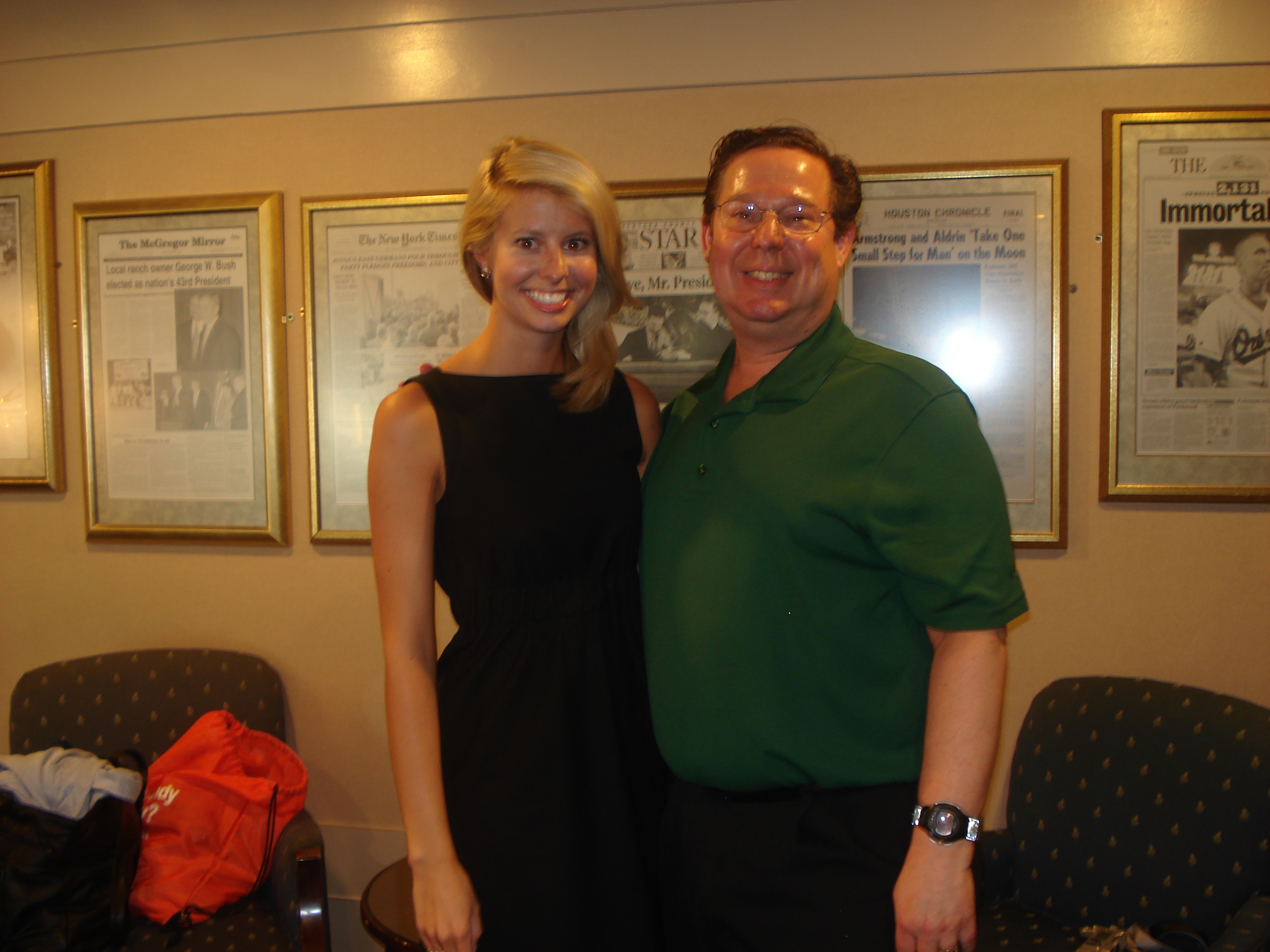
With MacKenzie Warren before she became a famous TV anchor. (Photo by Marco Van Stralen)
3. Helping to launch the careers of so many talented young journalists
It’s been a pleasure and an honor to work with so many talented interns from across the globe. Our former interns have gone on to journalism greatness (already) at the Los Angeles Times, New York Times, Politico, The Hill, Roll Call and many other news outlets, large and small, print and broadcast … and digital. I hope my interns learned as much from me as I learned from them. The interns’ talents and enthusiasm prove to me that there is a future in journalism. To all my interns: You have inspired me.
4. Teaching cutting-edge training programs for journalism students and midcareer professionals
Through my role as president of the National Press Club Journalism Institute — the educational and charitable arm of the National Press Club — I was able to teach thousands of aspiring journalists, midcareer journalists, journalism educators and professional communicators the skills they needed to survive and thrive in today’s rapidly changing multimedia world. Whether the subject was writing for the web or building a community and brand via Twitter, I embraced the turbulent times and tried to help others navigate through rocky seas. That training has trained me for the next chapter in my life.
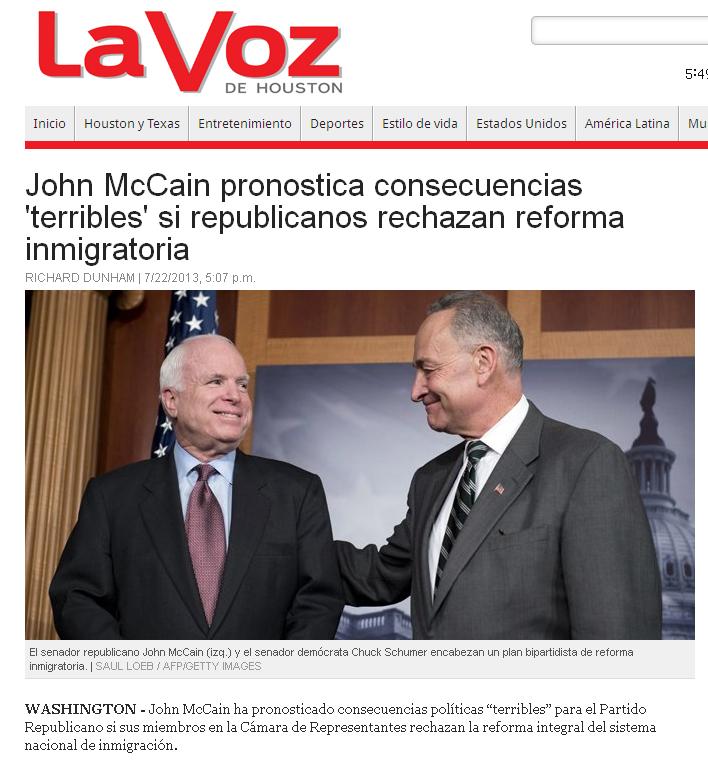 5. Offering robust coverage of issues of importance to our Latino audience
Before Texas on the Potomac came along, there was a void in “mainstream media” coverage of Latino politics and national policy issues of interest to Texas Latinos. With the help of my TxPotomac compatriots and superb La Voz de Houston editors Aurora Losada and Silvia Struthers, we provided comprehensive coverage of important issues such as immigration, health care, border policy, U.S.-Mexico issues, Voter ID, voting rights, redistricting, education and other matters of particular interest to our Latino audience. We gave special attention to Latino elected officials and representatives of heavily Latino districts across Texas. I often wrote stories that appeared in print only in Spanish in La Voz.

Covering Rick Perry in New York (Photo by Andrea Vasquez)
6. Award-winning coverage of Rick Perry’s 2012 presidential campaign
Texas Associated Press Managing Editors gave only one journalism award for coverage of the 2012 elections. It was to our Houston Chronicle team for coverage of Rick Perry’s disastrous White House run. I was proud to have created “Rick Perry Watch” on Texas on the Potomac, the forerunner of our robust “Perry Presidential” web site. Our coverage combined breaking news, ahead-of-the-curve analysis, multimedia storytelling and interesting items culled from other outlets. The result was the most comprehensive daily report on an ill-fated campaign, one that became a must-read for political reporters covering the 2012 campaign.
“First, readers were lucky to have a newspaper willing to dedicate the staff to cover Perry’s bid as an intensely local story,” the Texas Associated Press Managing Editors wrote in their citation. “Just as important, the overall level of work was superb.”
7. Starting a monthly lunch with the Texas delegation
When I arrived as Chronicle Washington bureau chief, there was widespread grumbling in the Houston-area congressional delegation about the Chronicle. To improve lines of communication, I created a monthly, bipartisan lunch with our local lawmakers and the Chronicle reporters and editors. It gave Houston-area House members a chance to tell us what they were working on and what their constituents were talking about, and gave us a chance to ask questions and develop in-depth stories. It also provided opportunities for some bipartisan legislative efforts on issues such as energy, transportation . All in all, it allowed all of us to better serve our joint constituency — the news consumers of Texas and the voters of the Houston area.
I owe bipartisan thanks to Rep. Kevin Brady of The Woodlands and Gene Green of Houston for rounding up lawmakers from Houston — and more recently South Texas — each month.
8. Reaching one million monthly page views on Texas on the Potomac
When I created Texas on the Potomac, I asked how we would judge success. I was told 100,000 page views per month.
Well, we twice hit one million page views — once during the Republican National Convention in August 2012 and again in November, the month of the election. The doubters have been vanquished. Even with very little publicity, we built a franchise. It also helped that I taught our tremendous team of interns the science of search engine optimization.
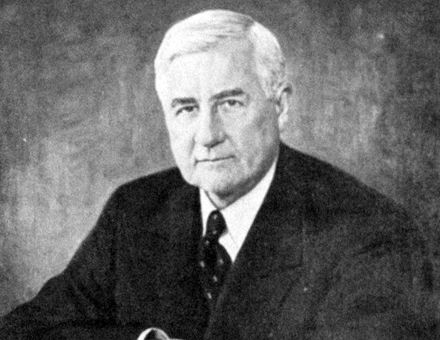
“Mister Houston,” a.k.a., Jesse Jones — publisher of the Houston Chronicle and Commerce Secretary to President Franklin D. Roosevelt
9. Winning all those “Jesse” Award nominations — if not the award itself
I’ve been the Susan Lucci of the Houston Chronicle. Year after year, I’ve been nominated for the “Jesse” Award for outstanding Houston journalism but I never took home the statuette. Reporter of the Year. Editor of the Year. Innovation of the Year. Blog of the Year. Multimedia Journalist of the Year. And some more that I can’t remember right now. Congrats to all the winners! As they say, it’s an honor just to be nominated.
10. An emphasis on teamwork
The Chronicle is one of the ten largest newspapers in America and has drawn, over the years, some of the most talented journalists in America. I hope I contributed to that sense of teamwork — the “we” rather than the “me” — that leads to great journalism. My DC colleague Stewart Powell has been the consummate professional and a willing teammate on Houston stories. Energy expert Jennifer Dlouhy has “taken one for the team” numerous times — I’ll remember those emails at 10:30 on Sunday night as she gets a head start on the week ahead.
Special kudos to super-editor George Haj, who has the best news judgment of any editor I’ve ever worked with, Jacquee Petchel, the best investigative and projects editor in the USA, now teaching the next generation at Arizona State, Ernie Williamson, the best election night editor there ever was, Alan Bernstein, who has a deeper knowledge of Houston politics (and Chron politics) than anybody else in town, Peggy Fikac, the hardest working reporter in Texas, Dwight Silverman, the tech wizard and my favorite web consultant, and Patti Kilday Hart, my partner in journalistic crime in Dallas, Austin and Houston.


Recent Comments