Day 2 Analysis: History, and her story
Posted: July 27, 2016 Filed under: U.S. politics | Tags: 2016 presidential race, American politics, Bill Clinton, CNN, Democratic National Convention, Donald Trump, Donny Ferguson, Fidel Castro, Fox News, Frank Luntz, Hillary Clinton, Jonathan Allen, MSNBC, Rex Huppke, Ron Fournier Leave a comment
The Washington Post’s captured this photo of Bill Clinton as he wrapped up his speech.
His voice is weaker. His right hand occasionally trembles. His stamina for 90-minute orations is no longer Castro-esque. (Then again, neither is Fidel’s.) But Bill Clinton showed Tuesday night that he can still inspire the Democratic party faithful and connect with average Americans beyond the Beltway bubble and cultural elites.
With his wife’s presidential candidacy endangered by the widespread perception that she is unlikable and untrustworthy, the 42nd president meticulously rebuilt the case for a President Hillary Clinton by reciting, slowly yet steadily, a string of anecdotes that wrote a very different biography of the woman he met at the law school library more than four decades ago.
Hillary Clinton has admitted, in an uncharacteristic moment of public self-reflection this year, that she’s not a natural politician or a fluid public speaker. Her husband, for all of his flaws that we all know all too well, is a natural. And his skills, diminished slightly with age but still daunting, were on display at the Democratic National Convention in Philadelphia.
Many of Bill Clinton’s critics say his public life is all about Bill ~ sort of the rap against his former friend and longtime admirer Donald Trump. But for 40 minutes on the second night of the Democratic convention, Bill Clinton kept the focus on Hillary. And if the biography was a bit sanitized (none of the “bimbo eruptions”), it was heart-felt and detailed. Anecdote by anecdote, it built a case for a caring woman who gets things done.
Bill Clinton credited Tom DeLay, Newt Gingrich, and the WSJ.
Does he know which convention he’s attending? Very, very smart. #DemsInPhilly
— Frank Luntz (@FrankLuntz) July 27, 2016
You always forget how effective Bill Clinton is until he speaks
— Jonathan Allen (@jonallendc) July 27, 2016
“I gotta get this right.” He didhttps://t.co/5CVtqtjJ8s
— Ron Fournier (@ron_fournier) July 27, 2016
And as the speech reached its denouement, the former president faced head-on the “lock her up” iconography on display at the Republican National Convention in Cleveland.
To Bill Clinton, if not the Hillary skeptics, the Cleveland Clinton is bogus. Hillary Clinton has two images, her husband said: “One is real. The other is made up.”
“You nominated the real one,” Bill Clinton concluded, as if anyone was in doubt where he stood.
Clinton critics will be quick to dismiss his oration as another performance from a master showman, the man who allegedly could cry from one eye for the cameras. The hard-core Hillary doubters will never be sated or satisfied.
CNN: Bill Clinton humanizes Hillary
MSNBC: Bill Clinton humanizes Hillary
Fox News: Fornicator lies about murderess#DemsInPhilly
— Rex Huppke (@RexHuppke) July 27, 2016
One longtime Clinton fan, Donald Trump, has even changed his opinion of the man whose candidacy and foundation he once generously supported:
Trump tonight: Bill Clinton is “overrrated.”
Trump in 2014: Bill Clinton is “a terrific guy.”
Trump in 2013: Bill Clinton is “terrific.”— Donny Ferguson (@DonnyFerguson) July 27, 2016
Overrated or terrific, Tuesday was a historic day. For the first time, a major political party in America nominated a woman as its candidate for president. Indeed, it was history. But, for the sake of the general election, Tuesday was more about her story.
Day 1 Analysis: Heavily scripted convention tries to make Clinton seem more authentic
Posted: July 26, 2016 Filed under: U.S. politics | Tags: 2016 presidential race, Adam Nagourney, Al Franken, American politics, Bernie Sanders, Chuck Schumer, Democratic National Convention, Donald Trump, Elizabeth Warren, George W. Bush, Hillary Clinton, Mark McKinnon, Michelle Obama, Paul Simon, Rick Wilson, Rush Limbaugh, Sarah Silverman, Ted Cruz 1 Comment
Hillary Clinton has the nomination, but Bernie Sanders had the passion on the first day of the Democratic National Convention.
Americans claim to want their politicians to be “authentic.” Even if the authenticity comes by way of Hollywood (like Ronald Reagan’s aw-shucks, cowboy hero persona) or Madison Avenue (Bill Clinton’s rural roots in “a place called Hope”).
That’s one of the things I’ve heard over and over from Donald Trump supporters. Some concede he’s a bigot, others admit he’s a bully and a blowhard, many acknowledge he’s a narcissist of the first order. But they like how he’s willing to “stick it” to “them.” The “them” is elites (however you choose to define them), minorities, foreigners, Muslims, the “politically correct,” even his fellow Republicans.
Hillary Clinton has a problem with this concept of being “real.” Many voters remain uncertain of who she is at her core, what she believes in, who she trusts, or if she can be trusted. Only 30 percent of Americans consider her honest and trustworthy, according to a pre-convention CNN poll. It’s imperative for Clinton to use her week in the national media spotlight to shift public perceptions of her, if she is to win what is now a close race with Trump.
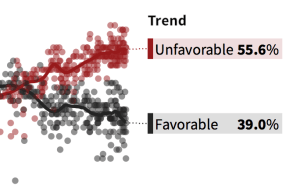
Hillary Clinton’s image has been damaged during the 2016 campaign, as seen in HuffPost Pollster graphic.
On the first day of the convention, Team Clinton may have tried too hard. Message: she cares. Message: She’s passionate about people’s problems. Most of the speeches were too smooth and too predictable. (Exceptions: Michelle Obama and Bernie Sanders. More on that later.)
“Every speech here feels vetted to death,” Adam Nagourney, Los Angeles bureau chief of the New York Times, wrote during a convention liveblog. “I’m sure they have an extensive speech reviewing-shop.”
The action on the convention podium was disciplined and carefully scripted, even if the crowd was raucous and often off-script. Somehow, the DNC managed to squeeze the intelligent ridicule out of Al Franken. Instead of coming off as clever, he came off as somebody reading a speech written by someone else, which it undoubtedly was.
The most unscripted moment of the event came when Franken and comedian Sarah Silverman were directed to waste time so that ’60s music legend Paul Simon could get comfortable at his piano. She filled the “dead time” with a pointed message to the “Bernie or Bust” crowd: “You’re being ridiculous.”
Franken, who became famous as a political commentator by roasting Rush Limbaugh as “a big, fat idiot,” looked momentarily stunned. Then the convention returned to script.
The most effective scripted moments came during First Lady Michelle Obama’s speech. In a speech praised by political analysts from both parties, she described her life in the White House and its impact on her family. In a gentle reminder that Donald Trump is the Republican nominee, she noted that the 2016 election will determine “who will have the power to shape our children for the next four or eight years of their lives.” She also noted politely that you can’t solve complex policy problems in 140 characters.
“Michelle Obama tonight delivered one of the best speeches I have ever seen in my career in politics,” former George W. Bush adviser Mark McKinnon wrote on his Facebook page.
Obama was followed by a keynote address by Massachusetts Sen. Elizabeth Warren, who was predictable in her attacks on Trump and her “proud” support of Hillary.
(The password of the night was “proud.” Democrats are proud of Hillary.)
Warren’s address, which did not receive nearly the applause of Obama’s, served as a bridge to Bernie Sanders’ gracious speech endorsing Clinton. The Vermont senator spent 30 minutes making the case both for Clinton and against Trump, all the while thanking his supporters in the Democrats’ socialist, populist revolution. It was no concession speech. He conceded no ground. But he did advance the cause of party unity.
One Sanders speech is unlikely to mollify his hard-core supporters. Acrimony was evident everywhere on Monday. In state delegation meetings. On the steamy streets of Philadelphia. And in a convention hall that was packed (unlike Cleveland), but abnormally unresponsive to speakers’ calls for unity — at least until Obama and Sanders came along late in prime time.
“It was a rough day earlier on,” Senate Democratic Leader-in-Waiting Chuck Schumer admitted on NBC. But it could have been worse, he quickly added: “Compare this to Ted Cruz”
If this was your first time watching a national convention, you might think these public displays of division are bad news for Democrats’ hopes of winning. But for those of us who’ve seen Democratic schisms in the past, this was relatively mild. Past divisions have been deeper and far more fundamental. Take it from this Republican activist:
Let’s be honest. This is a hot mess, but they’re Democrats. They care about winning. They’re like that. By then end it’ll be a lovefest.
— Rick Wilson (@TheRickWilson) July 26, 2016
Team Hillary hopes that’s the case.
Democratic preview: 10 things Hillary Clinton needs to accomplish in Philadelphia
Posted: July 24, 2016 Filed under: Top Ten, U.S. politics | Tags: 2016 presidential race, American politics, Apollo Creed, Barack Obama, Bernie Sanders, Creed, David Duke, Democratic National Convention, Donald Trump, Gary Johnson, Hillary Clinton, Joe Biden, John Kerry, Pennsylvania, Philadelphia, Reuters, Rocky, Rocky Balboa Leave a comment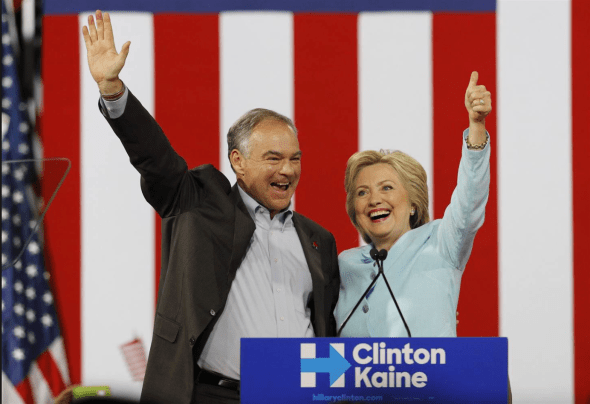
The Veep pick got good reviews. But the convention is even more important to Hillary Clinton’s future.
Donald Trump is the most disliked presidential nominee in the history of scientific polling. But most national polls still show him barely trailing in his unconventional outsider bid for the presidency. The combination of those two facts creates an uncomfortable reality for Hillary Clinton as she prepares for the first Democratic National Convention in Philadelphia since 1948. She has work to do.
Here are 10 things I think Clinton needs to accomplish in Philly to make her week a success.
1. Lower her negative ratings.
Clinton’s high unfavorable ratings would be lethal in a normal year. But this is not a normal year. True, she’s the most unpopular Democratic nominee in modern times. Her opponent, however, is even more widely loathed. Still, Trump is hanging tough in most national polls conducted the week of the Republican National Convention. In the next four days, Clinton has to convince at least a few of the anti-Trump, anti-Clinton undecided voters that she’s acceptable. Or, as Barack Obama said infamously in the 2008 New Hampshire primary debate, “likable enough.”
2. Connect with working-class whites.
That’s one of the reason she picked a running mate with a blue-collar family background, Virginia Senator Tim Kaine. But she has to convince displaced white workers in the industrial heartland that she understands why they feel dispossessed and angry at the system. A tall order, but that’s what national conventions are for. (Right, Donald?)
3. Convince Democratic liberals to get on her bandwagon.
Clinton is doing better than Trump at winning back supporters of her primary opponent(s). But that’s a low bar. She needs 95 percent of Bernie Sanders’ supporters to back her, not just 80 percent. And if she can’t persuade them not to vote for Jill Stein, she needs to at least make sure they don’t vote for Trump. Debbie Wasserman Schultz (and the Russian hackers who released the scurrilous, embarrassing Democratic National Committee emails the weekend before the convention) didn’t do the nominee any favors. Eight years ago, I covered an event featuring “NObama” activists who had backed Clinton during their bitter primary battle. By the end of the week, they were on the Obama team.

Memo to Hillary: Don’t do this kind of stuff.
4. Keep the convention on the issues and avoid personal attacks on Trump.
Undecided voters don’t need to hear jokes about Donald Trump’s combover or his gold-plated chairs. They don’t like Trump already. No need to remind them. Democrats would be better served by dissecting Trump on issues, from foreign policy and national defense and outsourcing jobs to tax cuts and family leave and stiffing small businesses. There’s plenty of meat there for Democrats to devour. And they can make the case that her judgment and temperament are more presidential than Trump’s. If we hear jokes about his hand size or bald spot, it’s a bad sign.
5. Increase her margin among Latinos — and the turnout.
For at least two decades, I’ve seen Latinos described as “the sleeping giant of American politics.” It’s a tiresome cliche, but it’s still being used because the turnout rate of Hispanic Americans remains significantly lower than African Americans, Asian Americans, and non-Hispanic whites. Clinton is crushing Trump among Democratic and independent Latinos. She has a huge lead among the wealthiest Latinos — about 50 percentage points, according to my analysis of Reuters presidential polling data. But 40 percent of this Republican-leaning group remains undecided. Clinton needs to convince them to vote for her, not to vote for Libertarian Gary Johnson or stay home. A Latino wave could drown Trump in Florida, Nevada, Colorado and even Arizona, making it all but impossible for him to win, even if he takes Pennsylvania and Ohio.
6. Match Barack Obama in the African American vote.
For the past two presidential elections, African American turnout has been higher than non-Hispanic white turnout. Many political journalists attribute that to the historic Obama candidacy. Can Clinton maintain that level of support and enthusiasm? Support: undoubtedly. Two state polls in Ohio and Pennsylvania showed Trump registered zero percent of the African American vote. Can’t do much worse than that. But Clinton needs to mobilize African Americans who are either enthusiastic about her agenda or scared of Donald Trump’s vision for America (or his backing among white supremacists like David Duke).
7. Appeal to young Americans.
The major party candidates have the oldest combined age of any nominees in American history. Young voters overwhelming reject Trump. But young Democrats overwhelming rejected Clinton for the even-older Bernie Sanders. So that means it’s not about age, but ideas and outlook. Clinton must describe her ideas that can improve the lives of the Millennial Generation. College-loan debt, equal pay for women, paid family leave and an improved environment for job creation would be good places to start.
8. Make the convention about the future and not the past.
Yes, yes, Bill Clinton and Barack Obama and Joe Biden will be speaking. But this convention is not about the glories of past Democratic victories. It’s about what’s yet to come. Donald Trump wants to return America to its past greatness.
Nostalgia is not a winning formula in an increasingly young, diverse America. Today’s 18-year-old voters were 2 years old when Hillary Clinton was elected to the Senate and 14 when she stepped down as Secretary of State. Yes, old accomplishments are fine. But they are old. What will you do for us tomorrow?
9. Avoid a cheesesteak blunder.
As a native Philadelphian, I cringed when John Kerry, then running for president, ordered a cheesesteak with swiss cheese in 2004. That’s a cultural faux pas. If you’re trying to appeal to “average folks,” it’s best not to act like an out-of-touch politician. Please don’t play the theme to Rocky — or even talk about Apollo Creed and his son. It doesn’t fit. Authenticity matters. I know that’s going to be tough, but be yourself. Whatever that is.
10. No plagiarism.
Right, Michelle Obama?
>> Catch my daily analysis of ongoings at the Democratic convention, right here on RickDunhamBlog.com.
Day 4 Analysis: Welcome to ’96 America — 1896, that is
Posted: July 22, 2016 Filed under: U.S. politics | Tags: 2016 presidential race, America First, American politics, Cleveland, Cross of Gold, Donald Trump, George W. Bush, Ivanka Trump, John F. Kennedy, nativism, Republican National Convention, Ronald Reagan, William Jennings Bryan, William McKinley, Winston Churchill Leave a comment
No “cross of gold” in Trump’s speech. But there was a gold stage.
At their best, presidential nominating conventions are about inspiration and optimism. Ronald Reagan’s “springtime of hope” in Dallas, 1984. Bill Clinton’s bridge to the 21st century. George W. Bush’s compassionate conservatism.
“We are not here to curse the darkness; we are here to light a candle,” Democratic nominee John F. Kennedy told delegates at the 1960 Democratic convention in Los Angeles. “As Winston Churchill said on taking office some twenty years ago: If we open a quarrel between the present and the past, we shall be in danger of losing the future.”
Donald Trump’s acceptance speech did not harken back to the optimism of Reagan or Kennedy, to the inclusiveness of Bush and Johnson. Instead, his speech was the most apocalyptic vision enunciated by a presidential nominee since ’96.

Reagan, 1984. Trump in 2016 was more like William Jennings Bryan than the Gipper.
1896, that is.
That was the year that a populist demagogue seized control of a deeply divided party and used his campaign to rail against the powerful elites in the United States and foreign capitals. It took more than a century for a presidential acceptance speech to choose a rhetorical path that dark.
Trump’s speech angrily mourned an era of American humiliation, degradation, instability and leadership incompetence. He promised, as is his campaign slogan, to “make America great again” by putting “American first.”
In many ways, the 1896 parallels make sense. The United States and the world are being destabilized by profound technological shifts. Millions of American workers have been displaced after having lost jobs that are redundant because of modern technology and increasing globalism. Those left behind — often stuck in shriveling small towns and struggling farms — angrily grasp for the lost America of the past, blaming elites and immigrants for the changes they are ill-prepared to master.
The 1896 Democratic presidential nominee, William Jennings Bryan, like Trump, was the champion of dispossessed farmers and fearful Main Street merchants. His opponent, William McKinley, was a candidate with broad support among business leaders, internationalists and educated urbanites. McKinley talked optimistically about the potential for America if it embraced the changes it faced. Bryan said McKinley would sacrifice American sovereignty before the New World Order. Trump says that he would ensure that other nations treat America with “the respect that we deserve.”
Bryan’s speech at the 1896 Democratic National Convention is best remembered for his vow to moneyed elites that “you shall not crucify mankind upon a cross of gold.” That seems a bit outdated in 2016, but many of the Boy Orator of the Platte’s words ring true in Trump’s vision of America.
In his famous speech, Bryan said that McKinley and the Republicans were “willing to surrender the right of self-government and place the legislative control of our affairs in the hands of foreign potentates and powers.”
It’s a remarkable reversal. A century and a quarter ago, the Democrats were the party of the past, the voice of an idealized order. Today, the Republicans long for a gauzy past they insist has been lost by hostile and incompetent leaders in the public and private sectors. Trump promised to represent these “forgotten” Americans left behind by Big Business and Washington power brokers.
“I am your voice,” he said.
Ivanka Trump called her father “the people’s nominee.” That’s exactly what Bryan promised to be. Donald Trump rails against Wall Street capitalism. Bryan called himself a warrior against the “the idle holders of idle capital.” Unlike his opponent, Bryan said he was truly “on the side of the struggling masses” against international competitors and urban elites. Today, Trump said, the party of Bryan has become the party of “corporate spin.”
“We cannot afford to be so politically correct,” he said, choosing a phrase that did not exist in Bryan’s day.
Instead of the “bimetalism” condemned by Bryan, you have “multilateralism” lamented by Trump. If you just substitute “factory jobs” for “farms,” Bryan’s words reflect Trump’s call for a return to the old days of imagined American industrial might:
Burn down your cities and leave our farms, and your cities will spring up again as if by magic; but destroy our farms and the grass will grow in the streets of every city in the country.
Bryan’s apocalyptical version has many parallel’s to Trump’s nihilist vision. As he worked his way up to his famous “cross of gold” climax, Bryan told the delegates:
If they dare come out in the open field and defend the gold standard as a good thing, we will fight them to the uttermost. Having behind us the producing masses of this nation… supported by… the toilers everywhere.
Trump could not have said it better himself.
>>> Read William Jennings Bryan’s Cross of Gold speech here. It also contains audio of the speech. (Modern technology in 1896.)
Day 3 Analysis: The 2020 GOP race begins
Posted: July 21, 2016 Filed under: U.S. politics | Tags: 2016 presidential race, American politics, Chris Wilson, Cleveland, David Frum, Donald Trump, Erick Erickson, Lee Harvey Oswald, Marco Rubio, Mike Pence, Peter King, Politico, Scott Walker, Sheldon Adelson, Ted Cruz Leave a comment
Cruz in Cleveland: The 2020 campaign begins.
The 2020 Republican presidential race began on a fractious and flummoxing night in Cleveland, one day after a deeply and bitterly divided party formally selected its 2016 nominee.
Four of the most likely contenders for the party’s nomination in four years spoke to the delegates at Donald Trump’s convention and laid out their cases for the post-Trump Republican Party, even before the current nominee is scheduled to deliver his acceptance speech on Thursday.
The quartet — vice presidential nominee Mike Pence, presidential runner-up Ted Cruz, presidential flameout Scott Walker, and remote-control speaker Marco Rubio — all took different paths to the podium and aimed their remarks at different audiences.
Pence was the loyal lieutenant to Donald Trump. The Indiana governor once supported Ted Cruz, but he switched teams after Trump’s triumph and urged other Republicans to do it. His gracious, low-key approach will endear him to die-hard Trump loyalists and to congressional Republicans who are not (and never have been) enamored with Trump.
Walker urged the party to unite, but mostly repeated his pro-business, anti-Washington talk that has made him a hero in anti-union circles but didn’t resonate particularly well with the working-class white voters who this year seized control of the Republican Party. His praise for Trump was tepid. “A vote for anyone other than Donald Trump is a vote for Hillary,” he told the delegates.
Rubio, as has been his style during his single term in the Senate, tried to have it both ways. He didn’t attend the convention — giving him a bit of distance from Trump, in case the GOP nominee eventually self-immolates. But his brief video remarks included all the right touches to win applause from the Trump loyalists in Cleveland. “The time for fighting each other is over,” said Rubio, who famously described Trump as a small-handed “con artist” and “the most vulgar person ever to aspire to the presidency.” That was then, this is now: “It’s time to come together,” he told delegates.
That message didn’t reach Ted Cruz. The Texas senator, dubbed “Lyin’ Ted” by Trump, couldn’t bring himself to endorse the nominee. Cruz, whose father was linked to Kennedy assassin Lee Harvey Oswald by Trump, gave a Reagan-like conservative call to arms. He talked conservative principles. He didn’t talk Trump. He didn’t endorse Trump’s policies or his candidacy. He said to Americans, “Vote your conscience.” He was heckled during his speech. He was booed as he left the stage.
It was a calculated gamble with his national political future hanging in the balance. If Trump manages to win the election, Cruz is going to be a non-person in Donald Trump’s Washington. The Senate leadership, Republican and Democrat, despises him and the president would, too. If Trump loses, Cruz has already volunteered to lead the ragged Republican survivors.
In the meantime, he’s a non-person in Trump World. Even Las Vegas casino magnate Sheldon Adelson disinvited Cruz to his convention suite, with associates telling CNN that he didn’t want to be an anti-Trump prop at this point.
The reaction from Republicans was varied, but it was almost all emotionally charged, positively and negatively.
Of note, Ted Cruz is getting praised from both the left and right of the GOP, but not from the establishment. Perfect set up for 2020.
— Erick Erickson (@EWErickson) July 21, 2016
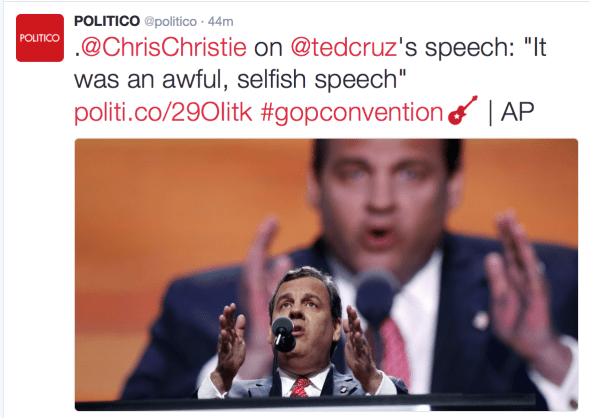
Not hard to find CRUZ delegates who think he lit his career on fire
— Steven Dennis (@StevenTDennis) July 21, 2016
Representative Peter King of New York, an enthusiastic Cruz hater, piled on.
“To me, Ted Cruz showed America what he really is,” King told NBC in a post-speech rant. “He’s a fraud. He’s a liar. He’s self-centered. He disqualified himself from ever being considered for president of the United States.
“He took a pledge to support the nominee. Today the Ted Cruz that I’ve known — he cannot be trusted and he’s not a true Republican. He’s not a true conservative. I never saw as much outrage on the floor as I did tonight.”
King’s views are widely held among moderate Republicans and Trumpistas, but Cruz is confident there is a path to victory following a Trump defeat. Like Ronald Reagan following his 1976 loss to Gerald Ford, Cruz sent a clear signal that he will keep on running, even if it means challenging an incumbent President Trump in four years.
But not every Republican shares King’s contempt for Cruz. The Texas firebrand is hoping that people like David Frum will help him rebuild the Republican Party from the rubble of Trump — if it is indeed rubble come November.
Ted Cruz earned the most honorable boos at a GOP convention since those for Nelson Rockefeller for condemning the John Birch Society.
— David Frum (@davidfrum) July 21, 2016
I have never been more proud to work for Ted Cruz that I was tonight. This speech will survive the test of time-historically courageous.
— Chris Wilson (@WilsonWPA) July 21, 2016
//platform.twitter.com/widgets.js
For one day, at least, Ted Cruz got what he wants. We’re talking about him and not about Donald Trump. And we’re talking about him as the post-Trump voice of the GOP. That’s what most reporters are writing today. But remember the other three 2020 candidates who also auditioned for the next nomination on a crazy night in Cleveland.
Day 2 Analysis: Job One? Beating Clinton
Posted: July 20, 2016 Filed under: U.S. politics | Tags: 2016 presidential race, Amanda Carpenter, American politics, Andrew Sullivan, Barack Obama, Ben Carson, Benghazi, Chris Cox, Cleveland, Donald Trump, Donald Trump Jr., Erick Erickson, Harry Reid, Hillary Clinton, Islam, Nate Silver, National Rifle Association, Nick Confessore, NRA, RedState.org, Reince Preibus, Republican National Convention, Rudy Giuliani, Scott Baio, Shelly Moore Capito, Tiffany Trump Leave a comment
There were some politically effective speeches on Tuesday, but inattention to detail and sloppy clock management hurt Team Trump. (Frame grab from Washington Post livestream)
Day 2 at the Republican National Convention was billed as jobs night: “Make America Work Again,” in Trump-speak.
But there only seemed to be one job that convention speakers cared much about: Donald Trump’s.
More precisely, the theme was to make sure that one American is unemployed come January: Hillary Clinton.
Benghazi, Lucifer, Clinton emails, Harry Reid, Barack Obama, even recycled 1960s radical Saul Alinsky. “Lock her up,” the delegates serenaded Hillary Clinton, again and again.
A long night of primetime speeches, but not a single plan from Trump to create American jobs. Except at Trump Winery in Virginia.
That led a former Ted Cruz staffer to tweet this:
Unless Trump is going to make America work again by making Republicans prison guards for Democrats, I don’t know what the big jobs plan is.
— Amanda Carpenter (@amandacarpenter) July 20, 2016
Some establishment speakers such as Senate GOP leader Mitch McConnell and House Speaker Paul Ryan barely mentioned Trump. (Maybe that’s part of the reason why they were booed by many Trump delegates.)

From New York Times live feed
The ongoings in Cleveland led Erick Erickson, founder of RedState.org, to write that GOP establishment Trump apologists have been reduced to declaring that their nominee is “better than Clinton.”
More to the point, they mean “less bad than Clinton.”
Time management of the convention continues to be dreadful. Some of the most effective speakers — Tiffany Trump (who used anecdotes to humanize her father), National Rifle Association lobbyist Chris Cox (who built a policy case for why electing Trump matters) and McConnell (who skewered Clinton time and again with embarrassing examples from her past) — were pushed out of the live-TV 10 p.m. hour for a soap opera actress and 2016 also-ran Ben Carson. And the winery woman. That looked more like an infomercial than a political convention.
“Whoever organized this event would be fired from a regional sales conference,” tweeted Andrew Sullivan.
By the way, did I forget to tell you that Donald Trump and Mike Pence were officially nominated for president and vice president?
That got lost in the ad hoc scheduling stew.
It’s important to note that candidates are only graded by the media for hewing to political traditions. Trump is unlike any other presidential nominee ever, so it may not be fair to judge him by historical standards. After all, he has turned history on its head over the past year. So I think it’s necessary for all of us to put ourselves inside the heads of undecided voters or reluctant Republicans.
What is the best way for Trump to defeat Hillary? It’s to destroy her. He’s the most unpopular presidential nominee in the history of polling, so he’s not going to convince the doubters that he’s a good guy. That’s why he’s enlisted Rudy Giuliani and Chris Christie and Shelly Moore Capito and Mitch McConnell and Scott Baio and many more, to try to shred what’s left of Clinton’s credibility.
That process takes more than one speech. It is an accumulation of days (or weeks) of disciplined attacks.
Does Team Trump have the skill and the discipline to pull it off? Can establishment figures such as Republican National Committee Chairman Reince Preibus and McConnell play constructive (or is it destructive) roles? That’s what the rest of Trump’s convention week is about.
Day 1 Analysis: What else could go wrong for Trump? (We have 3 days to find out)
Posted: July 19, 2016 Filed under: U.S. politics | Tags: 2016 presidential race, American politics, Cleveland, David Frum, Donald Trump, George W. Bush, Hillary Clinton, Hubert Humphrey, Jodi Ernst, Linda Lingle, Mayor Daley, Melania Trump, Michelle Obama, MSNBC, Paul Manafort, plagiarism, Reince Preibus, Republican National Committee, Republican National Convention, Republican Party, Rob Portman, Rudy Giuliani, Steve King 1 Comment
Empty seats during Senator Joni Ernst’s speech.
A national presidential nominating convention is supposed to help the party’s candidate win the general election.
Since I started watching political conventions in 1968 (and attending at least one each campaign since 1976), there have been only two exceptions: the 1968 Democratic disaster in Chicago, and the 1972 Democratic chaos-fest in Miami.
After one day, I’m prepared to say that the 2016 Republican National Convention in Cleveland could join this short and ignominious list.
Day One of the GOP convention did nothing to help Donald Trump appeal to undecided voters. It did nothing to reassure wavering Republicans or independents who dislike both GOP nominee-to-be Donald Trump and Democratic nominee-in-waiting Hillary Clinton.
And that was before the plagiarism thing.
From the early morning, the Trump campaign seemed to be trying its best to sabotage its stated Day One message of national security. At a breakfast meeting with reporters, its campaign chief picked an unnecessary fight with Ohio Gov. John Kasich by insulting the popular governor of a state he needs to win to have any plausible shot at an Electoral College majority. Paul Manafort’s unforced error drew a fast and furious rebuke from the Ohio Republican Party chair. Suffice it to say that Ohio Republicans will concentrate their efforts and passions on re-electing endangered incumbent Sen. Rob Portman now, rather than the presidential race.

It was “Make America Safe Again” night. Do you think it was effective?
Later in the morning, in an episode I missed until it was pointed out on Twitter by ex-Bush speechwriter David Frum, Team Trump forced the GOP to tear up its platform to excise a section that might ruffle the feathers of one Vladimir Putin. Kowtowing to the Russian leader is not exactly the image of strong American leadership. Hard-core Trumpistas won’t care, but undecided voters won’t be impressed.
To further alienate Jewish voters, the Republican National Committee had to shut down a convention live chat during a speech by former Hawaii Governor Linda Lingle (who happens to be Jewish) when it was bombarded by pro-Trump, pro-Hitler, profanely anti-Jewish ranters, according to a report in the Times of Israel.
And then there was a white supremacist riff from Iowa Congressman Steve King, who belittled all contributions to global civilization from non-white, non-Christian humans. “Where did any other subgroup of people contribute more to civilization?” he asked on MSNBC, setting off a hourlong tweet storm in the Twitterverse.
Before the prime-time speeches, Republicans had a Democrat-like rumble over convention rules. It reminded me a little of Chicago 1968, when Mayor Daley had the microphones turned off on anti-war, anti-Humphrey delegations. Republican National Committee Chairman Reince Preibus’ team played hardball to prevent an actual recorded vote that would have shown the world the level of dissatisfaction with Trump among convention delegates.
You have to divide the evening session into three parts: pre-Melania, Melania and after Melania.
Pre-Melania was red-meat rhetoric for Trump Lovers and Hillary Haters. Also birthers. One speaker said Obama was certainly a Muslim. Several called for throwing Clinton in jail. Rudy Giuliani is passionate, and he hates Hillary Clinton, but there’s nothing he said that would convince wavering voters why they should vote for Trump. Indeed, I didn’t hear a single Trump policy initiative from any speaker.
Post-Melania was a sleeping pill for America. Rising star Senator Joni Ernst of Iowa was pushed out of prime time by a rambling, never-ending speech by an obscure military guy named Flynn. Don’t think this will launch a speaking career for him. And Ernst, speaking to a mostly empty auditorium, gave her normal stump speech, evoking the parallel political worlds Republicans live in. Just watching the early lines to the exits, you can see that this is not a Republican national convention, it is the Trump national convention. Many Trump delegates don’t care about Republican rising stars. Only Trump.
Finally, Melania, the most important speaker of the night. I liked the speech. It was well-written. It was human. It was plagiarized.
The part about honesty.
Oops.
To all the Trump backers who tweeted that Melania will bring class back to the White House after eight years of Michelle Obama, all I can say is … I don’t really have anything to say.
I had forgotten that Mrs. Obama said many of the same words in a similar introduction-to-the-nation speech eight years ago. In the afternoon, Mrs. Trump boasted in an interview that she had written almost all of her speech. By the end of the evening, Team Trump released a curious statement citing a “team” of speechwriters.
As the aforementioned Hubert H. Humphrey once remarked, “To err is human. To blame someone else is politics.”
Day Two. What else could go wrong?
I will be analyzing the convention on CCTV’s World Insight program at 10:15 a.m. EDT/9:15 EDT on Tuesday. Tune in for a live discussion.
Who are the undecided voters in 2016? Mormon women, wealthy Latinos, Midwestern white women
Posted: July 7, 2016 Filed under: Dunham's Discourses, The Index, U.S. politics | Tags: 2016 presidential race, American politics, Bernie Sanders, Democratic Party, Donald Trump, Hillary Clinton, Republican Party, Undecided voters Leave a comment Welcome to the third installment of The Index, a series of posts analyzing the latest polling data through the lens of 100 micro-targeted demographic groups. Today, we look at the voters who can’t make up their minds.
The presidential campaign polling has been remarkable stable over the past month — despite temporary blips — but the number of voters who are not supporting either Hillary Clinton or Donald Trump remains historically high for the summer before a presidential election.
On June 5, Hillary Clinton was leading Donald Trump in Reuters Polling, 40.9 percent to 30.9 percent — a margin of 10 percentage points.
On July 5, Clinton led the presumptive Republican nominee by 40.2 percent to 30.0 percent — a margin of 10.2 percentage points.
Both candidates declined a little over the month. Trump slipped a bit more than his Democratic rival. In some ways, the minuscule decline is good news for Trump. He had a horrendous month in “free media”: Jewish stars and white supremacist message boards; a quick trip to Scotland; a vice presidential search (and rescue) mission; more praise for Saddam Hussein’s murderous efficiency; and more former Reagan and Bush (41 + 43) officials endorsing Democrat Clinton. The controversies dinged Trump temporarily, but each time he seemed to bounce back to his core support, 10 points behind Clinton’s core.
Clinton also weathered a media storm over her email server and the final report of the Republican Benghazi committee. But the clouds over her candidacy are hindering her from pulling away from the most unpopular Republican presidential candidate since the invention of scientific polling.
Amid the two candidates’ troubles, the number of undecided voters — already higher than at comparable times in recent election cycles — continued to grow. These are the people who tell Reuters they support another candidate, favor “none of the above,” plan to stay home on Election Day, or refuse to answer the question. This “other” category ticked up from 28.2 percent to 29.8 percent — within the poll’s margin of error, but still the only number that has gone up since early June.
To get from 30 percent to 50 percent, Trump has to win about two-thirds of these up-for-grabs voters. So let’s look at our 34 “battleground” voting groups and see which of these blocs has the most undecided voters. You can decide for yourself if Trump is likely to win two-thirds of them.
Battleground groups with highest share in the “other” column:
- Mormon women 54% (Clinton leads by 4 points*)
- Latinos earning $100,000 a year and more 39% (Clinton leads by 41 points)
- Midwestern white women 39% (Trump leads by 7)
- Lean conservative 38% (Clinton leads by 4 points)
- Great Lakes states voters 35% (Clinton leads by 6 points)
- All women 33.7% (Clinton leads by 7 points)
- White men under age 30 32% (Clinton leads by 4 points)
- Midwestern voters 31.8% (Clinton leads by 6.5 points)
- White voters under 40 31.1% (Clinton leads by 24.9 points)
- Single whites (never married) 30.9% (Clinton leads by 19)
Analysis: Mormon women can’t decide between two unpalatable choices. Trump has the support of only 10 percent of America’s wealthiest Latinos, but 39 percent still are not committed to either major-party candidate. Midwestern voters are the most volatile, with Midwestern women resisting Clinton but not fully embracing Trump. White men under 30 — the Bernie Sanders demographic — still have not moved to Clinton. But they haven’t gone to Trump, either.
Bottom line: More upside for Clinton among these voters, if she can close the deal. Trump can do very little to win many of these voters. They are there for Clinton to win or lose.
Now here are the battleground groups with lowest share in the “other” column:
- White Catholic men 13% (Clinton leads by 13 points)
- Whites earning between $75K and $100K 18% (Clinton leads by 18 points)
- Southern white men with college degree 20% (Clinton leads by 2 points)
- All men 20.7% (Clinton leads by 8.9 points)
- Voters earning $75K+ 22.2% (Clinton leads by 20.4 points)
Analysis: Men are more likely to have made up their minds already. And Clinton is doing surprisingly well among some unlikely blocs including Southern white men with college degrees and white Catholic men. If she were doing as well among white Catholic women as among men, she would have clinched the battleground states of the industrial heartland. Trump has lost upper-middle-class voters of all races and genders, and he’s losing college-educated voters, even in the South.
Bottom line: Most swing voters who’ve made up their minds have chosen Clinton.
While the overall “horserace” numbers haven’t changed in the past month, some of my 100 key demographic subgroups have shown movement. Here are some examples:

Trump has cratered among white voters under the age of 40. But 31.1 percent of them are in the “other” category.

While young whites despise Trump, white Baby Boomers are keeping Trump in the race with a double-digit edge over Clinton.
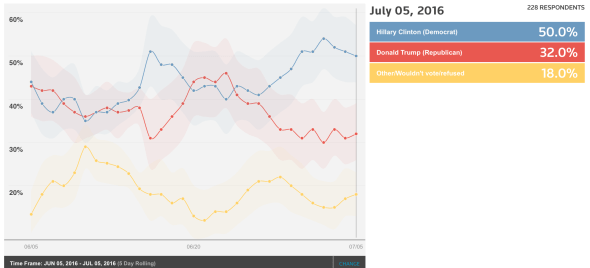
Clinton has opened up a big lead among upper-middle-class whites, voters with family incomes of between $75,000 and $100,000.

Trump has pulled ahead among divorced white people.
Previous posts:
>>>A look at 100 key demographic blocs, and how Trump and Clinton are faring among them
Methodology:
The Index analyzes the 2016 presidential election through the voting preferences of 100 different demographic blocs. Thirty-three of them are part of Donald Trump’s Republican base. Thirty-three of them are part of Hillary Clinton’s Democratic base. And 34 of them are battleground groups — keys to both candidates’ paths to the White House.
The information for the feature comes from Reuters’ polling data, which is available, open source, on the internet. I am using Reuters’ rolling five-day averages for most of my analysis. I chose Reuters’ numbers because the poll is respected, but, most of all, because the global news service makes the information available to anyone. You can check behind me to examine my methodology — or to create new searches of your own.
One small asterisk (*): Certain subgroups are too small to have a statistically significant counts on the five-day average. In the cases marked with an asterisk (*), I have included data for these groups from the past 30 days of polling. One warning: Subgroups are, by definition, smaller than the entire survey, so they have a larger margin of error and more volatility from survey to survey.
Global Business Journalism Program: Leading the next generation of journalism around the world
Posted: July 4, 2016 Filed under: Discovering China, Dunham's Discourses, Global Business Journalism, Journalism Training, Uncategorized | Tags: Bank of America, Barrows Dunham, Bloomberg News, China, commencement, Cynthia Chen, Gaelle Patricia Chekma, Global Business Journalism, Global Business Journalism Program, ICFJ, International Center for Journalists, Jade Ladal, Jarchine Zhou, Jiao Jie, Jordyn Dahl, Journalism, journalism education, journalism ethics, Journalism Training, Knight Foundation, Media Economics, philosophy, Tsinghua University, Zhou Jaxin Leave a commentIt has been a honor to serve as international co-director of the Global Business Journalism Program at Tsinghua University for the past three years. Here is a transcript of my remarks at the 2016 commencement on June 30:
This is a very special day for all of us. To you, the graduating class of 2016, it is the culmination of a multicultural, global experience that is certain to benefit you personally and professionally. For me, this day is very special, too.
This is the first group of Chinese students I taught at Tsinghua, and you have made this veteran journalist into a better professor and a better person. Jiao Jie, Cynthia, Jarchine. I could go on and on. I have such respect and affection for you. I am so proud of all of you.
This is the first group of international students I interviewed, taught and mentored from beginning to end. Jade: you may not remember it, but I recall asking you in your interview: Who was your favorite character from En Attendant Godot? (I bet you didn’t prepare for that question.)
From the beginning, I can remember being supremely impressed by the qualifications and enthusiasm of Lauren and Gaelle, who have been leaders and high achievers since the day they arrived.
And I can remember recruiting Jordyn as if she were a star athlete in the United States and I were an eager coach. I knew she would be an invaluable addition to our program. Even while she’s still in school, she’s published superb articles in Forbes and Beijing Review, respected global news outlets.
I am honored, on behalf of the faculty of the Global Business Journalism Program and the International Center for Journalists, to congratulate all of you on your successful completion of graduate studies at the Tsinghua School of Journalism and Communication.
You are entering an uncertain world of journalism … of business and economics … of geopolitics and global conflict. I guess any commencement speaker could have said that at any time. But the pace of technological change, the immediacy brought by social media and 24/7 news, and the interconnectedness of the world, have made it easier for human beings to create positive things — or sow destruction anywhere, anytime.
The disruption created by the digital communications revolution has affected businesses from Dallas to Da Tong. In our world of journalism and communication, traditional forms of communication are collapsing – rapidly in America and Europe, more slowly in China. But make no mistake about it, the old world is gone and will never be revived, despite the antediluvian longings of ultranationalists and isolationists and technophobes.
The good news is that there are so many opportunities for people who embrace change and embrace the latest technologies. You are among the fortunate few. You have been trained in the latest technologies, but you also understand the enduring basics of journalism: accuracy, fairness, accountability, ethics and compelling storytelling. The Global Business Journalism program is a combination of a rigorous academic education taught by some of the finest professors in China, and a real-world journalism newsroom where students learn from distinguished journalists from around the world and create professional multimedia projects and data journalism reports.
With the skills you have learned, and the intelligence and drive you bring to your work, I have no doubt some of you are going to be journalism industry leaders and innovators, in China and around the world.
The Global Business Journalism Program is about to begin its tenth academic year this fall. In its first decade — with the support of Bloomberg News, ICFJ, the Knight Foundation and Merrill Lynch/Bank of America — it has brought together students from about 60 countries to experience a diversity of cultures and ideas.
The GBJ program has been indispensable in creating a new generation of business journalists who are reshaping and improving journalism in China. Not only does Chinese journalism benefit from our superbly trained alumni, but international journalism benefits because the next generation of reporters from Cameroon to California have a more accurate and sophisticated view of the Chinese economy and its role in global growth – and an understanding of the highest standards in global reporting.
What’s more, GBJ has created de facto goodwill ambassadors for China in dozens of countries throughout Africa, Asia, Europe and the Americas. It could not come at a more important time.
The journalism industry is facing an era of limits. In the United States and Europe, those limits are mostly economic: the profit imperative at a time of declining revenues, the mistaken choice of click bait journalism over quality. In China, those limits are mostly political.
But neither the journalism establishments of China nor the rest of the world can afford to be reactive. Traditional news outlets, whether in Beijing or Great Britain, are at risk of losing the next generation of information consumers to social media or alternative sources of information. We must – and we will –adapt, to create innovative new ways to share news.
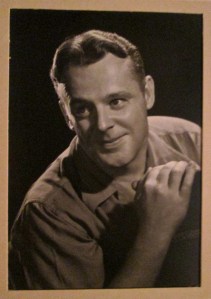
Barrows Dunham, 1947
I would like to close by quoting from my favorite philosopher, who happens to be my grandfather, Barrows Dunham. Seventy years ago, as the world emerged from the destruction wrought by fascists, he wrote in his book Man Against Myth that the peoples of our planet faced “ambiguous gloom, which may perhaps be twilight and may perhaps be dawn.”
Sounds like today. Looking at the pace of change, he wrote in 1947:
“In our day, indeed, events have attained so formidable a tempo that a single lifetime … will seem to contain more than there once appeared to be in history itself.”
Sounds like today.
Every generation sees an unprecedented pace of social change. That is the reality of human accomplishment, and human nature. There are always those who see the dawn and those who see the sunset. In the dawn of our new era, many in our chosen line of work will resist the changes that are needed.
This challenge reminds me of the Season 6 finale of Game of Thrones – specifically, the reaction of the receptionist at the Citadel, who, in response to a message delivered by Samwell Tarly, told our hero: “This is highly irregular.”
“Well,” Samwell responded, “I suppose that life is irregular.”
Indeed, life is irregular. But we can’t respond to occasional irregularities by retreating or taking the safe path. We must pursue the ambitious vision we learned in GBJ.
As all of you know, I am an optimist. I choose to see the dawn. I don’t fear the future, and you should not, either. You are uniquely prepared to be the change – to lead the change – as we approach the third decade of the 21st century.
To quote Dr. Dunham one last time: “Even now, we ourselves are determining the future, not by knowing what it will be, but by conceiving what it can be.”
Congratulations to the GBJ graduating class. Good luck to all of you. Thank you.
The changing South, the educational chasm and Latino backlash: 10 takeaways from a deep analysis of polling data
Posted: June 29, 2016 Filed under: The Index, Top Ten, U.S. politics | Tags: 2016 presidential race, American politics, Barack Obama, Democratic Party, Donald Trump, Hillary Clinton, presidential election, Republican Party, U.S. politics 2 CommentsEvery recent national poll agrees: Hillary Clinton is leading Donald Trump as the 2016 presidential campaign enters the sizzling summer convention season.
But, as we all know, because of America’s antiquated Electoral College, the national “horserace” numbers don’t tell us much about what’s happening at the grassroots level, where there are 50 state-by-state contests going on. That’s one of the reasons I launched “The Index” this week. Through a deep analysis of demographic subgroups, we can get a very good idea about the way the race is shaping up in certain regions (or even states) from the ground up.
There are some important findings, and some that may surprise you, about military families, empty-nesters, young white Southerners and prosperous Latinos. I identified big shifts among Latinos, northern working-class whites, and Mormons … not always in the same direction.
>>>A look at 100 key demographic blocs, and how Trump and Clinton are faring among them
Here are ten key takeaways from my analysis of the first round of data (taken from Reuters Polling’s five-day rolling average, June 20-24):
- Education is a key defining demographic in the 2016 election. American presidential election analysis was governed by economic determinism: the higher your income, the more likely you were to vote Republican. That’s not the case this year, when the poorest and the richest are most likely to favor Hillary Clinton over Donald Trump. The divide isn’t one of income in 2016, it’s educational attainment — for white people, at least. College graduates favor Clinton by 32.2 points. That soars to a 45-point lead among Americans with advanced university degrees. Among whites without a degree, Trump leads by 14.3 points, while minority voters without college degrees favor Clinton by 41 points. Trump’s lead among less-educated whites is largest in the industrial Midwest, where millions of manufacturing jobs once filled by Americans without college diplomas have been lost over the past four decades.
- The South is changing, and the way we think about Southern politics should change. There have been far too many stories about the Republicans’ “Solid South,” which is no more solid now than the Democrats’ Dixie was in the middle of the last century. President Barack Obama won Florida and Virginia twice and North Carolina once. Because of racial, educational and generational factors, the South could become even more competitive — and very soon. Yes, Trump is strong with less-educated and older white voters, particularly southern women without college degrees (+26 points). But young white southerners are a swing voting group. White southerners with college degrees, a growing vote bloc, are nearly evenly divided, with women slightly favoring Clinton. Even with Florida’s Cuban-American’s traditional ties to the GOP, Latino voters in the Southeast are strongly Democratic in 2016 (+24 points). With the growth of the Hispanic vote in Florida, Virginia, North Carolina and Georgia, the trend lines in all of these states are likely to move toward Democrats unless Latinos or young voters reverse course. States with smaller minority populations (Arkansas, Tennessee, Kentucky, West Virginia) will remain out of reach for the party of Obama and Clinton. But Florida, North Carolina, Georgia and South Carolina are slowly trending Democratic as a new generation replaces the Confederate flag wavers, and whites from the North migrate to the warmer climes of the Southeast.
- America’s industrial heartland is deeply divided by race, religion and education. As strange as it sounds, Donald Trump might have a better chance to win Pennsylvania this year than Florida. The reason is the changing demographics of the American heartland states running west from Pennsylvania to Iowa. These areas have large, traditionally Democratic Catholic populations, a higher proportion of older voters, and more whites without college degrees. All of those factors play into Trump’s current strengths. He leads among midwestern men without college degrees by 26 points, among white Catholics over the age of 40 by 12 points, and among white Catholic women by 5. Shifts among these groups put the Clinton campaign in the danger zone: She leads in the Midwest by just 4.9 points and in the Great Lakes states by 3 points, well below her national polling numbers. If current trends hold, Trump might “bet the ranch” on winning historically Democratic states such as Pennsylvania, Michigan and Wisconsin, along with Democratic-leaning swing states such as Ohio and Iowa. States with lower minority populations (Pennsylvania, Iowa and Wisconsin) may be particularly attractive to Team Trump. Clinton easily beats Trump among mainstream Protestant denominations here, but older white Catholics are a tougher sell.
- The Latino vote could bury Trump. I have suspected from the day Trump announced — when he called Mexicans criminals and rapists — that he was going to do worse than the 27 percent Mitt Romney received in 2012. After all of his talk of a wall on the U.S. southern border, the electoral reality is sinking in. Trump is losing every kind of Latino voter: young, old, liberal, conservative, Mexican-American, Puerto Rican, Dominican — even Cuban-American, which hasn’t ever happened before. He’s doing worst among Latinos in the Pacific region (California, Nevada), where Clinton has a 60-point edge. Say goodbye to Nevada, Donald. He’s 49 points behind among Latinos in the Southwest (Arizona, New Mexico, Texas) — more than twice the deficit GOP presidential candidates have faced in the past two decades. That takes New Mexico off the table for Trump and puts Arizona into play. Even in the Southeast, with a large bloc of Cuban-Americans in Florida, Trump is down by 24 points. Unless he improves his standing, that’ll make Florida all but impossible for him to win, it’ll complicate his efforts to hold the swing state of North Carolina, and it could even help put Georgia into play. How badly is Trump doing among Hispanic Americans? Latinos earning more than $100,000 per year — a swing voter bloc — now favor Clinton by 24 points. For Latinos, Trump may have done in 2016 what “America First” anti-Semites did for Jewish voters in the 1930s and Barry Goldwater did for African Americans in 1964: unite a voting bloc of disparate national origins and varying political philosophies. If this shift is lasting, it could be profound.
- The Generation Gap is back. There is a chasm between America’s oldest (white) voters and younger voters (of all races and ethnicities). But younger voters are far more anti-Trump than older voters are pro-Trump (or anti-Clinton). Whites over age 50 favor Trump by 5.9 points, while whites under the age of 40 favor Clinton by 1.2 points. The younger the voter, the more Democratic. White men under 30 give Clinton a 10-point edge. Among students of all races, Clinton tops Trump by 33 points. This is a problem for Trump in 2016. It is a problem for Republicans for a generation.
- A wide-open battle for the white middle class. Almost everyone in America claims to be a member of the “middle class.” But when you divide U.S. incomes into numerical ranges, the plurality of voters is between $50,000 and $100,000 a year. The candidate who wins most of these votes usually wins the election. Today, that candidate is Hillary Clinton, leading by 9.3 points (almost the same as her national lead). But among white voters earning $50-100K, Trump’s up by 2.7 points. The reason is his support from the lower half of the middle class, the group earning between $50K and $75K, where he leads by 5. As middle-class incomes rise, so does support for Clinton. Trump’s appeal is stronger to lower-income whites struggling with rising costs and stagnant wages. So it should be no surprise that Trump does better in areas with more lower-middle-class whites and fewer minorities.
- The new “soccer moms”? How about “the empty-nesters”? Political reporters love to humanize swing voter blocs. The soccer moms were the rage at the turn of this century. We haven’t come up with a new one yet, but for 2016, I’ll nominate “empty-nesters.” That’s mothers who don’t have any of their kids living with them. Because all minority moms are overwhelmingly Democratic, we’ll concentrate on white empty-nest moms. They are a swing group because young moms skew Democratic like all young voters. Middle-aged and older white women tend to be a bit more Republican than the entire universe of women voters. According to the late-June Reuters polling, Clinton leads among these “empty-nesters” by 2.8 points, less than her lead among all voters but better than Barack Obama did in his successful 2012 re-election race.
- Democratic dissatisfaction with Clinton and Republican concerns about Trump are canceling themselves out at this point. There have been lots of stories about conservatives angered by Donald Trump’s coarse behavior, his repeated denunciations of Bush-Cheney foreign policy, and his long-enunciated liberal beliefs on issues ranging from abortion to gay rights. There have been stories about moderate Republicans scared off by his xenophobia and racially tinged campaign rhetoric. There have been stories about Bernie Sanders supporters pledging never, ever to vote for Hillary Clinton. But the polling numbers don’t match the stories, at least at this point. Very few hard-core partisans have switched sides. Clinton leads by 68.2 points among Obama voters, and Trump leads by 67.6 points among Romney voters. Almost identical. There appears to be at least a small enthusiasm gap on the ideological extreme: Clinton leads by 59.4 points among very liberal Democrats; Trump’s lead among very conservative Republicans is “just” 45 points, with a large number parking in the undecided column.
- Military families are shifting toward Democrats. This is one trend story that has eluded the American political media. But it makes perfect sense. As more and more of the U.S. military is made up of women and minorities, the share of presidential votes won by Democrats is going up. Trump may have accelerated the shift by his unproven allegations that U.S. troops in Iraq had pocketed stolen loot after the overthrow of Saddam Hussein. Trump hasn’t helped with his repeated assertion that the U.S. military has been incompetent under Presidents Bush and Obama. The Reuters polling shows that active duty military personnel favor Clinton by 9.4 points, and the families of active duty military and veterans lean to Clinton by 9.6 percent. Trump still leads among veterans, a predominantly white group, by 5.7 percent.
- Trump indeed has a Mormon problem. Trump’s ongoing war of words with Romney, a leading Mormon politician, and his demonization of a religion (Islam) clearly contribute to his troubles with one of the most Republican voting blocs in the country. Romney beat Obama among Mormons by some 50 points. Trump’s lead, according to a month of Reuters numbers, is 13 points — and just 8 among Mormon women. This is unlikely to cause Trump to lose heavily Mormon (and very heavily Republican) Utah, but it could prove costly in nearby states with significant Mormon presences like Nevada, Arizona, Colorado and New Mexico.
These polling numbers reflect a snapshot in time, and they could change (again and again) between now and Election Day, November 8. But this kind of data analysis can help us understand what often is oversimplified in the “who’s up, who’s down” world of daily political coverage.
This analysis is part of a series that will continue through the election season.
Click here to see the data for all 100 blocs and demographic subgroups.


Recent Comments